For laboratory research only. Not for human or animal use. This article gives no dosing, administration or therapeutic advice.
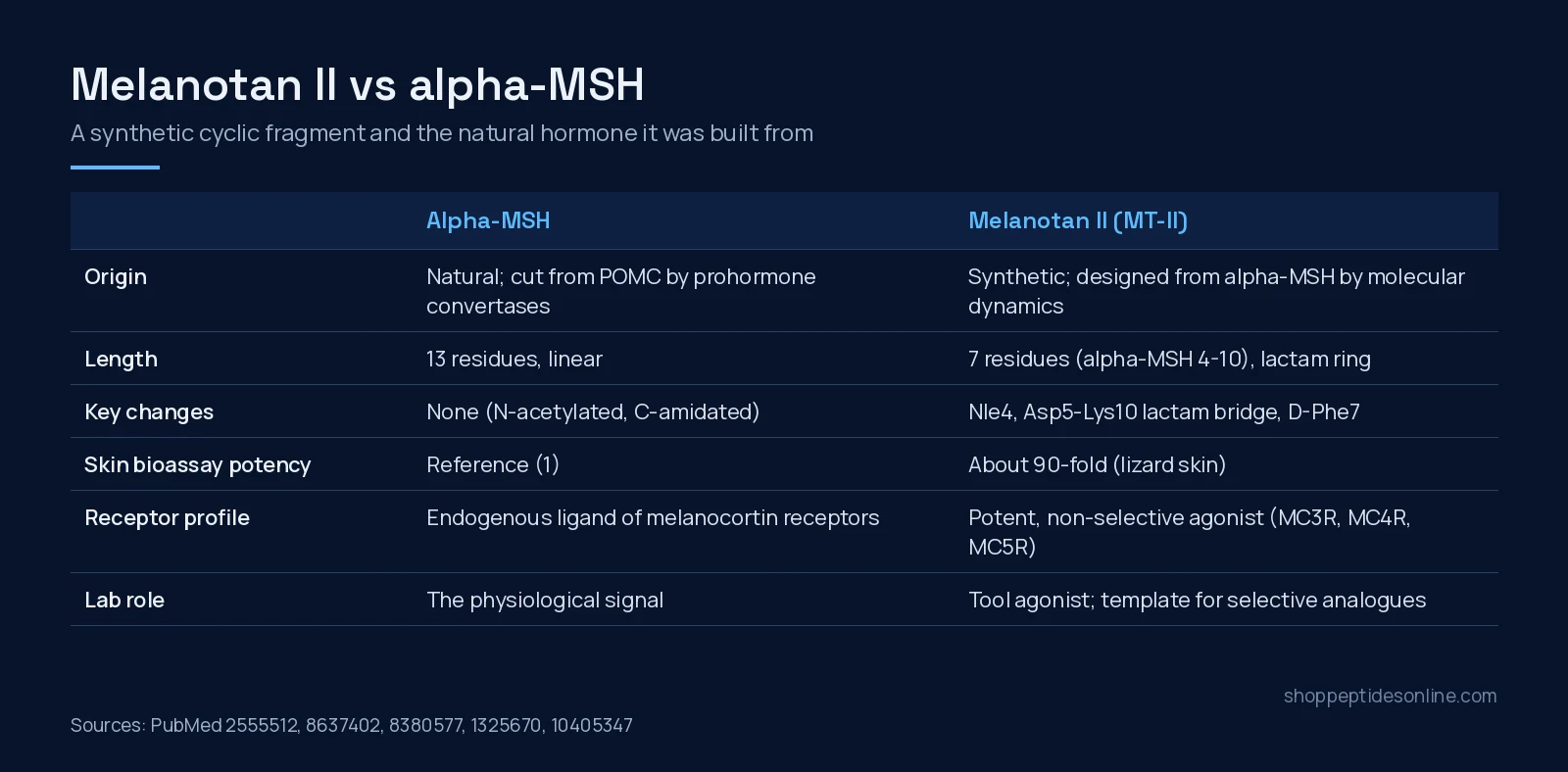
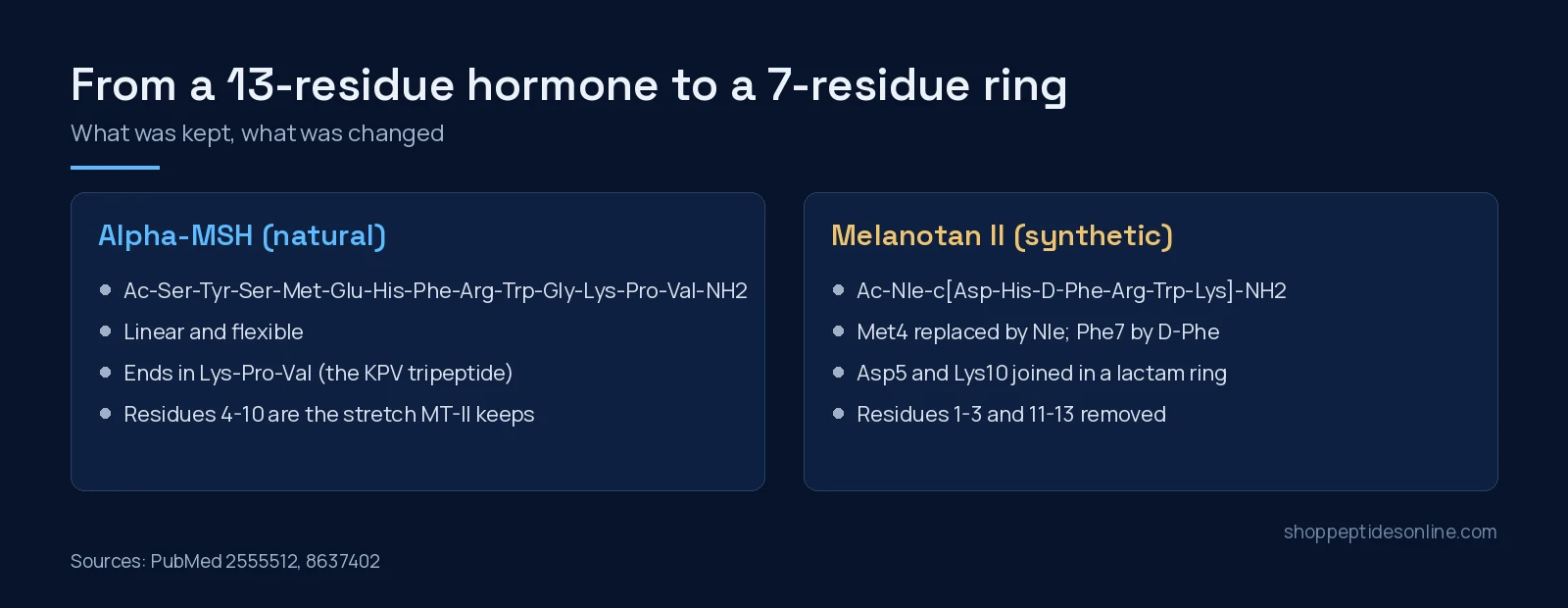
Short answer: alpha-MSH is the natural 13-residue melanocortin hormone; melanotan II (MT-II) is a synthetic seven-residue ring cut from the middle of it. MT-II keeps alpha-MSH positions 4 to 10, swaps methionine for norleucine and phenylalanine for D-phenylalanine, and locks Asp5 to Lys10 in a lactam bridge[1][2]. In lizard skin assays that ring was about 90 times as potent as alpha-MSH, with prolonged activity[1], and at human receptors MT-II behaves as a potent but non-selective agonist[9]. The hormone is the signal; MT-II is the tool built to imitate it more strongly and for longer.
Side by side
| Alpha-MSH | Melanotan II | |
|---|---|---|
| Sequence | Ac-Ser-Tyr-Ser-Met-Glu-His-Phe-Arg-Trp-Gly-Lys-Pro-Val-NH2[1] | Ac-Nle4-c[Asp5-His6-D-Phe7-Arg8-Trp9-Lys10]-NH2 (alpha-MSH 4–10)[2] |
| How it is made | Processed from the POMC precursor by prohormone convertases, then N-acetylated[4] | Solid-phase or solution synthesis with a side-chain lactam bridge[1] |
| Shape | Linear | 23-membered lactam ring[1] |
| Relative skin bioassay potency | 1 (reference)[1] | About 90 (lizard skin)[1] |
| Receptors | Endogenous agonist of the melanocortin receptor family[3][8] | Potent agonist across MC3R, MC4R and MC5R[9] |
| Status | Endogenous hormone | Not an approved medicine; studied in small pilot trials in the 1990s[2] |
| At SPO | Not sold | Melanotan 2 10mg (research grade) |
Alpha-MSH: one product of a long precursor
Alpha-MSH is not made directly from its own gene. It is one of several peptides cut from pro-opiomelanocortin (POMC). Two subtilisin-like enzymes, PC1 and PC2, do the cutting. Pituitary corticotropes express mainly PC1 and make a limited set of cleavages; melanotropes of the intermediate pituitary express both and cut POMC further. When mouse AtT-20 corticotrope cells were given PC2, they gained the extra cleavages seen in melanotropes, but not the alpha-N-acetylation step, which is a separate enzymatic event[4].
The receptors came into view in 1992, when the murine and human MSH receptors and a human ACTH receptor were cloned. They formed a distinct subfamily of G protein-coupled receptors, and the paper noted that MSH and ACTH act well beyond pigment and adrenal cells, including in the brain, pituitary and immune system[3].
One of those wider roles is immune. A review of the field described alpha-MSH as an endogenous neuroimmunomodulatory peptide that inhibits fever and the major forms of experimental inflammation, acting through receptors on macrophages and neutrophils and through descending neural pathways that start at alpha-MSH receptors in the brain[5]. Its last three residues, Lys-Pro-Val, are the tripeptide studied separately as KPV.
Melanotan II: designing a stronger ring
MT-II came out of a 1989 design study that used structure-activity data and molecular dynamics on alpha-MSH and on the superpotent linear analogue Ac-[Nle4,D-Phe7]-alpha-MSH. The team made seven cyclic lactam fragments and tested them in frog and lizard skin. Ring size mattered: 23-membered rings gave about 100-fold higher potency than alpha-MSH, larger or smaller rings lost potency, and only the 23- and 24-membered rings showed prolonged activity. The Asp5/Lys10 alpha-MSH 4–10 fragment, the structure later named MT-II, scored about 90 in the lizard assay[1].
Selectivity is where MT-II differs most from a clean tool. At human receptors it is a potent, non-selective agonist. Replacing Nle4 with proline kept similar affinity and potency at hMC4R but cut potency about 400-fold at hMC5R and about 20-fold at hMC3R. Further N-terminal changes showed that the Ac-Nle4 segment outside the ring has almost no effect at hMC4R but is needed for full potency at hMC5R[9]. Later work modified position 6 of MT-II and of the antagonist SHU-9119 and produced new hMC4R-selective ligands and a selective hMC3R antagonist, PG-106[10].
What MT-II revealed about the natural hormone
Because it is stable and strong, MT-II became the probe for alpha-MSH signalling in the brain. Given into the brain ventricles of mice, it inhibited feeding in four hyperphagia models (fasted, ob/ob, agouti A(Y) and NPY-injected mice), and the antagonist SHU9119 blocked that effect. SHU9119 alone increased night-time and post-fast feeding, which pointed to a tonic melanocortin brake on feeding[6].
Genetics filled in the receptor. Mice lacking MC4R developed a maturity-onset obesity syndrome with hyperphagia, hyperinsulinaemia and hyperglycaemia[7], and MC4R-deficient mice did not respond to the anorectic effect of MT-II, which suggests that alpha-MSH limits feeding mainly through MC4R[8]. The same study found that obese MC4R-deficient mice still responded to several other feeding signals, so the pathway is one route among several, not the only one[8].
Which one fits which question?
- POMC processing, acetylation and endogenous signalling: alpha-MSH[4].
- A stable, potent melanocortin agonist for receptor pharmacology: MT-II[1][9].
- Central feeding circuits and MC4R: MT-II with SHU9119 or knockout controls[6][8].
- Immune and anti-inflammatory melanocortin biology: alpha-MSH[5].
For the linear analogue on the other branch of the family tree, see melanotan II vs afamelanotide; for the C-terminal tripeptide, see KPV vs BPC-157. For the rest of the catalogue, see our guide to buy peptides online in Canada.
Frequently asked questions
What is the difference between melanotan II and alpha-MSH?
Alpha-MSH is the natural 13-residue melanocortin hormone. Melanotan II is a synthetic seven-residue lactam ring based on alpha-MSH positions 4 to 10, with norleucine and D-phenylalanine substitutions.
Is melanotan II selective for one melanocortin receptor?
No. At human receptors it is a potent, non-selective agonist, active at MC3R, MC4R and MC5R.
Where does alpha-MSH come from?
It is cut from the POMC precursor by the prohormone convertases PC1 and PC2 and then N-acetylated.
What is SHU9119?
A cyclic melanocortin antagonist related to MT-II. In mice it blocked MT-II’s effect on feeding and is used to confirm melanocortin receptor involvement.
Does Shop Peptides Online sell alpha-MSH?
No. SPO lists melanotan II for laboratory research only. Native alpha-MSH is not in the catalogue.
References
- Al-Obeidi F, Castrucci AM, Hadley ME et al. (1989). Potent and prolonged acting cyclic lactam analogues of alpha-melanotropin: design based on molecular dynamics. J Med Chem. PMID: 2555512. doi: 10.1021/jm00132a010.
- Dorr RT, Lines R, Levine N et al. (1996). Evaluation of melanotan-II, a superpotent cyclic melanotropic peptide in a pilot phase-I clinical study. Life Sci. PMID: 8637402. doi: 10.1016/0024-3205(96)00160-9.
- Mountjoy KG, Robbins LS, Mortrud MT et al. (1992). The cloning of a family of genes that encode the melanocortin receptors. Science. PMID: 1325670. doi: 10.1126/science.1325670.
- Zhou A, Bloomquist BT, Mains RE (1993). The prohormone convertases PC1 and PC2 mediate distinct endoproteolytic cleavages in a strict temporal order during proopiomelanocortin biosynthetic processing. J Biol Chem. PMID: 8380577.
- Lipton JM, Catania A (1997). Anti-inflammatory actions of the neuroimmunomodulator alpha-MSH. Immunol Today. PMID: 9078687. doi: 10.1016/s0167-5699(97)01009-8.
- Fan W, Boston BA, Kesterson RA et al. (1997). Role of melanocortinergic neurons in feeding and the agouti obesity syndrome. Nature. PMID: 8990120. doi: 10.1038/385165a0.
- Huszar D, Lynch CA, Fairchild-Huntress V et al. (1997). Targeted disruption of the melanocortin-4 receptor results in obesity in mice. Cell. PMID: 9019399. doi: 10.1016/s0092-8674(00)81865-6.
- Marsh DJ, Hollopeter G, Huszar D et al. (1999). Response of melanocortin-4 receptor-deficient mice to anorectic and orexigenic peptides. Nat Genet. PMID: 9916804. doi: 10.1038/5070.
- Bednarek MA, Macneil T, Kalyani RN et al. (1999). Analogs of MTII, lactam derivatives of alpha-melanotropin, modified at the N-terminus, and their selectivity at human melanocortin receptors 3, 4, and 5. Biochem Biophys Res Commun. PMID: 10405347. doi: 10.1006/bbrc.1999.0981.
- Grieco P, Cai M, Han G et al. (2007). Further structure-activity studies of lactam derivatives of MT-II and SHU-9119: their activity and selectivity at human melanocortin receptors 3, 4, and 5. Peptides. PMID: 17482720. doi: 10.1016/j.peptides.2007.02.012.