
Your cart is currently empty!.
You may check out all the available products and buy some in the shop.
Continue ShoppingTirzepatide research peptide, priced in CAD and shipped within Canada by Canada Post. Compare the 20mg and 60mg vials, check the COA library for batch documentation (none is posted yet for these strengths), and order with free shipping over $300.
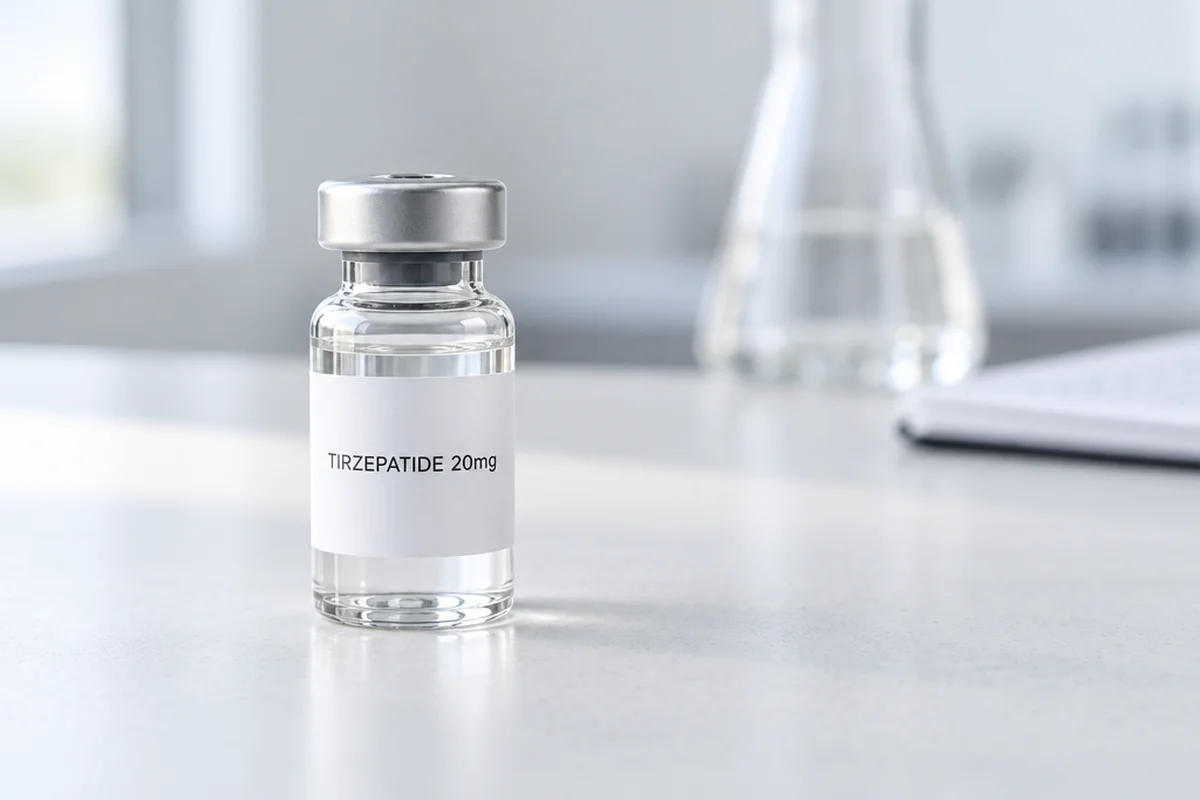
Price and delivery: Tirzepatide is stocked as a 20mg vial and a 60mg vial (free Canada Post Xpresspost shipping over $300). Orders ship from within Canada — payments confirmed before 11:00 AM PST on business days go out the same day, Priority typically arrives in 1–3 business days, tracked and plainly packaged. A batch-specific COA for these strengths has not been posted yet — see the COA library. Related: GLP-3 (retatrutide) Canada · the full range is on our buy peptides online in Canada page.
The catalog lists Tirzepatide in two labeled amounts, both in vial format. The cards below draw the current price and availability directly from the store. Do not confuse labeled amount with a separately measured analytical quantity.


The 20MG vial and 60MG vial have separate product pages. Keep those listing references separate in a procurement record, and check the current batch information for the item you intend to review.
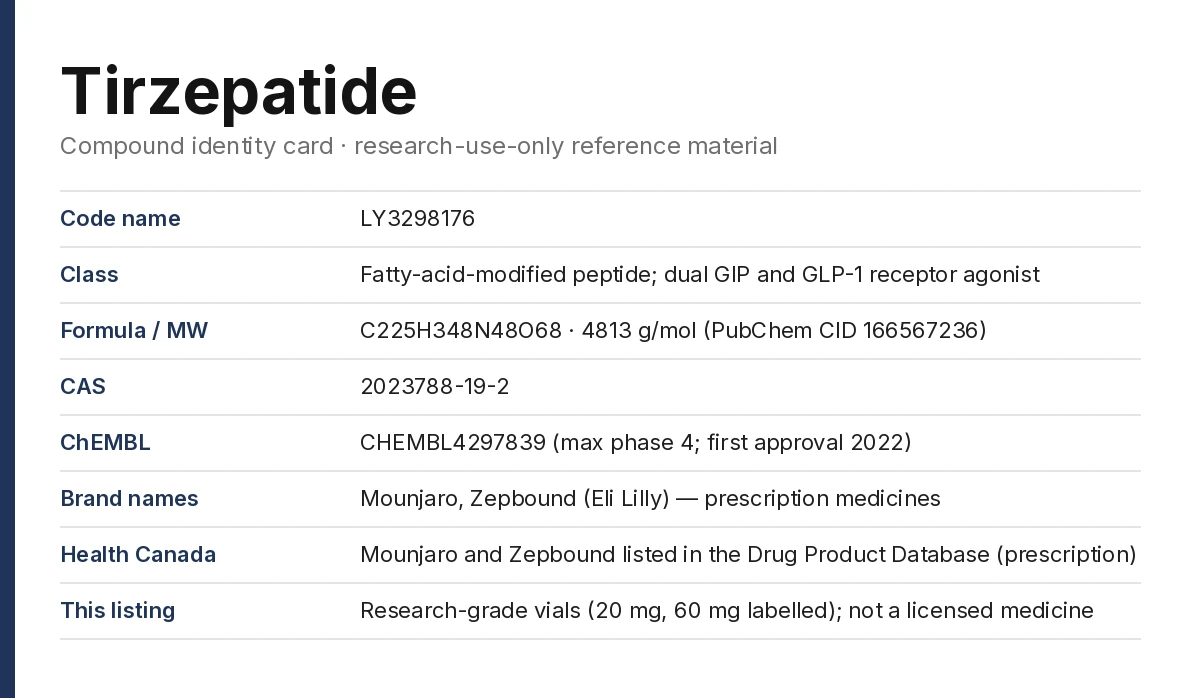
Tirzepatide (development code LY3298176) is a fatty-acid-modified synthetic peptide that activates two incretin receptors, the glucose-dependent insulinotropic polypeptide receptor (GIPR) and the glucagon-like peptide-1 receptor (GLP-1R)[1]. Unlike most research peptides sold in Canada, it is also an approved prescription medicine: Eli Lilly markets it as Mounjaro and Zepbound, and both brand names appear in the Health Canada Drug Product Database as prescription products. The vials on this page are research-grade material; they are not Mounjaro or Zepbound, not a licensed medicine, and are sold for laboratory research only.
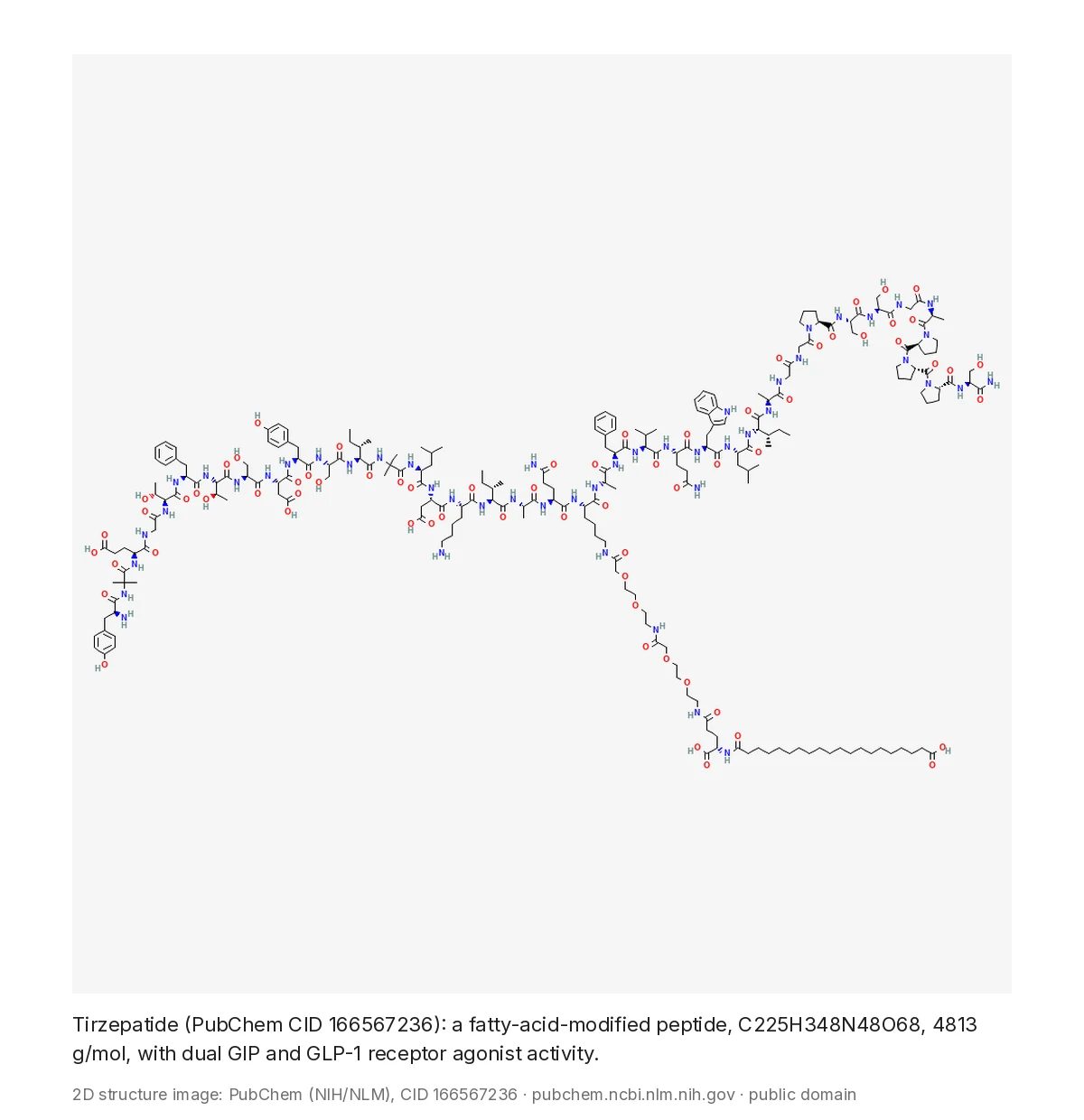
Lilly scientists described LY3298176 in 2018 as a peptide built to test whether adding GIP-receptor activity to GLP-1-receptor agonism would add metabolic effect in type 2 diabetes. The discovery paper characterised it in cell lines expressing recombinant or native incretin receptors and in mice, where it drove glucose-dependent insulin secretion through both receptors, and reported the first randomised phase 1 studies in healthy volunteers and people with type 2 diabetes, whose primary aim was safety and tolerability[1]. A 26-week phase 2 study in type 2 diabetes followed, comparing several dose levels with placebo and with the GLP-1 receptor agonist dulaglutide[6]. Phase 3 began with SURPASS-1, a 40-week placebo-controlled trial at 52 centres in India, Japan, Mexico and the USA in people whose diabetes was not controlled by diet and exercise[7].
| Name | Tirzepatide (LY3298176) |
|---|---|
| Molecular formula | C225H348N48O68 |
| Molecular weight | 4813 g/mol (PubChem computed) |
| PubChem CID | 166567236 |
| CAS | 2023788-19-2 |
| ChEMBL | CHEMBL4297839 (max phase 4, first approval 2022; ChEMBL lists no computed molecular weight for it) |
| Structure type | Synthetic peptide carrying a fatty-acid modification |
| Brand names (medicine) | Mounjaro, Zepbound (Eli Lilly) |
| Listed forms here | Lyophilized powder, 20 mg or 60 mg labelled per vial (research grade) |
Occupancy calculations in a 2020 study showed tirzepatide engaging the GIP receptor more than the GLP-1 receptor at clinically relevant exposure, which the authors called an “imbalanced” mechanism. At the GIP receptor it behaved like native GIP; at the GLP-1 receptor it favoured cAMP generation over β-arrestin recruitment and internalised the receptor less than GLP-1 did. In primary islets, β-arrestin1 limited the insulin response to GLP-1 but not to GIP or tirzepatide[2]. A separate HEK293 study also found bias for tirzepatide, measured this time as ERK1/2 phosphorylation relative to cAMP at both receptors[3], a reminder that “bias” depends on which pathways are compared.
Cryo-electron microscopy and molecular-dynamics work in 2022 resolved how tirzepatide sits in each receptor: it activates GIPR much as GIP does but engages GLP-1R differently from GLP-1, with less receptor desensitisation, and the fatty-acid modification together with the amino-acid sequence shapes that behaviour[4].
In obese mice, tirzepatide improved insulin sensitivity more than a GLP-1 receptor agonist. In mice lacking the GLP-1 receptor, where no GLP-1R-driven weight change could occur, it still improved insulin sensitivity through glucose disposal in white adipose tissue, and a long-acting GIP-receptor agonist did the same, pointing to GIPR signalling for that effect[5]. The 2018 discovery paper had already shown that its insulin-secretion effect in mice required both receptors[1].
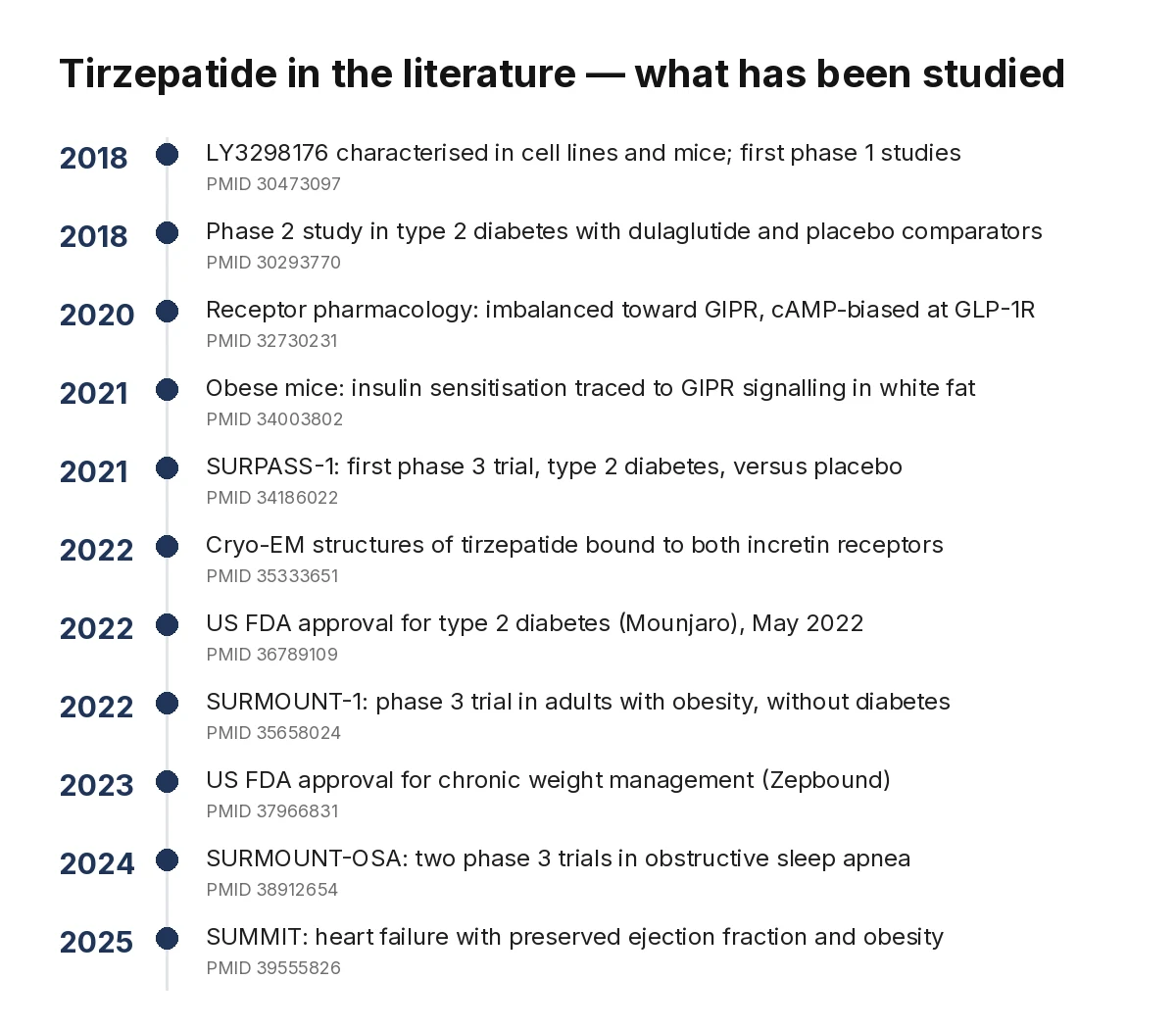
Tirzepatide is one of the few compounds in this catalogue with large human trials. They are summarised here by design and endpoint only; this page does not report or claim clinical outcomes for the research material sold here, and gives no dosing or administration information.
On safety, a 2023 meta-analysis of ten trials (6,836 participants) found gastrointestinal adverse events, mainly nausea and diarrhoea, to be the most common and dose-dependent, with severe hypoglycaemia, pancreatitis and gallbladder events rare[12].
| Year | Model | What was investigated | PMID |
|---|---|---|---|
| 2018 | Cell lines, mouse; human phase 1 | Discovery: dual receptor activity, insulin secretion; first safety and pharmacokinetic studies | PMID 30473097 |
| 2018 | Human, phase 2 | 26-week comparison with placebo and dulaglutide in type 2 diabetes | PMID 30293770 |
| 2020 | Cells, primary islets | Receptor occupancy, signalling bias, β-arrestin and insulin secretion | PMID 32730231 |
| 2020 | HEK293 cells | Signalling bias of mono-, dual- and tri-agonists at GIPR and GLP-1R | PMID 32360365 |
| 2021 | Obese WT and Glp-1r-null mice | Insulin sensitivity, white-adipose glucose disposal, GIPR role | PMID 34003802 |
| 2021 | Human, phase 3 (SURPASS-1) | Monotherapy vs placebo in type 2 diabetes | PMID 34186022 |
| 2021 | Human, phase 3 (SURPASS-2) | Comparison with semaglutide in type 2 diabetes | PMID 34170647 |
| 2022 | Purified receptors (cryo-EM) | Structural basis of dual agonism | PMID 35333651 |
| 2022 | Human, phase 3 (SURMOUNT-1) | Adults with obesity, without diabetes; body-weight endpoints | PMID 35658024 |
| 2023 | Meta-analysis, 10 trials | Rates of individual adverse events | PMID 36789109 |
| 2024 | Human, phase 3 (SURMOUNT-OSA) | Obstructive sleep apnea with obesity | PMID 38912654 |
| 2025 | Human (SUMMIT) | Heart failure with preserved ejection fraction and obesity | PMID 39555826 |
Both listings are lyophilized powder in sealed vials. Keep unopened vials frozen at −20 °C, dry and protected from light, and avoid repeated freeze–thaw cycles. Bacteriostatic water is listed separately; solvent, concentration and method are set by the researcher. Note the batch number on the label so it can be matched to any report later posted in the COA library.
These two Tirzepatide listings are vials. This page does not advertise a Tirzepatide pen or suggest that a different product format is interchangeable. The research pen catalog is a separate destination for the pen-format materials the store actually lists.
Format is a procurement fact, not administration guidance. A vial label does not establish a preparation procedure, compatibility with a particular experiment or any medical use. Laboratories should rely on their own validated methods and the material’s documentation.
Start with the exact sample or batch identifier and the listed compound name. Then read the laboratory results according to what each test actually reports. A purity result, an identity assignment and a measured quantity answer different questions.
Use the COA library for available documentation. We do not claim that a document exists for every current item or that every listed quantity has been independently measured. If you cannot match a report to the current offered batch, ask before treating the match as established.
Our HPLC purity versus mass-spectrometry guide explains why these fields should remain separate.
Compare the labeled amount, current availability, documentation and the needs of the laboratory procurement record. This page makes no claim that one strength is scientifically better, more effective or appropriate for a particular protocol. The total on the label is not a substitute for identity or batch evidence.
Before ordering, save the exact product URL and any report reference you reviewed. Record missing information as unresolved. The research procurement guide offers a wider checklist for identity, format and supplier questions.
Review the shipping policy and the destination, charges and options presented at checkout. This page does not promise a delivery date, a particular carrier or legal suitability for every destination. Use store support for current listing or batch questions.
Yes, as a medicine: the US FDA approved it for type 2 diabetes in May 2022 (PMID 36789109) and, as Zepbound, for chronic weight management in 2023 (PMID 37966831); Mounjaro and Zepbound are listed as prescription drugs by Health Canada. The research-grade vials sold here are not those medicines and are for laboratory research only.
In cell studies it activates both the GIP and GLP-1 receptors, engaging the GIP receptor more strongly and favouring cAMP over β-arrestin signalling at the GLP-1 receptor (PMID 32730231). Cryo-EM structures show how its sequence and fatty-acid modification produce that profile (PMID 35333651).
Only the labelled amount of lyophilized powder per vial. The compound is the same; neither strength is presented as more suitable for any purpose.
A batch-specific COA for these strengths has not been posted yet — see the COA library (/coa/). We do not substitute a report from another product or strength.