
Your cart is currently empty!.
You may check out all the available products and buy some in the shop.
Continue ShoppingCANADA · RESEARCH MATERIALS · DOCUMENTATION
Find the Selank 10MG listing, then check the named material, labelled vial amount and batch record before adding it to a laboratory inventory.

Shop Peptides Online lists Selank 10MG in vial format. The listing is the source for current stock, price and product details; this guide does not freeze those changing details into a second record.
Selank is a synthetic seven-residue peptide, Thr-Lys-Pro-Arg-Pro-Gly-Pro (TKPRPGP), built by attaching the tripeptide Pro-Gly-Pro to the C-terminus of the tetrapeptide tuftsin (Thr-Lys-Pro-Arg)[2]. Most published work on it comes from Russian research groups, mainly in rodent models of anxiety-like behaviour, learning and stress, in cell and tissue gene-expression work, and in a small number of Russian-language clinical comparisons[3, 1, 16]. It has no Health Canada, FDA or EMA approval that we could find, and a 2021 US review called it a “poorly studied Russian drug” that was being sold to US consumers as a dietary supplement[19]. The material listed here is sold for laboratory research only.
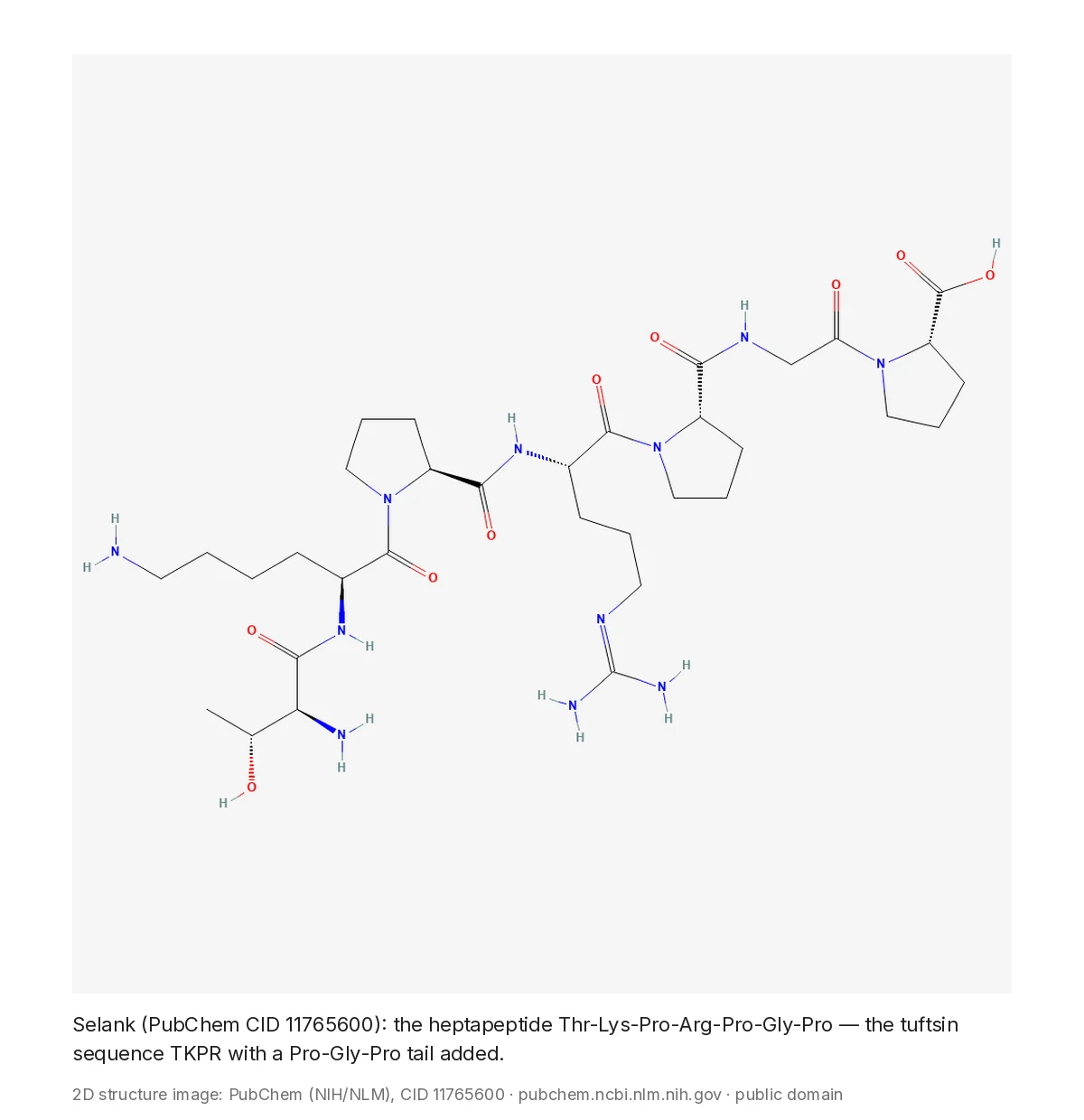
Selank keeps the four-residue tuftsin sequence and adds Pro-Gly-Pro; a 2006 Polish rat study described it simply as “a structure of tuftsin, to which three natural L-amino-acids Pro-Gly-Pro are attached”[2]. A 2003 comparison of ten tuftsin-family peptides and Selank in rats and mice under conflict stress concluded that each peptide’s effect depended on its structure and on its degradation fragments[3]. That point is borne out by the breakdown work: when Selank was labelled evenly with tritium and incubated in blood plasma, the pentapeptide TKPRP, the tripeptide TKP and the dipeptides RP and GP were the main products[6]. Several later papers therefore tested the Gly-Pro fragment alongside the full peptide[14].
| Name | Selank (TP-7, Selanc) |
|---|---|
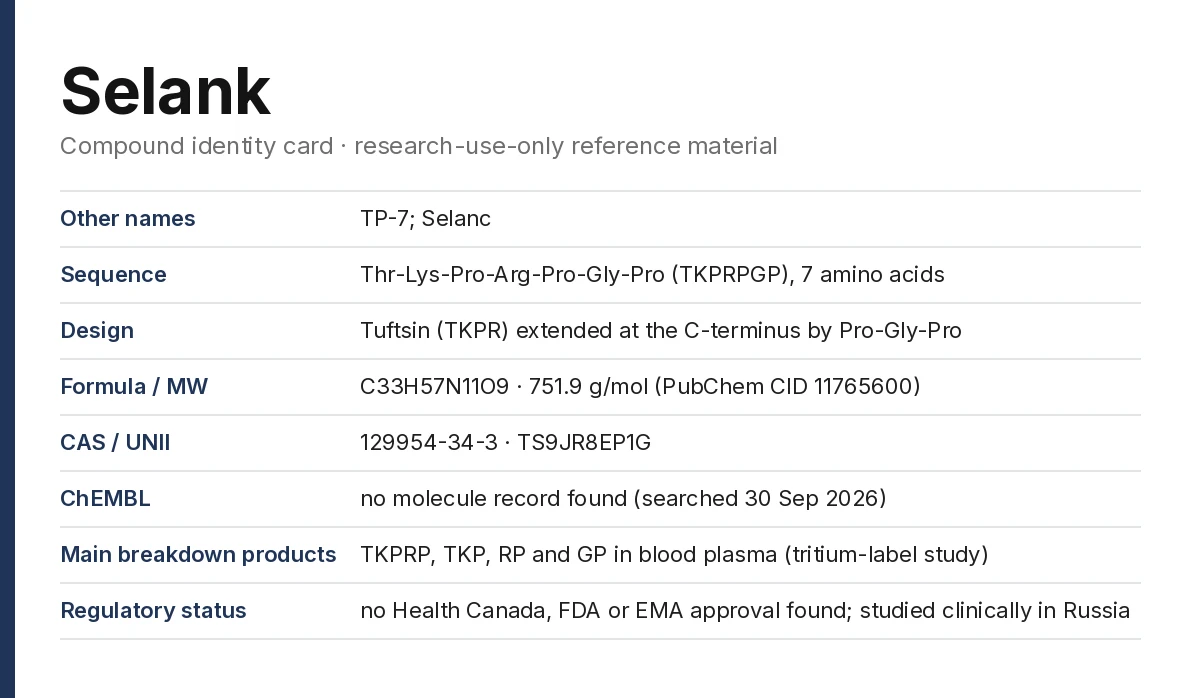
| Sequence | H-Thr-Lys-Pro-Arg-Pro-Gly-Pro-OH (TKPRPGP) |
| Molecular formula | C33H57N11O9 |
| Molecular weight | 751.9 g/mol (PubChem computed) |
| PubChem CID | 11765600 |
| CAS / UNII | 129954-34-3 / TS9JR8EP1G |
| ChEMBL | No molecule record found (search run 30 September 2026) |
| Parent peptide | Tuftsin, Thr-Lys-Pro-Arg |
| Listed form here | Lyophilized powder, 10 mg labelled per vial |
Radioligand experiments on isolated brain-cell membranes showed Selank acting on [3H]GABA binding as a positive allosteric modulator; combined with benzodiazepines the effect was not additive, and Selank blocked the modulating action of diazepam and olanzapine, which the authors read as partly overlapping but distinct binding sites[1]. In neuroblastoma IMR-32 cells, by contrast, Selank alone changed the mRNA level of none of 84 GABA-system and neurotransmission genes; it altered expression only when combined with GABA (largely cancelling GABA’s changes) or with olanzapine[8].
In plasma samples, Selank inhibited enkephalin-hydrolysing enzymes in a dose-dependent way and was more potent than the peptidase inhibitors bacitracin and puromycin[4]. A mouse study then compared two strains: in BALB/c mice Selank lengthened the plasma half-life of leu-enkephalin and changed open-field behaviour, while in C57Bl/6 mice it affected neither[5].
In the rat frontal cortex, Selank and GABA each changed the expression of 45 of 84 neurotransmission genes one hour after administration and 22 genes at three hours, with correlated patterns between the two[7]. Behavioural rat work has looked at the elevated plus maze under unpredictable chronic mild stress, alone and with diazepam[9]; conditioned active-avoidance learning compared with piracetam, where the clearest effect was in rats that learned poorly at baseline[10]; memory and hippocampal/frontal BDNF in rats given ethanol for 30 weeks[11]; and naloxone-precipitated morphine withdrawal, where Selank reduced the withdrawal index but less than the diazepam comparator[12].
Earlier transcriptome work had linked Selank to inflammatory processes, so several groups measured immune genes[13]. In mouse spleen, a single injection changed the expression of 34 of 84 inflammation-related genes, with Bcl6 among the clearest[13]; a follow-up tracked C3, Casp1, Il2rg and Xcr1 over the first hours and found the Gly-Pro fragment reproduced part of the pattern[14]. Against influenza A/Aichi/2/68 (H3N2), Selank suppressed viral reproduction in cell culture when added 24 hours before inoculation and improved survival in infected mice given it on a preventive schedule, with increased interferon-alpha gene expression[15].
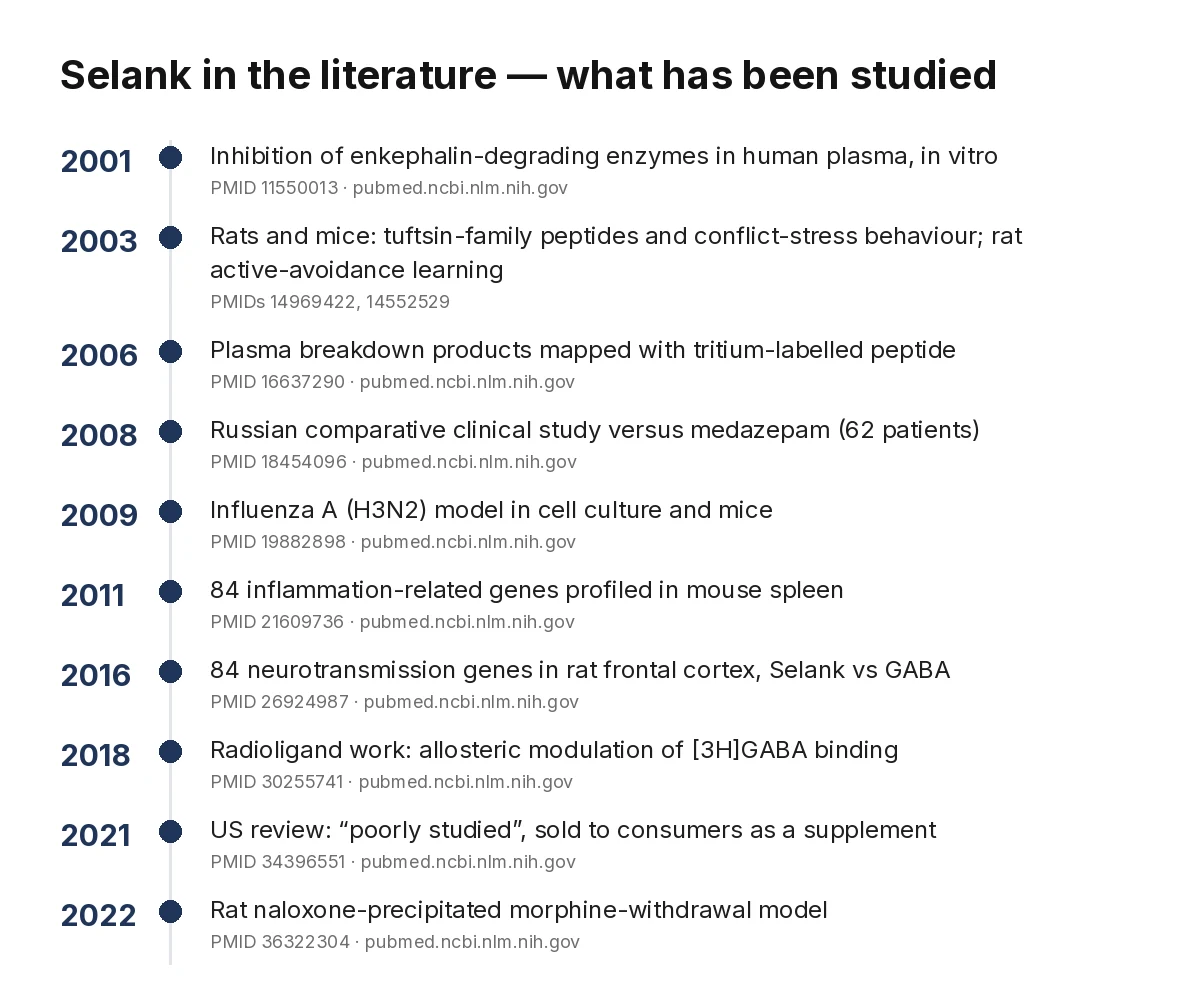
| Year | Model | What was investigated | PMID |
|---|---|---|---|
| 2001 | Human plasma, in vitro | Inhibition of enkephalin-degrading enzymes (IC50 15 µM) | PMID 11550013 |
| 2002 | Mouse (BALB/c, C57Bl/6), 100 µg/kg | Open-field behaviour and plasma leu-enkephalin half-life by strain | PMID 12432865 |
| 2003 | Rat, mouse | Tuftsin-family peptides and Selank in conflict-stress behaviour | PMID 14969422 |
| 2003 | Rat, 300 µg/kg | Active-avoidance learning vs piracetam | PMID 14552529 |
| 2006 | Rat, 0.3 mg/kg i.p., 4 weeks | Long-term anxiety-phobic behaviour and body weight | PMID 16963804 |
| 2006 | Blood plasma; brain tissue (tritium label) | Biodegradation products and brain distribution | PMID 16637290 |
| 2008 | Human (n=62), Russia | Comparison with medazepam; serum enkephalin activity | PMID 18454096 |
| 2008 | Human blood cells and serum, Russia | IL-6 expression and Th1/Th2 cytokine balance | PMID 18577961 |
| 2009 | Cell culture, mouse | Influenza A (H3N2) reproduction, survival, cytokine genes | PMID 19882898 |
| 2011 | Mouse spleen, 100 µg/kg | 84 inflammation-related genes at 6 and 24 h | PMID 21609736 |
| 2014 | Mouse spleen, 100 µg/kg | Time course of C3, Casp1, Il2rg, Xcr1; Gly-Pro fragment | PMID 24291245 |
| 2014 | Human (n=60), Russia | Comparison with phenazepam; tolerability | PMID 25176261 |
| 2016 | Rat frontal cortex, 300 µg/kg | 84 neurotransmission genes, Selank vs GABA | PMID 26924987 |
| 2017 | IMR-32 neuroblastoma cells | GABA-system gene expression with GABA and olanzapine | PMID 28293190 |
| 2017 | Rat | Elevated plus maze under chronic mild stress, with diazepam | PMID 28280289 |
| 2018 | Rat brain membranes | [3H]GABA binding (allosteric modulation) | PMID 30255741 |
| 2019 | Rat, 0.3 mg/kg i.p., 7 days | Ethanol-induced memory impairment; BDNF | PMID 31625062 |
| 2022 | Rat, 0.3 mg/kg i.p. | Morphine-withdrawal signs vs diazepam | PMID 36322304 |
Two Russian clinical papers compared Selank with a benzodiazepine: one randomised 62 patients with generalised anxiety disorder or neurasthenia to Selank or medazepam and reported similar anxiolytic scores[16], and the other compared it with phenazepam in 60 patients with phobic-anxiety and somatoform disorders[17]. A related study measured interleukin-6 expression and cytokine balance in patients’ blood[18]. All three were small, were published in Russian, and have not been repeated by independent groups elsewhere; the 2021 US review cited above describes the evidence as thin[19]. None of this makes Selank an approved or recommended product, and this page gives no dosing or administration information.
Selank 10MG is supplied as lyophilized powder in a sealed vial. Keep unopened vials frozen at −20 °C, dry and away from light, and avoid repeated freeze–thaw cycles. Reconstitution solvents such as bacteriostatic water are listed separately; concentrations and protocols are set by the researcher. Record the batch number from the vial label in your inventory and compare it with any report in the COA library.
A purchase description, a received label and a laboratory report answer different questions. Keep them together rather than treating a product title as a substitute for testing.
The catalog also lists Semax 10MG. A similar name or the same labelled amount does not make these interchangeable inventory entries. Retain separate procurement and report records for each named material. A Semax report should not be filed as the documentation for a Selank vial.
This distinction matters when comparing supplier records: keep the exact spelling from the listing and label in your inventory, and preserve the report’s own sample name rather than silently renaming it.
The HPLC and mass-spectrometry guide explains why purity and identity are separate analytical questions. A purity percentage is a result under the report’s method, not a universal approval of every possible use. Likewise, a labelled 10MG vial amount is not itself a measured quantity result.
When a report includes quantity, identity or purity results, record which tests were actually performed and their units. Keep any missing field marked as missing. This page does not certify a particular Selank batch, assert a purity percentage or guarantee that every test is available.
Review the live Selank listing and shipping policy for ordering terms. Confirm the destination, total charges and current availability at checkout. Your laboratory’s procurement rules and suitability review remain separate from the seller’s catalog description.
For a broader comparison, use the research-peptide catalog and its links to other named materials. The rest of our range is on the buy peptides online in Canada page. Keep this page as the Selank-specific starting point, not a general guide to treatment or personal use.
Selank is a seven-residue synthetic peptide, Thr-Lys-Pro-Arg-Pro-Gly-Pro: the tuftsin sequence with Pro-Gly-Pro added at the end. PubChem lists it as C33H57N11O9, 751.9 g/mol (CID 11765600).
The proposals come from animal and in-vitro work: allosteric modulation of GABA binding in brain membranes (PMID 30255741) and inhibition of enkephalin-degrading enzymes (PMID 11550013). A neuroblastoma-cell study found no gene-expression change from Selank alone (PMID 28293190), so the mechanism is not settled.
Only in a few small Russian clinical studies published in Russian, such as a 62-patient comparison with medazepam (PMID 18454096). It has no Health Canada, FDA or EMA approval that we found, and this page gives no dosing or administration information.
A batch-specific COA for this strength has not been posted yet — see the COA library (/coa/). We do not substitute a report from another product or strength.