For laboratory research only. Not for human or animal use. This article gives no dosing, administration or therapeutic advice.
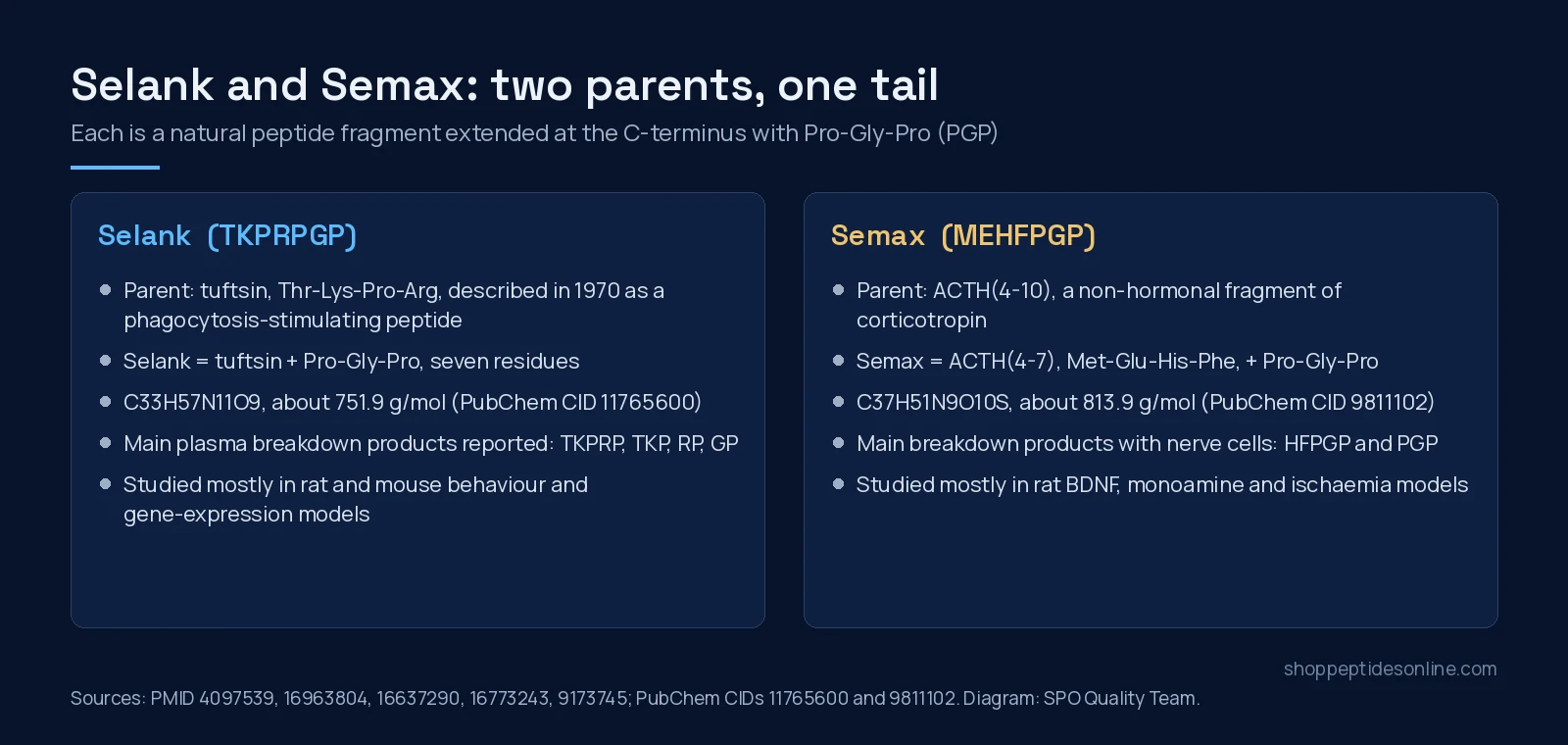
Short answer: Selank and Semax are both seven-residue synthetic peptides developed by Russian research groups, and both end in the same Pro-Gly-Pro (PGP) tripeptide. Their front halves come from unrelated parents. Selank is tuftsin (Thr-Lys-Pro-Arg), a peptide first described as a stimulator of phagocytosis, with PGP added[1],[2]. Semax is the ACTH(4-7) fragment (Met-Glu-His-Phe) with PGP added, designed as an analogue of ACTH(4-10)[3],[4]. Nearly all of the published work on both comes from rodent and cell models and from Russian clinical studies, and we found no approval for either in Canada, the US or the EU.
Where each sequence comes from
Tuftsin was reported in 1970 as a natural peptide that stimulates phagocytosis[1]. Selank, also called TP-7 in early papers, keeps tuftsin’s four residues and adds Pro-Gly-Pro at the C-terminus[2]. A 2003 rat and mouse study compared ten tuftsin-family peptides with Selank in a stress model. The authors reported that the effects depended on each peptide’s structure and on its breakdown fragments[5].
Semax started from ACTH(4-10), a fragment of corticotropin. A 1997 review from the group that designed it covers fifteen years of work on the analogue[3]. Later papers describe Semax directly as ACTH(4-7)PGP[4],[6]. Its N-terminal amine also matters chemically. A 2016 study compared Semax with an N-acetylated version and found that both bound zinc(II) with similar strength and that the acetylation changed how the peptide coordinated copper(II)[7].
The shared PGP tail is the design link. Both peptides were built on the idea that a Pro-Gly-Pro extension slows breakdown of a short, active fragment. Tritium-labelling work followed what happens to each. In blood plasma, Selank was broken down mainly to TKPRP, TKP, RP and GP. With nerve cells, Semax was broken down mainly to HFPGP and PGP[8],[9]. So a “Selank” or “Semax” experiment always involves a mixture of the parent peptide and its fragments. Tuftsin-family studies make the same point[5].
Identity side by side
| Property | Selank | Semax |
|---|---|---|
| Sequence | Thr-Lys-Pro-Arg-Pro-Gly-Pro (TKPRPGP)[10] | Met-Glu-His-Phe-Pro-Gly-Pro (MEHFPGP)[9] |
| Parent peptide | Tuftsin (TKPR)[1],[2] | ACTH(4-10); Semax keeps ACTH(4-7)[3],[4] |
| Formula / molecular weight | C33H57N11O9, about 751.9 g/mol (PubChem CID 11765600) | C37H51N9O10S, about 813.9 g/mol (PubChem CID 9811102) |
| Other names | TP-7, Selanc | ACTH(4-7)PGP |
| Reported breakdown products | TKPRP, TKP, RP, GP (plasma)[8] | HFPGP, PGP (nerve cells); loss of ME and GP (rat forebrain cells)[8],[9] |
| Main research themes | Enkephalinase inhibition, GABA-related gene expression, inflammation genes[10],[11],[12] | BDNF/trkB, monoamines, ischaemia models[13],[14],[4] |
| Regulatory status | Studied clinically in Russia; described in a 2021 US review as poorly studied[15],[16] | Studied clinically in Russia[17]; no approval found in Canada, the US or the EU |
What has been studied, by model
Selank
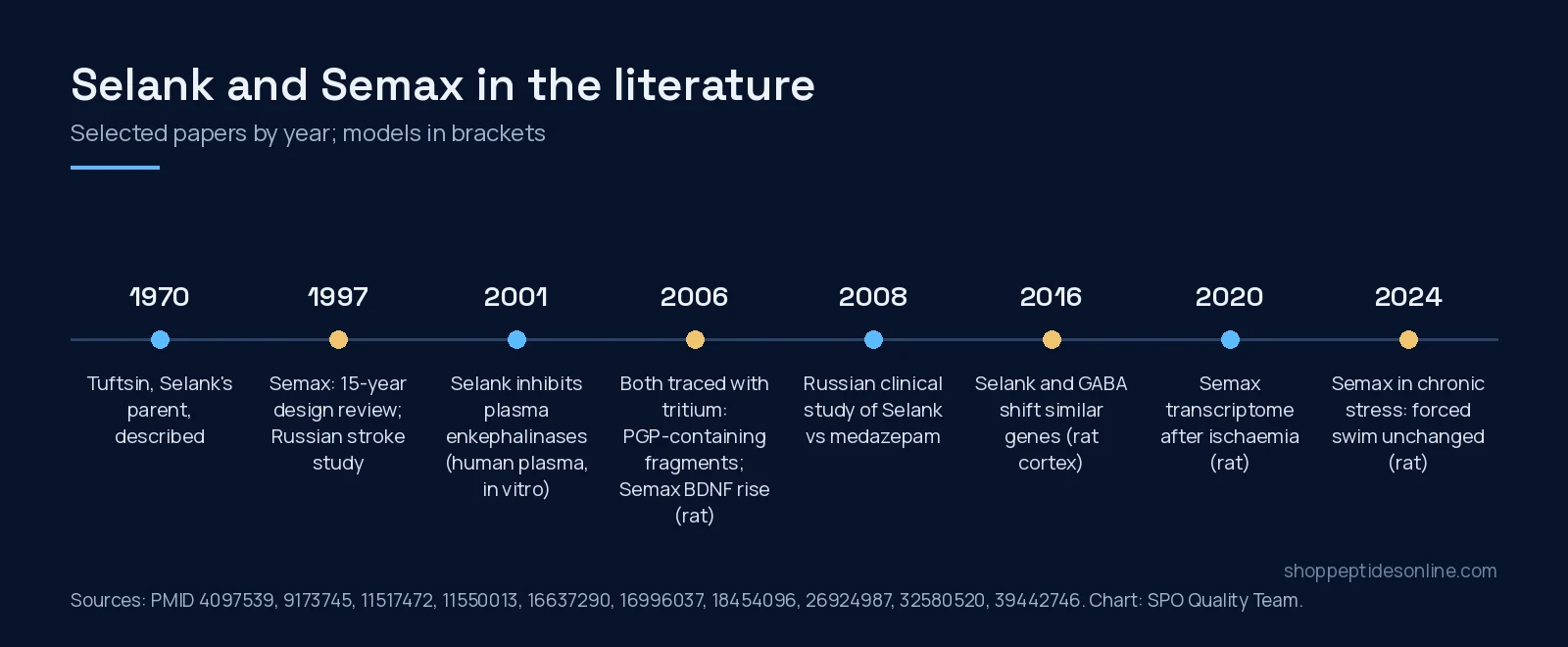
- Human plasma, in vitro. Selank inhibited enzymatic breakdown of plasma enkephalin in a dose-dependent way (IC50 15 µM) and was more potent than bacitracin or puromycin[10]. The same tritium study that tracked Semax also found a strong inhibitory effect of Semax on plasma enkephalinases[8]. This is one of the few findings the two peptides share.
- Rat frontal cortex, gene expression. Across 84 neurotransmission genes, Selank and GABA each changed the expression of 45 genes at 1 hour and 22 at 3 hours, and the changes were positively correlated[11]. The same group ran related work in IMR-32 neuroblastoma cells[18].
- Mouse spleen. A single dose changed the expression of 34 of 84 inflammation-related genes, including Bcl6[12].
- Rat behaviour. In Wistar rats with high emotional reactivity, a four-week study reported lower anxiety-phobic scores and no change in body mass[2]. A 2017 chronic-mild-stress study included an awkward result: even without stress, a course of the test substances pushed anxiety indicators the wrong way, less so for Selank alone[19].
- Human (Russia). A clinical study compared Selank with medazepam in generalised anxiety and neurasthenia and measured serum enkephalin half-life[15]. A 2021 US pharmacology review calls Selank a poorly studied Russian drug with GABAergic mechanisms[16].
Semax
- Rat hippocampus. A single application raised BDNF protein about 1.4-fold and trkB phosphorylation about 1.6-fold, alongside more conditioned avoidance responses[13]. BDNF and NGF gene expression were also tracked over time in rat hippocampus and frontal cortex[20].
- Rodent monoamines, including a null result. Semax increased striatal serotonin turnover, but on its own it failed to change tissue or extracellular dopamine and its metabolites. It enhanced the dopamine and locomotor response to D-amphetamine[14].
- Rat ischaemia-reperfusion. After transient middle cerebral artery occlusion, 394 genes were differentially expressed with Semax compared with saline. Inflammation genes went down and neurotransmission genes went up[4]. A protein-level follow-up reported a consistent profile[6].
- Rat chronic stress, another null result. In a 2024 chronic unpredictable stress study, Semax and melanotan II affected anhedonia and hippocampal BDNF. Neither stress nor the peptides changed immobility time in the forced swim test[21].
- Human (Russia). Semax was studied as an add-on in acute ischaemic stroke in Russian clinical work[17]. These are small, local studies, and they are not evidence of benefit outside that setting.
Where the evidence is thin
The Western literature on both peptides is small. Most papers come from a handful of Russian groups, many are in Russian-language journals, and few have been replicated independently. No head-to-head study of Selank against Semax turned up in our PubMed searches. Rodent behaviour results vary with strain and emotional phenotype, a point the tuftsin-family work makes directly[5],[22]. Gene-expression studies show that something changed, not that the change matters. For a lab, the practical question is identity: two 7-mers that share a PGP tail differ by about 62 Da, so a mass-spec match on the batch certificate is what separates them. Our explainer on HPLC purity versus MS identity covers how to read that.
SPO’s Selank research overview carries the full Selank study table, and the Semax 10mg page lists the Semax sources. Neither product has a batch COA posted yet. If you plan to buy peptides online in Canada, check each supplier’s documentation for the exact batch you would receive.
Frequently asked questions
What is the difference between Selank and Semax?
Both are seven-residue synthetic peptides ending in Pro-Gly-Pro. Selank is built on tuftsin (Thr-Lys-Pro-Arg); Semax is built on the ACTH(4-7) fragment (Met-Glu-His-Phe). The parents are unrelated, and so is most of each peptide’s research literature.
Why do both end in Pro-Gly-Pro?
The PGP extension was added to short active fragments to slow their breakdown. Tritium-labelling studies show that both are still broken down, into fragments such as TKP for Selank and HFPGP and PGP for Semax.
Are Selank or Semax approved in Canada?
We found no approval for either in Canada, the US or the EU. Both were studied clinically in Russia. Research-grade material is sold for laboratory use only.
Has anyone compared Selank and Semax directly?
Not in a head-to-head study that we could find on PubMed. Both do inhibit plasma enkephalin-degrading enzymes in vitro, one of the few findings they share.
How can a lab tell them apart?
By mass. Selank is about 751.9 g/mol and Semax about 813.9 g/mol, so a mass-spectrometry identity result on the batch COA distinguishes them.
References
- Najjar VA, Nishioka K (1970). “Tuftsin”: a natural phagocytosis stimulating peptide. Nature. PMID: 4097539. doi: 10.1038/228672a0.
- Czabak-Garbacz R, Cygan B, Wolański L et al. (2006). Influence of long-term treatment with tuftsin analogue TP-7 on the anxiety-phobic states and body weight. Pharmacol Rep. PMID: 16963804.
- Asmarin IP, Nezavibat’ko VN, Miasoedov NF et al. (1997). [A nootropic adrenocorticotropin analog 4-10-semax (l5 years experience in its design and study)]. Zh Vyssh Nerv Deiat Im I P Pavlova. PMID: 9173745.
- Filippenkov IB, Stavchansky VV, Denisova AE et al. (2020). Novel Insights into the Protective Properties of ACTH((4-7))PGP (Semax) Peptide at the Transcriptome Level Following Cerebral Ischaemia-Reperfusion in Rats. Genes (Basel). PMID: 32580520. doi: 10.3390/genes11060681.
- Kozlovskaya MM, Kozlovskii II, Val’dman EA et al. (2003). Selank and short peptides of the tuftsin family in the regulation of adaptive behavior in stress. Neurosci Behav Physiol. PMID: 14969422. doi: 10.1023/a:1025988519919.
- Sudarkina OY, Filippenkov IB, Stavchansky VV et al. (2021). Brain Protein Expression Profile Confirms the Protective Effect of the ACTH((4-7))PGP Peptide (Semax) in a Rat Model of Cerebral Ischemia-Reperfusion. Int J Mol Sci. PMID: 34201112. doi: 10.3390/ijms22126179.
- Magrì A, Tabbì G, Giuffrida A et al. (2016). Influence of the N-terminus acetylation of Semax, a synthetic analog of ACTH(4-10), on copper(II) and zinc(II) coordination and biological properties. J Inorg Biochem. PMID: 27586814. doi: 10.1016/j.jinorgbio.2016.08.013.
- Zolotarev IuA, Dadaian AK, Dolotov OV et al. (2006). [Evenly tritium-labeled peptides and their in vivo and in vitro biodegradation]. Bioorg Khim. PMID: 16637290.
- Zolotarev YA, Dolotov OV, Inozemtseva LS et al. (2006). Degradation of the ACTH(4-10) analog Semax in the presence of rat basal forebrain cell cultures and plasma membranes. Amino Acids. PMID: 16773243. doi: 10.1007/s00726-006-0328-8.
- Zozulya AA, Kost NV, Yu Sokolov O et al. (2001). The inhibitory effect of Selank on enkephalin-degrading enzymes as a possible mechanism of its anxiolytic activity. Bull Exp Biol Med. PMID: 11550013. doi: 10.1023/a:1017979514274.
- Volkova A, Shadrina M, Kolomin T et al. (2016). Selank Administration Affects the Expression of Some Genes Involved in GABAergic Neurotransmission. Front Pharmacol. PMID: 26924987. doi: 10.3389/fphar.2016.00031.
- Kolomin T, Shadrina M, Andreeva L et al. (2011). Expression of inflammation-related genes in mouse spleen under tuftsin analog Selank. Regul Pept. PMID: 21609736. doi: 10.1016/j.regpep.2011.05.001.
- Dolotov OV, Karpenko EA, Inozemtseva LS et al. (2006). Semax, an analog of ACTH(4-10) with cognitive effects, regulates BDNF and trkB expression in the rat hippocampus. Brain Res. PMID: 16996037. doi: 10.1016/j.brainres.2006.07.108.
- Eremin KO, Kudrin VS, Saransaari P et al. (2005). Semax, an ACTH(4-10) analogue with nootropic properties, activates dopaminergic and serotoninergic brain systems in rodents. Neurochem Res. PMID: 16362768. doi: 10.1007/s11064-005-8826-8.
- Zozulia AA, Neznamov GG, Siuniakov TS et al. (2008). [Efficacy and possible mechanisms of action of a new peptide anxiolytic selank in the therapy of generalized anxiety disorders and neurasthenia]. Zh Nevrol Psikhiatr Im S S Korsakova. PMID: 18454096.
- Doyno CR, White CM (2021). Sedative-Hypnotic Agents That Impact Gamma-Aminobutyric Acid Receptors: Focus on Flunitrazepam, Gamma-Hydroxybutyric Acid, Phenibut, and Selank. J Clin Pharmacol. PMID: 34396551. doi: 10.1002/jcph.1922.
- Gusev EI, Skvortsova VI, Miasoedov NF et al. (1997). [Effectiveness of semax in acute period of hemispheric ischemic stroke (a clinical and electrophysiological study)]. Zh Nevrol Psikhiatr Im S S Korsakova. PMID: 11517472.
- Filatova E, Kasian A, Kolomin T et al. (2017). GABA, Selank, and Olanzapine Affect the Expression of Genes Involved in GABAergic Neurotransmission in IMR-32 Cells. Front Pharmacol. PMID: 28293190. doi: 10.3389/fphar.2017.00089.
- Kasian A, Kolomin T, Andreeva L et al. (2017). Peptide Selank Enhances the Effect of Diazepam in Reducing Anxiety in Unpredictable Chronic Mild Stress Conditions in Rats. Behav Neurol. PMID: 28280289. doi: 10.1155/2017/5091027.
- Agapova TIu, Agniullin IaV, Silachev DN et al. (2008). [Effect of semax on the temporary dynamics of brain-derived neurotrophic factor and nerve growth factor gene expression in the rat hippocampus and frontal cortex]. Mol Gen Mikrobiol Virusol. PMID: 18756821.
- Inozemtseva LS, Yatsenko KA, Glazova NY et al. (2024). Antidepressant-like and antistress effects of the ACTH(4-10) synthetic analogs Semax and Melanotan II on male rats in a model of chronic unpredictable stress. Eur J Pharmacol. PMID: 39442746. doi: 10.1016/j.ejphar.2024.177068.
- Sokolov OY, Meshavkin VK, Kost NV et al. (2002). Effects of Selank on behavioral reactions and activities of plasma enkephalin-degrading enzymes in mice with different phenotypes of emotional and stress reactions. Bull Exp Biol Med. PMID: 12432865. doi: 10.1023/a:1015582302311.