For laboratory research only. Not for human or animal use. This article gives no dosing, administration or therapeutic advice.
Short answer: both peptides pair GLP-1-receptor activity with glucagon-receptor activity. Retatrutide (LY3437943) adds a third target, the GIP receptor[1]; survodutide (BI 456906) stays a dual GLP-1/glucagon agonist[2]. Both have now reached phase 3[11][10], but no trial has compared them directly, and their trials enrolled different people and measured different end points. For a research buyer, the useful comparison is pharmacological: which receptors, what each one is thought to add, and what the published models can and cannot show.
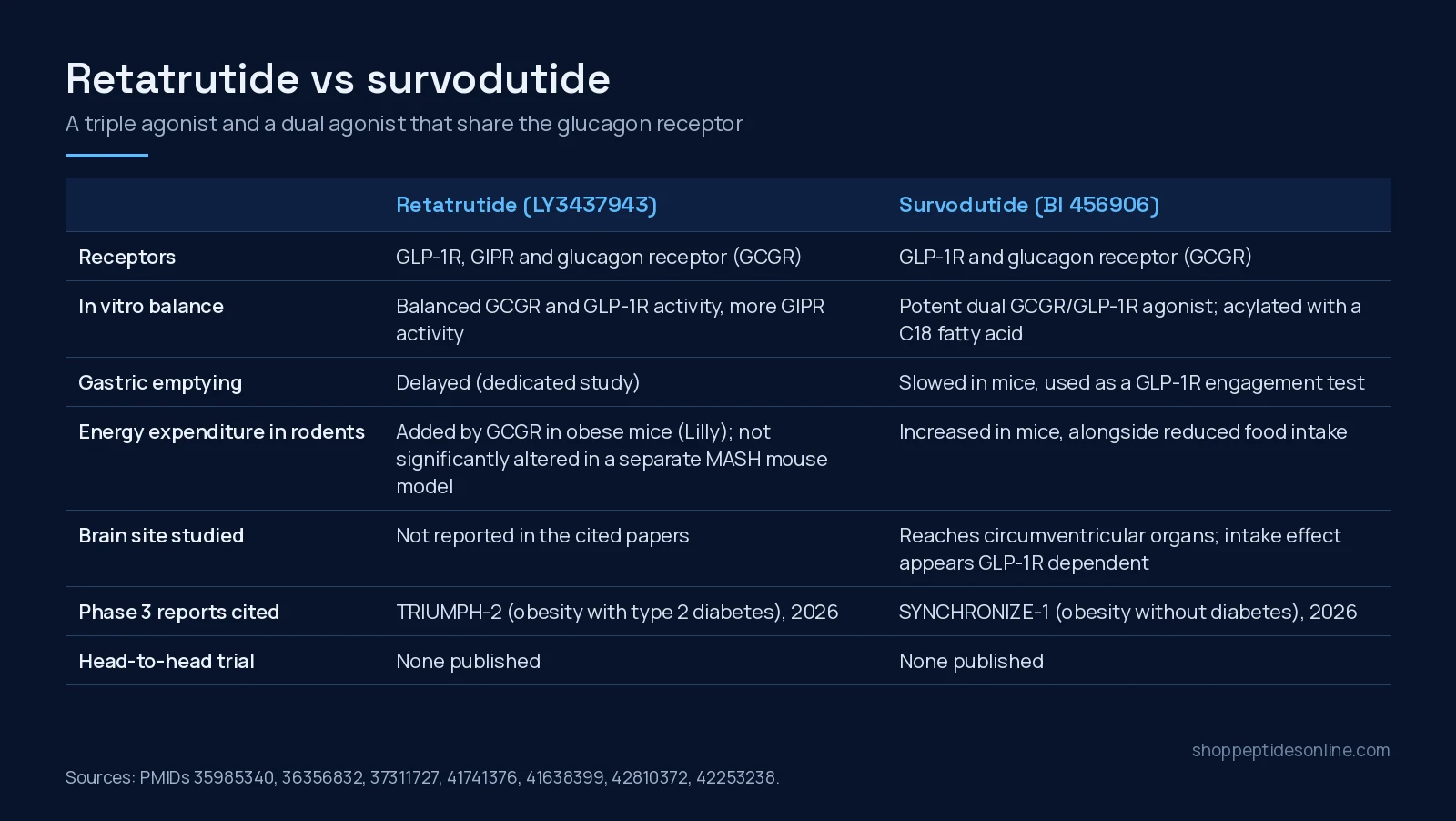
Side by side
| Retatrutide (LY3437943) | Survodutide (BI 456906) | |
|---|---|---|
| Receptor targets | Glucagon receptor (GCGR), GIP receptor (GIPR), GLP-1 receptor (GLP-1R)[1] | GCGR and GLP-1R[2] |
| In vitro profile | Balanced GCGR and GLP-1R activity, with more GIPR activity[1] | Potent dual agonist, like the gut peptide oxyntomodulin, which activates both receptors; acylated with a C18 fatty acid to extend half-life[2] |
| Gastric emptying | Delayed, in a dedicated study[13] | Slowed in mice, used as a test of GLP-1R engagement[2] |
| Liver-focused trials | Phase 2a liver fat substudy in MASLD[9] | Phase 2 biopsy trial in MASH with fibrosis[8]; phase 1 study in cirrhosis[12] |
| Phase 3 report cited here | TRIUMPH-2: adults with obesity and type 2 diabetes[11] | SYNCHRONIZE-1: adults with obesity without diabetes[10] |
| At SPO | GLP-3 (RT) 10mg (catalogue name for retatrutide) | Not sold |
What the glucagon receptor is meant to add
Glucagon raises blood glucose, so putting glucagon-receptor activity into a metabolic peptide looks odd at first. The rationale in both programmes is energy balance. In obese mice, Lilly’s team reported that GCGR-mediated increases in energy expenditure added to the reduction in calorie intake driven by GIPR and GLP-1R activity[1]. Boehringer Ingelheim’s preclinical paper for survodutide reached the same kind of conclusion: in mice, its effect came from increased energy expenditure plus reduced food intake, and GCGR engagement was confirmed with liver nicotinamide N-methyltransferase expression and circulating amino acids and FGF-21[2].
Two cautions apply. A 2026 IUPHAR review of glucagon agonism states that the mechanistic data so far come from rodent models and that evidence for similar processes in humans is limited[3]. And the rodent data are not uniform: in a separate diet-induced obese MASH mouse model run by a separate group, retatrutide reduced food intake in the first days of treatment, but energy expenditure was not altered significantly[4].
Where survodutide acts in the brain
A 2026 mouse study gives survodutide something retatrutide does not yet have in the literature cited here: a mapped central site of action. GCGR was barely detectable at single-cell level in the area postrema and arcuate nucleus, whereas GLP1R was expressed there. Fluorophore-labelled survodutide reached the circumventricular organs and adjacent hypothalamic and hindbrain nuclei without evidence of uniformly crossing the blood-brain barrier, and it activated several feeding-related nuclei on c-Fos staining. A long-acting GCGR agonist alone did not activate those satiety regions or reduce food intake, though it still lowered body weight[5]. The authors read this as a division of labour: the intake effect runs through GLP-1R, and GCGR contributes elsewhere.
How the clinical programmes differ
The trial designs differ more than the receptor lists suggest, which is one reason cross-trial comparisons mislead.
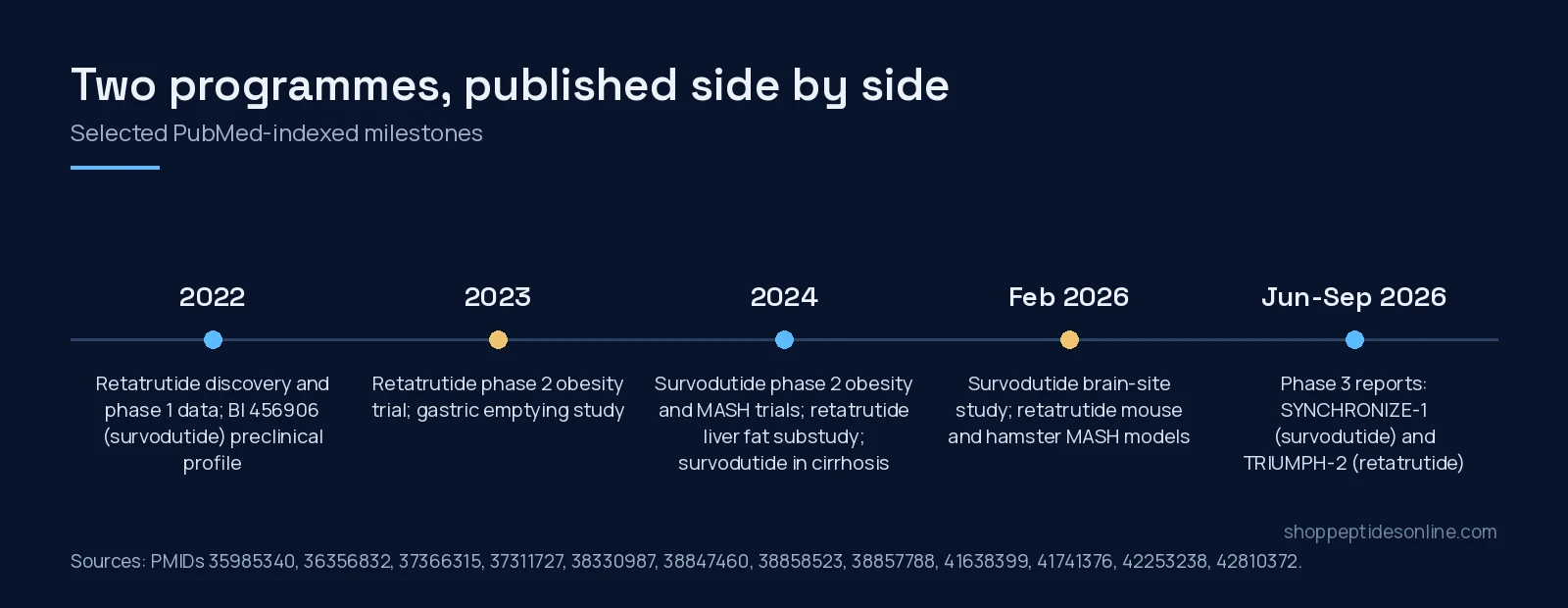
- Obesity, phase 2. Retatrutide’s 48-week trial enrolled 338 adults and used percentage change in body weight at 24 weeks as the primary end point[6]. Survodutide’s dose-finding phase 2 trial was also randomised, double-blind and placebo-controlled[7].
- Liver. Retatrutide’s liver data come from a substudy of 98 participants with MASLD and at least 10% liver fat, with relative change in liver fat at 24 weeks as the primary objective[9]. Survodutide’s MASH trial was a 48-week biopsy study in adults with fibrosis stages F1 to F3, with histologic improvement in MASH without worsening of fibrosis as the primary end point[8]. A phase 1 study found survodutide’s plasma exposure after a single administration similar in people with cirrhosis and in healthy controls[12].
- Phase 3. TRIUMPH-2 randomised adults with a BMI of 27 or higher and type 2 diabetes across 92 centres in eight countries[11]. SYNCHRONIZE-1 randomised 725 adults with obesity and excluded diabetes, with two primary end points at week 76[10].
Tolerability: the shared signal
Gastrointestinal events dominate the safety tables for both.
- In retatrutide’s phase 2 obesity trial, the most common adverse events were gastrointestinal, dose-related and mostly mild to moderate, and they were partly mitigated by a gentler start to escalation. Heart rate rose in a dose-dependent way, peaked at 24 weeks and declined thereafter[6].
- In survodutide’s phase 2 obesity trial, adverse events occurred in 91% of survodutide recipients and 75% of placebo recipients, mainly gastrointestinal (75% vs 42%)[7]. In the MASH trial, nausea, diarrhoea and vomiting were more frequent than with placebo, while serious adverse events were similar (8% vs 7%)[8].
- In SYNCHRONIZE-1, gastrointestinal symptoms were again the most common adverse events, typically mild to moderate, and no deaths were reported[10].
Which one fits which question?
- Adding GIP-receptor signalling to a GLP-1/glucagon background: retatrutide[1]. For how it sits beside tirzepatide and semaglutide, see our tirzepatide vs semaglutide vs retatrutide comparison.
- Isolating GLP-1R plus GCGR, or central sites of action: survodutide has the published brain-mapping work[5].
- Liver-model work: both have rodent and clinical liver data, but with different end points: liver fat for retatrutide[9][4], histology for survodutide[8].
Product information for our retatrutide material is on the GLP-3 research page. For the full catalogue, see how to buy peptides online in Canada.
Frequently asked questions
What is the difference between retatrutide and survodutide?
Retatrutide is a single peptide that activates three receptors: GLP-1, GIP and glucagon. Survodutide activates two, GLP-1 and glucagon. Both add glucagon-receptor activity to GLP-1-receptor activity; only retatrutide also carries GIP-receptor activity.
Why add glucagon-receptor activity at all?
In rodent studies, glucagon-receptor agonism raised energy expenditure, while GLP-1 and GIP receptor activity lowered food intake. A 2026 review notes that this mechanistic evidence comes mainly from rodents and that human evidence for the same processes is limited.
Has retatrutide been compared directly with survodutide?
No head-to-head trial has been published. The two programmes used different populations, end points and time points, so numbers from separate trials cannot be compared directly.
What adverse events were reported in the trials?
In both programmes the most common adverse events were gastrointestinal. Retatrutide’s phase 2 obesity trial also reported dose-dependent heart-rate increases that peaked at 24 weeks and then declined.
Is retatrutide the same as GLP-3?
GLP-3 is the catalogue name SPO uses for retatrutide (LY3437943), sold as a research material only. SPO does not sell survodutide.
References
- Coskun T, Urva S, Roell WC et al. (2022). LY3437943, a novel triple glucagon, GIP, and GLP-1 receptor agonist for glycemic control and weight loss: From discovery to clinical proof of concept. Cell Metab. PMID: 35985340. doi: 10.1016/j.cmet.2022.07.013.
- Zimmermann T, Thomas L, Baader-Pagler T et al. (2022). BI 456906: Discovery and preclinical pharmacology of a novel GCGR/GLP-1R dual agonist with robust anti-obesity efficacy. Mol Metab. PMID: 36356832. doi: 10.1016/j.molmet.2022.101633.
- Elmendorf AJ, Yousefian M, Kim IM et al. (2026). IUPHAR review: From foe to friend: Repurposing glucagon to treat obesity and type 2 diabetes. Pharmacol Res. PMID: 41478576. doi: 10.1016/j.phrs.2025.108077.
- Briand F, Le Cudennec C, Grasset E et al. (2026). Retatrutide Shows Multiple Metabolic Benefits in Diet-Induced Obese MASH Mouse and Hamster Models. Obesity (Silver Spring). PMID: 41741376. doi: 10.1002/oby.70155.
- Zimmermann T, Bleymehl K, Haebel P et al. (2026). Survodutide acts through circumventricular organs in the brain and activates neuronal regions associated with appetite regulation. Mol Metab. PMID: 41638399. doi: 10.1016/j.molmet.2026.102326.
- Jastreboff AM, Kaplan LM, Frías JP et al. (2023). Triple-Hormone-Receptor Agonist Retatrutide for Obesity – A Phase 2 Trial. N Engl J Med. PMID: 37366315. doi: 10.1056/NEJMoa2301972.
- le Roux CW, Steen O, Lucas KJ et al. (2024). Glucagon and GLP-1 receptor dual agonist survodutide for obesity: a randomised, double-blind, placebo-controlled, dose-finding phase 2 trial. Lancet Diabetes Endocrinol. PMID: 38330987. doi: 10.1016/S2213-8587(23)00356-X.
- Sanyal AJ, Bedossa P, Fraessdorf M et al. (2024). A Phase 2 Randomized Trial of Survodutide in MASH and Fibrosis. N Engl J Med. PMID: 38847460. doi: 10.1056/NEJMoa2401755.
- Sanyal AJ, Kaplan LM, Frias JP et al. (2024). Triple hormone receptor agonist retatrutide for metabolic dysfunction-associated steatotic liver disease: a randomized phase 2a trial. Nat Med. PMID: 38858523. doi: 10.1038/s41591-024-03018-2.
- le Roux CW, Wharton S, Startseva E et al. (2026). Survodutide Once Weekly for the Treatment of Adults with Obesity. N Engl J Med. PMID: 42253238. doi: 10.1056/NEJMoa2600751.
- Bellido V, le Roux CW, Ekinci EI et al. (2026). Retatrutide in adults with obesity and type 2 diabetes (TRIUMPH-2): a double-blind, parallel-group, randomised, placebo-controlled, phase 3 trial. Lancet. PMID: 42810372. doi: 10.1016/S0140-6736(26)01861-1.
- Lawitz EJ, Fraessdorf M, Neff GW et al. (2024). Efficacy, tolerability and pharmacokinetics of survodutide, a glucagon/glucagon-like peptide-1 receptor dual agonist, in cirrhosis. J Hepatol. PMID: 38857788. doi: 10.1016/j.jhep.2024.06.003.
- Urva S, O’Farrell L, Du Y et al. (2023). The novel GIP, GLP-1 and glucagon receptor agonist retatrutide delays gastric emptying. Diabetes Obes Metab. PMID: 37311727. doi: 10.1111/dom.15167.