For laboratory research only. Not for human or animal use. This article gives no dosing, administration or therapeutic advice.
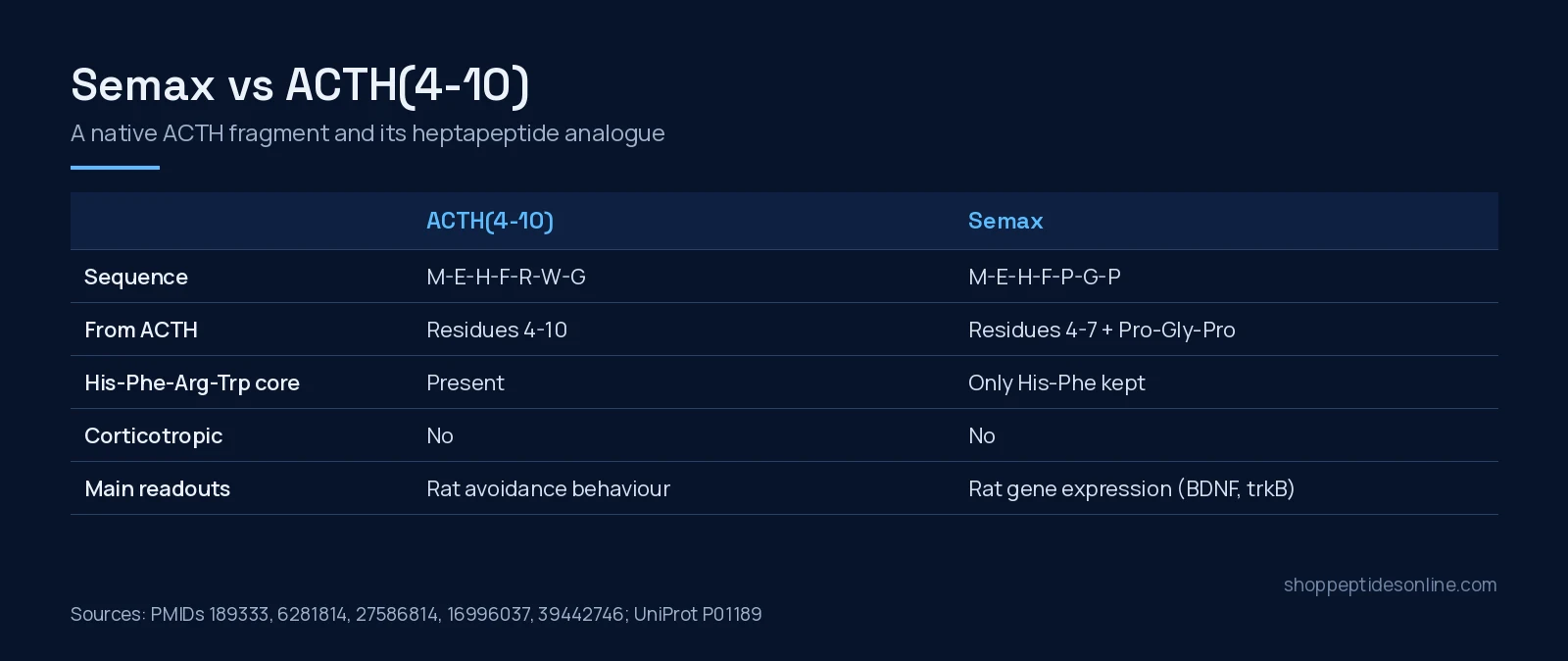
Short answer: ACTH(4–10) is a seven-residue fragment of adrenocorticotropic hormone, Met-Glu-His-Phe-Arg-Trp-Gly, reported to lack ACTH’s endocrine effects[1] and studied since the 1970s for behavioural effects in rats[2]. Semax (Met-Glu-His-Phe-Pro-Gly-Pro) keeps ACTH residues 4–7 and replaces the last three with a Pro-Gly-Pro tripeptide[3]. Both are described as noncorticotropic ACTH(4–10) analogues[4]. The research on semax has moved toward gene expression, especially neurotrophins, in rat models[5][6].
Side by side
| ACTH(4–10) | Semax | |
|---|---|---|
| Sequence | Met-Glu-His-Phe-Arg-Trp-Gly, residues 4–10 of ACTH (UniProt P01189) | Met-Glu-His-Phe-Pro-Gly-Pro[3] |
| Relation to ACTH | Native fragment[1] | ACTH(4–7) plus a C-terminal Pro-Gly-Pro[3][7] |
| His-Phe-Arg-Trp core | Present (His6-Phe7-Arg8-Trp9)[8] | Only His-Phe kept; Arg-Trp replaced (sequence comparison) |
| Endocrine activity | Lacks ACTH’s endocrine and metabolic effects[1] | Noncorticotropic[4] |
| Typical research readouts | Avoidance and memory behaviour in rats[9][2][10] | BDNF/trkB and gene expression in rat brain[5][6][11] |
| Metal binding | Not covered here | Forms Cu(II) and Zn(II) complexes; N-acetylation changes them[3] |
| At SPO | Not sold | Semax 10mg |
The parent: ACTH(4–10) and the “behavioural peptides”
ACTH(4–10) was synthesised as a fragment of pituitary ACTH. Early work suggested it lacks the endocrine and metabolic effects of the full hormone[1], which made it a tool for asking whether parts of ACTH act on the brain independently of the adrenal gland.
Rat studies from that period found:
- ACTH(4–10) delayed extinction of pole-jumping avoidance and facilitated passive avoidance. An ACTH(4–9) analogue, ORG 2766, was about a thousand times more active[2].
- Swapping one residue reversed part of the effect: [D-Phe7]ACTH(4–10) facilitated extinction of avoidance instead of delaying it[2][12].
- ACTH(4–10) still changed passive avoidance in Brattleboro rats with no vasopressin, arguing against the idea that it works by releasing vasopressin[9].
- Given before testing, ACTH(4–10) increased latencies to enter a previously shocked arm in a dose-dependent way, a measure of aversive memory retrieval[10].
The D-Phe7 result is a reminder that small changes in this short sequence can flip behavioural outcomes.
Semax: what changed
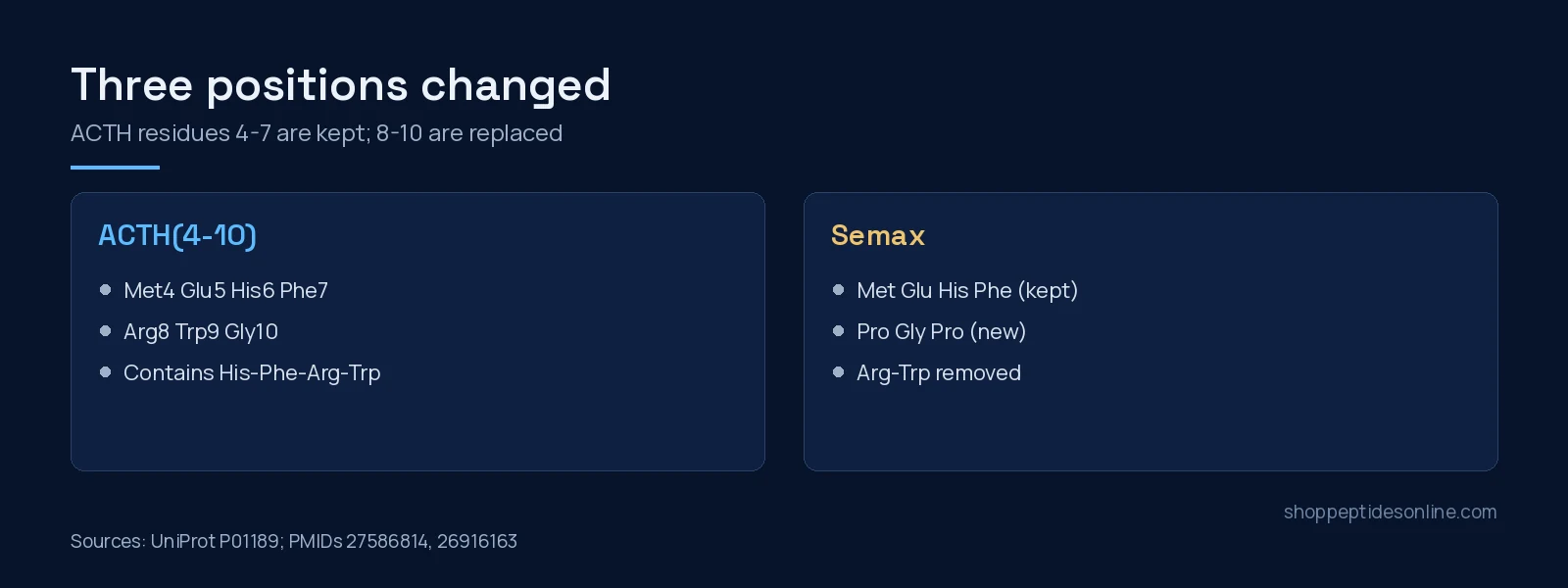
Semax keeps the first four residues of ACTH(4–10), Met-Glu-His-Phe, and replaces Arg-Trp-Gly with Pro-Gly-Pro[3]. Compare that with the melanocortin receptor family: their natural ligands all share the His-Phe-Arg-Trp core[8]. Semax keeps His-Phe but not Arg-Trp, so it should not be assumed to behave like a classic melanocortin agonist. Melanotan II, by contrast, keeps the full core and is a potent melanocortin agonist; a 2024 rat study tested both side by side as ACTH(4–10) analogues[4].
The chemistry of the free N-terminus also matters. Semax forms complexes with copper(II) and zinc(II), and acetylating its N-terminal amino group changes the copper complex that forms at physiological pH[3]. Acetylated and non-acetylated forms are therefore different research materials.
What the semax studies measure
Most semax work comes from rat studies of gene and protein expression:
- Neurotrophins. A single application raised BDNF protein and trkB phosphorylation in the rat hippocampus, along with BDNF and trkB mRNA[5]. A follow-up examined rapid changes in neurotrophin gene expression in rat brain[6].
- Ischaemia models. A genome-wide study in rats with permanent middle cerebral artery occlusion found semax mainly enhanced expression of immune-related genes, with vascular genes also affected[11]. A later protein-profiling study in a transient occlusion model reported changes consistent with those transcript findings[13].
- Spinal cord injury. A 2025 mouse study linked semax to the μ-opioid receptor gene Oprm1 and lysosomal membrane pathways after injury[7].
These are animal models. They show what semax changes in rodent tissue, not effects in people.
Related reading
For semax against its sister peptide, see Selank vs Semax. Batch identity and purity testing are explained in HPLC purity vs mass spectrometry identity. Shop Peptides Online supplies semax for laboratory research only. For the full catalogue, see our guide to buy peptides online in Canada.
Frequently asked questions
What is the difference between semax and ACTH(4-10)?
ACTH(4-10) is the native fragment Met-Glu-His-Phe-Arg-Trp-Gly. Semax keeps the first four residues and replaces Arg-Trp-Gly with Pro-Gly-Pro, giving Met-Glu-His-Phe-Pro-Gly-Pro.
Do semax and ACTH(4-10) act like ACTH on the adrenal gland?
Both are described as noncorticotropic: ACTH(4-10) was reported to lack ACTH’s endocrine and metabolic effects, and semax is studied as a noncorticotropic analogue.
Is semax a melanocortin receptor agonist?
Natural melanocortin ligands share a His-Phe-Arg-Trp core. Semax keeps His-Phe but not Arg-Trp, so it should not be assumed to act like classic melanocortin agonists such as melanotan II.
What do semax studies usually measure?
Mostly gene and protein expression in rat brain, such as BDNF and trkB in the hippocampus, and transcriptome changes in ischaemia models.
Does Shop Peptides Online sell ACTH(4-10)?
No. SPO lists semax 10mg for laboratory research only, not for human or animal use.
References
- Dornbush RL, Nikolovski O (1976). ACTH 4-10 and short-term memory. Pharmacol Biochem Behav. PMID: 189333. doi: 10.1016/0091-3057(76)90331-2.
- Fekete M, De Wied D (1982). Potency and duration of action of the ACTH 4-9 analog (ORG 2766) as compared to ACTH 4-10 and [D-Phe7] ACTH 4-10 on active and passive avoidance behavior of rats. Pharmacol Biochem Behav. PMID: 6281814. doi: 10.1016/0091-3057(82)90439-7.
- Magrì A, Tabbì G, Giuffrida A et al. (2016). Influence of the N-terminus acetylation of Semax, a synthetic analog of ACTH(4-10), on copper(II) and zinc(II) coordination and biological properties. J Inorg Biochem. PMID: 27586814. doi: 10.1016/j.jinorgbio.2016.08.013.
- Inozemtseva LS, Yatsenko KA, Glazova NY et al. (2024). Antidepressant-like and antistress effects of the ACTH(4-10) synthetic analogs Semax and Melanotan II on male rats in a model of chronic unpredictable stress. Eur J Pharmacol. PMID: 39442746. doi: 10.1016/j.ejphar.2024.177068.
- Dolotov OV, Karpenko EA, Inozemtseva LS et al. (2006). Semax, an analog of ACTH(4-10) with cognitive effects, regulates BDNF and trkB expression in the rat hippocampus. Brain Res. PMID: 16996037. doi: 10.1016/j.brainres.2006.07.108.
- Agapova TY, Agniullin YV, Shadrina MI et al. (2007). Neurotrophin gene expression in rat brain under the action of Semax, an analogue of ACTH 4-10. Neurosci Lett. PMID: 17353092. doi: 10.1016/j.neulet.2007.02.042.
- Liu R, Chen Y, Huang H et al. (2025). Semax peptide targets the μ opioid receptor gene Oprm1 to promote deubiquitination and functional recovery after spinal cord injury in female mice. Br J Pharmacol. PMID: 40692165. doi: 10.1111/bph.70122.
- Cai M, Hruby VJ (2016). The Melanocortin Receptor System: A Target for Multiple Degenerative Diseases. Curr Protein Pept Sci. PMID: 26916163. doi: 10.2174/1389203717666160226145330.
- Bailey WH, Weiss JM (1978). Effect of ACTH 4-10 on passive avoidance of rats lacking vasopressin (Brattleboro strain). Horm Behav. PMID: 207631. doi: 10.1016/0018-506x(78)90021-1.
- Kumar KB, Karanth KS (1995). Effects of ACTH and ACTH 4-10 on aversive memory retrieval in rats. J Neural Transm Gen Sect. PMID: 8695052. doi: 10.1007/BF01271559.
- Medvedeva EV, Dmitrieva VG, Povarova OV et al. (2014). The peptide semax affects the expression of genes related to the immune and vascular systems in rat brain focal ischemia: genome-wide transcriptional analysis. BMC Genomics. PMID: 24661604. doi: 10.1186/1471-2164-15-228.
- Wiegant VM, Colbern D, van Wimersma Greidanus TJ et al. (1978). Differential behavioral effects of ACTH 4-10 and [D-Phe7] ACTH 4-10. Brain Res Bull. PMID: 206319. doi: 10.1016/0361-9230(78)90042-4.
- Sudarkina OY, Filippenkov IB, Stavchansky VV et al. (2021). Brain Protein Expression Profile Confirms the Protective Effect of the ACTH((4-7))PGP Peptide (Semax) in a Rat Model of Cerebral Ischemia-Reperfusion. Int J Mol Sci. PMID: 34201112. doi: 10.3390/ijms22126179.