For laboratory research only. Not for human or animal use. This article gives no dosing, administration or therapeutic advice.
Short answer: tuftsin is a natural tetrapeptide, Thr-Lys-Pro-Arg, cut from the Fc region of immunoglobulin G and best known for stimulating phagocytic cells[1][2]. Selank (also coded TP-7) is a synthetic heptapeptide: the same four residues followed by Pro-Gly-Pro[3][4]. The extension changes the research picture. Tuftsin work centres on macrophages, microglia and the receptor neuropilin-1[5][6]; Selank work centres on rodent stress behaviour, enkephalin-degrading enzymes and GABA-related gene expression[7][8]. Two rat studies tested both peptides side by side, and in both the analogue behaved differently from the parent[3][4].
Side by side
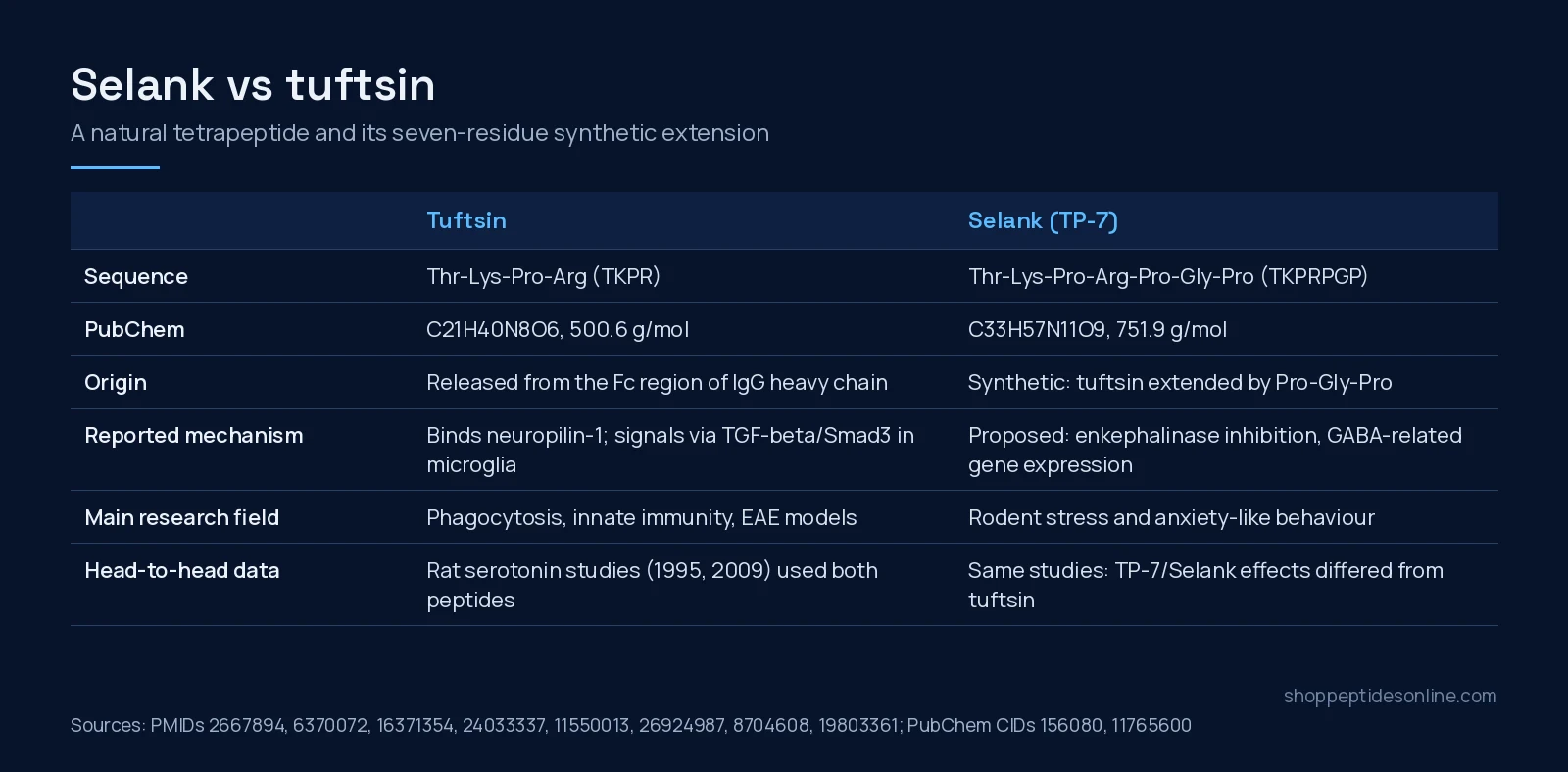
| Tuftsin | Selank (TP-7) | |
|---|---|---|
| Sequence | Thr-Lys-Pro-Arg (TKPR)[1] | Thr-Lys-Pro-Arg-Pro-Gly-Pro (TKPRPGP)[3] |
| Formula (PubChem) | C21H40N8O6, 500.6 g/mol (CID 156080) | C33H57N11O9, 751.9 g/mol (CID 11765600) |
| Origin | Released from IgG heavy chain by two enzymes, one in the spleen[2] | Synthetic analogue of tuftsin[9] |
| Reported mechanism | Binds neuropilin-1; signals through the TGF-beta pathway in microglia[5][6] | Proposed: inhibition of enkephalin-degrading enzymes; changes in GABA-related gene expression[7][8] |
| Main models | Phagocytes, microglia, mouse EAE[10][11] | Rat and mouse stress and behaviour models[12] |
| Breakdown products | — | TKPRP, TKP and the dipeptides RP and GP[13] |
| At SPO | Not sold | Selank 10mg |
Tuftsin: an antibody fragment that activates phagocytes
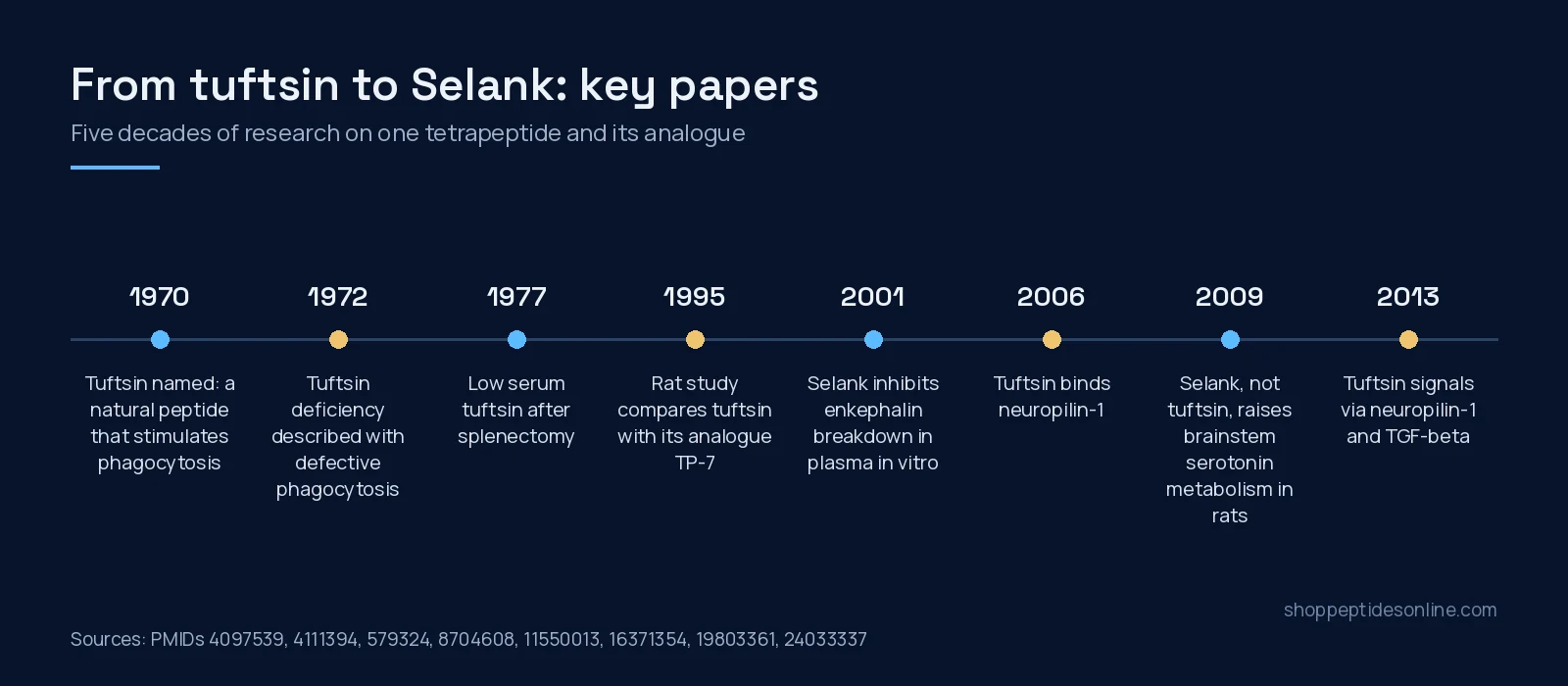
Tuftsin was named in 1970 as a natural phagocytosis-stimulating peptide[14]. Its discovery came from the kinetics of phagocytosis: the stimulating effect of a cytophilic gamma-globulin on neutrophils was short-lived, and a small oligopeptide turned out to carry it. The peptide was isolated, sequenced as Thr-Lys-Pro-Arg and synthesised[2].
Two enzymes free it from the parent antibody: one in the spleen that cuts after the arginine, and one on the outer surface of the phagocyte membrane that cuts before the threonine[2]. That spleen step explains a clinical observation from the 1970s. Serum tuftsin was much lower in people who had undergone traumatic or elective splenectomy, and it fell in the days after the operation in patients measured before and after[15]. A tuftsin deficiency syndrome with defective phagocytosis was also described[16], in which a mutant peptide, Thr-Glu-Pro-Arg, was isolated[2].
The receptor question stayed open for decades. In 2006, tuftsin was found to bind neuropilin-1 selectively and to block VEGF binding to it[5]. In 2013, the same line of work showed that tuftsin’s anti-inflammatory “M2” shift in microglia depends on neuropilin-1 and on canonical TGF-beta signalling, with more Smad3 phosphorylation and less Akt phosphorylation[6]. In mouse experimental autoimmune encephalomyelitis (EAE), tuftsin shifted microglia toward an anti-inflammatory phenotype and T cells toward Th2 and regulatory responses[10], and a 2019 EAE study linked tuftsin-induced microglial activity with remyelination[11].
Selank: tuftsin plus Pro-Gly-Pro
Selank was built on the tuftsin sequence and is described in its own literature as a synthetic tuftsin analogue[9]. Most of its research comes from Russian groups and uses rodent behaviour models:
- Stress behaviour. A comparison of ten tuftsin-family peptides and Selank in rats and mice, grouped by emotional reactivity, found antistress effects that depended on each peptide’s structure and its breakdown fragments[12].
- Enkephalin breakdown. In plasma in vitro, Selank inhibited the enzymatic hydrolysis of enkephalin in a dose-dependent way and was more potent than the peptidase inhibitors bacitracin and puromycin[7].
- GABA-related genes. In rat frontal cortex, Selank and GABA changed the expression of overlapping sets of neurotransmission genes within an hour, which the authors read as possible allosteric modulation of the GABA system[8].
- Immune genes. In mouse spleen, Selank and two of its fragments altered the expression of 34 of 84 inflammation-related genes, including Bcl6[9].
Tracer work with tritium-labelled peptides identified TKPRP, TKP and the dipeptides RP and GP as Selank’s main breakdown products[13]. So Selank is partly broken back down toward tuftsin-like fragments, and some effects attributed to it may come from those fragments[12].
When the two were tested together
Two rat studies give the only direct comparisons we found:
- 1995. In 95 rats with a neonatally depleted serotonin system, both tuftsin and TP-7 reduced stress perception, steadied exploratory behaviour and normalised brain serotonin. The anxiolytic and psychostimulant activity of TP-7 was more pronounced than that of tuftsin[3].
- 2009. In 87 rats pretreated with a serotonin-synthesis inhibitor, Selank increased serotonin metabolism in the brain stem 30 minutes after injection. Tuftsin did not change it there and lowered it in the neocortex[4].
Limits of the evidence
- Most Selank papers, including those cited here, come from Russian groups and rely on behavioural or gene-expression endpoints in rodents[12][8].
- Small Russian clinical studies have compared Selank with a benzodiazepine[17]. A 2021 US pharmacology review described Selank as a poorly studied Russian drug that is sold to US consumers as a dietary supplement[18].
- Tuftsin’s neuropilin-1 mechanism was worked out decades after its discovery, and the 2006 authors proposed that only “at least some” of its reported effects run through that receptor[5].
Which one fits which question?
- Phagocytosis, macrophage and microglial activation, neuropilin-1 signalling: tuftsin[6][10].
- Rodent stress-behaviour models, enkephalinase activity, GABA-related gene expression: Selank[7][8].
- Structure-activity work on the TKPR core: both, ideally with the breakdown fragments as extra arms[13][12].
Our Selank research page collects product details and the wider literature, and Selank vs Semax compares it with the other Russian heptapeptide. For the full catalogue, see our guide to buy peptides online in Canada.
Frequently asked questions
Is Selank the same as tuftsin?
No. Tuftsin is the natural tetrapeptide Thr-Lys-Pro-Arg. Selank is a synthetic heptapeptide that adds Pro-Gly-Pro to that sequence, giving Thr-Lys-Pro-Arg-Pro-Gly-Pro.
Where does tuftsin come from?
It is released from the Fc region of the immunoglobulin G heavy chain by two enzymes, one in the spleen and one on the phagocyte cell membrane. Serum levels were found to be low after splenectomy.
What receptor does tuftsin use?
Tuftsin binds neuropilin-1. In microglia, its anti-inflammatory shift depends on neuropilin-1 and the canonical TGF-beta pathway.
Have Selank and tuftsin been compared directly?
Yes, in two small rat studies of serotonin-depleted animals. In 1995 the analogue TP-7 had more pronounced effects than tuftsin, and in 2009 Selank raised brainstem serotonin metabolism while tuftsin did not.
What does Selank break down into?
Tracer studies identified the pentapeptide TKPRP, the tripeptide TKP and the dipeptides RP and GP as its main breakdown products. SPO lists Selank 10mg for laboratory research only.
References
- Fridkin M, Najjar VA (1989). Tuftsin: its chemistry, biology, and clinical potential. Crit Rev Biochem Mol Biol. PMID: 2667894. doi: 10.3109/10409238909082550.
- Najjar VA (1983). Tuftsin, a natural activator of phagocyte cells: an overview. Ann N Y Acad Sci. PMID: 6370072. doi: 10.1111/j.1749-6632.1983.tb37086.x.
- Seredenin SB, Semenova TP, Kozlovskaia MM et al. (1995). [The characteristics of the anxiolytic action of taftsin and its analog TP-7 on behavior and serotonin metabolism in the brain of rats with chronic deprivation of serotoninergic system activity]. Eksp Klin Farmakol. PMID: 8704608.
- Semenova TP, kozlovskiĭ II, Zakharova NM et al. (2009). [Comparison of the effects of selank and tuftsin on the metabolism of serotonin in the brain of rats pretreated with PCPA]. Eksp Klin Farmakol. PMID: 19803361.
- von Wronski MA, Raju N, Pillai R et al. (2006). Tuftsin binds neuropilin-1 through a sequence similar to that encoded by exon 8 of vascular endothelial growth factor. J Biol Chem. PMID: 16371354. doi: 10.1074/jbc.M511941200.
- Nissen JC, Selwood DL, Tsirka SE (2013). Tuftsin signals through its receptor neuropilin-1 via the transforming growth factor beta pathway. J Neurochem. PMID: 24033337. doi: 10.1111/jnc.12404.
- Zozulya AA, Kost NV, Yu Sokolov O et al. (2001). The inhibitory effect of Selank on enkephalin-degrading enzymes as a possible mechanism of its anxiolytic activity. Bull Exp Biol Med. PMID: 11550013. doi: 10.1023/a:1017979514274.
- Volkova A, Shadrina M, Kolomin T et al. (2016). Selank Administration Affects the Expression of Some Genes Involved in GABAergic Neurotransmission. Front Pharmacol. PMID: 26924987. doi: 10.3389/fphar.2016.00031.
- Kolomin T, Shadrina M, Andreeva L et al. (2011). Expression of inflammation-related genes in mouse spleen under tuftsin analog Selank. Regul Pept. PMID: 21609736. doi: 10.1016/j.regpep.2011.05.001.
- Wu M, Nissen JC, Chen EI et al. (2012). Tuftsin promotes an anti-inflammatory switch and attenuates symptoms in experimental autoimmune encephalomyelitis. PLoS One. PMID: 22529957. doi: 10.1371/journal.pone.0034933.
- Bao Z, Hao J, Li Y et al. (2019). Promotion of microglial phagocytosis by tuftsin stimulates remyelination in experimental autoimmune encephalomyelitis. Mol Med Rep. PMID: 31702807. doi: 10.3892/mmr.2019.10788.
- Kozlovskaya MM, Kozlovskii II, Val’dman EA et al. (2003). Selank and short peptides of the tuftsin family in the regulation of adaptive behavior in stress. Neurosci Behav Physiol. PMID: 14969422. doi: 10.1023/a:1025988519919.
- Zolotarev IuA, Dadaian AK, Dolotov OV et al. (2006). [Evenly tritium-labeled peptides and their in vivo and in vitro biodegradation]. Bioorg Khim. PMID: 16637290.
- Najjar VA, Nishioka K (1970). “Tuftsin”: a natural phagocytosis stimulating peptide. Nature. PMID: 4097539. doi: 10.1038/228672a0.
- Spirer Z, Zakuth V, Diamant S et al. (1977). Decreased tuftsin concentrations in patients who have undergone splenectomy. Br Med J. PMID: 579324. doi: 10.1136/bmj.2.6102.1574.
- Constantopoulos A, Najjar VA, Smith JW (1972). Tuftsin deficiency: a new syndrome with defective phagocytosis. J Pediatr. PMID: 4111394. doi: 10.1016/s0022-3476(72)80051-9.
- Zozulia AA, Neznamov GG, Siuniakov TS et al. (2008). [Efficacy and possible mechanisms of action of a new peptide anxiolytic selank in the therapy of generalized anxiety disorders and neurasthenia]. Zh Nevrol Psikhiatr Im S S Korsakova. PMID: 18454096.
- Doyno CR, White CM (2021). Sedative-Hypnotic Agents That Impact Gamma-Aminobutyric Acid Receptors: Focus on Flunitrazepam, Gamma-Hydroxybutyric Acid, Phenibut, and Selank. J Clin Pharmacol. PMID: 34396551. doi: 10.1002/jcph.1922.