For laboratory research only. Not for human or animal use. This article gives no dosing, administration or therapeutic advice.
Short answer: GIP and GLP-1 are the two incretin hormones: gut peptides released within minutes of a meal that amplify glucose-dependent insulin secretion through two related but distinct receptors[1]. GIP is a 42-residue peptide from endocrine cells of the small intestine; GLP-1 is a 30–31-residue fragment of proglucagon made in intestinal L cells[2][3][4]. They part ways on glucagon, on the stomach and on fat tissue[5][6][1]. Tirzepatide is a single molecule that activates both receptors, but not equally: it engages the GIP receptor more and acts at the GLP-1 receptor in a biased way[7].
Side by side
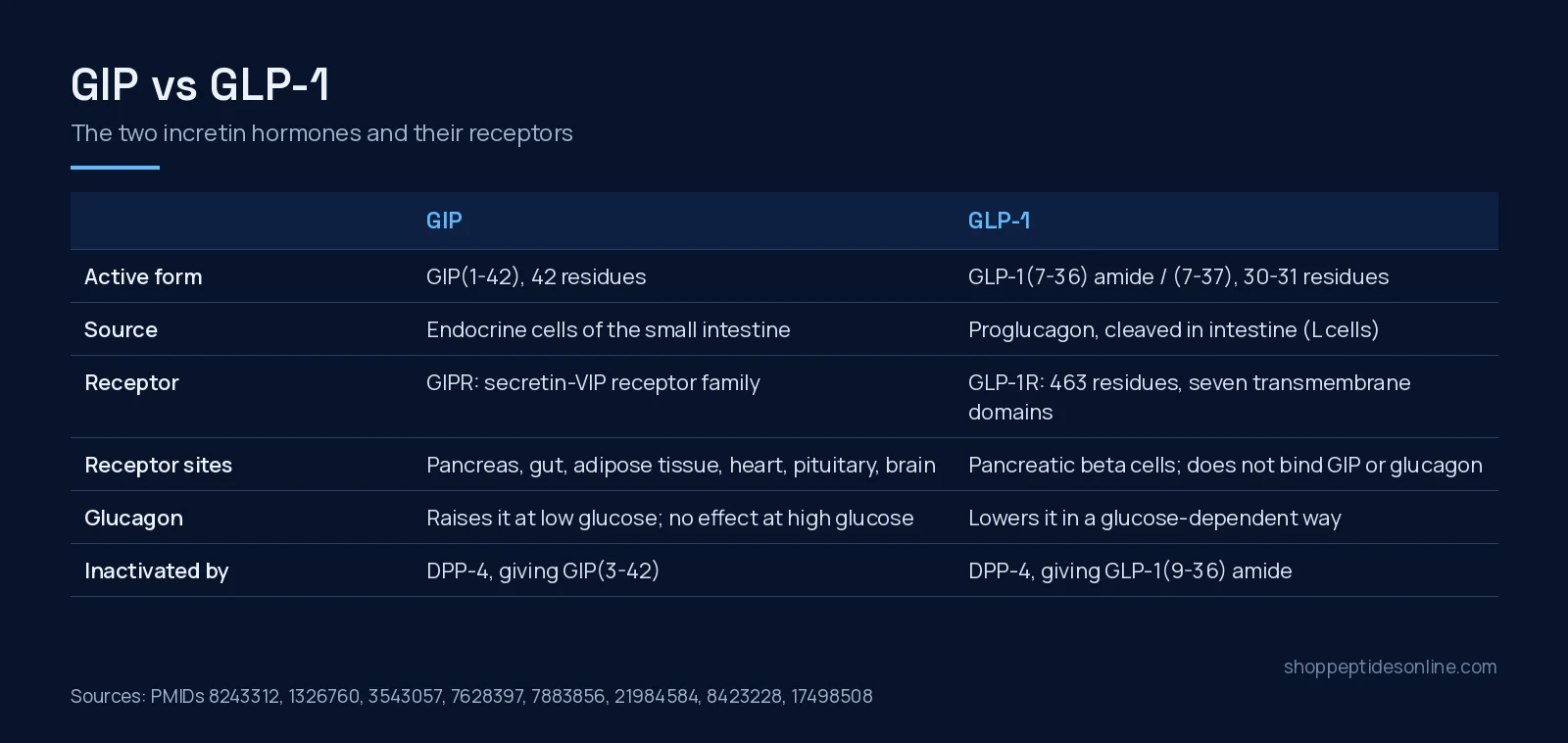
| GIP | GLP-1 | |
|---|---|---|
| Full name | Gastric inhibitory polypeptide, now usually glucose-dependent insulinotropic polypeptide[8] | Glucagon-like peptide-1[3] |
| Active form | GIP(1-42)[2] | GLP-1(7-36) amide and GLP-1(7-37)[9][3] |
| Made in | Endocrine cells of the small intestine[8] | Intestinal L cells, from proglucagon[4] |
| Receptor | GIPR, a secretin–VIP family G-protein-coupled receptor[8] | GLP-1R, 463 residues with seven transmembrane domains[4] |
| Effect on glucagon | Raises it at low and normal glucose; no effect at high glucose[5] | Lowers it[6] |
| Inactivated by | DPP-4, giving GIP(3-42)[2] | DPP-4, giving GLP-1(9-36) amide[10][2] |
| At SPO | Neither native hormone is sold. Dual agonist: tirzepatide 20mg | |
Two hormones, found 16 years apart
GIP was named for the wrong job. It was isolated as a polypeptide that inhibits gastric acid secretion, with its complete amino acid sequence reported in 1971[11][12]. Two years later it was shown to stimulate insulin secretion in people[13], and the abbreviation was kept with a new meaning: glucose-dependent insulinotropic polypeptide[8].
GLP-1 came out of the glucagon gene. Proglucagon contains glucagon plus further glucagon-like peptides that are released in both pancreas and intestine. In 1987, GLP-1(7-37) proved a potent insulin secretagogue in the perfused rat pancreas, while the longer GLP-1(1-37) had no effect even at far higher concentrations[3]. The same year, a truncated GLP-1 (proglucagon 78-107) isolated from pig intestine increased insulin secretion from the perfused pig pancreas[9].
Two receptors from the same family
The GLP-1 receptor was cloned in 1992 from a rat islet library. It binds GLP-1 with high affinity, couples to adenylate cyclase, and does not bind glucagon, GIP, VIP or secretin[4]. The GIP receptor followed in 1993. It belongs to the secretin–VIP receptor family, raises cAMP and intracellular calcium, and its mRNA was found in pancreas, gut, adipose tissue, heart, pituitary, adrenal cortex and several brain regions, but not in kidney, spleen or liver[8].
That tissue map explains much of what follows. Both receptors act on beta cells, but GIP also acts directly on fat tissue, and GLP-1 slows gastric emptying and suppresses glucagon[1].
Where the two hormones differ
- Glucagon. In healthy men, GIP raised glucagon during low and normal blood glucose, where it did little for insulin, and left glucagon unchanged at high glucose while strongly increasing insulin secretion[5]. GLP-1 lowered glucagon in both healthy and type 2 diabetic subjects in a 1993 comparison; GIP did not[6].
- Type 2 diabetes. In that same study, GIP’s maximum insulin effect in people with mild type 2 diabetes was markedly reduced, while GLP-1 kept much of its insulinotropic activity[6].
- The stomach. In healthy volunteers, GLP-1 slowed gastric emptying of a liquid meal in a dose-dependent way, and the authors concluded this effect outweighed its insulin effect after the meal[14].
- Fat tissue. Mice lacking the GIP receptor were protected from obesity and insulin resistance on a high-fat diet and preferentially used fat as fuel[15].
What they share: a short life in plasma
Both hormones are cut by the same enzyme. DPP-4 removes two N-terminal residues, producing the inactive GIP(3-42) and GLP-1(9-36) amide; a DPP-4 inhibitor blocked the cleavage in rat serum[2]. In human plasma in vitro, intact GLP-1(7-36) amide had a half-life of about 20 minutes, and DPP-4 inhibitors or cold prevented the breakdown completely[10].
Why tirzepatide made the GIP receptor interesting again
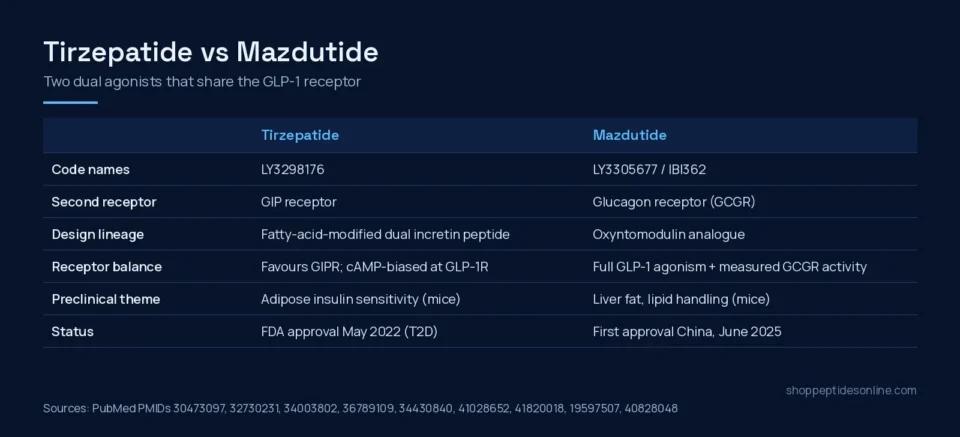
After the 1993 finding that GIP loses much of its insulin effect in type 2 diabetes, and the 2002 knockout mice, adding GIP receptor agonism to a metabolic drug was not an obvious step[6][15]. Tirzepatide (LY3298176) was developed to test whether GIP action adds to GLP-1 receptor agonism. It is a fatty-acid-modified peptide that activated both receptors in cell assays[16].
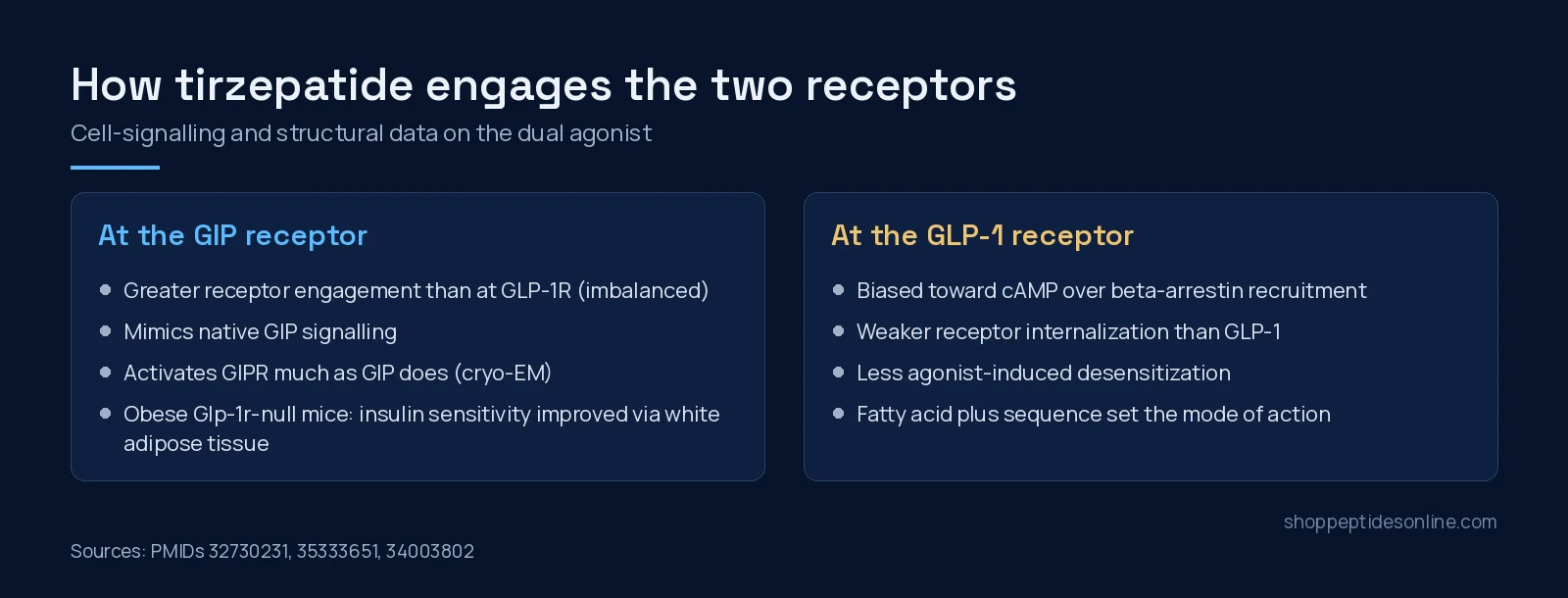
- Imbalanced. Receptor-occupancy modelling showed greater engagement of the GIP receptor than the GLP-1 receptor[7].
- Biased at GLP-1R. Tirzepatide mimics native GIP at the GIP receptor. At the GLP-1 receptor, it favours cAMP over beta-arrestin recruitment and drives less receptor internalization than GLP-1[7].
- Structure. Cryo-electron microscopy showed tirzepatide activating GIPR much as GIP does but GLP-1R quite differently, with less desensitization; the fatty-acid modification and sequence together set this behaviour[17].
- The GIP arm in mice. In obese mice lacking the GLP-1 receptor, tirzepatide still improved insulin sensitivity through glucose disposal in white adipose tissue, and a long-acting GIPR agonist did the same[18].
Regulatory status, stated for context: tirzepatide was approved by the US Food and Drug Administration in May 2022 for patients with type 2 diabetes[19].
Which one fits which question?
- Glucagon regulation across glucose levels, adipose tissue biology: GIP and GIPR[5][15].
- Gastric emptying and glucagon suppression: GLP-1 and GLP-1R[14][6].
- Peptide stability and DPP-4 resistance: both native hormones, with their DPP-4 products as controls[2][10].
- Receptor bias and dual agonism: tirzepatide, compared with each native hormone[7][17].
Our tirzepatide research page covers the product, and tirzepatide vs semaglutide vs retatrutide sets the dual agonist beside single and triple agonists. For the full catalogue, see our guide to buy peptides online in Canada.
Frequently asked questions
What is the difference between GIP and GLP-1?
Both are incretin hormones from the gut that amplify glucose-dependent insulin secretion. GIP is a 42-residue peptide that also acts on fat tissue and can raise glucagon at low glucose; GLP-1 comes from proglucagon, lowers glucagon and slows gastric emptying.
Do GIP and GLP-1 share a receptor?
No. Each has its own G-protein-coupled receptor. The cloned GLP-1 receptor did not bind GIP, glucagon, VIP or secretin, and the GIP receptor belongs to the secretin–VIP receptor family.
Why are GIP and GLP-1 so short-lived?
The enzyme DPP-4 removes two N-terminal residues from each, giving the inactive GIP(3-42) and GLP-1(9-36) amide. Intact GLP-1 had a half-life of about 20 minutes in human plasma in vitro.
Does tirzepatide activate both receptors equally?
No. Receptor-occupancy modelling found greater engagement of the GIP receptor, and at the GLP-1 receptor tirzepatide favours cAMP signalling over beta-arrestin recruitment.
Does Shop Peptides Online sell GIP or GLP-1?
SPO does not sell the native hormones. Tirzepatide is listed for laboratory research only, not for human or animal use.
References
- Baggio LL, Drucker DJ (2007). Biology of incretins: GLP-1 and GIP. Gastroenterology. PMID: 17498508. doi: 10.1053/j.gastro.2007.03.054.
- Kieffer TJ, McIntosh CH, Pederson RA (1995). Degradation of glucose-dependent insulinotropic polypeptide and truncated glucagon-like peptide 1 in vitro and in vivo by dipeptidyl peptidase IV. Endocrinology. PMID: 7628397. doi: 10.1210/endo.136.8.7628397.
- Mojsov S, Weir GC, Habener JF (1987). Insulinotropin: glucagon-like peptide I (7-37) co-encoded in the glucagon gene is a potent stimulator of insulin release in the perfused rat pancreas. J Clin Invest. PMID: 3543057. doi: 10.1172/JCI112855.
- Thorens B (1992). Expression cloning of the pancreatic beta cell receptor for the gluco-incretin hormone glucagon-like peptide 1. Proc Natl Acad Sci U S A. PMID: 1326760. doi: 10.1073/pnas.89.18.8641.
- Christensen M, Vedtofte L, Holst JJ et al. (2011). Glucose-dependent insulinotropic polypeptide: a bifunctional glucose-dependent regulator of glucagon and insulin secretion in humans. Diabetes. PMID: 21984584. doi: 10.2337/db11-0979.
- Nauck MA, Heimesaat MM, Orskov C et al. (1993). Preserved incretin activity of glucagon-like peptide 1 [7-36 amide] but not of synthetic human gastric inhibitory polypeptide in patients with type-2 diabetes mellitus. J Clin Invest. PMID: 8423228. doi: 10.1172/JCI116186.
- Willard FS, Douros JD, Gabe MB et al. (2020). Tirzepatide is an imbalanced and biased dual GIP and GLP-1 receptor agonist. JCI Insight. PMID: 32730231. doi: 10.1172/jci.insight.140532.
- Usdin TB, Mezey E, Button DC et al. (1993). Gastric inhibitory polypeptide receptor, a member of the secretin-vasoactive intestinal peptide receptor family, is widely distributed in peripheral organs and the brain. Endocrinology. PMID: 8243312. doi: 10.1210/endo.133.6.8243312.
- Holst JJ, Orskov C, Nielsen OV et al. (1987). Truncated glucagon-like peptide I, an insulin-releasing hormone from the distal gut. FEBS Lett. PMID: 3542566. doi: 10.1016/0014-5793(87)81430-8.
- Deacon CF, Johnsen AH, Holst JJ (1995). Degradation of glucagon-like peptide-1 by human plasma in vitro yields an N-terminally truncated peptide that is a major endogenous metabolite in vivo. J Clin Endocrinol Metab. PMID: 7883856. doi: 10.1210/jcem.80.3.7883856.
- Brown JC, Dryburgh JR (1971). A gastric inhibitory polypeptide. II. The complete amino acid sequence. Can J Biochem. PMID: 5120249. doi: 10.1139/o71-122.
- Pederson RA, Brown JC (1972). Inhibition of histamine-, pentagastrin-, and insulin-stimulated canine gastric secretion by pure “gastric inhibitory polypeptide”. Gastroenterology. PMID: 4551806.
- Dupre J, Ross SA, Watson D et al. (1973). Stimulation of insulin secretion by gastric inhibitory polypeptide in man. J Clin Endocrinol Metab. PMID: 4749457. doi: 10.1210/jcem-37-5-826.
- Nauck MA, Niedereichholz U, Ettler R et al. (1997). Glucagon-like peptide 1 inhibition of gastric emptying outweighs its insulinotropic effects in healthy humans. Am J Physiol. PMID: 9374685. doi: 10.1152/ajpendo.1997.273.5.E981.
- Miyawaki K, Yamada Y, Ban N et al. (2002). Inhibition of gastric inhibitory polypeptide signaling prevents obesity. Nat Med. PMID: 12068290. doi: 10.1038/nm727.
- Coskun T, Sloop KW, Loghin C et al. (2018). LY3298176, a novel dual GIP and GLP-1 receptor agonist for the treatment of type 2 diabetes mellitus: From discovery to clinical proof of concept. Mol Metab. PMID: 30473097. doi: 10.1016/j.molmet.2018.09.009.
- Sun B, Willard FS, Feng D et al. (2022). Structural determinants of dual incretin receptor agonism by tirzepatide. Proc Natl Acad Sci U S A. PMID: 35333651. doi: 10.1073/pnas.2116506119.
- Samms RJ, Christe ME, Collins KA et al. (2021). GIPR agonism mediates weight-independent insulin sensitization by tirzepatide in obese mice. J Clin Invest. PMID: 34003802. doi: 10.1172/JCI146353.
- Mishra R, Raj R, Elshimy G et al. (2023). Adverse Events Related to Tirzepatide. J Endocr Soc. PMID: 36789109. doi: 10.1210/jendso/bvad016.