For laboratory research only. Not for human or animal use. This article gives no dosing, administration or therapeutic advice.
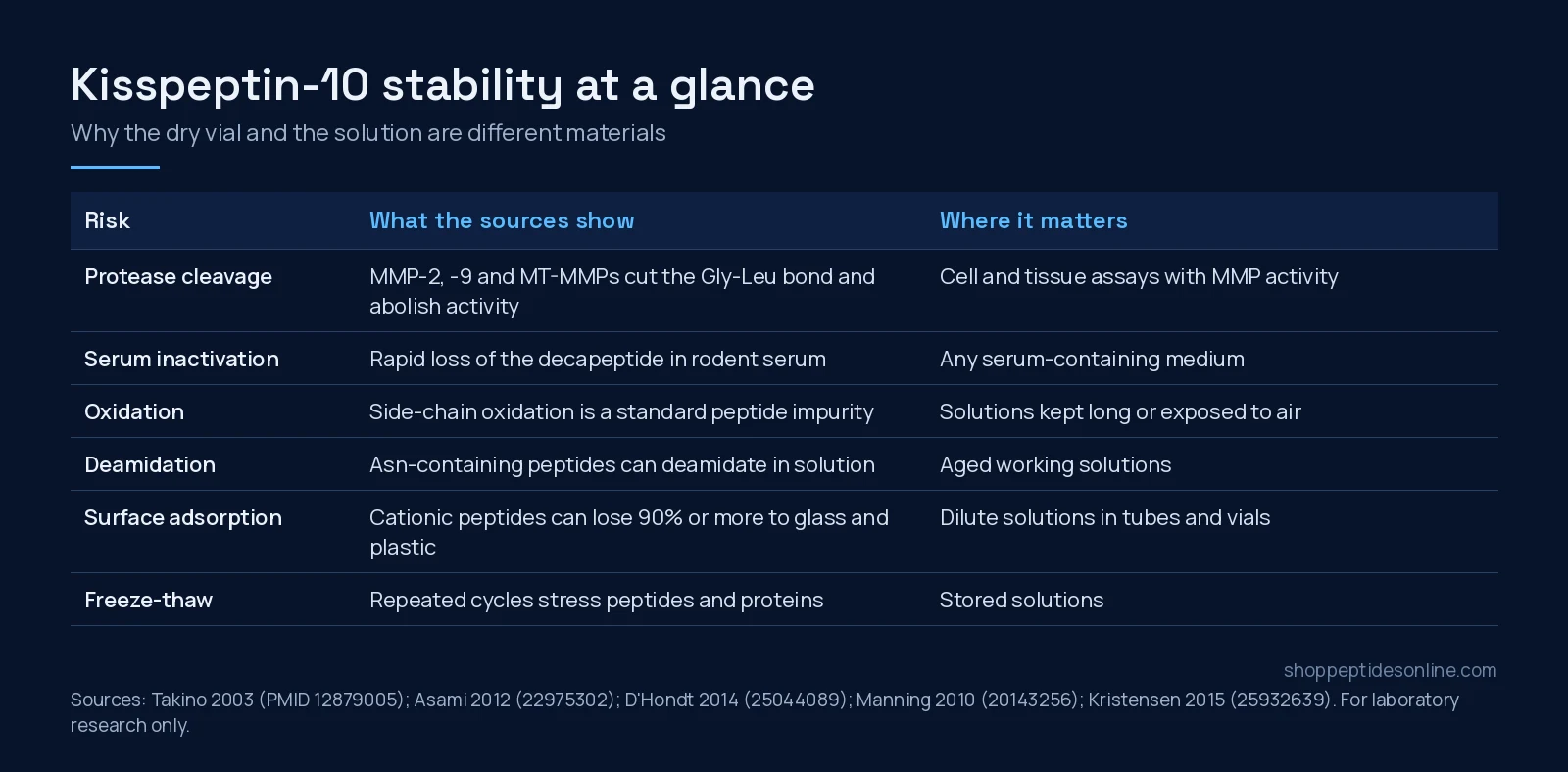
Short answer: Kisspeptin-10 is stable enough to ship and store as a dry powder, and much less so once it is in solution. The decapeptide is cleaved by matrix metalloproteinases at the Gly-Leu bond, which abolishes its activity[1], and it is rapidly inactivated in rodent serum[2]. In solution it is also exposed to oxidation, deamidation and loss to container walls[5][7]. This guide sets out what the literature says about each risk so you can plan laboratory handling. It gives no preparation steps or doses. If you are buying kisspeptin peptide in Canada for research, keep the supplier’s storage statement with the lot record and follow your own validated protocol.
What makes kisspeptin-10 fragile
Kisspeptin-10 is a ten-residue peptide, YNWNSFGLRF-NH2 (see the kisspeptin-10 research guide for its structure). Short linear peptides have no folded core to protect their peptide bonds, so they are open to enzymes in any biological medium. Two lines of evidence show this directly.
- MMP cleavage. Active MMP-2, MMP-9, MT1-MMP, MT3-MMP and MT5-MMP cleaved the Gly118-Leu119 bond of both full-length KiSS-1 and the metastin decapeptide, and digestion by MMP abolished its ligand activity[1].
- Serum instability. The N-terminally truncated decapeptide, metastin(45-54), binds the receptor more tightly than the 54-residue form but is rapidly inactivated in serum[2]. Analogues with azaglycine or D-amino-acid substitutions were designed to resist it[2][3].
A radiolabelled DOTA-kisspeptin-10 construct showed a blood half-life of 18 ± 3 minutes by micro-PET/CT in animals, and its authors called for analogues with proteolytic resistance[4]. For an in vitro experimenter the lesson is that every minute in serum-containing medium, or in tissue with MMP activity, changes the effective concentration.
Lyophilized powder vs solution
| Lyophilized powder | In solution | |
|---|---|---|
| Water | Removed; a freeze-dried peptide still holds some residual moisture[6] | Present; most chemical routes need water[6] |
| Main risks | Moisture uptake if the vial is opened cold or left unsealed | Oxidation, deamidation, hydrolysis, aggregation[6][5] |
| Container effects | Minor | Adsorption to glass and plastic can remove most of a dilute cationic peptide[7] |
| Freeze-thaw | Not applicable | Repeated cycles are a standard source of physical stress for stored solutions |
| Supplier statement | This site states up to 24 months at -20 °C for the sealed vial | Not stated; the researcher validates |
Manning’s review of protein and peptide stability describes the same split: chemical and physical instability are both much more limited in the dried state, and stabilisation in aqueous solution is a separate problem[6].
Chemical routes that matter for this sequence
The kisspeptin-10 sequence has tyrosine, tryptophan and two asparagines. Reviews of peptide impurities list oxidation of side chains and the degradation routes typical of peptides in solution[5]. Tryptophan and tyrosine are the residues usually named for oxidation. Asparagine can deamidate, and the rate depends on its neighbours. These changes can be small in mass, so they are checked by LC-MS rather than by HPLC purity alone. See HPLC purity vs mass spectrometry identity for how to read that evidence. A structure-activity study shows why a single residue change matters here: alanine at position 6 or 10 sharply reduced receptor activation[8].
Handling principles from the literature
- Keep the sealed vial in the supplier’s stated conditions, and record the date received and the lot number.
- Treat a solution as a different material from the powder, with its own shelf life that you establish, not assume.
- Avoid repeated freeze-thaw of solutions, as the supplier’s statement also advises.
- In assays, account for serum and MMP activity[1][2], and test whether the container surface is removing peptide[7].
- Confirm identity and purity of each lot with the COA before comparing results between lots.
Reconstitution and working protocols belong to the researcher and are not described here. The kisspeptin research page and the kisspeptin-10 10mg product page carry the storage statement for this vial, and the full catalogue is in our guide to buy peptides online in Canada.
Frequently asked questions
How is lyophilized kisspeptin-10 usually stored?
As a sealed dry powder at -20 °C, away from light and moisture. SPO states up to 24 months for the sealed vial. Follow the lot’s own storage statement.
Why is kisspeptin-10 less stable in solution?
Water allows oxidation, deamidation and hydrolysis, and proteases can cut it. MMPs cleave the Gly-Leu bond of the decapeptide and abolish its activity, and it is rapidly inactivated in rodent serum.
Can kisspeptin-10 stick to tubes and vials?
Cationic peptides have been shown to adsorb to glass and plastic, with 90% or more lost from dilute solutions in one study of other peptides. Test for surface loss in your own set-up.
Does repeated freeze-thaw matter?
Repeated freeze-thaw is a standard physical stress on stored peptide solutions, and the supplier’s storage statement advises against it. Whether a given solution tolerates it is for the researcher to test.
Is kisspeptin-10 from SPO for human use?
No. It is supplied for laboratory research only, not for human or animal use. This article gives no preparation or dosing advice.
References
- Takino T, Koshikawa N, Miyamori H et al. (2003). Cleavage of metastasis suppressor gene product KiSS-1 protein/metastin by matrix metalloproteinases. Oncogene. PMID: 12879005. doi: 10.1038/sj.onc.1206542.
- Asami T, Nishizawa N, Ishibashi Y et al. (2012). Serum stability of selected decapeptide agonists of KISS1R using pseudopeptides. Bioorg Med Chem Lett. PMID: 22975302. doi: 10.1016/j.bmcl.2012.08.069.
- Asami T, Nishizawa N, Matsui H et al. (2013). Design, synthesis, and biological evaluation of novel investigational nonapeptide KISS1R agonists with testosterone-suppressive activity. J Med Chem. PMID: 24047141. doi: 10.1021/jm401056w.
- Kleynhans J, Reeve R, Driver CHS et al. (2025). Synthesis and characterisation of DOTA-kisspeptin-10 as a potential gallium-68/lutetium-177 pan-tumour radiopharmaceutical. J Neuroendocrinol. PMID: 39775975. doi: 10.1111/jne.13487.
- D’Hondt M, Bracke N, Taevernier L et al. (2014). Related impurities in peptide medicines. J Pharm Biomed Anal. PMID: 25044089. doi: 10.1016/j.jpba.2014.06.012.
- Manning MC, Chou DK, Murphy BM et al. (2010). Stability of protein pharmaceuticals: an update. Pharm Res. PMID: 20143256. doi: 10.1007/s11095-009-0045-6.
- Kristensen K, Henriksen JR, Andresen TL (2015). Adsorption of cationic peptides to solid surfaces of glass and plastic. PLoS One. PMID: 25932639. doi: 10.1371/journal.pone.0122419.
- Gutiérrez-Pascual E, Leprince J, Martínez-Fuentes AJ et al. (2009). In vivo and in vitro structure-activity relationships and structural conformation of Kisspeptin-10-related peptides. Mol Pharmacol. PMID: 19389922. doi: 10.1124/mol.108.053751.
- Kotani M, Detheux M, Vandenbogaerde A et al. (2001). The metastasis suppressor gene KiSS-1 encodes kisspeptins, the natural ligands of the orphan G protein-coupled receptor GPR54. J Biol Chem. PMID: 11457843. doi: 10.1074/jbc.M104847200.