For laboratory research only. Not for human or animal use. This article gives no dosing, administration or therapeutic advice.
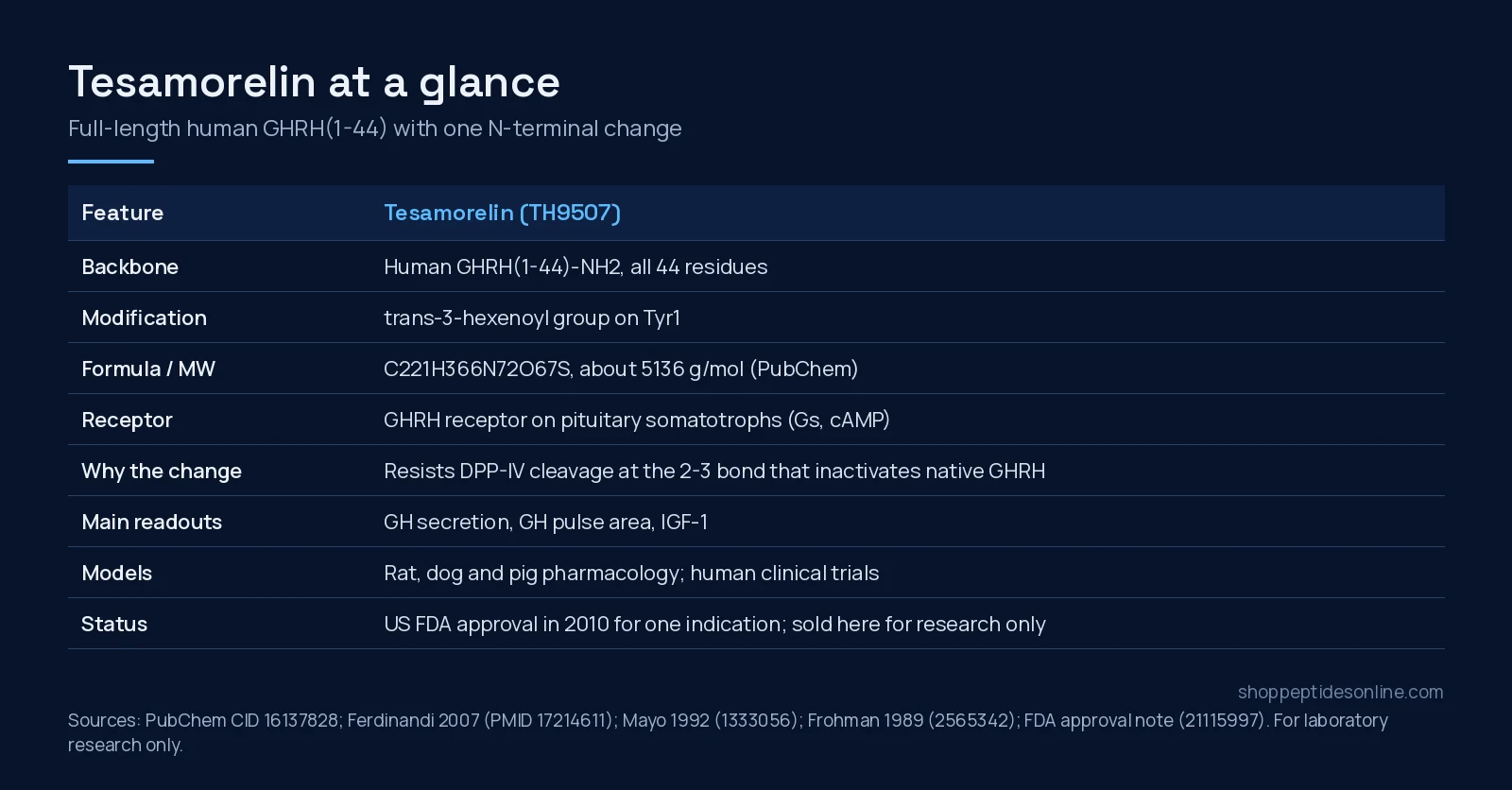
Short answer: Tesamorelin is the full 44-residue human growth hormone-releasing hormone, GHRH(1-44)-NH2, with one change: a trans-3-hexenoyl group attached to the tyrosine at position 1[6]. Native GHRH is cut quickly in plasma by dipeptidyl peptidase-IV at the bond between residues 2 and 3[5]. The added group makes tesamorelin resistant to that enzyme, and in rat, dog and human plasma it degraded more slowly than the native peptide[6]. It acts on the pituitary GHRH receptor and raises growth hormone and IGF-1 in animal models[6]. In 2010 it became the first GHRH analogue approved by the US FDA for a specific indication[8]. This overview covers its structure, receptor, key studies and the models used. Labs sourcing tesamorelin peptide in Canada will also find notes on what to verify.
Where tesamorelin comes from
GHRH was isolated in 1982 from pancreatic tumours that caused acromegaly, because they made the hormone in large amounts[1][2]. The full-length human peptide has 44 residues and an amidated C-terminus. Its receptor was cloned ten years later: a seven-transmembrane, G protein-coupled receptor from the pituitary that bound GHRH with high affinity and raised intracellular cAMP[3].
The obstacle to using native GHRH as a research tool is its short life in plasma. In human plasma, HPLC showed the intact peptide disappearing with a half-life of about 17 minutes, replaced by a fragment that still reacted in immunoassays[4]. That fragment, GHRH(3-44), is formed by dipeptidyl peptidase-IV removing the first two residues[5]. Measuring by immunoassay alone therefore overstates how much active hormone is left.
One modification, full-length sequence
Tesamorelin (development code TH9507) keeps all 44 residues of human GHRH. The only change is the trans-3-hexenoyl group on Tyr1[6]. PubChem (CID 16137828) lists the formula C221H366N72O67S and a molecular weight of about 5136 g/mol. Research material is usually supplied as a salt, so the weight on a certificate can differ from this free-base figure.
| Native GHRH(1-44) | Tesamorelin | |
|---|---|---|
| Length | 44 residues[1] | 44 residues[6] |
| N-terminus | Free Tyr1 | trans-3-hexenoyl-Tyr1[6] |
| DPP-IV cleavage | Cut at the 2-3 bond[5] | Resistant[6] |
| Plasma degradation | Fast; intact peptide half-life about 17 min in human plasma in vitro[4] | Slower in rat, dog and human plasma[6] |
| Receptor | Pituitary GHRH receptor, cAMP signalling[3] | |
For how tesamorelin compares with shorter analogues built on GHRH(1-29), see tesamorelin vs sermorelin vs CJC-1295.
What the non-clinical studies showed
The non-clinical pharmacology package tested TH9507 in pigs, rats and dogs[6]. Plasma GH and IGF-1 rose markedly with repeated intravenous or subcutaneous exposure. In toxicity studies of up to four months, rats and dogs gained more body weight. Dogs showed a stronger anabolic effect and reversible findings in liver, kidney and blood counts. The authors linked these to sustained, above-normal GH and IGF-1 rather than to the peptide itself. The apparent elimination half-life in dogs was 21 to 45 minutes. A separate dog study looked at pulmonary delivery as an alternative route[14].
The clinical record, briefly
Most published human data on tesamorelin come from one population. A 26-week randomised trial enrolled 412 people with HIV and abdominal fat accumulation[10]. Later work used imaging to measure visceral and liver fat[11]. The FDA approved the drug in 2010 for reducing excess abdominal fat in HIV-associated lipodystrophy[8]. Reviews describe it as the first and only treatment for that indication at the time[9][7]. These are records of a regulated medicine studied under trial protocols. They are not claims about any research vial, and nothing here is advice on human use.
Study models and readouts
- Receptor assays: cells expressing the GHRH receptor, read by cAMP[3].
- Stability work: plasma incubations analysed by HPLC, not immunoassay alone, so DPP-IV fragments are not counted as intact peptide[4][5].
- Animal pharmacology: GH and IGF-1 in rats, dogs and pigs[6].
- Analytical detection: anti-doping laboratories have mapped tesamorelin’s in vitro metabolites and built LC-MS/MS methods to detect it in urine[13].
What to verify on a research lot
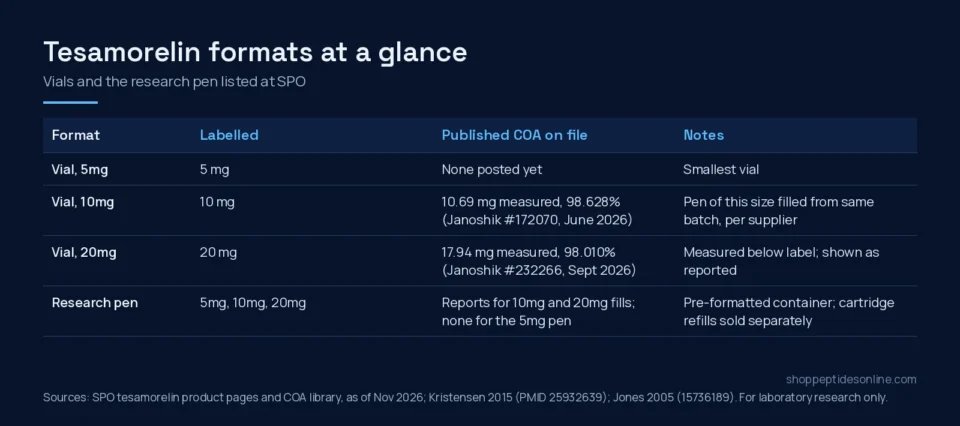
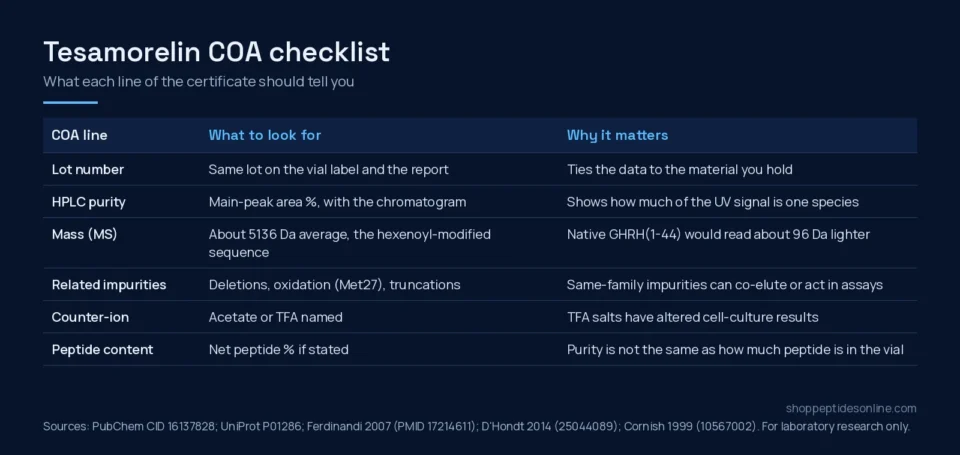
Because tesamorelin is a 44-residue peptide with one modified residue, identity by mass spectrometry matters as much as HPLC purity. The mass should match the hexenoyl-modified sequence, not native GHRH. Our tesamorelin research page lists the formats, and you can order the tesamorelin 10mg vial for laboratory work. For the rest of the catalogue, see our guide to buy peptides online in Canada.
Frequently asked questions
What is tesamorelin?
Tesamorelin is a synthetic analogue of human growth hormone-releasing hormone. It keeps all 44 residues of GHRH(1-44)-NH2 and adds a trans-3-hexenoyl group to the tyrosine at position 1.
Why was tesamorelin modified at Tyr1?
Native GHRH is cut by dipeptidyl peptidase-IV between residues 2 and 3, which inactivates it. The trans-3-hexenoyl group makes tesamorelin resistant to that enzyme and slows its breakdown in plasma.
How does tesamorelin differ from sermorelin?
Sermorelin is the shorter GHRH(1-29) fragment with no N-terminal modification. Tesamorelin is the full 44-residue sequence with the hexenoyl group.
Which receptor does tesamorelin act on?
It acts on the GHRH receptor on pituitary somatotrophs, a G protein-coupled receptor that signals through cAMP. GH and then IGF-1 rise downstream.
Is tesamorelin from Shop Peptides Online for human use?
No. SPO supplies tesamorelin in Canada for laboratory research only. It is not for human or animal use, and this article gives no dosing advice.
References
- Guillemin R, Brazeau P, Böhlen P et al. (1982). Growth hormone-releasing factor from a human pancreatic tumor that caused acromegaly. Science. PMID: 6812220. doi: 10.1126/science.6812220.
- Rivier J, Spiess J, Thorner M et al. (1982). Characterization of a growth hormone-releasing factor from a human pancreatic islet tumour. Nature. PMID: 6292724. doi: 10.1038/300276a0.
- Mayo KE (1992). Molecular cloning and expression of a pituitary-specific receptor for growth hormone-releasing hormone. Mol Endocrinol. PMID: 1333056. doi: 10.1210/mend.6.10.1333056.
- Frohman LA, Downs TR, Williams TC et al. (1986). Rapid enzymatic degradation of growth hormone-releasing hormone by plasma in vitro and in vivo to a biologically inactive product cleaved at the NH2 terminus. J Clin Invest. PMID: 3093533. doi: 10.1172/JCI112679.
- Frohman LA, Downs TR, Heimer EP et al. (1989). Dipeptidylpeptidase IV and trypsin-like enzymatic degradation of human growth hormone-releasing hormone in plasma. J Clin Invest. PMID: 2565342. doi: 10.1172/JCI114049.
- Ferdinandi ES, Brazeau P, High K et al. (2007). Non-clinical pharmacology and safety evaluation of TH9507, a human growth hormone-releasing factor analogue. Basic Clin Pharmacol Toxicol. PMID: 17214611. doi: 10.1111/j.1742-7843.2007.00008.x.
- Wang Y, Tomlinson B (2009). Tesamorelin, a human growth hormone releasing factor analogue. Expert Opin Investig Drugs. PMID: 19243281. doi: 10.1517/13543780802707658.
- Traynor K (2010). FDA approves tesamorelin for HIV-related lipodystrophy. Am J Health Syst Pharm. PMID: 21115997. doi: 10.2146/news100082.
- Dhillon S (2011). Tesamorelin: a review of its use in the management of HIV-associated lipodystrophy. Drugs. PMID: 21668043. doi: 10.2165/11202240-000000000-00000.
- Falutz J, Allas S, Blot K et al. (2007). Metabolic effects of a growth hormone-releasing factor in patients with HIV. N Engl J Med. PMID: 18057338. doi: 10.1056/NEJMoa072375.
- Stanley TL, Feldpausch MN, Oh J et al. (2014). Effect of tesamorelin on visceral fat and liver fat in HIV-infected patients with abdominal fat accumulation: a randomized clinical trial. JAMA. PMID: 25038357. doi: 10.1001/jama.2014.8334.
- Stanley TL, Chen CY, Branch KL et al. (2011). Effects of a growth hormone-releasing hormone analog on endogenous GH pulsatility and insulin sensitivity in healthy men. J Clin Endocrinol Metab. PMID: 20943777. doi: 10.1210/jc.2010-1587.
- Memdouh S, Gavrilović I, Ng K et al. (2021). Advances in the detection of growth hormone releasing hormone synthetic analogs. Drug Test Anal. PMID: 34665524. doi: 10.1002/dta.3183.
- Jansen M, Darby I, Abribat T et al. (2004). Pulmonary delivery of TH9507, a growth hormone releasing factor analogue, in the dog. Int J Pharm. PMID: 15113616. doi: 10.1016/j.ijpharm.2004.02.012.