
Your cart is currently empty!.
You may check out all the available products and buy some in the shop.
Continue ShoppingCompare Tesamorelin research listings by strength, format, current price, stock and batch documentation — then read what this GHRH analogue is, how it was developed, and what the animal pharmacology and the registered human trials of the approved drug actually measured, with references. Shop Peptides Online carries Tesamorelin in 5mg, 10mg and 20mg vials and in pen format.
For laboratory research use only. Not for human consumption. Shop Peptides Online does not provide dosing or administration guidance.
Tesamorelin in 5mg, 10mg and 20mg vials.


Tesamorelin in pen format. Strength options and details are on the Tesamorelin pen page.
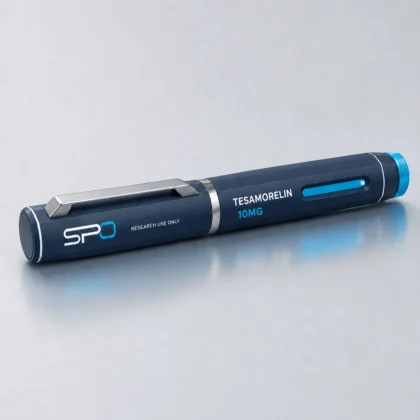
Bacteriostatic water, pen needles and alcohol pads, listed separately.
Choose the format (vial or pen) and strength, then check the current price, stock status and COA shown on that listing. Vials and pens are separate products, so confirm the exact item in your cart before checkout.
Available COAs for Tesamorelin are shown on the product page and in the COA library. Match the product name, strength and batch to the document before relying on it.
Tesamorelin (development code TH9507; brand name Egrifta) is a synthetic 44-amino-acid peptide built on the sequence of human growth hormone-releasing hormone, GHRH(1–44)-NH2. One change separates it from the native hormone: a trans-3-hexenoyl group attached to the N-terminal tyrosine, which in the original pharmacology work made the peptide resistant to inactivation by the enzyme dipeptidyl peptidase-IV[1]. Unlike most peptides sold for research, tesamorelin is also an approved prescription drug: the US FDA approved it in November 2010 for one narrow indication, the reduction of excess abdominal fat in HIV-infected patients with lipodystrophy[8, 9]. The vials listed on this page are research-grade material for in-vitro and preclinical laboratory work only. They are not the approved drug, and nothing reported below about the drug in patients transfers to them.
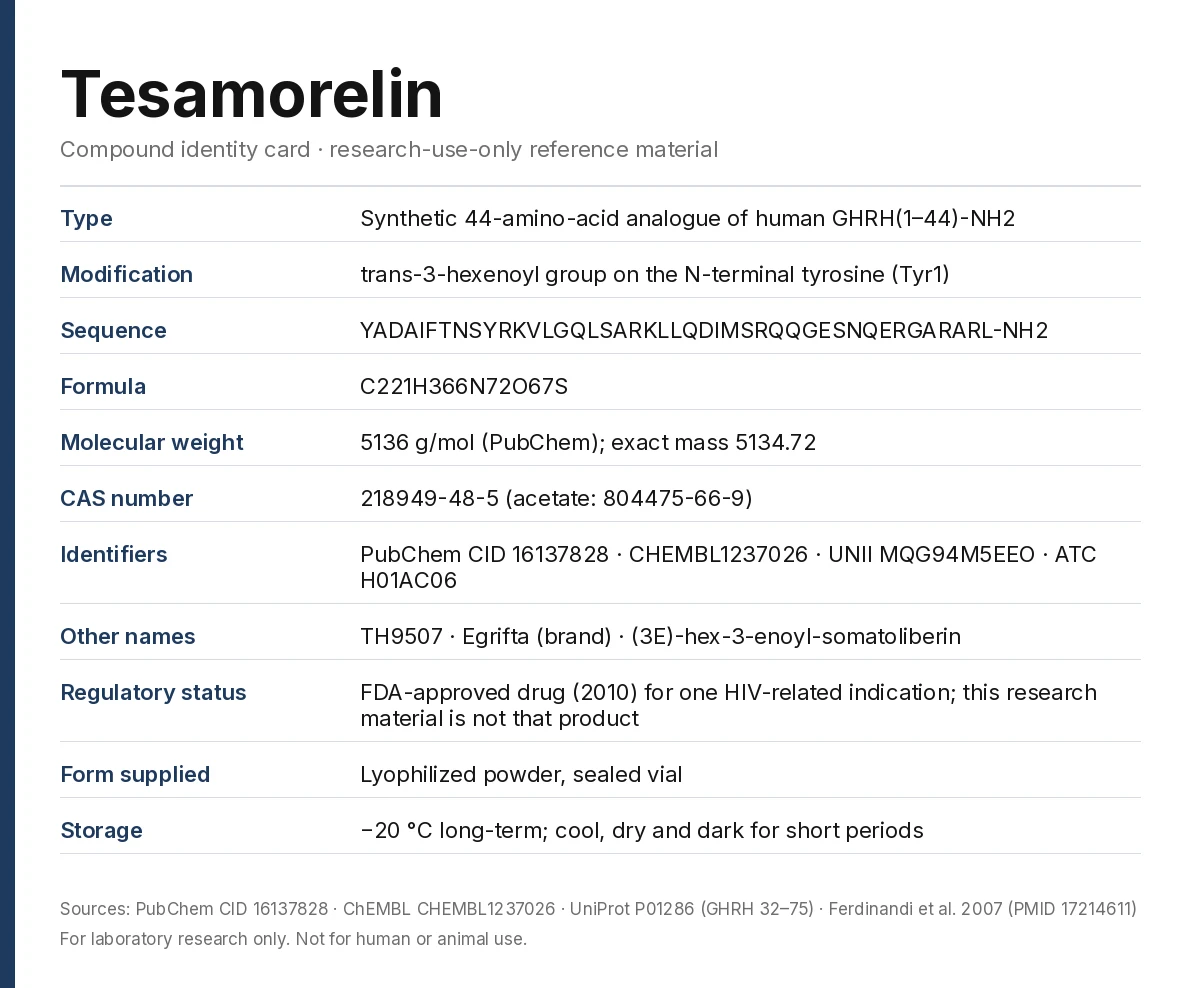
Native GHRH is released by the hypothalamus and acts on the pituitary to trigger growth hormone (GH) secretion. It is cleared quickly in plasma, partly because dipeptidyl peptidase-IV clips its first two residues. TH9507 was designed to slow that step. In the non-clinical evaluation published in 2007, the hexenoyl-modified peptide degraded more slowly than natural hGRF(1–44)NH2 in rat, dog and human plasma in vitro, and its elimination from plasma after injection was prolonged in vivo[1]. The compound was developed by the Montréal company Theratechnologies; a 2006 drug-evaluation review recorded Phase III trials under way in HIV-associated lipodystrophy and Phase II programmes in sleep maintenance insomnia, hip-fracture recovery, chronic obstructive pulmonary disease and immune dysfunction[3]. Of those, only the HIV indication reached approval[8, 4].
A 2004 dog study, the earliest tesamorelin paper indexed in PubMed, tested whether the peptide could be delivered by inhalation: intratracheal dry powder gave 41% of the bioavailability of a subcutaneous dose, with a terminal half-life of 39 minutes versus 26 minutes subcutaneously[2]. The inhaled route was not pursued into the approved product.
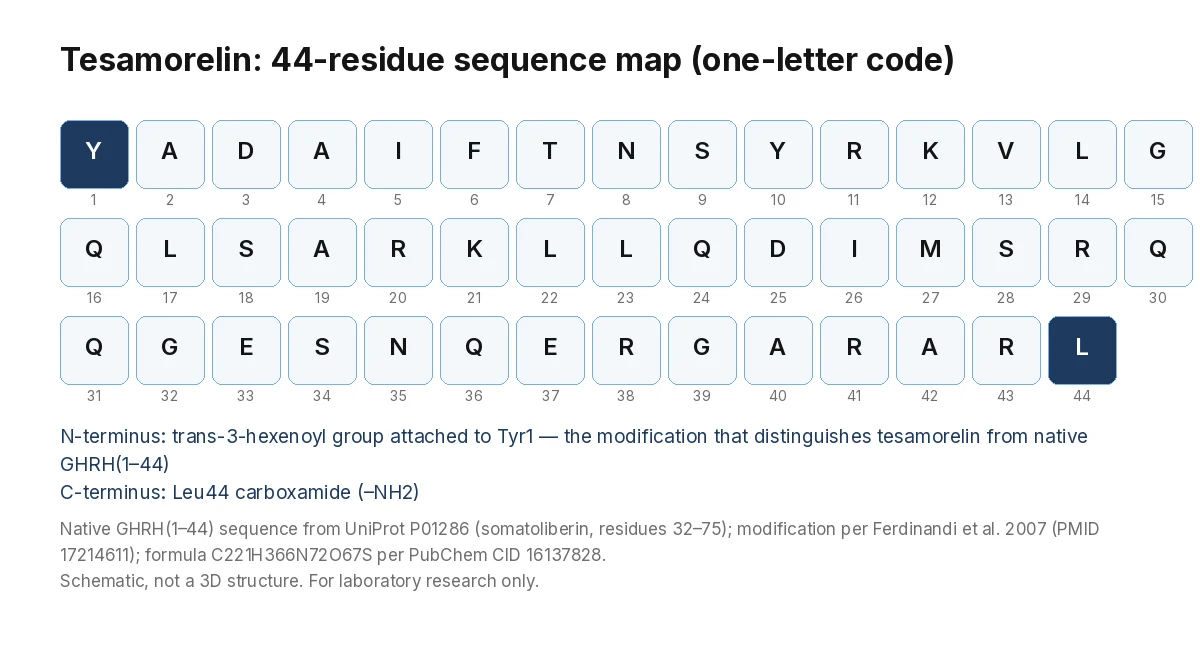
| Property | Value | Source |
|---|---|---|
| Name | Tesamorelin (INN, USAN); TH9507; Egrifta | PubChem synonyms; ChEMBL |
| Type | Synthetic analogue of human GHRH(1–44)-NH2 with N-terminal trans-3-hexenoyl | Ferdinandi et al. 2007[1] |
| Length | 44 amino acids | Jansen et al. 2004[2] |
| Molecular formula | C221H366N72O67S | PubChem CID 16137828 |
| Molecular weight | 5136 g/mol (exact mass 5134.7234) | PubChem |
| CAS | 218949-48-5 (free peptide); 804475-66-9 (acetate) | PubChem synonyms |
| ChEMBL | CHEMBL1237026 — max phase 4, first approval 2010 | ChEMBL (EMBL-EBI) |
| Other identifiers | UNII MQG94M5EEO; ATC H01AC06; ChEBI 63626 | PubChem synonyms |
PubChem and ChEMBL agree on the identity and formula; ChEMBL classes the molecule as a protein and does not publish a separate molecular weight, so the single figure above is PubChem’s.
The 2007 non-clinical package is the main preclinical source. After daily intravenous or subcutaneous injections at doses up to 600 µg/kg, plasma GH and insulin-like growth factor-1 (IGF-1) rose markedly in pigs, rats and dogs. Sub-chronic toxicity studies of up to four months in rats and dogs showed a significant but not dose-related increase in body-weight gain. Dogs showed a more pronounced anabolic response than rats and more evident, reversible adverse findings (liver and kidney changes, anaemia, clinical-chemistry and organ-weight changes), which the authors attributed to sustained supraphysiological GH and IGF-1 rather than to the peptide itself. The apparent elimination half-life in dogs was 21–45 minutes[1]. The dog inhalation study measured a subcutaneous half-life of about 26 minutes[2].
Tesamorelin acts as a secretagogue: it increases basal and pulsatile GH secretion and, downstream, IGF-1[13]. In the first Phase III trial, IGF-1 rose 81% over 26 weeks in the tesamorelin group versus a 5% fall with placebo[5]; in the pooled Phase III analysis the mean increase was 108 ng/ml against −7 ng/ml[7]. A population pharmacokinetic model built from 38 HIV-infected and healthy adults given daily injections for 14 days estimated plasma clearance at about 1,060 L/h and a volume of distribution of about 200 L, with no covariate (age, body size, race, health status) predicting exposure[13].
The approval rests on two 26-week, placebo-controlled Phase III trials in antiretroviral-treated adults with abdominal fat accumulation. In the first (412 participants), CT-measured visceral adipose tissue fell 15.2% on tesamorelin and rose 5.0% on placebo, triglycerides fell 50 mg/dL versus a 9 mg/dL rise, and glucose measures did not differ; more participants on tesamorelin withdrew because of adverse events[5]. The pooled analysis of both trials (806 randomised) reported a −15.4% treatment effect on visceral fat at week 26, no significant change in abdominal subcutaneous fat, and maintenance of the reduction at week 52 in those who stayed on treatment[7]. The 26-week extension of the first trial showed that visceral fat re-accumulated after the drug was stopped[6]. A 2011 review of the programme recorded treatment-emergent serious adverse events in under 4% of patients over 26 weeks, with injection-site reactions, arthralgia, headache and peripheral oedema among the most common events[9]. A 2026 systematic review pooling four RCTs (909 patients) confirmed the visceral-fat, waist and lean-mass findings but noted GH-related adverse effects, a higher discontinuation rate, and limited long-term safety data[18].
A 50-person randomised trial at Massachusetts General Hospital found that six months of the drug reduced visceral fat and produced a modest reduction in liver fat; fasting glucose rose at two weeks but not at six months[12]. A 12-month, 61-person trial in HIV-associated non-alcoholic fatty liver disease reported a 37% relative reduction in hepatic fat fraction versus placebo, more injection-site complaints, and no difference in fasting glucose or HbA1c[14]. Paired liver biopsies from that trial showed increased expression of oxidative-phosphorylation gene sets and decreased expression of inflammation, tissue-repair and cell-division gene sets in the treated arm[15]. A 2024 sub-analysis restricted to participants on integrase-inhibitor regimens reported similar body-composition changes[16]. In the earlier Phase III population, tesamorelin lowered tissue plasminogen activator antigen but did not significantly change PAI-1 antigen or C-reactive protein[10].
A 20-week randomised trial in 152 adults aged 55–87 (66 with mild cognitive impairment) with nightly injections reported a favourable overall effect on a cognitive composite (P = 0.03)[11]. A 2025 open-label Phase 2 trial in 73 people with HIV and abdominal obesity found a trend within the tesamorelin group but no significant between-group difference in neurocognitive performance, and the authors state the study was under-powered and had no placebo arm[17]. The two findings do not point the same way, and neither concerns research-grade material.
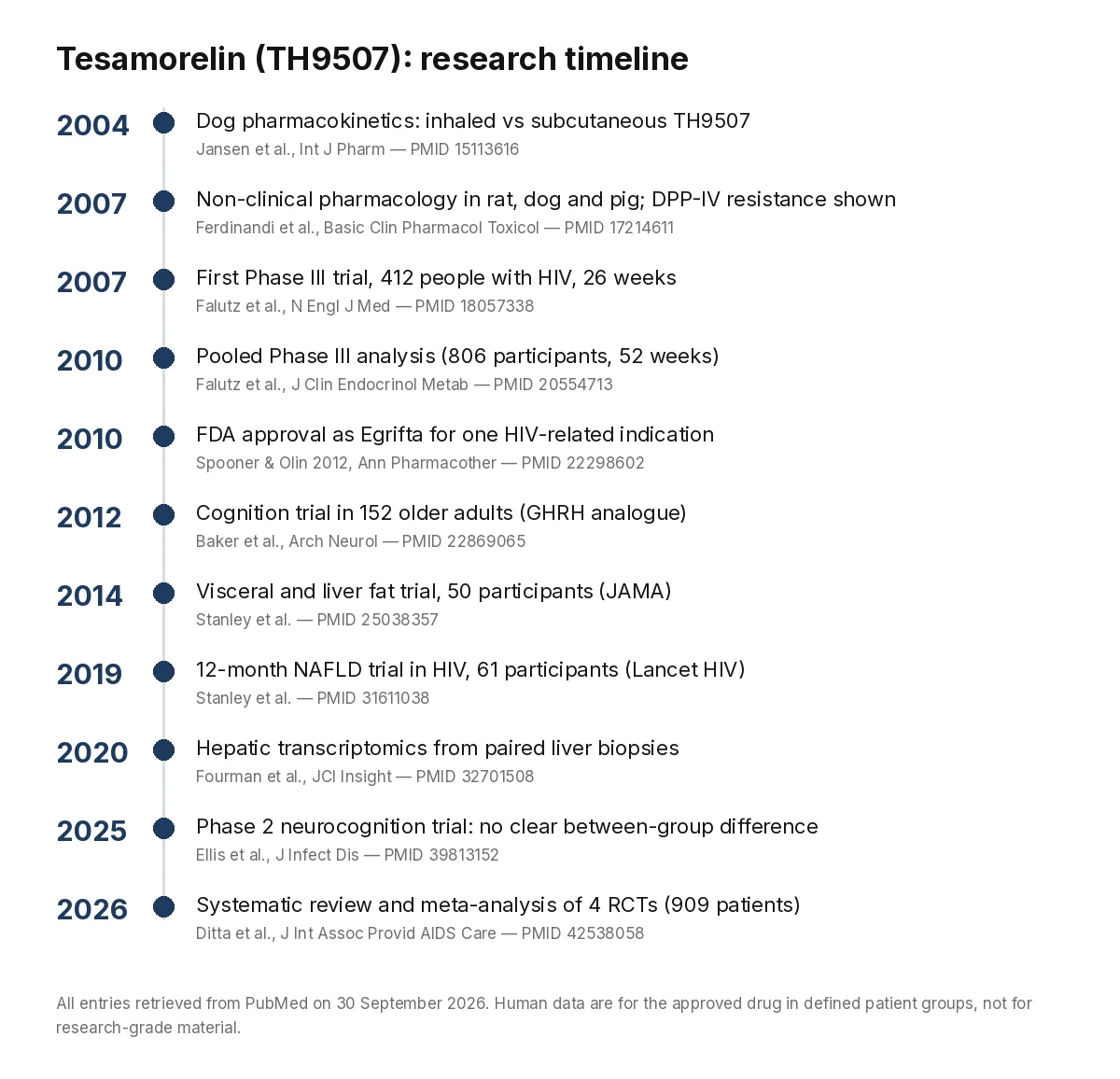
| Year | Model | What was investigated | Reference |
|---|---|---|---|
| 2004 | Beagle dog | Inhaled vs subcutaneous TH9507: bioavailability, half-life | PMID 15113616 |
| 2007 | Rat, dog, pig; rat/dog/human plasma in vitro | DPP-IV resistance, GH/IGF-1 response, 4-month toxicity, toxicokinetics | PMID 17214611 |
| 2007 | Human RCT, n=412, HIV, 26 wk | Visceral fat (CT), lipids, IGF-1, glucose | PMID 18057338 |
| 2008 | Human RCT extension, 52 wk | Long-term safety; fat re-accumulation after stopping | PMID 18690162 |
| 2010 | Pooled Phase III, n=806 | Visceral vs subcutaneous fat, lipids, body image, glucose | PMID 20554713 |
| 2011 | Human RCT, n=410 | PAI-1, tPA, CRP, adiponectin | PMID 21516030 |
| 2012 | Human RCT, n=152, older adults ± MCI | Cognitive composites after 20 wk | PMID 22869065 |
| 2014 | Human RCT, n=50, HIV | Visceral fat and liver fat (MRS), glucose | PMID 25038357 |
| 2015 | Human PK model, n=38 | Population pharmacokinetics; clearance, volume | PMID 25358450 |
| 2019 | Human RCT, n=61, HIV + NAFLD, 12 mo | Hepatic fat fraction, histology, glucose | PMID 31611038 |
| 2020 | Human liver biopsies (paired) | Hepatic gene-set expression | PMID 32701508 |
| 2024 | Human RCT subgroup, n=38 on INSTIs | Visceral fat, hepatic fat, safety | PMID 38905488 |
| 2025 | Human open-label Phase 2, n=73 | Neurocognitive performance, waist circumference | PMID 39813152 |
| 2026 | Systematic review, 4 RCTs, 909 patients | Pooled body-composition, lipid and safety outcomes | PMID 42538058 |
Independent Janoshik reports are posted for the 20mg vial (report #232266, analysed 21 September 2026: 17.94 mg measured, 98.010% purity) and the 10mg vial (report #172070, analysed 18 June 2026: 10.69 mg measured, 98.628% purity). Each product page shows its own report and states whether the posted document matches that exact strength; the 5mg vial has no posted report at the time of this review. Read the report yourself: the measured content and the purity are separate lines, and the lot on your label must match before the document applies.
Tesamorelin sits alongside every other compound on the page where you can buy peptides online in Canada, each with the same research-use-only terms and its own documentation.
All references were retrieved from PubMed (NCBI) on 30 September 2026 and cross-checked against Europe PMC; identity data from PubChem, ChEMBL (EMBL-EBI) and UniProt on the same date; Canadian regulatory status from Health Canada’s Drug Product Database on the same date.
Shop Peptides Online lists Tesamorelin in 5mg, 10mg and 20mg vials and in pen format on this page. Orders ship from inside Canada by Canada Post, so there is no customs clearance; the free-shipping threshold and delivery times are in the shipping policy and shown at checkout. Every listing is research-grade material for laboratory use only, not the prescription product Egrifta.
Yes, for two strengths. The COA library holds independent Janoshik reports for the 20mg vial (#232266, analysed 21 September 2026: 17.94 mg measured, 98.010% purity) and the 10mg vial (#172070, analysed 18 June 2026: 10.69 mg measured, 98.628% purity). Each product page embeds its own report; no report is posted for the 5mg vial at the time of this review.
A synthetic 44-amino-acid analogue of human growth hormone-releasing hormone, GHRH(1–44)-NH2, carrying a trans-3-hexenoyl group on the N-terminal tyrosine that makes it resistant to dipeptidyl peptidase-IV (PMID 17214611). Formula C221H366N72O67S, molecular weight 5136 (PubChem CID 16137828), CAS 218949-48-5.
Tesamorelin is an FDA-approved prescription drug (Egrifta, 2010) for one indication: excess abdominal fat in HIV-associated lipodystrophy (PMID 22298602). The vials sold here are not that product. They are research-grade material for laboratory use only, not for human or animal consumption, and Shop Peptides Online provides no dosing or administration guidance.
For laboratory research use only. Not for human or animal consumption. This page identifies the material, its documentation and the published literature on the compound, and makes no claim of efficacy or safety for the material sold.