For laboratory research only. Not for human or animal use. This article gives no dosing, administration or therapeutic advice.
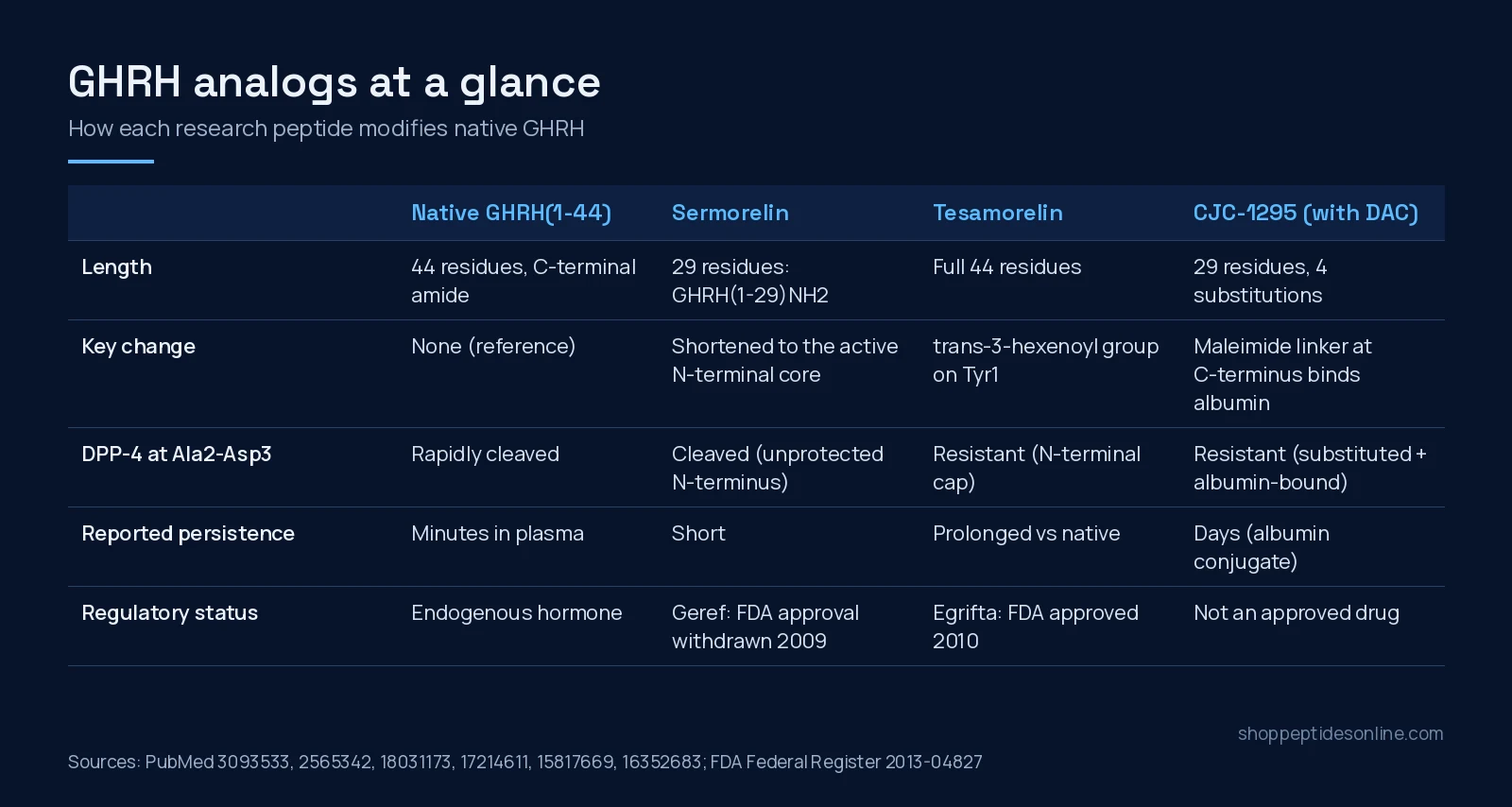
Short answer: tesamorelin, sermorelin and CJC-1295 all start from the same hormone, growth hormone-releasing hormone (GHRH). They differ in how they deal with GHRH’s main weakness: the enzyme dipeptidyl peptidase-4 (DPP-4) clips its first two amino acids within minutes in plasma[3][4]. Sermorelin is simply the shortest fully active fragment, GHRH(1-29), with no protection. Tesamorelin keeps all 44 residues and caps the N-terminus with a trans-3-hexenoyl group[8]. CJC-1295 swaps four residues in GHRH(1-29) and adds a group that bonds to serum albumin, which stretched its persistence in plasma from minutes to days in the published studies[10][11].
Where all three start: native GHRH
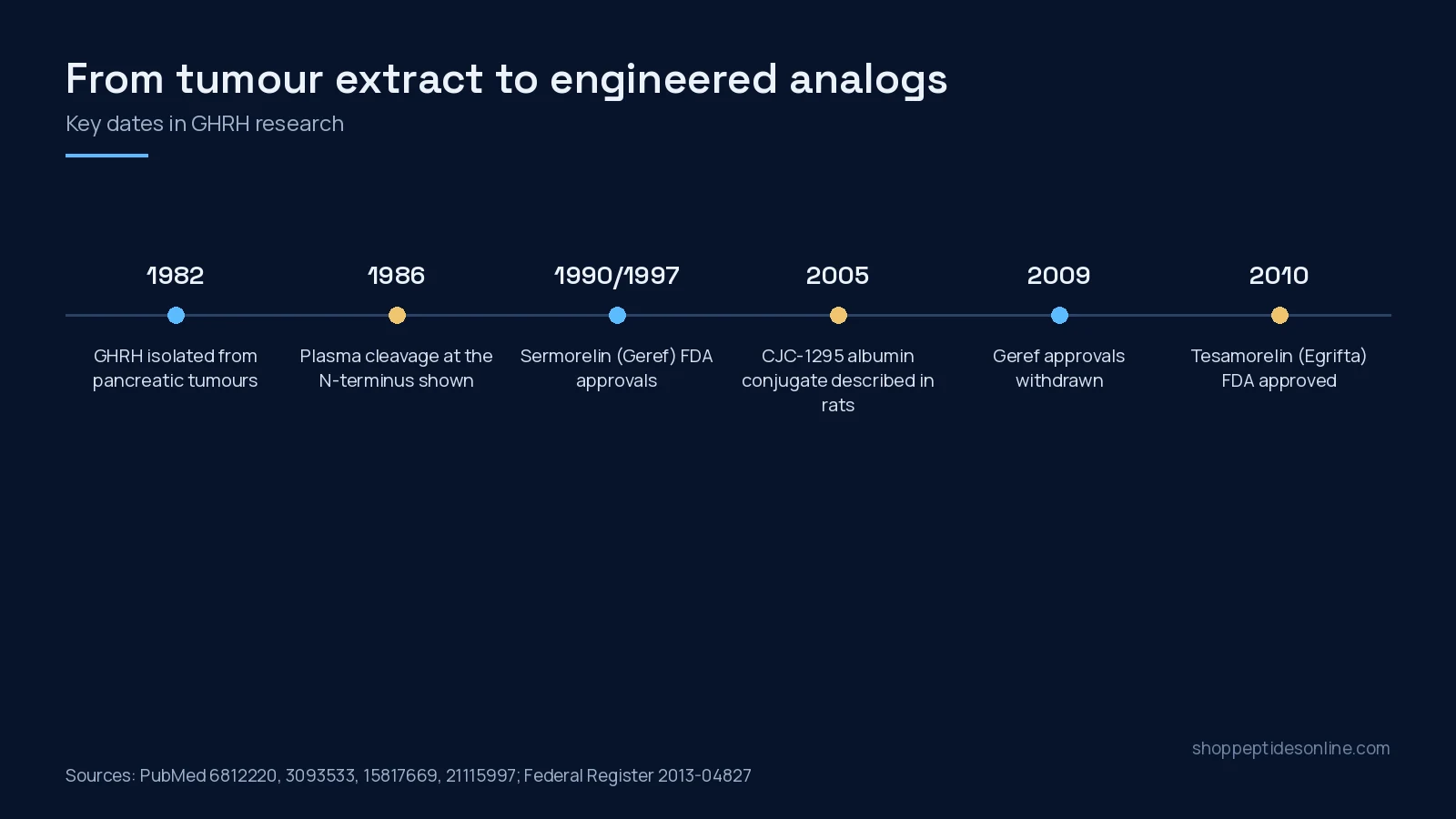
GHRH was first sequenced in 1982 from pancreatic tumours that had caused acromegaly. Two groups characterised the peptide independently[1][2]; one reported a 44-amino-acid peptide amide whose synthetic copy stimulated growth hormone secretion in vitro and in vivo[1]. That sequence, often written GHRH(1-44)NH2, is the reference point for every analog below.
The native hormone’s problem for researchers is stability. In human plasma studied in vitro, intact GHRH(1-44) disappeared on HPLC with a half-life of about 17 minutes, converted to GHRH(3-44), a fragment that still reacts in immunoassays but is biologically inactive[3]. A follow-up study identified the enzyme: cleavage at the Ala2-Asp3 bond was blocked by the DPP-4 inhibitor diprotin A and by D-amino-acid substitution at position 1 or 2. Shortened fragments, including GHRH(1-29)NH2, were also rapidly cleaved[4]. Native GHRH is additionally exposed to chemical changes in solution, such as Asn8 rearrangement and Met27 oxidation, which reduce bioactivity[5].
So every GHRH analog is, in effect, an answer to one question: how do you keep the active N-terminal region intact for longer?
Sermorelin: the shortest active fragment
Sermorelin is GHRH(1-29)NH2, a 29-amino-acid analog described as the shortest synthetic peptide with the full biological activity of GHRH[6]. It specifically stimulates growth hormone secretion from the anterior pituitary[6]. It carries no protective modification, so it shares the native hormone’s DPP-4 cleavage site; the 1989 enzyme study showed GHRH(1-29)NH2 was rapidly cleaved at that site[4].
Regulatory history, stated neutrally: according to an FDA notice in the Federal Register, sermorelin acetate was approved as Geref injection under two applications (one in December 1990 for a diagnostic use, one in September 1997). The manufacturer discontinued the products in 2008, and FDA withdrew approval of both applications effective June 18, 2009. In 2013 FDA determined they were not withdrawn for reasons of safety or effectiveness (Federal Register 2013-04827). Most published sermorelin data are older clinical diagnostic work in children, reviewed in 1999[6].
Tesamorelin: the full-length sequence with an N-terminal cap
Tesamorelin (development code TH9507) takes the opposite approach to sermorelin: it keeps the complete 44-residue human sequence and adds one modification, a trans-3-hexenoyl group on Tyr1[8]. In non-clinical work this cap made the peptide resistant to DPP-4 inactivation, slowed its degradation in rat, dog and human plasma in vitro compared with native GHRH(1-44), and prolonged plasma elimination of immunoreactive peptide in animals[8]. Growth hormone and IGF-1 rose in pigs, rats and dogs in that safety programme[8].
Regulatory status, stated neutrally: tesamorelin (Egrifta) received FDA approval in 2010 for a narrow indication in adults with HIV-associated lipodystrophy[9][7]. It is described as a synthetic GHRH analog that stimulates the synthesis and release of endogenous growth hormone[7]. That approval relates to one prescription product; it says nothing about research-grade material.
For laboratory work, Shop Peptides Online lists tesamorelin 10 mg alongside other strengths, and the tesamorelin research hub collects the identity data and certificates.
CJC-1295: substitutions plus albumin binding
CJC-1295 starts from the 29-residue fragment but changes more. Its developers described it as a tetrasubstituted hGRF(1-29) with an added N-epsilon-3-maleimidopropionamide derivative of lysine at the C-terminus[10]. Substitutions of this kind were explored earlier to block DPP-4 cleavage at the N-terminus, reduce Asn8 rearrangement and prevent Met27 oxidation[5].
The maleimide group is the “drug affinity complex” (DAC). In rats it bonded to the free thiol on Cys34 of serum albumin; the albumin conjugates were more stable against DPP-4 and remained bioactive in cultured rat pituitary cells, and CJC-1295 was still present in rat plasma beyond 72 hours[10]. A human pharmacokinetic study in healthy adults then estimated a half-life measured in days, with dose-dependent rises in GH and IGF-I across the doses tested[11]. A separate study found GH secretion stayed pulsatile after a single administration; pulse frequency was unchanged and the rise came mainly from higher trough levels[12]. In GHRH-knockout mice, repeated CJC-1295 administration normalised growth only at the most frequent schedule tested, not at longer intervals[13].
“CJC-1295 no DAC”: this name is used for the tetrasubstituted GHRH(1-29) backbone without the albumin-binding group, often called modified GRF(1-29). Anti-doping chemists treat CJC-1295 and CJC-1295 with DAC as separate analogs with their own metabolites[14]. Without the maleimide, the albumin-dependent persistence above does not carry over. CJC-1295 is not an approved drug, and GHRH and its analogs are prohibited in sport by the World Anti-Doping Agency[14].
Shop Peptides Online does not sell sermorelin or CJC-1295 (with or without DAC). They are included here for comparison only.
Side-by-side comparison
| Feature | Native GHRH(1-44) | Sermorelin | Tesamorelin | CJC-1295 (DAC) |
|---|---|---|---|---|
| Sequence | 44 residues, C-terminal amide[1] | GHRH(1-29)NH2[6] | Full GHRH(1-44)[8] | Tetrasubstituted GHRH(1-29)[10] |
| Modification | None | Truncation only | trans-3-hexenoyl on Tyr1[8] | C-terminal maleimide (DAC) binds albumin Cys34[10] |
| DPP-4 cleavage (Ala2-Asp3) | Rapid[3][4] | Rapid[4] | Resistant in non-clinical tests[8] | More stable as albumin conjugate[10] |
| Persistence reported | Minutes (in vitro plasma)[3] | Short, unprotected | Prolonged vs native in animals[8] | Days in human PK study[11] |
| Main models in literature | Tumour extracts, plasma in vitro | Paediatric diagnostic studies[6] | Pig, rat, dog; regulated clinical programme[8][7] | Rat, GHRH-knockout mouse, healthy adults[10][13][11] |
| Regulatory status | Endogenous hormone | Geref approvals withdrawn 2009 (FDA) | Egrifta, FDA approved 2010[9] | Not approved |
| Sold by SPO | No | No | Yes, for research | No |
How ipamorelin differs
Tesamorelin is often compared with ipamorelin, but they work through different receptors. Ipamorelin is a pentapeptide (Aib-His-D-2-Nal-D-Phe-Lys-NH2) developed from the GHRP series. Pharmacological profiling with GHRP and GHRH antagonists showed it releases GH through a GHRP-like receptor, not the GHRH receptor[15]. That is why the two are sometimes studied together: they act on different pathways. The full comparison is in our post Ipamorelin vs Tesamorelin, and ipamorelin 10 mg is listed for research.
What the evidence does not show
- There are no published head-to-head studies comparing sermorelin, tesamorelin and CJC-1295 in the same model. The table above sets separate studies side by side; it is not a ranking.
- Much of the CJC-1295 data comes from a small number of early studies by its developers and collaborators[10][11][12]. In GHRH-knockout mice, longer dosing intervals did not fully normalise growth[13].
- Persistence figures depend on the model, the assay and the formulation. An HPLC half-life in plasma in vitro[3] cannot be compared directly with a half-life estimated from a human pharmacokinetic study[11].
- Tesamorelin’s approval covers one prescription product and indication[9]. It does not validate any other use or any research-grade material.
Notes for lab buyers
Because these analogs differ by a few residues or a single chemical group, identity matters as much as purity. HPLC alone shows purity; mass spectrometry confirms that the mass matches the expected analog. Our explainer on HPLC purity vs mass spectrometry identity covers how to read both, and the certificates we hold are on the COA page. If you are setting up a new project, you can also buy peptides online in Canada from our research catalogue.
Frequently asked questions
Is tesamorelin the same as sermorelin?
No. Both are analogs of growth hormone-releasing hormone (GHRH), but sermorelin is the shortened GHRH(1-29) amide, while tesamorelin keeps the full 44-residue sequence and adds a trans-3-hexenoyl group to the N-terminal tyrosine. That cap was shown in non-clinical work to make the peptide resistant to DPP-4 inactivation.
What does DAC mean in CJC-1295?
DAC (drug affinity complex) refers to a reactive maleimide group attached to the C-terminal lysine. In rat studies it bonds to the free thiol on Cys34 of serum albumin, which kept the peptide in plasma far longer than unmodified GHRH(1-29).
Is CJC-1295 without DAC the same compound as CJC-1295?
Not quite. The name is used for the tetrasubstituted GHRH(1-29) backbone without the albumin-binding maleimide group, often called modified GRF(1-29). Without that group, the albumin-dependent persistence reported for CJC-1295 does not apply.
Is ipamorelin a GHRH analog?
No. Ipamorelin is a synthetic pentapeptide that acts through the growth hormone secretagogue (ghrelin-type) receptor, a different receptor from the GHRH receptor that tesamorelin, sermorelin and CJC-1295 target.
Does Shop Peptides Online sell sermorelin or CJC-1295?
No. Shop Peptides Online currently lists tesamorelin and ipamorelin for laboratory research, not sermorelin or CJC-1295. They are discussed here only for comparison.
References
- Guillemin R, Brazeau P, Böhlen P et al. (1982). Growth hormone-releasing factor from a human pancreatic tumor that caused acromegaly. Science. PMID: 6812220. doi: 10.1126/science.6812220.
- Rivier J, Spiess J, Thorner M et al. (1982). Characterization of a growth hormone-releasing factor from a human pancreatic islet tumour. Nature. PMID: 6292724. doi: 10.1038/300276a0.
- Frohman LA, Downs TR, Williams TC et al. (1986). Rapid enzymatic degradation of growth hormone-releasing hormone by plasma in vitro and in vivo to a biologically inactive product cleaved at the NH2 terminus. J Clin Invest. PMID: 3093533. doi: 10.1172/JCI112679.
- Frohman LA, Downs TR, Heimer EP et al. (1989). Dipeptidylpeptidase IV and trypsin-like enzymatic degradation of human growth hormone-releasing hormone in plasma. J Clin Invest. PMID: 2565342. doi: 10.1172/JCI114049.
- Campbell RM, Stricker P, Miller R et al. (1994). Enhanced stability and potency of novel growth hormone-releasing factor (GRF) analogues derived from rodent and human GRF sequences. Peptides. PMID: 7937325. doi: 10.1016/0196-9781(94)90211-9.
- Prakash A, Goa KL (1999). Sermorelin: a review of its use in the diagnosis and treatment of children with idiopathic growth hormone deficiency. BioDrugs. PMID: 18031173. doi: 10.2165/00063030-199912020-00007.
- Dhillon S (2011). Tesamorelin: a review of its use in the management of HIV-associated lipodystrophy. Drugs. PMID: 21668043. doi: 10.2165/11202240-000000000-00000.
- Ferdinandi ES, Brazeau P, High K et al. (2007). Non-clinical pharmacology and safety evaluation of TH9507, a human growth hormone-releasing factor analogue. Basic Clin Pharmacol Toxicol. PMID: 17214611. doi: 10.1111/j.1742-7843.2007.00008.x.
- Traynor K (2010). FDA approves tesamorelin for HIV-related lipodystrophy. Am J Health Syst Pharm. PMID: 21115997. doi: 10.2146/news100082.
- Jetté L, Léger R, Thibaudeau K et al. (2005). Human growth hormone-releasing factor (hGRF)1-29-albumin bioconjugates activate the GRF receptor on the anterior pituitary in rats: identification of CJC-1295 as a long-lasting GRF analog. Endocrinology. PMID: 15817669. doi: 10.1210/en.2004-1286.
- Teichman SL, Neale A, Lawrence B et al. (2006). Prolonged stimulation of growth hormone (GH) and insulin-like growth factor I secretion by CJC-1295, a long-acting analog of GH-releasing hormone, in healthy adults. J Clin Endocrinol Metab. PMID: 16352683. doi: 10.1210/jc.2005-1536.
- Ionescu M, Frohman LA (2006). Pulsatile secretion of growth hormone (GH) persists during continuous stimulation by CJC-1295, a long-acting GH-releasing hormone analog. J Clin Endocrinol Metab. PMID: 17018654. doi: 10.1210/jc.2006-1702.
- Alba M, Fintini D, Sagazio A et al. (2006). Once-daily administration of CJC-1295, a long-acting growth hormone-releasing hormone (GHRH) analog, normalizes growth in the GHRH knockout mouse. Am J Physiol Endocrinol Metab. PMID: 16822960. doi: 10.1152/ajpendo.00201.2006.
- Memdouh S, Gavrilović I, Ng K et al. (2021). Advances in the detection of growth hormone releasing hormone synthetic analogs. Drug Test Anal. PMID: 34665524. doi: 10.1002/dta.3183.
- Raun K, Hansen BS, Johansen NL et al. (1998). Ipamorelin, the first selective growth hormone secretagogue. Eur J Endocrinol. PMID: 9849822. doi: 10.1530/eje.0.1390552.