For laboratory research only. Not for human or animal use. This article gives no dosing, administration or therapeutic advice.
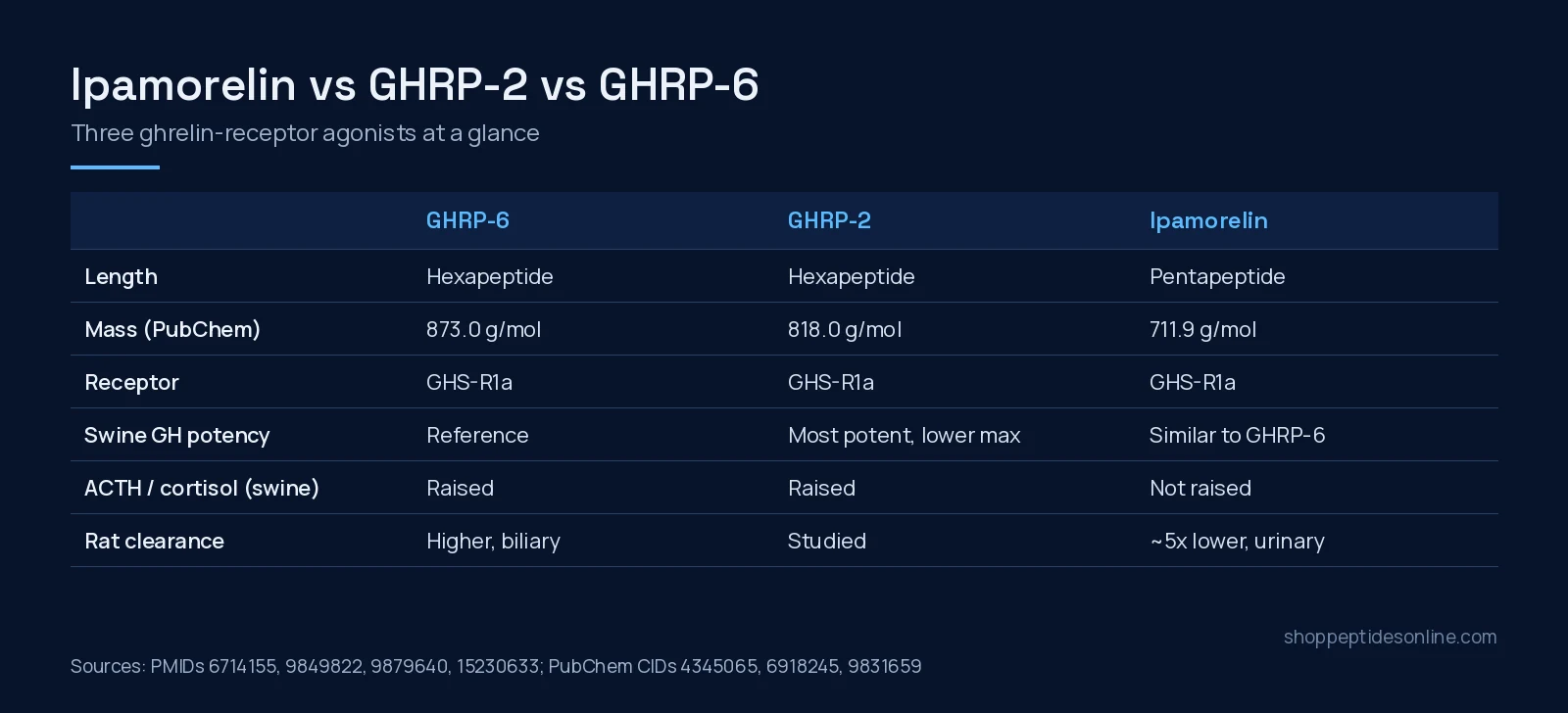
Short answer: GHRP-6, GHRP-2 and ipamorelin are synthetic growth hormone secretagogues that act on the same G-protein-coupled receptor, GHS-R1a, later shown to be the ghrelin receptor[1][2]. GHRP-6 was the first, a hexapeptide described in 1984[3]. GHRP-2 (pralmorelin) is a later, more potent relative[4]. Ipamorelin is a pentapeptide from a Novo Nordisk chemistry programme. In swine it released GH without the rise in ACTH and cortisol seen with GHRP-6 and GHRP-2, which is why it was called the first selective GH secretagogue[5].
Side by side
| GHRP-6 | GHRP-2 (pralmorelin) | Ipamorelin | |
|---|---|---|---|
| Length | Hexapeptide: His-D-Trp-Ala-Trp-D-Phe-Lys-NH2[3] | Hexapeptide, a GHRP-6 “superanalogue”[6] | Pentapeptide: Aib-His-D-2-Nal-D-Phe-Lys-NH2[5] |
| Formula (PubChem) | C46H56N12O6, 873.0 g/mol (CID 4345065) | C45H55N9O6, 818.0 g/mol (CID 6918245) | C38H49N9O5, 711.9 g/mol (CID 9831659) |
| Receptor | GHS-R1a[1] | GHS-R1a; mimics ghrelin[4] | GHRP-like receptor, blocked by GHRP antagonists[5] |
| GH release, conscious swine (ED50) | 3.9 nmol/kg[5] | 0.6 nmol/kg, lower maximal response[5] | 2.3 nmol/kg[5] |
| ACTH and cortisol in swine | Raised[5] | Raised[5] | Not different from GHRH, even far above the GH ED50[5] |
| Rat plasma clearance | Reference; mainly biliary excretion[7] | Studied in the same comparison[7] | About 5-fold lower than GHRP-6; mainly urinary[7] |
| At SPO | Not sold | Not sold | Ipamorelin 10mg |
Where the GHRPs came from
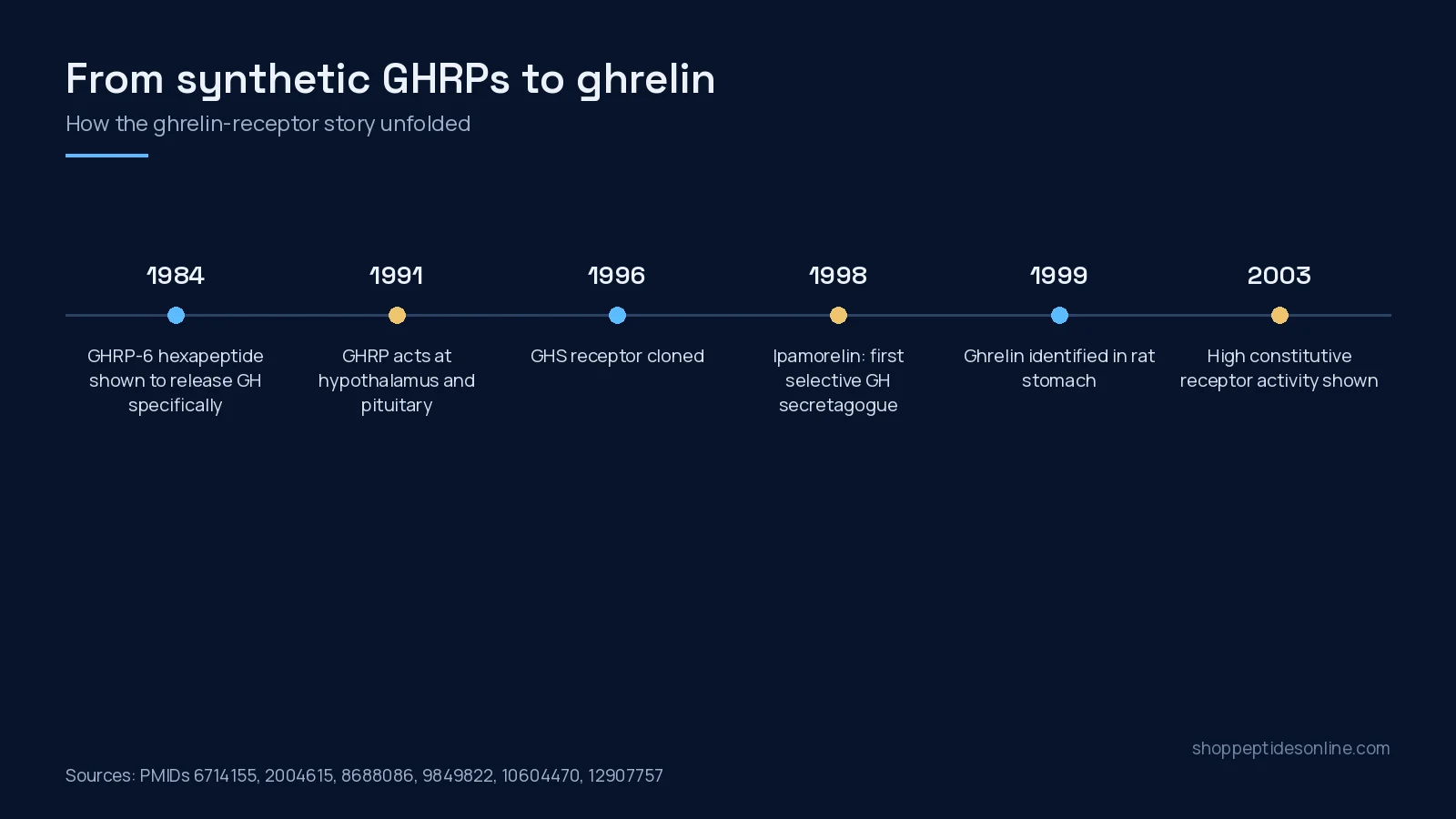
The story runs backwards from what you might expect: the synthetic peptides came first and the natural hormone was found later. In 1984, Bowers and colleagues reported that the hexapeptide His-D-Trp-Ala-Trp-D-Phe-Lys-NH2 released GH in a dose-related way, in vitro and in vivo, without releasing LH, FSH, TSH or prolactin[3]. In perifused rat pituitary cells the same year, GHRH (as GRF-44) was about 60 times more potent than this peptide, and continuous infusion of either one led to desensitisation[8].
Later rat work showed GHRP-6 acts at both the hypothalamus and the pituitary, through receptors that were neither GHRH nor opiate receptors[9]. Its target stayed unknown until 1996, when a G-protein-coupled receptor in the pituitary and hypothalamus of swine and humans was cloned and shown to be the site the secretagogues act on[1].
That left an orphan receptor. In 1999, Kojima and colleagues purified its natural ligand from rat stomach: a 28-residue peptide with an n-octanoyl group on serine 3, which is essential for activity. They named it ghrelin[2].
GHRP-2: the potent hexapeptide
GHRP-2, also called pralmorelin or KP-102, came out of the same Tulane research line led by Cyril Bowers. Its developers describe it as mimicking ghrelin’s action on GH release[4]. In the swine comparison it was the most potent of the three, with a lower ED50 than GHRP-6 or ipamorelin, but its maximal GH response was smaller[5].
The GHS family is not GH-specific. Human endocrine studies of GHRP-2 and hexarelin, another GHRP-6 analogue, describe significant prolactin- and ACTH/cortisol-releasing activity alongside GH release[6].
Ipamorelin: built for selectivity
Ipamorelin was found in a series of compounds that lack the central Ala-Trp dipeptide of GHRP-1. In primary rat pituitary cells it released GH with potency and efficacy close to GHRP-6. Experiments with GHRP and GHRH antagonists showed it works through the GHRP-type receptor[5].
The finding that set it apart came from swine. None of the secretagogues tested changed FSH, LH, prolactin or TSH. GHRP-6 and GHRP-2 raised ACTH and cortisol, while ipamorelin did not, even at doses more than 200 times its ED50 for GH release[5]. The authors concluded its selectivity for GH was similar to that of GHRH itself.
A rat pharmacokinetic study compared ipamorelin with GHRP-2 and GHRP-6. Ipamorelin’s systemic clearance was about five times lower than GHRP-6’s. It was excreted mainly in urine, while GHRP-6 went mainly into bile, and 60–80% of ipamorelin was recovered intact[7].
What this means for a lab choosing between them
- Studying GH release alone: ipamorelin’s animal selectivity profile makes it the cleaner tool, because ACTH and cortisol changes are less likely to confound the readout[5].
- Studying the wider GHS pharmacology: GHRP-6 and GHRP-2 are the historical reference compounds, with the longest literature[3][4].
- Comparing with GHRH-type peptides: GHRH analogues act on a different receptor. See our explainer on tesamorelin, sermorelin and CJC-1295 and the ipamorelin vs tesamorelin comparison.
Most of the selectivity and pharmacokinetic data here come from rats and swine in the 1990s. They describe pharmacology, not effects in people.
Checking identity in the lab
The three differ in mass by enough that intact-mass spectrometry separates them easily (PubChem values above). Purity by HPLC does not prove identity, which is why we explain both tests in HPLC purity vs mass spectrometry identity. Our ipamorelin research page collects the product details. For the full catalogue, see our guide to buy peptides online in Canada.
Frequently asked questions
What is the difference between ipamorelin, GHRP-2 and GHRP-6?
All three are synthetic growth hormone secretagogues acting on the ghrelin receptor (GHS-R1a). GHRP-6 and GHRP-2 are hexapeptides; ipamorelin is a pentapeptide. In swine, GHRP-6 and GHRP-2 raised ACTH and cortisol along with GH, while ipamorelin did not.
Do these peptides act on the same receptor as ghrelin?
Yes. The receptor they target was cloned in 1996, and ghrelin, a 28-residue acylated stomach peptide, was identified as its natural ligand in 1999.
Which is the most potent?
In a conscious-swine comparison, GHRP-2 had the lowest ED50 for GH release but a smaller maximal response. Ipamorelin and GHRP-6 were similar to each other. These are animal data only.
Why is ipamorelin called selective?
Because in swine it released GH without raising ACTH or cortisol above levels seen with GHRH, even at doses far above its GH ED50. GHRP-6 and GHRP-2 raised both.
Does Shop Peptides Online sell GHRP-2 or GHRP-6?
No. SPO lists ipamorelin 10mg for laboratory research only. None of these compounds is sold for human or animal use.
References
- Howard AD, Feighner SD, Cully DF et al. (1996). A receptor in pituitary and hypothalamus that functions in growth hormone release. Science. PMID: 8688086. doi: 10.1126/science.273.5277.974.
- Kojima M, Hosoda H, Date Y et al. (1999). Ghrelin is a growth-hormone-releasing acylated peptide from stomach. Nature. PMID: 10604470. doi: 10.1038/45230.
- Bowers CY, Momany FA, Reynolds GA et al. (1984). On the in vitro and in vivo activity of a new synthetic hexapeptide that acts on the pituitary to specifically release growth hormone. Endocrinology. PMID: 6714155. doi: 10.1210/endo-114-5-1537.
- (2004). Pralmorelin: GHRP 2, GPA 748, growth hormone-releasing peptide 2, KP-102 D, KP-102 LN, KP-102D, KP-102LN. Drugs R D. PMID: 15230633. doi: 10.2165/00126839-200405040-00011.
- Raun K, Hansen BS, Johansen NL et al. (1998). Ipamorelin, the first selective growth hormone secretagogue. Eur J Endocrinol. PMID: 9849822. doi: 10.1530/eje.0.1390552.
- Arvat E, Di Vito L, Lanfranco F et al. (1999). Tyr-Ala-Hexarelin, a synthetic octapeptide, possesses the same endocrine activities of Hexarelin and GHRP-2 in humans. J Endocrinol Invest. PMID: 10195374. doi: 10.1007/BF03350886.
- Johansen PB, Hansen KT, Andersen JV et al. (1998). Pharmacokinetic evaluation of ipamorelin and other peptidyl growth hormone secretagogues with emphasis on nasal absorption. Xenobiotica. PMID: 9879640. doi: 10.1080/004982598238976.
- Badger TM, Millard WJ, McCormick GF et al. (1984). The effects of growth hormone (GH)-releasing peptides on GH secretion in perifused pituitary cells of adult male rats. Endocrinology. PMID: 6148232. doi: 10.1210/endo-115-4-1432.
- Bowers CY, Sartor AO, Reynolds GA et al. (1991). On the actions of the growth hormone-releasing hexapeptide, GHRP. Endocrinology. PMID: 2004615. doi: 10.1210/endo-128-4-2027.
- Holst B, Cygankiewicz A, Jensen TH et al. (2003). High constitutive signaling of the ghrelin receptor–identification of a potent inverse agonist. Mol Endocrinol. PMID: 12907757. doi: 10.1210/me.2003-0069.