For laboratory research only. Not for human or animal use. This article gives no dosing, administration or therapeutic advice.
Short answer: Native GLP-1 is cut within minutes by the enzyme DPP-4, which removes its first two residues[1][2]. Liraglutide solved the short exposure by attaching a fatty acid so the peptide binds serum albumin[3][4]. Semaglutide, its successor, swaps Ala8 for the non-natural amino acid Aib to block DPP-4, adds Arg34, and carries a longer albumin-binding side chain on lysine 26. The result binds albumin more tightly and had a plasma half-life of about 46 hours in mini-pigs[4].
Side by side
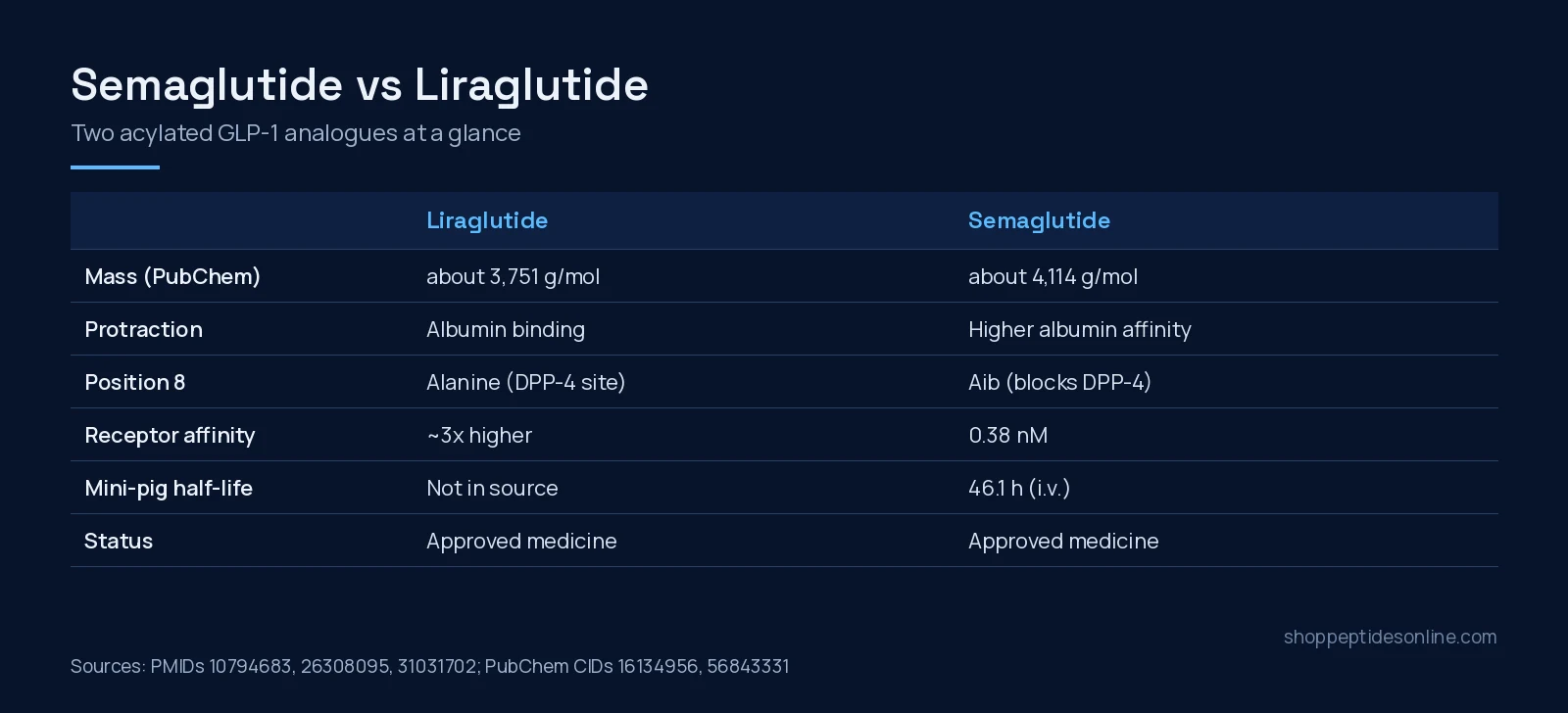
| Liraglutide | Semaglutide | |
|---|---|---|
| Formula (PubChem) | C172H265N43O51, about 3,751 g/mol (CID 16134956) | C187H291N45O59, about 4,114 g/mol (CID 56843331) |
| Design idea | Fatty-acid derivative of GLP-1 that binds albumin[3][4] | Higher albumin affinity plus full stability against metabolic degradation[4] |
| Changes vs human GLP-1 | Acylated GLP-1 analogue[4] | Aib8 and Arg34 substitutions, derivatised at Lys26[4] |
| GLP-1 receptor affinity | About 3-fold higher than semaglutide[4] | 0.38 nM, about 3-fold lower than liraglutide[4] |
| Albumin affinity | Lower[4] | Higher[4] |
| Animal pharmacokinetics | Strongly protracted vs GLP-1[3] | Mini-pig plasma half-life 46.1 h (i.v.)[4] |
| Status | Approved medicine[4] | Approved medicine (injectable and tablet forms)[5][6] |
| At SPO | Not sold | Semaglutide 10mg research material |
The problem both were built to solve
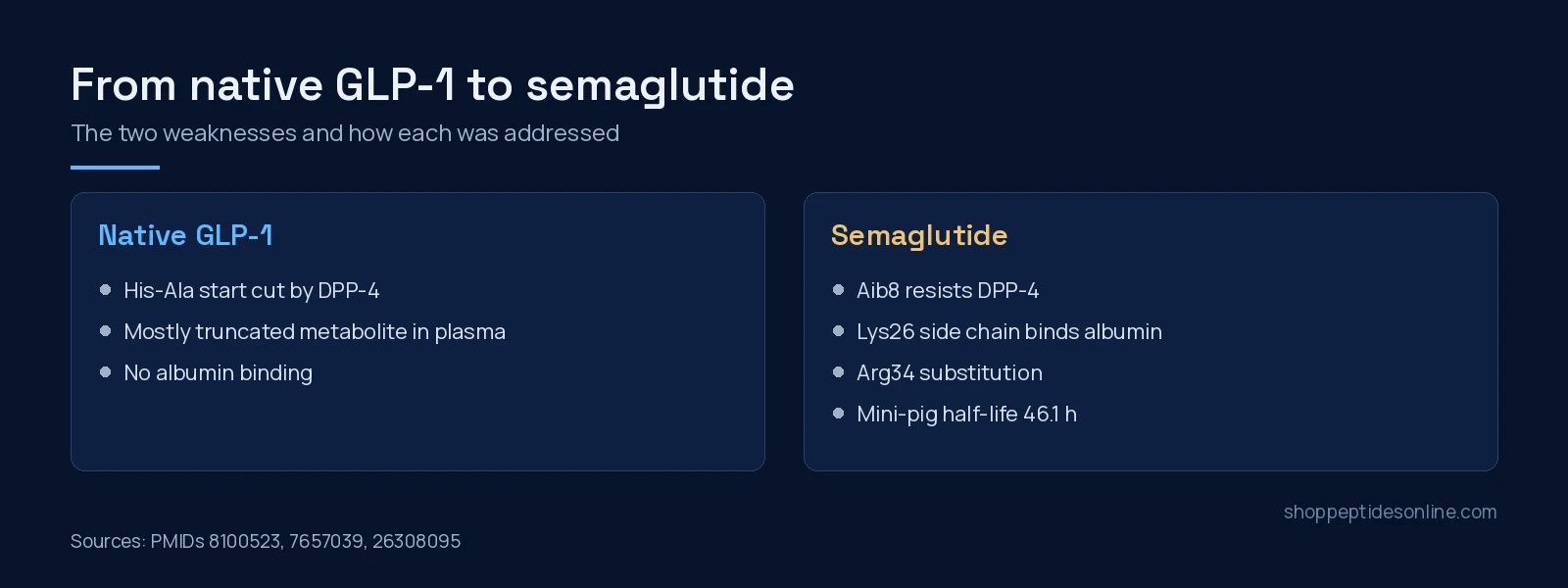
GLP-1(7-36)amide starts with His-Ala. Dipeptidyl peptidase IV (DPP-4) removes dipeptides from peptides with alanine or proline in the second position, and purified enzyme and human serum both cut GLP-1 to its des-His-Ala form[1]. In a human pharmacokinetic study, intact GLP-1 made up only about 20–25% of the circulating immunoreactivity after an intravenous infusion; the rest was the N-terminally truncated metabolite[2]. A research tool or drug built on native GLP-1 therefore needs a way around both DPP-4 and fast clearance.
Liraglutide: the albumin trick
In 2000, Knudsen and colleagues described a series of GLP-1 derivatives carrying fatty acids, designed to bind serum albumin and so stay in circulation longer. Native GLP-1 had an EC50 of 55 pM at the cloned human receptor, and many derivatives kept similar or even higher potency despite large substituents[3].
The structure-activity rules they reported still explain the class:
- Fatty acids of 12 carbons or longer made the peptides strongly protracted[3].
- Linear fatty acids up to 16 carbons could sit almost anywhere in the C-terminal part without much loss of potency; longer chains cost more potency[3].
- Two fatty-acid substituents caused a large loss of potency[3].
- Modifying the N-terminus at the same time, to resist DPP-4, interfered with the acylation and lowered potency[3].
Liraglutide came out of this work as an acylated GLP-1 analogue that binds albumin in vivo, an approved medicine[4]. A review by the developers describes reversible albumin binding as the protraction mechanism for both molecules, with fatty acid and linker combinations chosen to maximise albumin binding while keeping receptor potency[5].
Semaglutide: solving the N-terminus too
The semaglutide programme set out to extend exposure further by raising albumin affinity and securing full stability against metabolic degradation. The fatty acid moiety and the linking chemistry to GLP-1 were the key variables[4].
The selected molecule has two substitutions relative to human GLP-1, Aib at position 8 and Arg at position 34, and is derivatised at lysine 26[4]. Aib (α-aminoisobutyric acid) replaces the alanine that DPP-4 recognises. The trade-off is visible in the data: receptor affinity was about three times lower than liraglutide’s, while albumin affinity went up. In mini-pigs, the plasma half-life after intravenous dosing was 46.1 hours, with a mean residence time of 63.6 hours after subcutaneous dosing[4]. Those are animal pharmacokinetic values, not human ones.
A tablet form of a 4 kDa peptide
Peptides are normally poorly absorbed by mouth. Oral semaglutide is co-formulated with the absorption enhancer SNAC. In clinical and dog studies, absorption happened in the stomach, close to the tablet surface, and needed SNAC. SNAC buffered the local environment against enzymatic breakdown, and the uptake was transcellular, with no sign of effects on tight junctions[6].
Notes for the lab
- Identity: the two differ by about 363 Da (PubChem), so intact-mass LC-MS tells them apart. HPLC purity alone does not; see HPLC purity vs mass spectrometry identity.
- Albumin in the medium: because both are designed to bind albumin, serum or albumin content in an assay can shift apparent potency. Report it with your results.
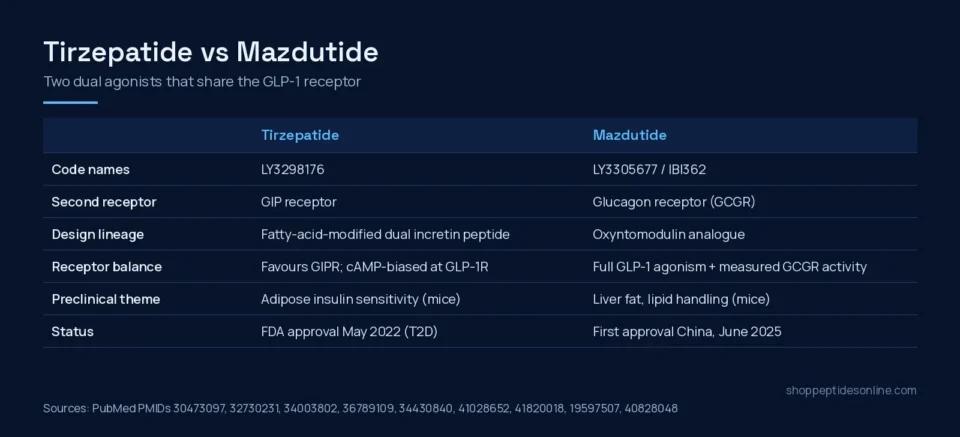
- Related compounds: semaglutide is a single GLP-1 receptor agonist. For dual and triple agonists, see tirzepatide vs semaglutide vs retatrutide and our tirzepatide research page.
Semaglutide and liraglutide are approved prescription medicines. Material sold by Shop Peptides Online is for laboratory research only. For the full catalogue, see our guide to buy peptides online in Canada.
Frequently asked questions
What is the main difference between semaglutide and liraglutide?
Both are acylated GLP-1 analogues that bind serum albumin. Semaglutide adds an Aib substitution at position 8 to resist DPP-4 and has a side chain with higher albumin affinity, giving a much longer half-life in animal studies.
Why is native GLP-1 so short-lived?
The enzyme DPP-4 removes its first two residues (His-Ala), producing an inactive truncated form. In a human pharmacokinetic study, most circulating GLP-1 after infusion was this metabolite.
Does semaglutide bind the GLP-1 receptor more strongly than liraglutide?
No. In the discovery paper its receptor affinity was about three-fold lower than liraglutide’s; its longer action comes from albumin binding and DPP-4 resistance.
How can oral semaglutide be absorbed?
It is co-formulated with the absorption enhancer SNAC. Studies found absorption in the stomach near the tablet surface, by a transcellular route.
Does Shop Peptides Online sell liraglutide?
No. SPO lists semaglutide as laboratory research material only, not for human or animal use.
References
- Mentlein R, Gallwitz B, Schmidt WE (1993). Dipeptidyl-peptidase IV hydrolyses gastric inhibitory polypeptide, glucagon-like peptide-1(7-36)amide, peptide histidine methionine and is responsible for their degradation in human serum. Eur J Biochem. PMID: 8100523. doi: 10.1111/j.1432-1033.1993.tb17986.x.
- Deacon CF, Nauck MA, Toft-Nielsen M et al. (1995). Both subcutaneously and intravenously administered glucagon-like peptide I are rapidly degraded from the NH2-terminus in type II diabetic patients and in healthy subjects. Diabetes. PMID: 7657039. doi: 10.2337/diab.44.9.1126.
- Knudsen LB, Nielsen PF, Huusfeldt PO et al. (2000). Potent derivatives of glucagon-like peptide-1 with pharmacokinetic properties suitable for once daily administration. J Med Chem. PMID: 10794683. doi: 10.1021/jm9909645.
- Lau J, Bloch P, Schäffer L et al. (2015). Discovery of the Once-Weekly Glucagon-Like Peptide-1 (GLP-1) Analogue Semaglutide. J Med Chem. PMID: 26308095. doi: 10.1021/acs.jmedchem.5b00726.
- Knudsen LB, Lau J (2019). The Discovery and Development of Liraglutide and Semaglutide. Front Endocrinol (Lausanne). PMID: 31031702. doi: 10.3389/fendo.2019.00155.
- Buckley ST, Bækdal TA, Vegge A et al. (2018). Transcellular stomach absorption of a derivatized glucagon-like peptide-1 receptor agonist. Sci Transl Med. PMID: 30429357. doi: 10.1126/scitranslmed.aar7047.