For laboratory research only. Not for human or animal use. This article gives no dosing, administration or therapeutic advice.
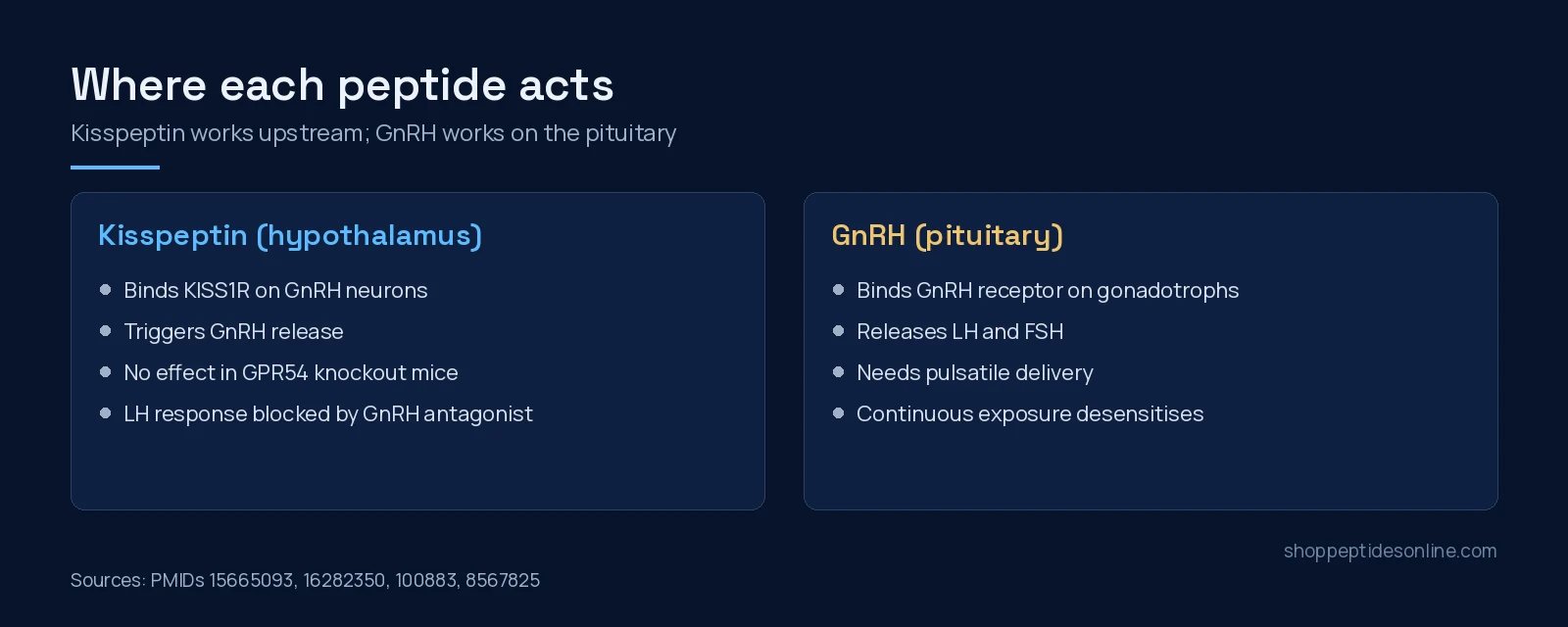
Short answer: GnRH is the hypothalamic decapeptide that tells the pituitary to release LH and FSH[1]. Kisspeptin sits one step upstream: it acts on its own receptor, KISS1R (GPR54), on GnRH neurons and triggers GnRH release[2]. Block the GnRH receptor and kisspeptin’s effect on LH disappears[3][2]. Both peptides need to be delivered in pulses: continuous GnRH desensitises the pituitary[4].
Side by side
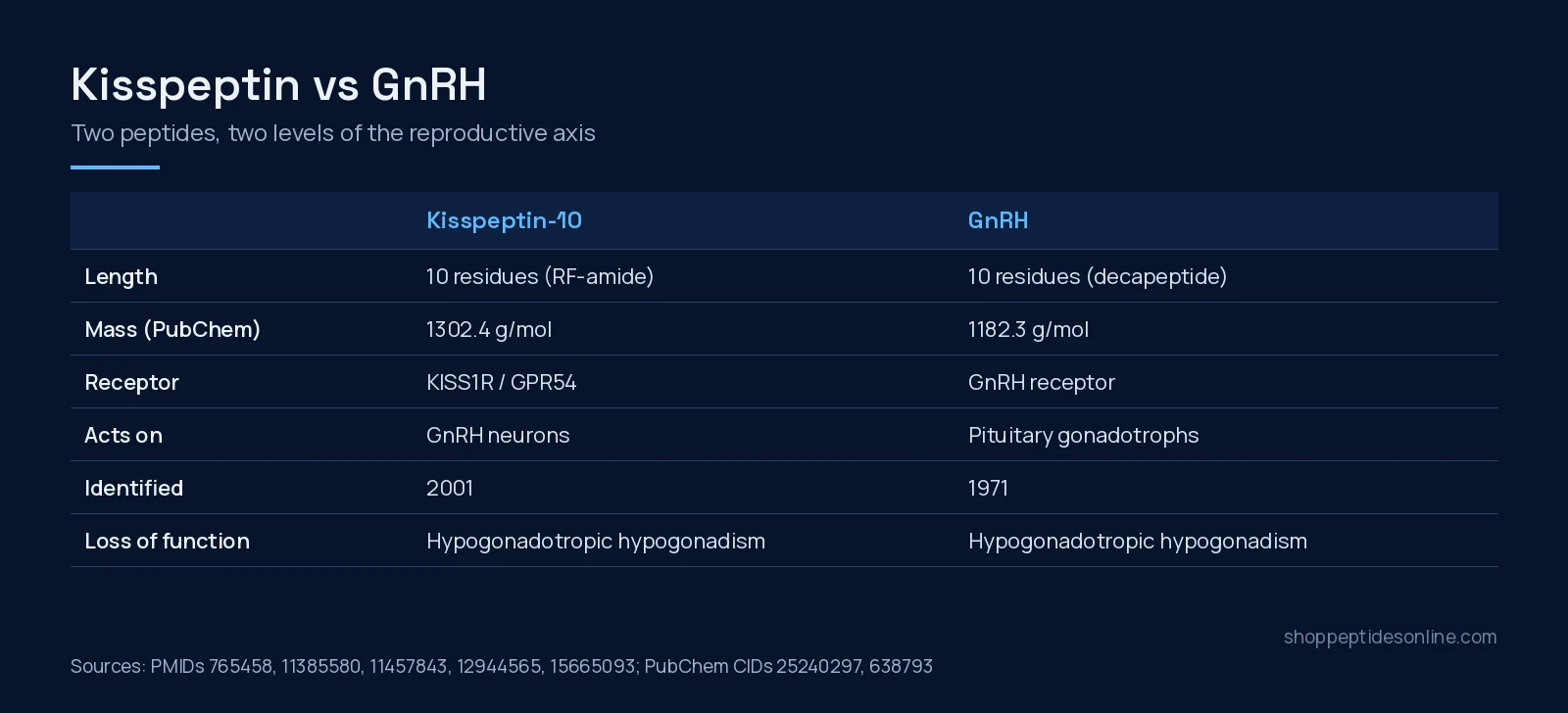
| Kisspeptin-10 | GnRH (gonadorelin) | |
|---|---|---|
| Sequence | YNWNSFGLRF-NH2, residues 112–121 of the 138-residue human KISS1 precursor (UniProt Q15726) | Decapeptide; same structure in ovine and porcine preparations[1] |
| Formula (PubChem) | C63H83N17O14, 1302.4 g/mol (CID 25240297) | C55H75N17O13, 1182.3 g/mol (CID 638793) |
| Receptor | KISS1R / GPR54[5][6] | GnRH receptor on pituitary gonadotrophs[7] |
| Main site of action | GnRH neurons in the hypothalamus[2] | Anterior pituitary[1] |
| Discovered | 2001, as the ligand of orphan GPR54[5][6] | 1971, isolated by Schally’s group[1] |
| Loss of function | GPR54 or KISS1 mutations cause hypogonadotropic hypogonadism[8][9][10] | GnRH-receptor mutations also cause it[8] |
| At SPO | Kisspeptin 10mg | Not sold |
GnRH came first
The idea that the brain controls the pituitary through blood-borne factors goes back to Harris in 1937. Hypothalamic LH-releasing activity was shown in 1960 and 1961, and porcine LH-RH (GnRH) was isolated by Schally and colleagues in 1971, followed by ovine LH-RH from Guillemin’s group. Both turned out to be the same decapeptide[1].
The most important early finding about GnRH concerned timing, not amount. In rhesus monkeys whose own gonadotropin release had been abolished by hypothalamic lesions, a constant infusion of GnRH failed to restore sustained gonadotropin secretion. Hourly pulses did restore it. Switching back to continuous delivery then caused “desensitisation” or “down-regulation”[4].
That property explains why GnRH analogues split into two classes. Agonists cause an initial “flare-up” and then desensitise gonadotroph cells and reduce receptor numbers; antagonists block the receptor immediately, lowering LH and FSH within hours[7].
Kisspeptin: from metastasis gene to reproductive gatekeeper
KiSS-1 was first described as a metastasis suppressor gene in melanoma[11]. In 2001, two groups showed its peptide products are the natural ligands of the orphan receptor GPR54. The isolated peptides, 54, 14 and 13 residues long, share an RF-amide C-terminus and bind GPR54 with low nanomolar affinity[5][6].
The reproductive role came from genetics in 2003:
- Five siblings with isolated hypogonadotropic hypogonadism, and a normal GnRH-receptor gene, carried a homozygous deletion in GPR54[8].
- A second study found GPR54 mutations in an affected family and an unrelated patient, and Gpr54-deficient mice also had hypogonadotropic hypogonadism[9].
- In 2012, an inactivating mutation in KISS1 itself was described in a family with pubertal failure[10].
How kisspeptin reaches the pituitary: through GnRH
Three lines of evidence place kisspeptin upstream of GnRH:
- Location. GPR54 transcripts colocalise with GnRH neurons in the mouse hypothalamus[2].
- Receptor dependence. Kisspeptin that triggered robust LH and FSH release in wild-type mice had no effect in gpr54 knockout mice, whose GnRH neurons were anatomically normal[2].
- GnRH release measured directly. In sheep, central kisspeptin produced a large release of GnRH into cerebrospinal fluid with a parallel rise in LH[2].
In agonadal juvenile male rhesus monkeys, hourly kisspeptin-10 pulses produced a train of LH discharges. A GnRH-receptor antagonist, acyline, abolished them[3]. In ovariectomised rats, kisspeptin-10 was studied for its effect on the electrical activity of the GnRH pulse generator[12], and in men kisspeptin reset the timing of endogenous GnRH pulses, as reflected in LH[13].
Which one fits which question?
- Pituitary gonadotroph biology: GnRH and its analogues act there directly[7].
- Upstream control of GnRH neurons, puberty timing and pulse generation: kisspeptin and KISS1R are the tools[2][13].
- Kisspeptin isoforms: for how the 10- and 54-residue forms differ, see kisspeptin-10 vs kisspeptin-54.
Our kisspeptin research page collects product information, and each batch’s identity and purity data are explained in HPLC purity vs mass spectrometry identity. For the full catalogue, see our guide to buy peptides online in Canada.
Frequently asked questions
What is the difference between kisspeptin and GnRH?
GnRH is a hypothalamic decapeptide that acts on the pituitary to release LH and FSH. Kisspeptin acts one step earlier, on KISS1R (GPR54) receptors on GnRH neurons, and triggers GnRH release.
Does kisspeptin act directly on the pituitary?
The key evidence points to the hypothalamus. Kisspeptin had no effect in GPR54 knockout mice, caused GnRH release into cerebrospinal fluid in sheep, and its LH response in monkeys was abolished by a GnRH-receptor antagonist.
Why does GnRH have to be pulsed?
In lesioned monkeys, hourly GnRH pulses restored gonadotropin secretion but continuous infusion did not, and switching to continuous delivery desensitised the pituitary.
What happens when the kisspeptin system is missing?
Loss-of-function mutations in GPR54, and later in KISS1 itself, were found in people with hypogonadotropic hypogonadism, and Gpr54-deficient mice show the same condition.
Does Shop Peptides Online sell GnRH?
No. SPO lists kisspeptin 10mg for laboratory research only, not for human or animal use.
References
- Mahesh VB (1975). Current status of luteinizing hormone-releasing hormone in diagnosis and treatment of disorders in reproductive function. J Reprod Med. PMID: 765458.
- Messager S, Chatzidaki EE, Ma D et al. (2005). Kisspeptin directly stimulates gonadotropin-releasing hormone release via G protein-coupled receptor 54. Proc Natl Acad Sci U S A. PMID: 15665093. doi: 10.1073/pnas.0409330102.
- Plant TM, Ramaswamy S, Dipietro MJ (2006). Repetitive activation of hypothalamic G protein-coupled receptor 54 with intravenous pulses of kisspeptin in the juvenile monkey (Macaca mulatta) elicits a sustained train of gonadotropin-releasing hormone discharges. Endocrinology. PMID: 16282350. doi: 10.1210/en.2005-1261.
- Belchetz PE, Plant TM, Nakai Y et al. (1978). Hypophysial responses to continuous and intermittent delivery of hypopthalamic gonadotropin-releasing hormone. Science. PMID: 100883. doi: 10.1126/science.100883.
- Ohtaki T, Shintani Y, Honda S et al. (2001). Metastasis suppressor gene KiSS-1 encodes peptide ligand of a G-protein-coupled receptor. Nature. PMID: 11385580. doi: 10.1038/35079135.
- Kotani M, Detheux M, Vandenbogaerde A et al. (2001). The metastasis suppressor gene KiSS-1 encodes kisspeptins, the natural ligands of the orphan G protein-coupled receptor GPR54. J Biol Chem. PMID: 11457843. doi: 10.1074/jbc.M104847200.
- Reissmann T, Felberbaum R, Diedrich K et al. (1995). Development and applications of luteinizing hormone-releasing hormone antagonists in the treatment of infertility: an overview. Hum Reprod. PMID: 8567825. doi: 10.1093/oxfordjournals.humrep.a136219.
- de Roux N, Genin E, Carel JC et al. (2003). Hypogonadotropic hypogonadism due to loss of function of the KiSS1-derived peptide receptor GPR54. Proc Natl Acad Sci U S A. PMID: 12944565. doi: 10.1073/pnas.1834399100.
- Seminara SB, Messager S, Chatzidaki EE et al. (2003). The GPR54 gene as a regulator of puberty. N Engl J Med. PMID: 14573733. doi: 10.1056/NEJMoa035322.
- Topaloglu AK, Tello JA, Kotan LD et al. (2012). Inactivating KISS1 mutation and hypogonadotropic hypogonadism. N Engl J Med. PMID: 22335740. doi: 10.1056/NEJMoa1111184.
- Lee JH, Miele ME, Hicks DJ et al. (1996). KiSS-1, a novel human malignant melanoma metastasis-suppressor gene. J Natl Cancer Inst. PMID: 8944003. doi: 10.1093/jnci/88.23.1731.
- Kinsey-Jones JS, Li XF, Luckman SM et al. (2008). Effects of kisspeptin-10 on the electrophysiological manifestation of gonadotropin-releasing hormone pulse generator activity in the female rat. Endocrinology. PMID: 18063679. doi: 10.1210/en.2007-1505.
- Chan YM, Butler JP, Pinnell NE et al. (2011). Kisspeptin resets the hypothalamic GnRH clock in men. J Clin Endocrinol Metab. PMID: 21470997. doi: 10.1210/jc.2010-3046.