For laboratory research only. Not for human or animal use. This article gives no dosing, administration or therapeutic advice.
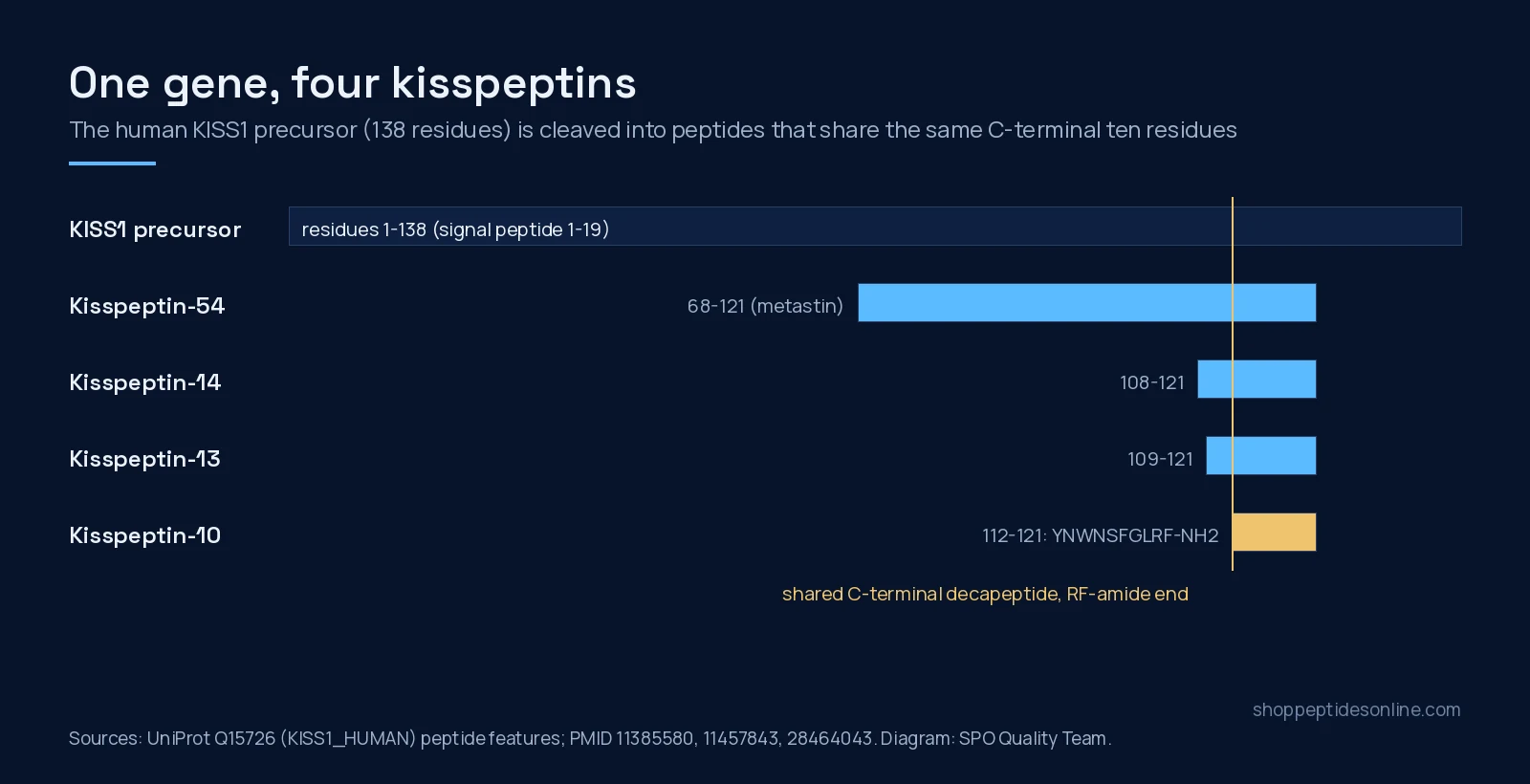
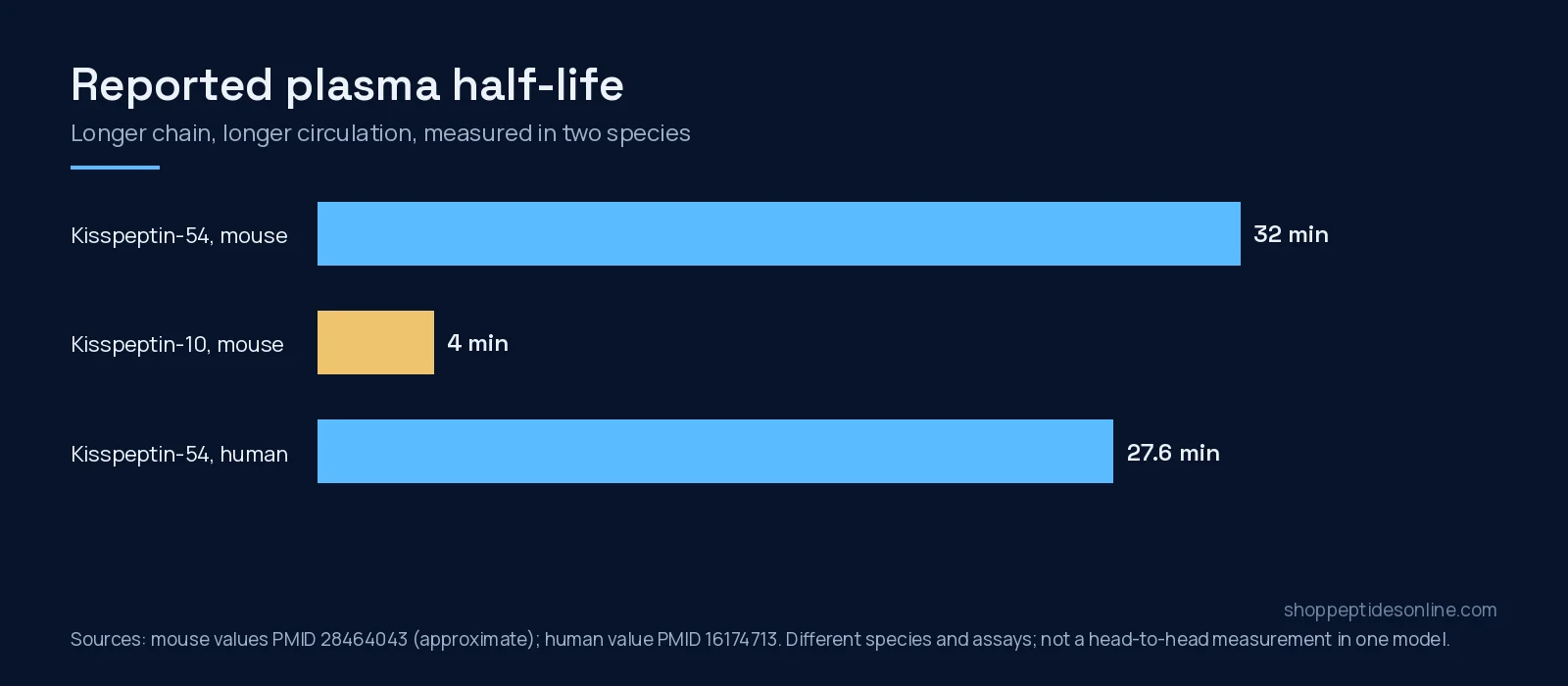
Short answer: kisspeptin-10 and kisspeptin-54 come from the same gene and activate the same receptor, KISS1R (GPR54). Kisspeptin-10 is simply the last ten residues of kisspeptin-54, and those ten residues are the part that binds the receptor[1],[2]. The difference is behaviour in vivo. In male mice, kisspeptin-54 circulated for about 32 minutes against about 4 minutes for kisspeptin-10. It sustained LH release far longer, and repeated kisspeptin-10 doses did not reproduce that effect[2]. In healthy men, however, the two gave similar gonadotrophin responses at the doses tested[3]. So “which is stronger” depends on the species, the route and the endpoint.
From a melanoma gene to a reproductive hormone
KiSS-1 was first reported in 1996 as a gene expressed in melanoma cells whose metastatic ability had been suppressed[4]. In 2001 two groups isolated its peptide products from human placenta. One named the 54-residue C-terminally amidated product “metastin” and found it was the ligand of an orphan GPCR[5]. The other isolated 54-, 14- and 13-residue peptides with a shared RF-amide C-terminus, named them kisspeptins, and showed low-nanomolar binding to rat and human GPR54[1].
The reproductive role came two years later. Loss-of-function mutations in GPR54 were found in families with hypogonadotropic hypogonadism, and in mice lacking the receptor[6],[7]. An inactivating mutation in KISS1 itself was reported in 2012[8]. Kisspeptin was then shown to stimulate GnRH release directly through GPR54[9].
The forms, side by side
| Form | Precursor residues (UniProt Q15726) | What the research reports |
|---|---|---|
| Kisspeptin-54 (metastin) | 68–121 | Isolated from placenta; plasma half-life about 32 min in mice and 27.6 min in men[5],[2],[10] |
| Kisspeptin-14 | 108–121 | Isolated from placenta with the 54 and 13 forms[1] |
| Kisspeptin-13 | 109–121 | Isolated from placenta; shares the RF-amide C-terminus[1] |
| Kisspeptin-10 | 112–121, YNWNSFGLRF-NH2 | Minimal active sequence; half-life about 4 min in mice; degrades within minutes in rat plasma[2],[11] |
Kisspeptin-10’s identifiers are PubChem CID 25240297, C63H83N17O14, about 1302.4 g/mol. Structure-activity work found that positions 6 and 10 of kisspeptin-10 are critical for its action at KISS1R. Substituting alanine at position 10 fully disrupted the helix in the C-terminal region[12].
Why length matters in vivo
A 2017 mouse study by d’Anglemont de Tassigny and colleagues is the clearest direct test. After systemic injection, kisspeptin-54 sustained LH release much longer than kisspeptin-10. The authors then gave kisspeptin-10 repeatedly to offset its shorter half-life, but it still did not reproduce the sustained LH rise. Only peripherally given kisspeptin-54 activated c-FOS in GnRH neurons behind the blood-brain barrier[2]. Their reading was that the difference is not only about clearance.
Stability is part of the picture too. In an LC-MS/MS study in rat plasma, kisspeptin-10 decomposed with half-lives of 6.8, 2.9 and 1.7 minutes at 4, 25 and 37 °C. The main product was the peptide missing its N-terminal tyrosine[11]. For anyone measuring kisspeptin-10 in biological samples, handling temperature changes the result within minutes.
Human data complicate a simple “54 is stronger” story. In a direct intravenous comparison in healthy men, kisspeptin-10 and kisspeptin-54 produced similar gonadotrophin secretion at the doses tested, and GnRH was more potent than either[3]. Separate human studies characterised each form alone: kisspeptin-54 raised LH, FSH and testosterone in male volunteers[10], and kisspeptin-10 boluses raised LH and pulse frequency in men[13].
Results that cut the other way
- Desensitisation. In juvenile male rhesus monkeys, a continuous infusion of human metastin 45-54 (the kisspeptin-10 sequence) desensitised GPR54. A further kisspeptin bolus no longer produced an LH pulse, while NMDA and GnRH boluses still did[14].
- Non-linear responses. In the kisspeptin-10 study in men, a higher bolus gave a smaller LH response than a lower one[13].
- Rat testis. Long-term kisspeptin-10 in prepubertal rats caused dose-dependent degenerative changes in the maturing testis[15].
The same peptide can stimulate the axis acutely and suppress it with continuous exposure. Investigational analogues TAK-448 and TAK-683 have been profiled against the GnRH analogue leuprolide in adult male rats[16].
Which form turns up in which models
Kisspeptin-10 dominates animal and structure-activity work because it is short, cheap to synthesise and carries the receptor-binding sequence. Because the ten-residue form is also the one that degrades fastest, results obtained with it partly reflect its short exposure. It has been used in rat GnRH pulse-generator studies[17] and in juvenile monkeys[18]. Kisspeptin-54 is the form most used in the human investigational literature from Imperial College London, including an IVF study and research on sexual and emotional brain processing[19],[20]. Kisspeptin is also under study as a diagnostic test of hypothalamic function[21]. All of this is investigational work in defined settings, not evidence of benefit.
SPO stocks kisspeptin-10. The kisspeptin research overview has the full study table, and the Kisspeptin-10 10mg page lists the product’s identity data. At about 1302 Da, kisspeptin-10 should give an unambiguous mass match on a batch certificate; our explainer on HPLC purity versus MS identity shows what to look for. Labs comparing sources can also read our notes on how to buy peptides online in Canada.
Frequently asked questions
What is the difference between kisspeptin-10 and kisspeptin-54?
Kisspeptin-10 is the last ten residues (112-121) of kisspeptin-54 (68-121). Both activate KISS1R (GPR54). The longer form circulates longer: about 32 versus 4 minutes in mice.
Is kisspeptin-54 more potent than kisspeptin-10?
In male mice, kisspeptin-54 sustained LH release far longer. In a direct intravenous comparison in healthy men, the two gave similar gonadotrophin responses at the doses tested.
Do the forms bind different receptors?
No. Kisspeptin-54, -14, -13 and -10 share the same RF-amide C-terminal decapeptide and all act on KISS1R, also called GPR54.
Why does continuous kisspeptin exposure reduce the response?
The receptor desensitises. In juvenile male rhesus monkeys, continuous infusion of the kisspeptin-10 sequence stopped a further kisspeptin bolus from producing an LH pulse, while GnRH still worked.
Is kisspeptin-10 stable in plasma?
Not for long. In rat plasma it decomposed with half-lives of 1.7 to 6.8 minutes depending on temperature, mainly by losing its N-terminal tyrosine.
References
- Kotani M, Detheux M, Vandenbogaerde A et al. (2001). The metastasis suppressor gene KiSS-1 encodes kisspeptins, the natural ligands of the orphan G protein-coupled receptor GPR54. J Biol Chem. PMID: 11457843. doi: 10.1074/jbc.M104847200.
- d’Anglemont de Tassigny X, Jayasena CN, Murphy KG et al. (2017). Mechanistic insights into the more potent effect of KP-54 compared to KP-10 in vivo. PLoS One. PMID: 28464043. doi: 10.1371/journal.pone.0176821.
- Jayasena CN, Abbara A, Narayanaswamy S et al. (2015). Direct comparison of the effects of intravenous kisspeptin-10, kisspeptin-54 and GnRH on gonadotrophin secretion in healthy men. Hum Reprod. PMID: 26089302. doi: 10.1093/humrep/dev143.
- Lee JH, Miele ME, Hicks DJ et al. (1996). KiSS-1, a novel human malignant melanoma metastasis-suppressor gene. J Natl Cancer Inst. PMID: 8944003. doi: 10.1093/jnci/88.23.1731.
- Ohtaki T, Shintani Y, Honda S et al. (2001). Metastasis suppressor gene KiSS-1 encodes peptide ligand of a G-protein-coupled receptor. Nature. PMID: 11385580. doi: 10.1038/35079135.
- de Roux N, Genin E, Carel JC et al. (2003). Hypogonadotropic hypogonadism due to loss of function of the KiSS1-derived peptide receptor GPR54. Proc Natl Acad Sci U S A. PMID: 12944565. doi: 10.1073/pnas.1834399100.
- Seminara SB, Messager S, Chatzidaki EE et al. (2003). The GPR54 gene as a regulator of puberty. N Engl J Med. PMID: 14573733. doi: 10.1056/NEJMoa035322.
- Topaloglu AK, Tello JA, Kotan LD et al. (2012). Inactivating KISS1 mutation and hypogonadotropic hypogonadism. N Engl J Med. PMID: 22335740. doi: 10.1056/NEJMoa1111184.
- Messager S, Chatzidaki EE, Ma D et al. (2005). Kisspeptin directly stimulates gonadotropin-releasing hormone release via G protein-coupled receptor 54. Proc Natl Acad Sci U S A. PMID: 15665093. doi: 10.1073/pnas.0409330102.
- Dhillo WS, Chaudhri OB, Patterson M et al. (2005). Kisspeptin-54 stimulates the hypothalamic-pituitary gonadal axis in human males. J Clin Endocrinol Metab. PMID: 16174713. doi: 10.1210/jc.2005-1468.
- Liu Z, Ren C, Jones W et al. (2013). LC-MS/MS quantification of a neuropeptide fragment kisspeptin-10 (NSC 741805) and characterization of its decomposition product and pharmacokinetics in rats. J Chromatogr B Analyt Technol Biomed Life Sci. PMID: 23524040. doi: 10.1016/j.jchromb.2013.02.027.
- Gutiérrez-Pascual E, Leprince J, Martínez-Fuentes AJ et al. (2009). In vivo and in vitro structure-activity relationships and structural conformation of Kisspeptin-10-related peptides. Mol Pharmacol. PMID: 19389922. doi: 10.1124/mol.108.053751.
- George JT, Veldhuis JD, Roseweir AK et al. (2011). Kisspeptin-10 is a potent stimulator of LH and increases pulse frequency in men. J Clin Endocrinol Metab. PMID: 21632807. doi: 10.1210/jc.2011-0089.
- Seminara SB, Dipietro MJ, Ramaswamy S et al. (2006). Continuous human metastin 45-54 infusion desensitizes G protein-coupled receptor 54-induced gonadotropin-releasing hormone release monitored indirectly in the juvenile male Rhesus monkey (Macaca mulatta): a finding with therapeutic implications. Endocrinology. PMID: 16469799. doi: 10.1210/en.2005-1550.
- Ramzan F, Qureshi IZ (2011). Intraperitoneal kisspeptin-10 administration induces dose-dependent degenerative changes in maturing rat testes. Life Sci. PMID: 21112339. doi: 10.1016/j.lfs.2010.11.019.
- Matsui H, Masaki T, Akinaga Y et al. (2014). Pharmacologic profiles of investigational kisspeptin/metastin analogues, TAK-448 and TAK-683, in adult male rats in comparison to the GnRH analogue leuprolide. Eur J Pharmacol. PMID: 24747751. doi: 10.1016/j.ejphar.2014.03.058.
- Kinsey-Jones JS, Li XF, Luckman SM et al. (2008). Effects of kisspeptin-10 on the electrophysiological manifestation of gonadotropin-releasing hormone pulse generator activity in the female rat. Endocrinology. PMID: 18063679. doi: 10.1210/en.2007-1505.
- Plant TM, Ramaswamy S, Dipietro MJ (2006). Repetitive activation of hypothalamic G protein-coupled receptor 54 with intravenous pulses of kisspeptin in the juvenile monkey (Macaca mulatta) elicits a sustained train of gonadotropin-releasing hormone discharges. Endocrinology. PMID: 16282350. doi: 10.1210/en.2005-1261.
- Jayasena CN, Abbara A, Comninos AN et al. (2014). Kisspeptin-54 triggers egg maturation in women undergoing in vitro fertilization. J Clin Invest. PMID: 25036713. doi: 10.1172/JCI75730.
- Comninos AN, Wall MB, Demetriou L et al. (2017). Kisspeptin modulates sexual and emotional brain processing in humans. J Clin Invest. PMID: 28112678. doi: 10.1172/JCI89519.
- Pierret ACS, Patel AH, Daniels E et al. (2026). Kisspeptin as a test of hypothalamic dysfunction in pubertal and reproductive disorders. Andrology. PMID: 39834030. doi: 10.1111/andr.13843.