
Your cart is currently empty!.
You may check out all the available products and buy some in the shop.
Continue ShoppingShop Peptides Online carries NAD+ in a 1000mg research vial. The listing below shows the current price, stock status and available batch documentation.
For laboratory research use only. Not for human consumption. Shop Peptides Online does not provide dosing or administration guidance.
NAD+ in a 1000mg vial for laboratory research.
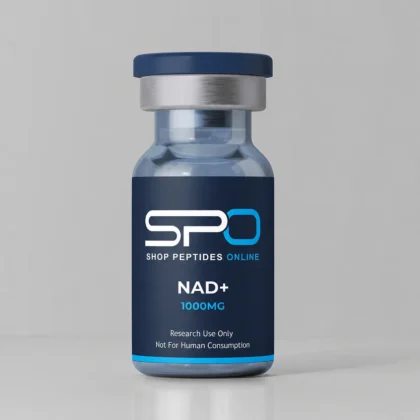
Bacteriostatic water and alcohol pads, listed separately.
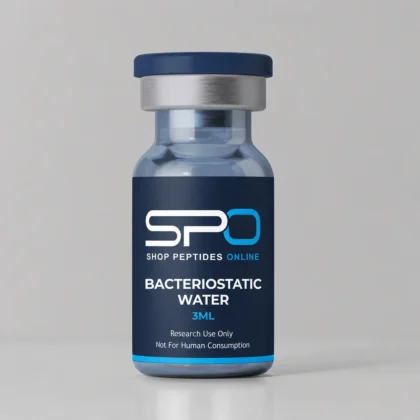
Check the current price and stock status on the NAD+ listing, and confirm the item in your cart before checkout.
A batch-specific COA for NAD+ 1000MG has not been posted yet — see the COA library. When one is posted, match the product name, strength and batch to the document before relying on it. The rest of our range is on the buy peptides online in Canada page.
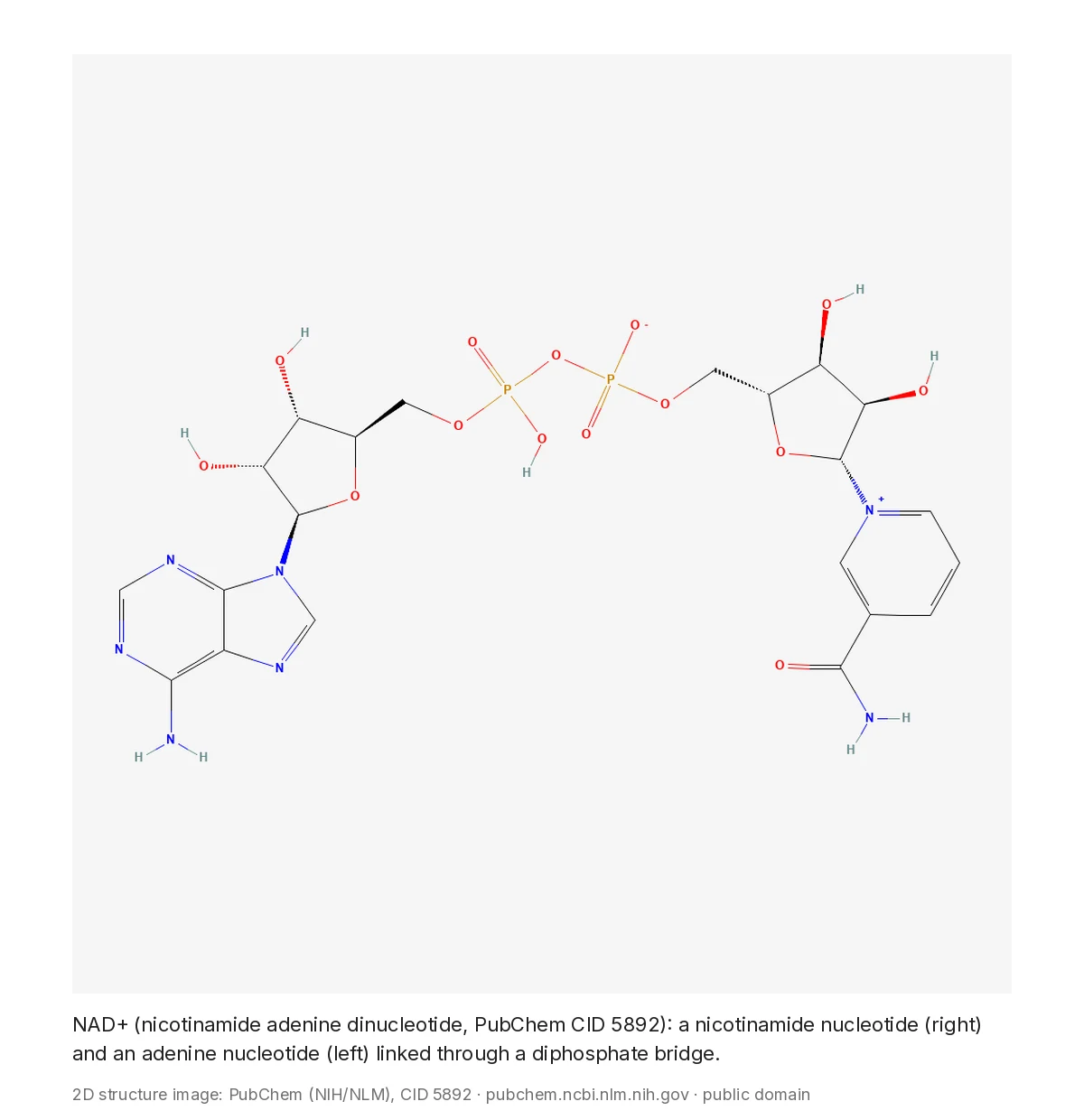
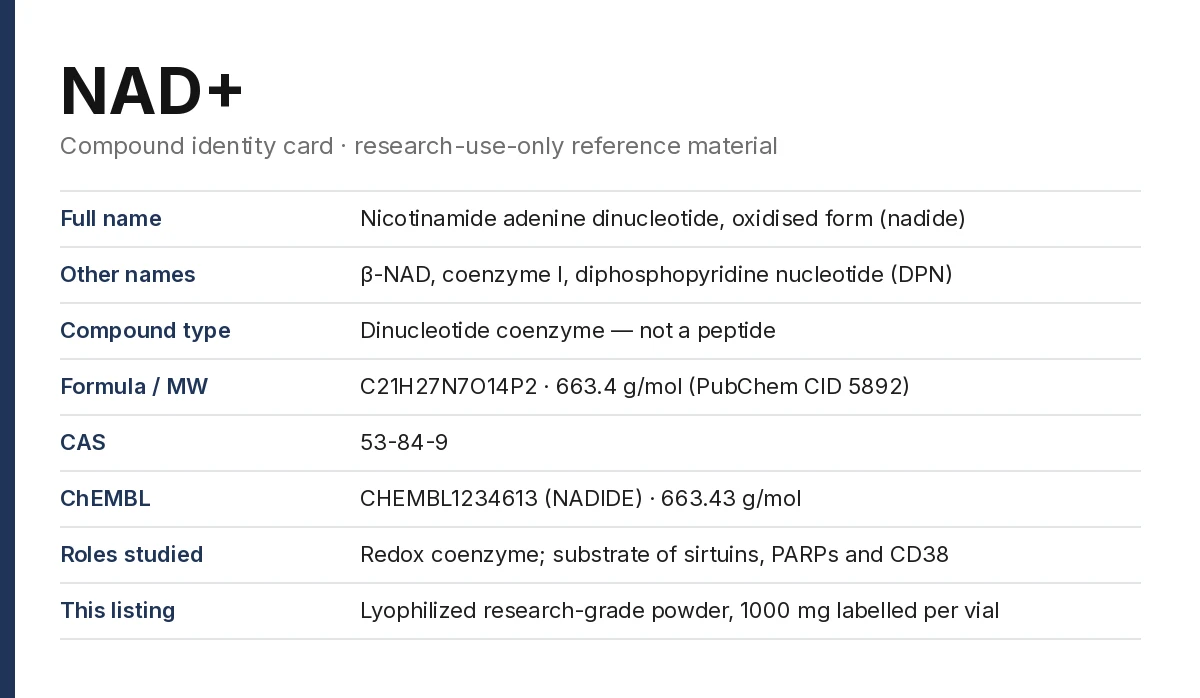
NAD+ (nicotinamide adenine dinucleotide, oxidised form; PubChem title “nadide”) is a coenzyme found in all living cells. It carries electrons in oxidation–reduction reactions, which puts it at the centre of energy metabolism, and it is also consumed as a substrate by non-redox enzymes, notably the sirtuins, CD38 and the poly(ADP-ribose) polymerases (PARPs)[1, 2]. Unlike almost everything else in this catalogue, NAD+ is not a peptide: it is a dinucleotide, two nucleotides joined through a diphosphate bridge (PubChem CID 5892). The 1000mg vial listed here is research-grade material sold for laboratory research only.
NAD+ research used to be the domain of enzymology, because NAD(H) and NADP(H) were seen mainly as co-factors in redox reactions such as mitochondrial electron transport. That picture has widened: NAD pathway metabolites are now linked to signalling, post-translational modification, epigenetic change and RNA capping, and the non-redox reactions steadily break the molecule down, which makes NAD metabolism unusually dynamic[3]. Reviews connect NAD+ with DNA repair, chromatin remodelling, cellular senescence and immune-cell function[1], and with the question of whether its concentration changes during ageing[2].
| Name | NAD+ (β-nicotinamide adenine dinucleotide, oxidised; nadide) |
|---|---|
| Other names | Coenzyme I, diphosphopyridine nucleotide (DPN), β-NAD |
| Molecular formula | C21H27N7O14P2 |
| Molecular weight | 663.4 g/mol (PubChem); 663.43 g/mol (ChEMBL). ChEMBL also holds a separate cationic record, C21H28N7O14P2+, at 664.44 g/mol — the same molecule drawn with one extra proton |
| PubChem CID | 5892 |
| CAS | 53-84-9 |
| ChEMBL | CHEMBL1234613 |
| Compound class | Dinucleotide coenzyme (not a peptide) |
| Listed form here | Lyophilized powder, 1000 mg labelled per vial |
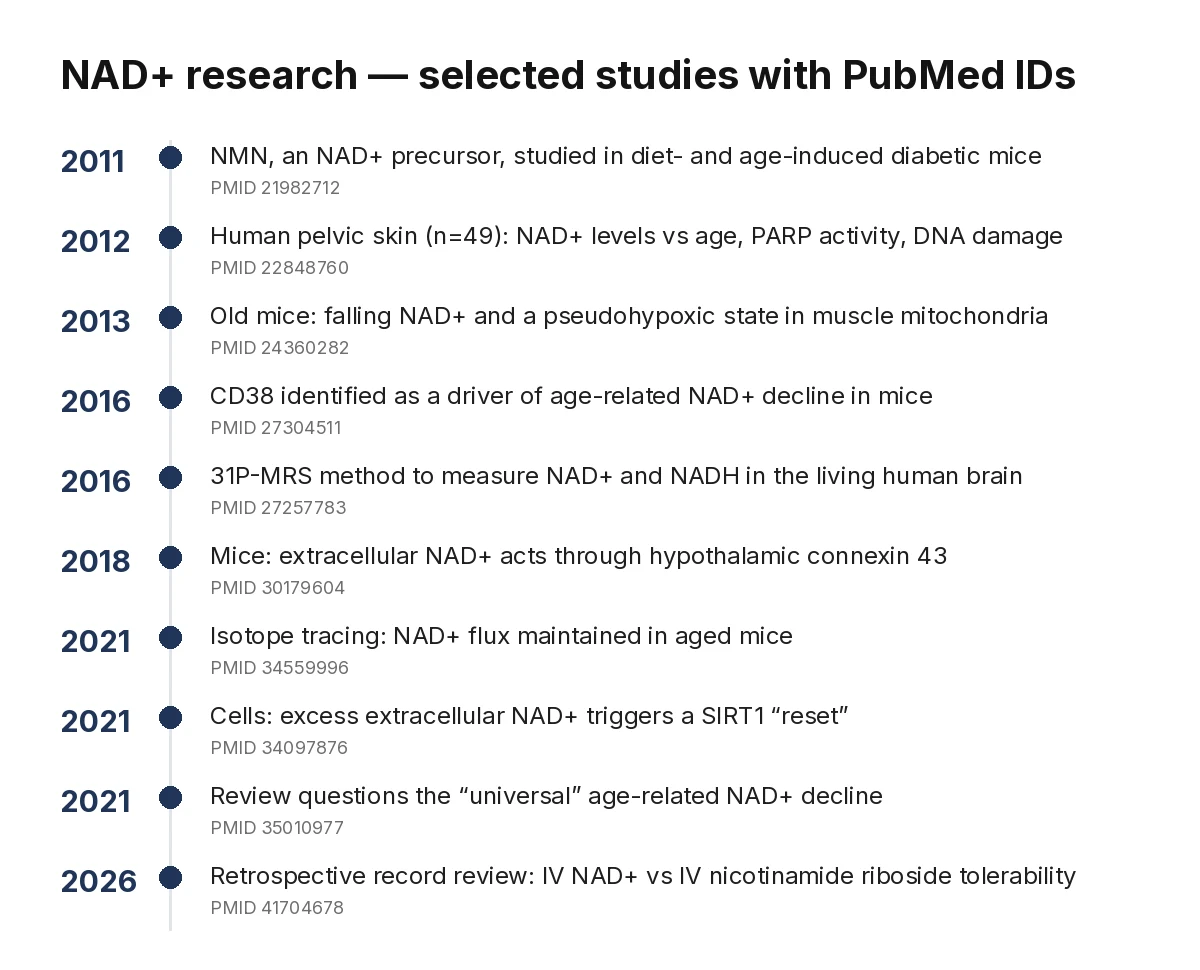
In pelvic skin samples from 49 people (newborns and patients aged 15–77 having unrelated surgery), NAD+ levels correlated negatively with age in both sexes, while PARP activity rose with age in men and tracked inversely with NAD+; the authors proposed that PARP activation by accumulated DNA damage drives NAD+ breakdown[5]. Methods to measure NAD in the living brain have also been developed: a 31P magnetic resonance spectroscopy assay quantified cerebral NAD concentration and NAD+/NADH redox state at a clinical field strength of 4 T[14]. A 2021 review, however, found the evidence for an across-the-board age-related decline “very limited and often restricted to a single tissue or cell type”, especially in humans[6].
Isotope-tracing work in aged mice found only a modest tissue NAD+ fall (median about 30%) with synthesis unimpaired; turnover of the smaller pool was faster, pointing to greater consumption rather than reduced production[7]. One consuming enzyme is CD38: its expression and activity rose with age in mice, and it was required for the age-related NAD decline and mitochondrial dysfunction, partly through SIRT3[8]. In ageing mouse muscle, falling NAD+ was linked to a “pseudohypoxic” state that disrupted nuclear–mitochondrial communication, and raising NAD+ restored mitochondrial function in a SIRT1-dependent way[9]. Much of the intervention work uses precursors rather than NAD+ itself — for example nicotinamide mononucleotide (NMN) in high-fat-diet and aged mice[10] — and a 2018 review of the in-vivo evidence covers those precursor molecules[11].
How NAD+ added from outside reaches cells is still debated. In HeLa cells, excess extracellular NAD+ triggered a SIRT1-dependent “reset” that brought intracellular levels back to normal by cutting uptake of its breakdown products, reducing CD73, the SLC12A8 transporter and nicotinamide riboside kinase[12]. In mouse hypothalamic cells, by contrast, extracellular NAD was imported through connexin 43 independently of CD73, and in mice NAD given centrally or peripherally raised hypothalamic NAD and changed fasting-induced feeding[13].
| Year | Model | What was investigated | PMID |
|---|---|---|---|
| 2011 | Mouse (high-fat diet, aged) | NAMPT-mediated NAD+ synthesis; NMN as a precursor | PMID 21982712 |
| 2012 | Human skin tissue (n=49) | NAD+, PARP, SIRT1 activity, DNA damage and lipid oxidation vs age | PMID 22848760 |
| 2013 | Mouse muscle | NAD+ decline, pseudohypoxia and nuclear–mitochondrial communication | PMID 24360282 |
| 2016 | Mouse (CD38 knockout) | CD38 as driver of age-related NAD decline; SIRT3 | PMID 27304511 |
| 2016 | Human brain, 31P-MRS at 4 T | Non-invasive NAD and NAD+/NADH measurement | PMID 27257783 |
| 2018 | Mouse, N1 hypothalamic cells | Uptake of extracellular NAD via connexin 43; feeding and SIRT1/FOXO1 | PMID 30179604 |
| 2021 | Mouse, isotope tracing | NAD+ synthesis, turnover and consumption in aged tissues | PMID 34559996 |
| 2021 | HeLa and other cells | SIRT1-mediated response to excess extracellular NAD+ | PMID 34097876 |
| 2021 | Review (mouse, monkey, human) | Whether NAD+ really declines with age | PMID 35010977 |
| 2026 | Human, retrospective records | Tolerability of intravenous NAD+ vs nicotinamide riboside | PMID 41704678 |
| 2026 | Systematic review | Preclinical and clinical NAD+ augmentation studies | PMID 41655607 |
Most human NAD research gives precursors by mouth, not NAD+. A 2026 systematic review found that oral nicotinamide riboside and NMN raised NAD-related markers and were generally well tolerated, but that effects on functional and metabolic outcomes were heterogeneous and often null, and it identified no eligible outcome trials of intravenous or intramuscular NAD+ itself[16]. A retrospective review of records from a commercial infusion setting compared intravenous NAD+ with intravenous nicotinamide riboside: people receiving NAD+ reported moderate to severe gastrointestinal symptoms, increased heart rate and chest pressure during infusions, which lengthened infusion times, and all symptoms resolved once infusions ended[15]. This page gives no dosing or administration information, and nothing here is a claim of benefit in people.
NAD+ 1000MG is supplied as lyophilized powder in a sealed vial. Keep it frozen at −20 °C, dry and protected from light, and avoid repeated freeze–thaw cycles. Solvents such as bacteriostatic water are listed separately, and preparation methods are set by the researcher.
No. NAD+ is a dinucleotide coenzyme (C21H27N7O14P2, 663.4 g/mol, PubChem CID 5892). It is sold alongside peptides because it is used in the same kinds of laboratory work.
It carries electrons in redox reactions and is consumed by enzymes such as sirtuins, PARPs and CD38 (PMID 33353981). Cells rebuild it mainly through the NAMPT salvage pathway (PMID 35203360).
Very little. A 2026 systematic review found no eligible outcome trials of intravenous or intramuscular NAD+ (PMID 41655607); most human studies give oral precursors instead. This page gives no dosing or administration information.
A batch-specific COA for this strength has not been posted yet — see the COA library (/coa/). We do not substitute a report from another product or strength.