For laboratory research only. Not for human or animal use. This article gives no dosing, administration or therapeutic advice.
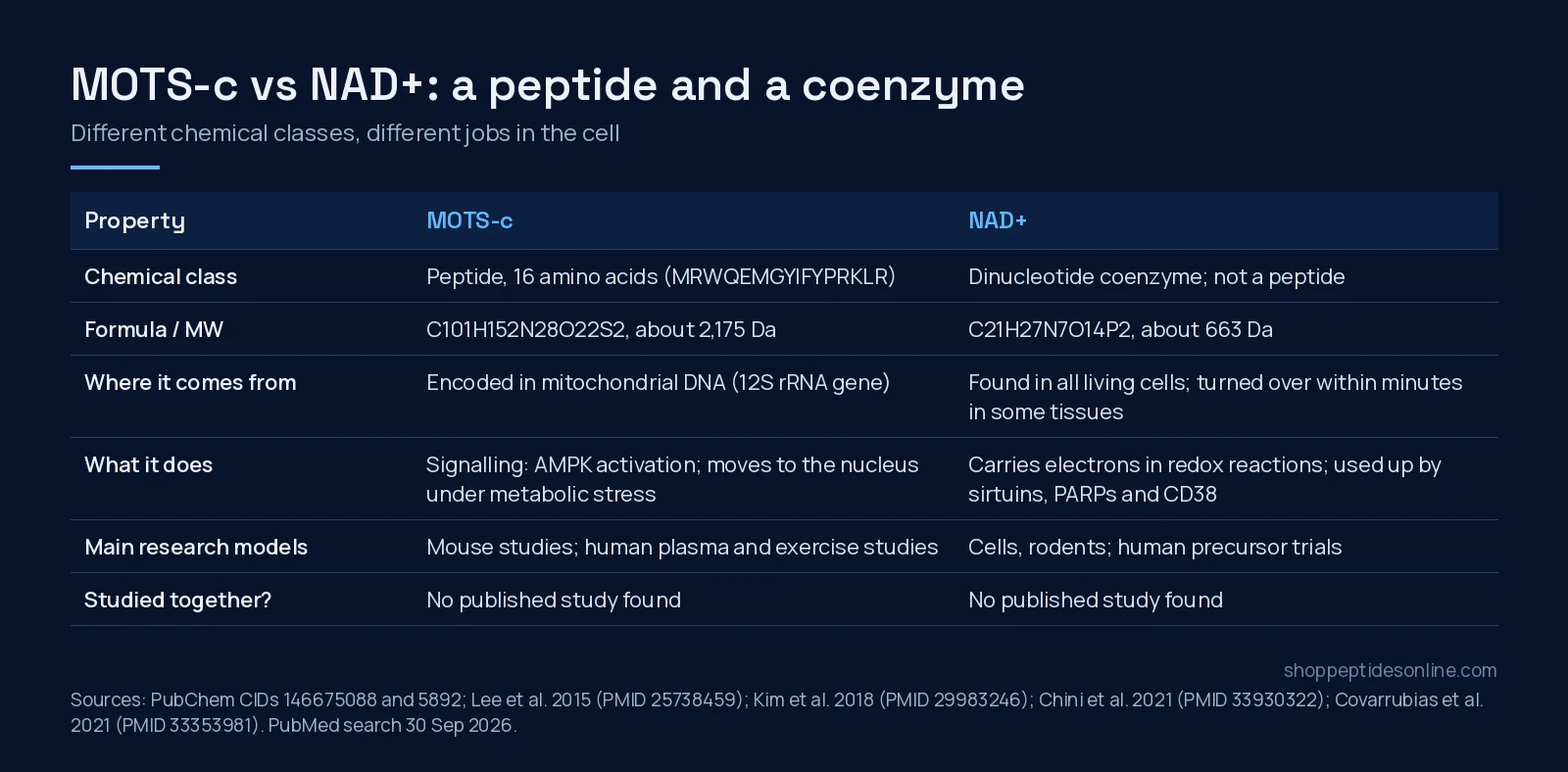
Short answer: MOTS-c and NAD+ are often mentioned together because both relate to mitochondria and metabolism, but they belong to different chemical classes. MOTS-c is a 16-amino-acid peptide encoded in mitochondrial DNA that acts as a signal.[1] NAD+ is a dinucleotide coenzyme present in every living cell, used to carry electrons and consumed by enzymes such as sirtuins and PARPs.[2],[3] One is a message; the other is working material. No published study has tested the two together.
What each molecule is
| MOTS-c | NAD+ | |
|---|---|---|
| What it is | A 16-residue peptide, MRWQEMGYIFYPRKLR (PubChem CID 146675088, about 2,175 Da)[1] | Nicotinamide adenine dinucleotide, a coenzyme (PubChem CID 5892, about 663 Da)[2] |
| Encoded by | Mitochondrial DNA, inside the 12S rRNA gene[1] | Not encoded; synthesised and recycled by enzymes in all cells[2],[4] |
| Main role | A signal: acts on the folate cycle and AMPK, and can enter the nucleus[1],[5] | A redox carrier and a substrate consumed by sirtuins, PARPs and CD38[3] |
| Changes with age | Reported in mouse studies; human data are plasma and exercise measurements[6] | Declines in some tissues; how general that is remains disputed[7],[8] |
| Human genetics | A variant (m.1382A>C, K14Q) linked to type 2 diabetes prevalence in men in a 27,527-person meta-analysis[9] | Not applicable in the same way |
| Human intervention data | No published interventional trial of MOTS-c found | Trials mostly of precursors (NR, NMN), not NAD+ itself[10] |
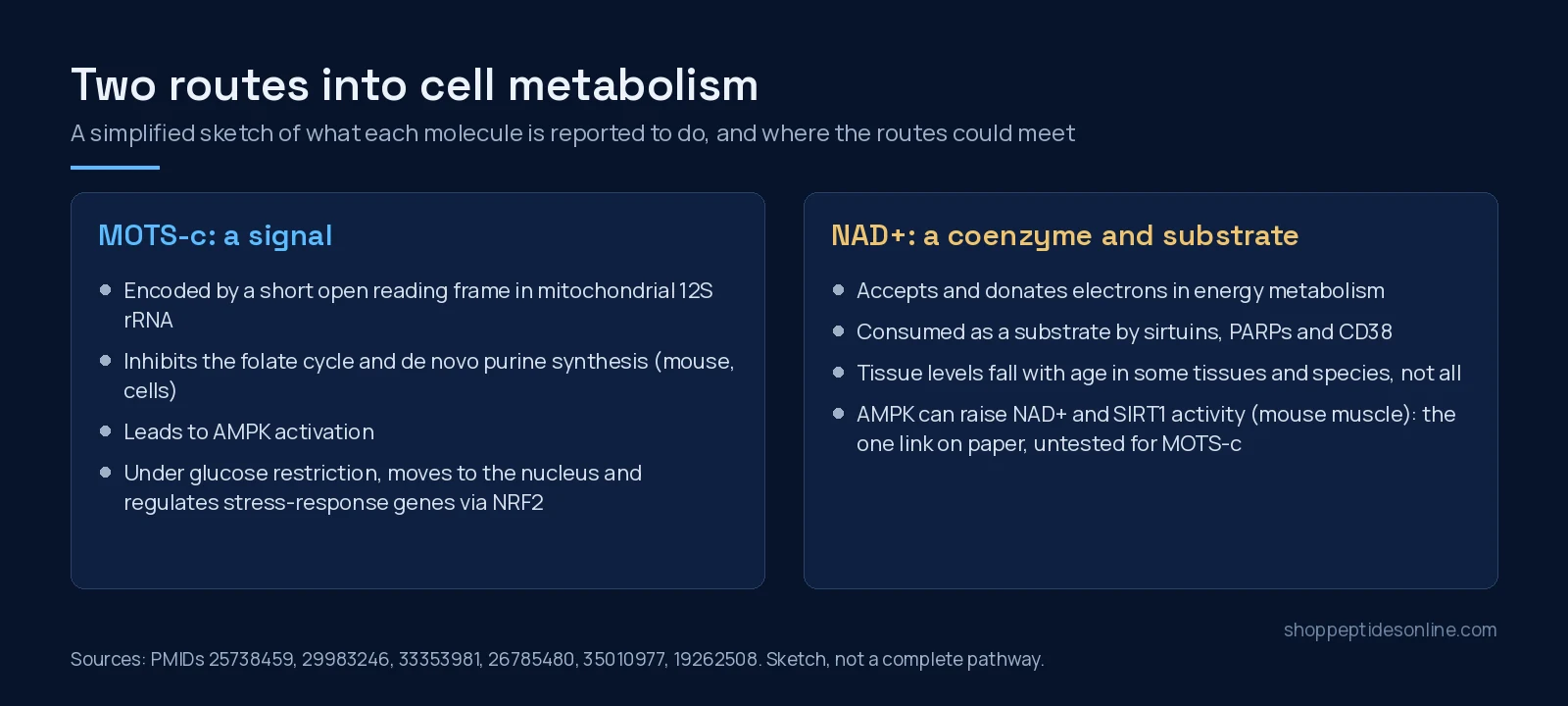
The chemistry sets the rest of the comparison. MOTS-c was found in 2015 as a short open reading frame inside the mitochondrial 12S rRNA gene. Its reported cellular actions start with inhibition of the folate cycle and the de novo purine synthesis tied to it, which leads to activation of AMPK, and its main target organ in mice appeared to be skeletal muscle.[1] In 2018 the same group showed that under glucose restriction MOTS-c moves into the nucleus and regulates a broad set of genes, including antioxidant-response genes, in an AMPK-dependent way.[5]
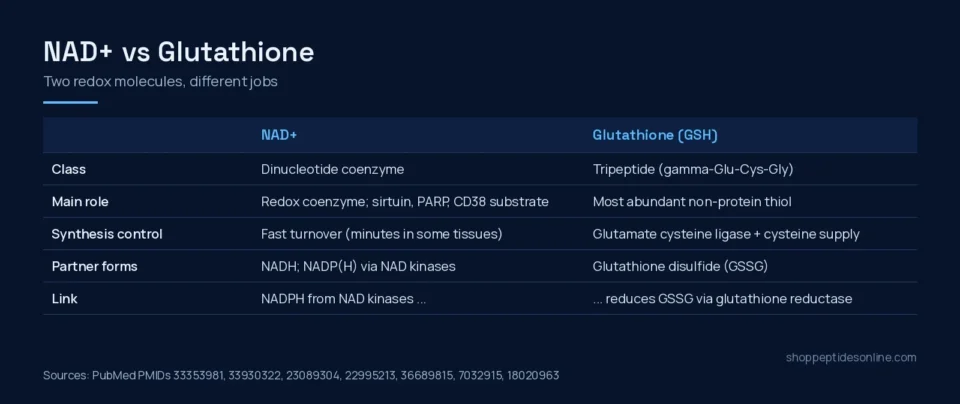
NAD+ is not a signal in that sense. It shuttles electrons between redox reactions and is also a co-substrate that NAD+-consuming enzymes break down as they work.[2] Because that consumption is constant, NAD metabolism is fast: some tissues turn over their pool within minutes.[4]
Where the two could meet
On paper there is one plausible link. MOTS-c activates AMPK in the 2015 mouse and cell work.[1] Separately, a 2009 mouse muscle study found that AMPK raises cellular NAD+ levels and with them SIRT1 activity.[11] That makes it reasonable to ask whether MOTS-c changes NAD+ in muscle. Nobody has published the answer. A PubMed search for MOTS-c together with NAD+ on 30 September 2026 returned no study measuring both; the two results were unrelated biomarker papers. Anything written about “stacking” the two rests on that gap, not on data.
The research, by model
| Study | Molecule | Model | Result | Limit |
|---|---|---|---|---|
| Lee 2015[1] | MOTS-c | Mice; cultured cells | Skeletal muscle as main target; folate-cycle inhibition and AMPK activation; better insulin sensitivity on a high-fat diet | Mouse metabolism |
| Kim 2018[5] | MOTS-c | Cells under glucose restriction | Moves to the nucleus and regulates stress-response genes, interacting with NRF2 | Cell culture |
| Cataldo 2018[12] | MOTS-c | Lean vs obese adults, 10 per group | Plasma levels were similar in both groups | Small, observational |
| Dieli-Conwright 2021[13] | MOTS-c | Breast cancer survivors in a 16-week exercise trial | Plasma MOTS-c rose with exercise in non-Hispanic White participants but not in Hispanic participants | Secondary analysis; endogenous peptide only |
| Camacho-Pereira 2016[14] | NAD+ | Aged mice | The NAD-degrading enzyme CD38 rises with age and is required for the age-related NAD decline | Mouse |
| McReynolds 2021[8] | NAD+ | Aged mice, isotope tracing | Modest tissue decline (median about 30%) while total production was maintained | Mouse |
| Buonvicino 2021[15] | NAD+ added outside cells | Cultured cells | Intracellular NAD+ rose, then returned to control levels | Cell culture |
| Gallagher 2026[10] | NAD+ and precursors | Systematic review: 33 human and 80 rodent studies | Precursors raised NAD markers in people; functional outcomes were mixed or null | No outcome trial of NAD+ itself was eligible |
Several results in that table cut against the simple story. Plasma MOTS-c did not differ between lean and obese adults, and its link with insulin sensitivity held only in the lean group.[12] Exercise raised circulating MOTS-c in one group of breast cancer survivors but not in another.[13] On the NAD+ side, a 2021 review of NAD+ levels across yeast, worms, rodents, monkeys and humans found the evidence for a general age-related decline “very limited” and often confined to a single tissue.[7] Isotope tracing in aged mice pointed to a modest drop in concentration with production intact.[8]
Human genetics adds a twist for MOTS-c. An East-Asian mitochondrial variant changes one residue of the peptide (K14Q). In a meta-analysis of three cohorts totalling 27,527 people, men carrying it had a higher prevalence of type 2 diabetes, and the variant peptide was less active in mice and cell assays.[9] In mice, MOTS-c has also been studied in young, middle-aged and old animals for physical performance, and exercise raises the body’s own MOTS-c in human muscle and blood.[6]
Where the human evidence stands
Neither molecule has an approved product. For MOTS-c, the human literature consists of measurements of the body’s own peptide and genetic association studies; we found no published interventional trial. For NAD+, a 2026 systematic review of 113 studies found that the precursors nicotinamide riboside and nicotinamide mononucleotide reliably raised NAD-related markers in people but had mixed or null effects on functional and metabolic outcomes. It found no eligible outcome trial of NAD+ itself.[10] Cell work also hints at why NAD+ and its precursors behave differently: in cultured cells exposed to extracellular NAD+, internal levels rose and then reset to baseline.[15]
What this means for a lab comparing them
For research design, the two answer different questions. MOTS-c is a tool for studying mitochondria-to-nucleus signalling and AMPK-linked metabolism. NAD+ is a tool for studying redox balance and the enzymes that consume it. Treating them as interchangeable “energy” compounds loses that distinction. Neither SPO listing has a batch-specific COA posted yet; check the COA library for updates.
The MOTS-c research hub and the NAD+ research hub carry the full identity data and study tables. The NAD+ listing is NAD+ 1000mg. For how SPO ships research compounds within Canada, see how to buy peptides online in Canada.
Frequently asked questions
Is MOTS-c a form of NAD+, or the other way round?
Neither. MOTS-c is a 16-amino-acid peptide encoded in mitochondrial DNA. NAD+ is a dinucleotide coenzyme built from nucleotides, not amino acids. They share a research theme, mitochondrial metabolism, but not a chemical class.
Has anyone studied MOTS-c and NAD+ together?
We found no published study. A PubMed search on 30 September 2026 returned no paper measuring both. The only link is indirect: MOTS-c activates AMPK in mouse and cell work, and AMPK was shown in mouse muscle to raise NAD+ levels.
Does NAD+ really decline with age?
In some tissues and models, yes, but a 2021 review across species found the evidence for a general decline limited and often restricted to one tissue. Isotope tracing in aged mice showed a modest drop in concentration while total NAD+ production was maintained.
Is there human trial data for either?
For MOTS-c, human studies measure the body’s own peptide or genetic variants; we found no published interventional trial. For NAD+, most human trials used precursors such as nicotinamide riboside and NMN, and a 2026 systematic review found no eligible outcome trial of NAD+ itself.
References
- Lee C, Zeng J, Drew BG et al. (2015). The mitochondrial-derived peptide MOTS-c promotes metabolic homeostasis and reduces obesity and insulin resistance. Cell Metab. PMID: 25738459. doi: 10.1016/j.cmet.2015.02.009.
- Verdin E (2015). NAD⁺ in aging, metabolism, and neurodegeneration. Science. PMID: 26785480. doi: 10.1126/science.aac4854.
- Covarrubias AJ, Perrone R, Grozio A et al. (2021). NAD(+) metabolism and its roles in cellular processes during ageing. Nat Rev Mol Cell Biol. PMID: 33353981. doi: 10.1038/s41580-020-00313-x.
- Chini CCS, Zeidler JD, Kashyap S et al. (2021). Evolving concepts in NAD(+) metabolism. Cell Metab. PMID: 33930322. doi: 10.1016/j.cmet.2021.04.003.
- Kim KH, Son JM, Benayoun BA et al. (2018). The Mitochondrial-Encoded Peptide MOTS-c Translocates to the Nucleus to Regulate Nuclear Gene Expression in Response to Metabolic Stress. Cell Metab. PMID: 29983246. doi: 10.1016/j.cmet.2018.06.008.
- Reynolds JC, Lai RW, Woodhead JST et al. (2021). MOTS-c is an exercise-induced mitochondrial-encoded regulator of age-dependent physical decline and muscle homeostasis. Nat Commun. PMID: 33473109. doi: 10.1038/s41467-020-20790-0.
- Peluso A, Damgaard MV, Mori MAS et al. (2021). Age-Dependent Decline of NAD(+)-Universal Truth or Confounded Consensus?. Nutrients. PMID: 35010977. doi: 10.3390/nu14010101.
- McReynolds MR, Chellappa K, Chiles E et al. (2021). NAD(+) flux is maintained in aged mice despite lower tissue concentrations. Cell Syst. PMID: 34559996. doi: 10.1016/j.cels.2021.09.001.
- Zempo H, Kim SJ, Fuku N et al. (2021). A pro-diabetogenic mtDNA polymorphism in the mitochondrial-derived peptide, MOTS-c. Aging (Albany NY). PMID: 33468709. doi: 10.18632/aging.202529.
- Gallagher C, Emmanuel OO (2026). NAD⁺ supplementation for anti-aging and wellness: A PRISMA-guided systematic review of preclinical and clinical evidence. Ageing Res Rev. PMID: 41655607. doi: 10.1016/j.arr.2026.103057.
- Cantó C, Gerhart-Hines Z, Feige JN et al. (2009). AMPK regulates energy expenditure by modulating NAD+ metabolism and SIRT1 activity. Nature. PMID: 19262508. doi: 10.1038/nature07813.
- Cataldo LR, Fernández-Verdejo R, Santos JL et al. (2018). Plasma MOTS-c levels are associated with insulin sensitivity in lean but not in obese individuals. J Investig Med. PMID: 29593067. doi: 10.1136/jim-2017-000681.
- Dieli-Conwright CM, Sami N, Norris MK et al. (2021). Effect of aerobic and resistance exercise on the mitochondrial peptide MOTS-c in Hispanic and Non-Hispanic White breast cancer survivors. Sci Rep. PMID: 34413391. doi: 10.1038/s41598-021-96419-z.
- Camacho-Pereira J, Tarragó MG, Chini CCS et al. (2016). CD38 Dictates Age-Related NAD Decline and Mitochondrial Dysfunction through an SIRT3-Dependent Mechanism. Cell Metab. PMID: 27304511. doi: 10.1016/j.cmet.2016.05.006.
- Buonvicino D, Ranieri G, Pittelli M et al. (2021). SIRT1-dependent restoration of NAD+ homeostasis after increased extracellular NAD+ exposure. J Biol Chem. PMID: 34097876. doi: 10.1016/j.jbc.2021.100855.