
Your cart is currently empty!.
You may check out all the available products and buy some in the shop.
Continue ShoppingCompare TB-500 research peptide listings by strength, current price, stock and batch documentation — then read what “TB-500” actually names (thymosin β4, or its 17–23 fragment), where it came from, and what the rat, mouse and human literature has studied, with references. Shop Peptides Online carries TB-500 in 5mg and 10mg vials and in BPC-157/TB-500 blends.
For laboratory research use only. Not for human consumption. Shop Peptides Online does not provide dosing or administration guidance.
Single-compound TB-500 in 5mg and 10mg vials.


Combined BPC-157 and TB-500 vials in 10mg and 20mg. See the BPC-157 page for single-compound BPC-157.
Bacteriostatic water and alcohol pads, listed separately.
Pick the strength you need, then check the current price, stock status and COA shown on that listing. The single-compound vials and the blends are separate products, so confirm the exact item in your cart before checkout.
Available COAs for TB-500 are shown on the product page and in the COA library. Match the product name, strength and batch to the document before relying on it. The rest of the catalogue is on the buy peptides online in Canada page.
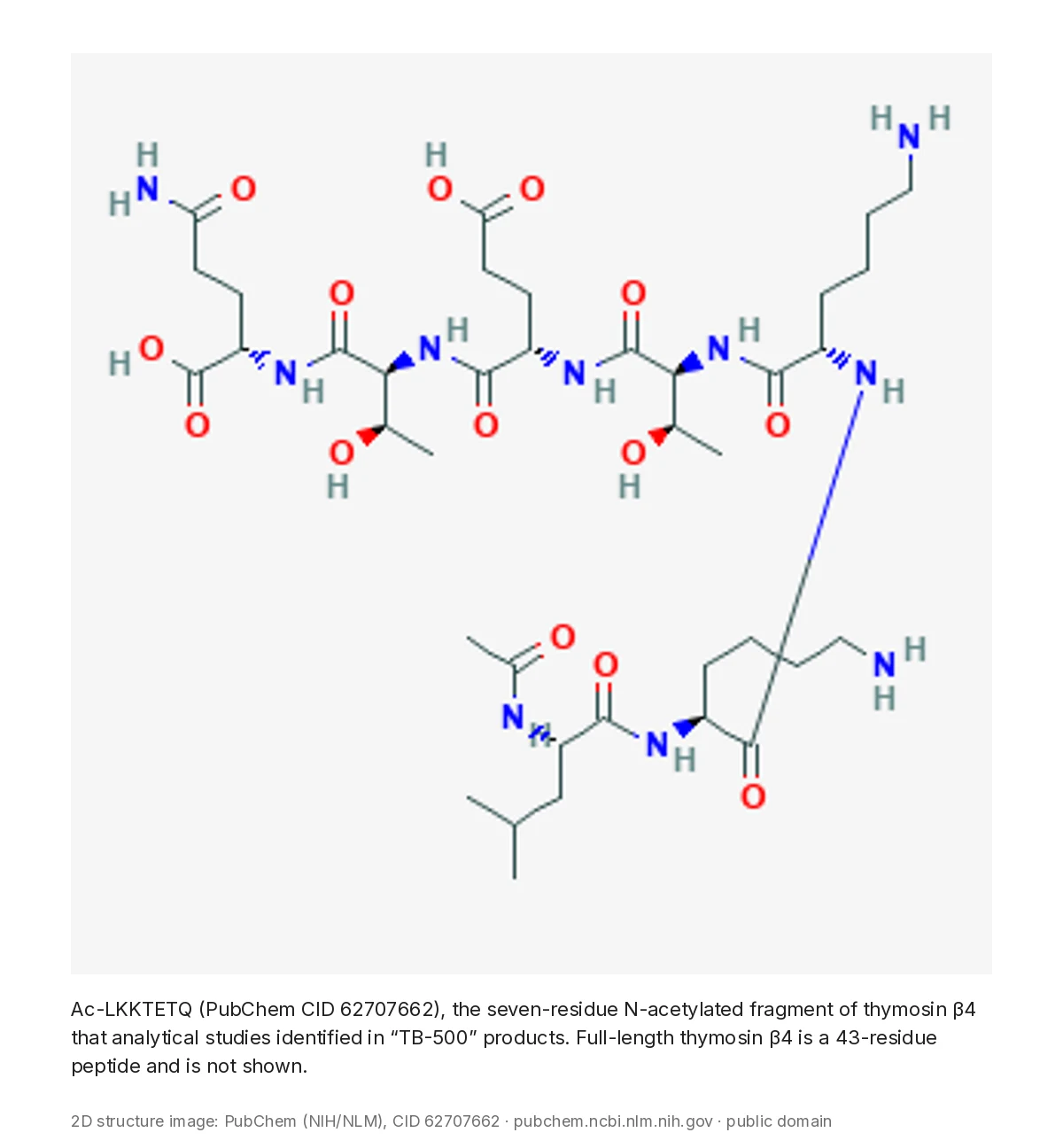
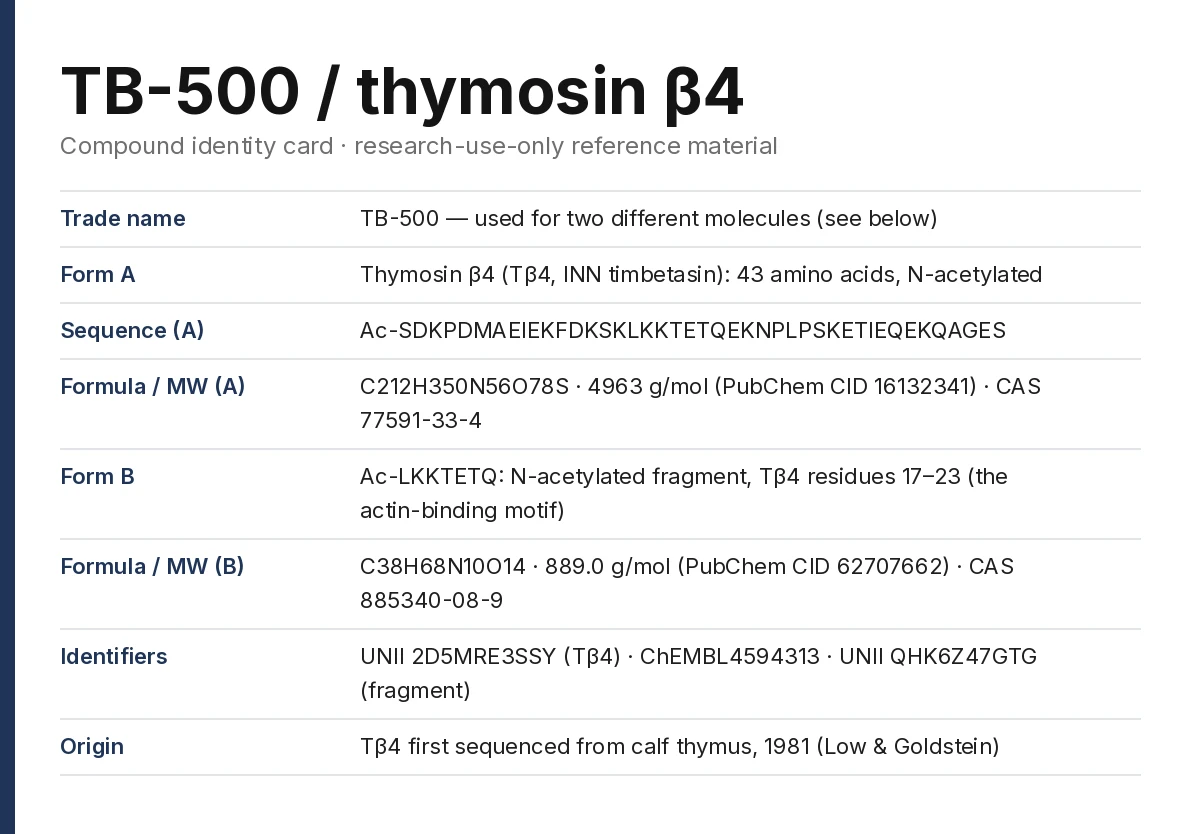
TB-500 is a trade name, not a chemical one, and it has been attached to two different molecules. The first is thymosin β4 (Tβ4, INN timbetasin), a 43-amino-acid, N-acetylated peptide that was sequenced from calf thymus in 1981 and later recognised as the main G-actin–sequestering peptide in mammalian cells[1, 3]. The second is Ac-LKKTETQ, the acetylated seven-residue fragment corresponding to Tβ4 residues 17–23; two 2012 analytical papers identified this fragment as the ingredient of commercial “TB-500” preparations[9, 10]. The two molecules differ by more than five-fold in mass (4963 vs 889 g/mol), so a laboratory buying “TB-500” has to read the certificate of analysis to know which one is in the vial. Neither form has an approved product for any use in Canada, the United States or the European Union; the material on this page is sold for laboratory research only.
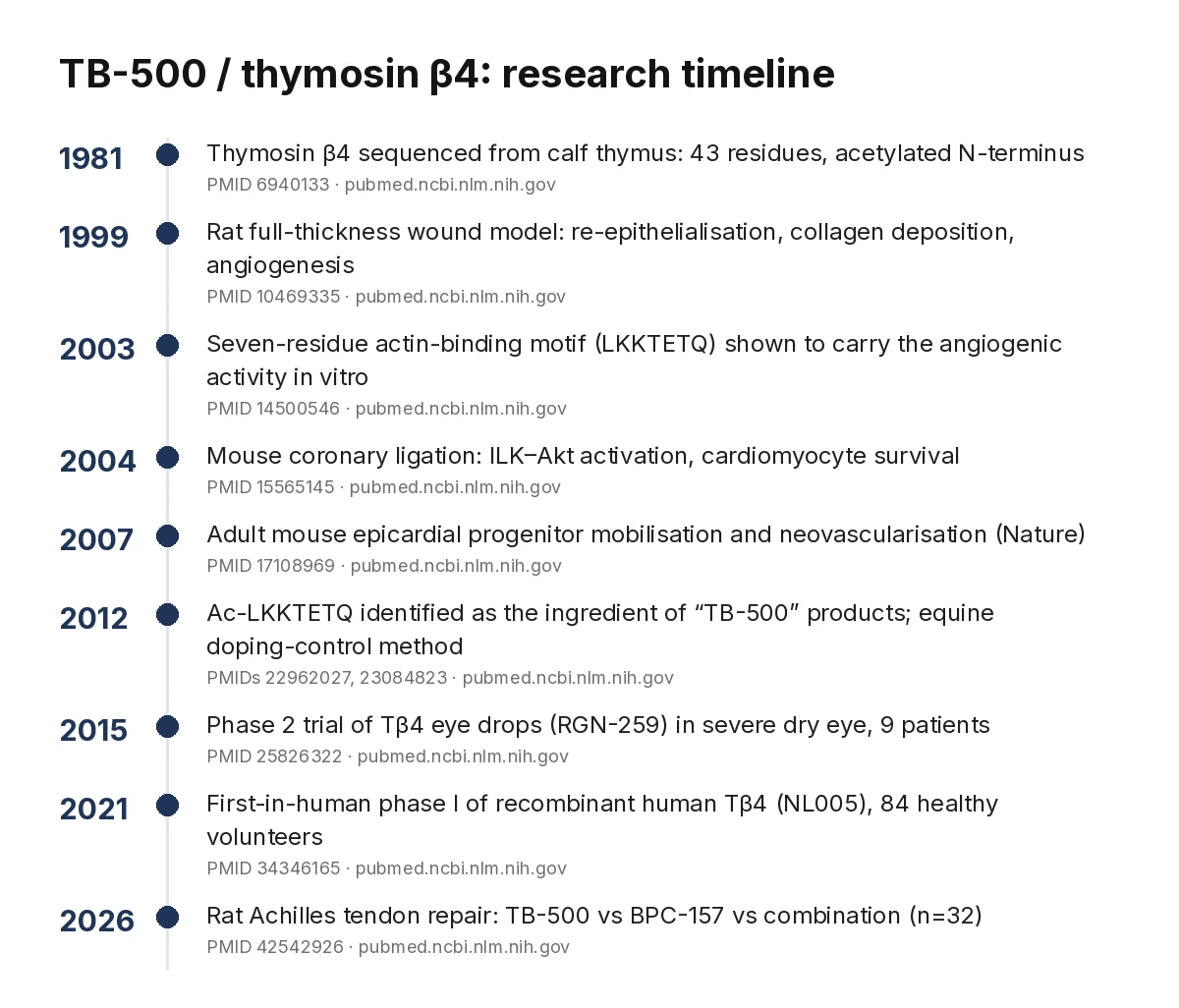
Thymosin β4 was purified from “thymosin fraction 5”, a calf-thymus extract studied as a possible thymic hormone. Low, Hu and Goldstein published its full sequence in 1981: 43 residues, a blocked (acetylated) N-terminus, a calculated mass of 4982 and an isoelectric point of 5.1, with an effect on terminal deoxynucleotidyl transferase in mouse thymocytes[1]. Over the following two decades it became clear that the peptide is present in most cell types and that its main biochemical job is to bind monomeric (G-) actin, keeping a reserve pool that cells draw on to remodel their cytoskeleton[3, 5]. Wound-repair work began in the late 1990s, when Malinda and colleagues reported that Tβ4 applied to full-thickness rat wounds increased re-epithelialisation and collagen deposition[2].
The name “TB-500” does not appear in that literature. It entered the scientific record through doping control: in 2012 Esposito and colleagues analysed a formulation sold as TB-500 by high-resolution mass spectrometry and found the N-acetylated 17–23 fragment of human Tβ4 (Ac-LKKTETQ)[9], and Ho and colleagues at the Hong Kong Jockey Club developed a method to detect the same acetylated heptapeptide and its metabolites in horse urine and plasma, describing TB-500 as a veterinary preparation whose “key ingredient” is LKKTETQ with an artificial N-acetyl group[10]. Vendors nevertheless also sell full-length Tβ4 under the TB-500 label, which is why the certificate of analysis matters.
| Thymosin β4 (timbetasin) | Ac-LKKTETQ (“TB-500” fragment) | |
|---|---|---|
| Sequence | Ac-SDKPDMAEIEKFDKSKLKKTETQEKNPLPSKETIEQEKQAGES (43 aa; UniProt P62328) | Ac-Leu-Lys-Lys-Thr-Glu-Thr-Gln-OH (Tβ4 17–23) |
| Formula | C212H350N56O78S | C38H68N10O14 |
| Molecular weight | 4963 g/mol (PubChem); 4982 by the 1981 calculation[1] | 889.0 g/mol (PubChem) |
| CAS | 77591-33-4 | 885340-08-9 |
| PubChem CID | 16132341 (also 45382195) | 62707662 |
| Other identifiers | UNII 2D5MRE3SSY; ChEMBL4594313 (timbetasin), ChEMBL4594314 (acetate) | UNII QHK6Z47GTG |
| Source | Endogenous in most mammalian cells; the research material is synthetic or recombinant | Synthetic only |
Values were read from PubChem and ChEMBL on 30 September 2026 and the sequence position of the fragment was checked against the UniProt entry (counting from the mature N-terminal serine after removal of the initiator methionine).
Philp and colleagues tested natural Tβ4, proteolytic fragments and synthetic peptides in human umbilical-vein endothelial cell migration and chick aortic-arch sprouting assays. The seven-residue actin-binding motif alone was as active as the whole peptide at roughly 50 nM, peptides lacking any part of the motif were inactive, and adding 5–50 nM soluble actin blocked adhesion and sprouting[3]. In cultured embryonic and postnatal mouse cardiomyocytes, Tβ4 formed a complex with PINCH and integrin-linked kinase (ILK), activating the kinase Akt and improving cell survival[4]. In high-glucose-treated endothelial cells, it increased migration and proliferation through the VEGF/Akt pathway[13]; in another endothelial model the effect tracked Notch and NF-κB signalling[14].
In the 1999 full-thickness wound study, topical or intraperitoneal Tβ4 increased re-epithelialisation by 42% at day 4 and up to 61% at day 7 versus saline, with more contraction, collagen and new vessels, and stimulated keratinocyte migration in a Boyden chamber at picogram amounts[2]. A 2015 study embedded Tβ4 in a collagen–chitosan sponge to obtain 12 days of controlled release in diabetic rats with hind-limb ischaemia, reporting faster re-epithelialisation, more CD31-positive vessels and a shift in inflammatory and angiogenic gene expression[13]. In 2026, a 32-rat Achilles-transection study compared BPC-157, “synthetic thymosin beta-4 (TB-500)” and their combination for four weeks: the TB-500 group had significantly higher load to failure and better Bonar and Movin histology scores than controls, and the combination added nothing over either agent alone[16]. Rat vibrissa-follicle keratinocytes migrated and differentiated more in the presence of nanomolar Tβ4, and hair growth increased in normal rats and mice[7].
Bock-Marquette and colleagues reported in 2004 that after coronary-artery ligation, Tβ4 treatment raised ILK and Akt activity in the heart, improved early myocyte survival and improved cardiac function[4]. Smart and colleagues showed in 2007 that Tβ4 is required for coronary vessel development in the embryo and that it drives quiescent adult epicardial explants to produce fibroblasts, smooth-muscle and endothelial cells; knocking it down reduced the pro-angiogenic cleavage product Ac-SDKP[6]. In dystrophin-deficient mdx mice given Tβ4 repeatedly over six months, regenerating skeletal-muscle fibres increased, but grip strength, systolic function and fibrosis did not improve[8]. In a critical-limb-ischaemia model, lentiviral Tβ4 over-expression increased CD31, α-SMA, Ang2, Tie2 and VEGFA in muscle[14].
The only in-vivo work on the fragment itself that we could locate is the equine doping-control study: after horses received a single dose of a TB-500 product, N-acetylated LKKTETQ and its metabolites were confirmed in plasma and urine at 0.02 and 0.01 ng/mL respectively[10]. It is a detection paper, not an efficacy study.
Full-length Tβ4 has been an investigational drug in several indications. A European dose-escalation study of topical Tβ4 in venous leg ulcers was designed for 72 patients across ten sites in Italy and Poland; the 2007 report describes the protocol and enrolment of the first 21 patients, not outcomes[11]. A small phase 2 trial of Tβ4 eye drops (RGN-259) in nine patients with severe dry eye reported reductions in ocular discomfort and corneal staining versus vehicle at day 56[12]. A first-in-human phase I study of recombinant human Tβ4 (NL005) in 84 healthy Chinese volunteers, given intravenously as single and repeated doses across the range tested, recorded only mild-to-moderate adverse events and no dose-limiting toxicity[15]. None of these has led to an approved medicine, and none of them studied the Ac-LKKTETQ fragment.
| Year | Model | What was investigated | Reference |
|---|---|---|---|
| 1981 | Calf thymus / mouse thymocytes | Sequence, mass, isoelectric point; TdT induction | PMID 6940133 |
| 1999 | Rat full-thickness wound; keratinocyte migration assay | Re-epithelialisation, contraction, collagen, angiogenesis | PMID 10469335 |
| 2003 | HUVEC migration; chick aortic arch | Mapping the angiogenic activity to the LKKTETQ actin-binding motif | PMID 14500546 |
| 2004 | Embryonic/postnatal mouse cardiomyocytes; mouse coronary ligation | ILK–Akt activation, cardiomyocyte survival, cardiac function | PMID 15565145 |
| 2004 | Rat and mouse skin; vibrissa follicle keratinocytes | Hair growth, stem-cell migration, MMP-2 | PMID 14657002 |
| 2005 | Review | Actin sequestration and repair biology | PMID 16099219 |
| 2007 | Mouse embryo; adult epicardial explants | Coronary vessel development; epicardial progenitor mobilisation; Ac-SDKP | PMID 17108969 |
| 2007 | Human, venous ulcers (protocol; 21 enrolled) | Safety/tolerability design of topical Tβ4 | PMID 17495250 |
| 2010 | mdx mouse, 6 months | Regenerating fibres up; strength, cardiac function and fibrosis unchanged | PMID 20126456 |
| 2012 | Analytical (LC–HRMS) of a TB-500 product | Identification of Ac-LKKTETQ; synthesis; detection strategy | PMID 22962027 |
| 2012 | Horse plasma and urine | Doping-control detection of Ac-LKKTETQ and metabolites | PMID 23084823 |
| 2015 | Human, severe dry eye (n=9, phase 2) | Tβ4 eye drops vs vehicle: discomfort, corneal staining | PMID 25826322 |
| 2015 | Diabetic rat with hind-limb ischaemia; HUVEC | Controlled-release scaffold; wound closure; VEGF/Akt | PMID 25204972 |
| 2020 | Mouse critical limb ischaemia; HUVEC | Angiogenesis via Notch/NF-κB | PMID 32945357 |
| 2021 | Healthy human volunteers (n=84, phase I) | Safety, PK and anti-drug antibodies of intravenous recombinant Tβ4 | PMID 34346165 |
| 2026 | Rat Achilles transection (n=32) | BPC-157 vs TB-500 vs combination: load to failure, histology, collagen I/III | PMID 42542926 |
Shop Peptides Online lists TB-500 in 5mg and 10mg vials and in BPC-157/TB-500 blends on this page, shipped from inside Canada by Canada Post (the shipping policy states the free-shipping threshold). All of it is supplied for laboratory research only.
Not necessarily. The name has been used for full-length thymosin β4 (43 amino acids, about 4963 g/mol) and for the acetylated fragment Ac-LKKTETQ (residues 17–23, 889 g/mol) that analytical chemists identified in commercial TB-500 products (PMID 22962027). The mass-spectrometry line on the batch report tells you which one is in a given vial.
Yes for the 5mg vial: Janoshik test report #219841 (analysis 20 August 2026) reports 4.52 mg measured content and 99.371% purity, with the result line labelled “TB-500 (TB-4)”. No report is posted for the 10mg vial at the time of writing; it will be added to the COA library when available.
No. TB-500 and thymosin β4 have no approved product in Canada, the US or the EU, the fragment is described in the doping-control literature as a suspected doping agent, and the human data that exist are small investigational trials of thymosin β4 in specific conditions. Everything here is for laboratory research; no dosing or administration guidance is given.