For laboratory research only. Not for human or animal use. This article gives no dosing, administration or therapeutic advice.
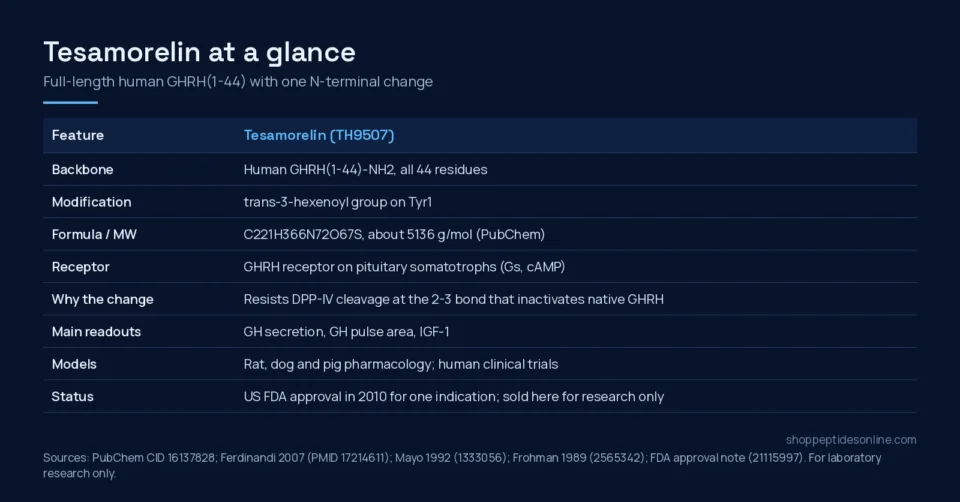
Short answer: A tesamorelin vial and a tesamorelin pen hold the same peptide, so the choice is about handling, record-keeping and how much material one experiment needs, not about different chemistry. Tesamorelin is a 44-residue GHRH analogue with a hexenoyl group on Tyr1[1]. SPO lists it as 5mg, 10mg and 20mg vials and as a research pen with cartridge refills. The more useful number on any listing is the measured content on the certificate, because it is not always equal to the label: for the 20mg lot, an independent report measured 17.94 mg. If you plan to buy tesamorelin 20mg in Canada, read this first.
The formats SPO lists
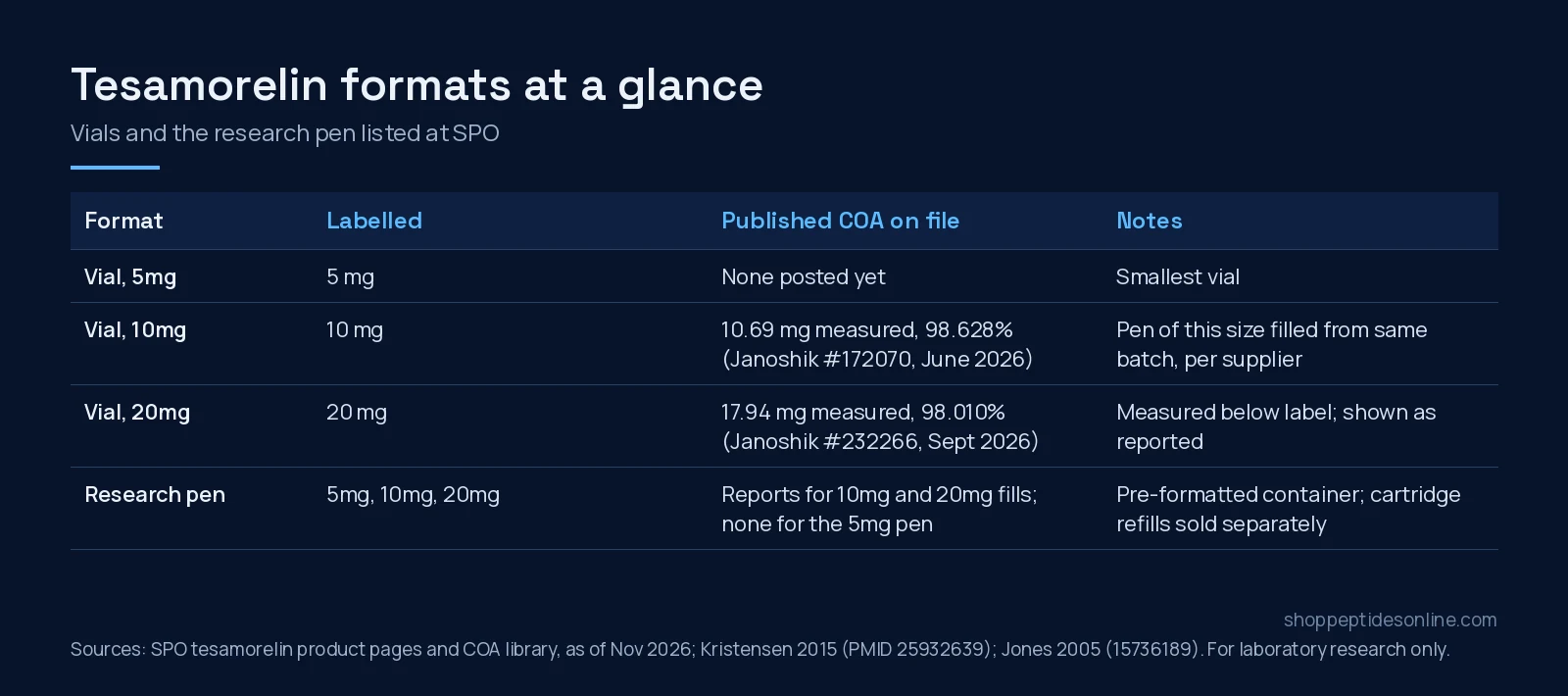
| Format | Labelled amount | COA on the listing |
|---|---|---|
| Vial, 5mg | 5 mg | Not yet posted |
| Vial, 10mg | 10 mg | Janoshik report #172070: 10.69 mg, purity 98.628% |
| Vial, 20mg | 20 mg | Janoshik report #232266: 17.94 mg, purity 98.010% |
| Research pen | 10mg or 20mg fills | Same two reports, filed under the pen as well, per the supplier |
| Research pen, 5mg | 5 mg | Not yet posted |
The reports are in the COA library. Each is for one lot, so the lot on your container has to match the report before it applies.
Labelled content is not measured content
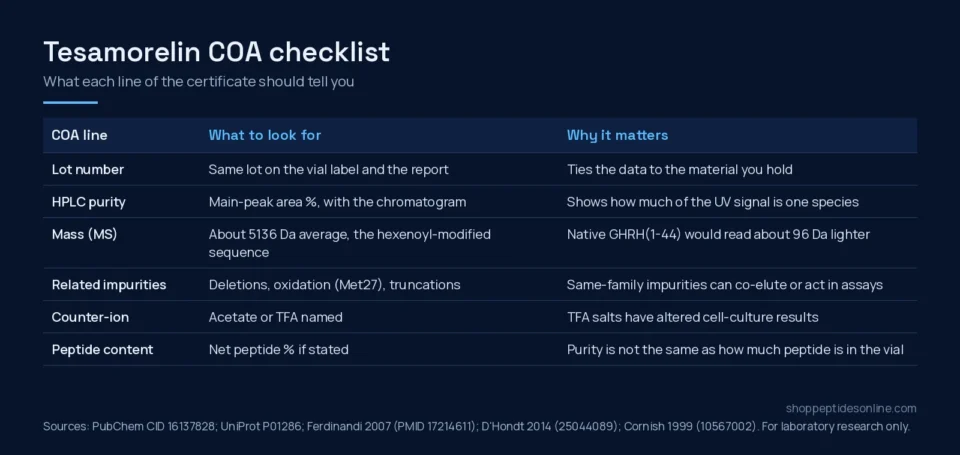
The 10mg lot measured 10.69 mg against its label. The 20mg lot measured 17.94 mg, about 10% below the label, and the product page prints that figure as the report gives it. Both are from the same independent laboratory. The practical point is simple: if an experiment depends on the amount of peptide, use the measured content from the lot’s report and note it in your records. The label alone is not enough. For how to read the other lines of a report, see our guide to checking a tesamorelin COA.
What a batch report cannot see: the container
A COA describes the powder at the time of testing. It does not describe what happens in the container afterwards, and the literature on peptide containers is relevant here:
- Adsorption. In a study of three cationic peptides, 90% or more could be lost from dilute solution to the walls of common glass and plastic containers[3]. Tesamorelin is a different peptide, so this does not give a figure for it, but it shows why the container is part of the experiment.
- Silicone oil. Silicone lubricant in syringes and cartridges has been shown to induce aggregation of proteins[4]. Whether it matters for a given peptide and device is something to check, not assume.
- Dual-chamber cartridges. Some pen-style products keep powder and diluent apart in a dual-chamber cartridge, and the engineering of freeze-drying inside those cartridges is its own field[5][6]. SPO’s listings call the pen a pre-formatted research container and do not describe its internals, so ask the supplier if the construction matters to your work.
Choosing a format for laboratory work
- Several small experiments over time: a smaller vial leaves less material open to handling.
- One large series from one lot: a 20mg vial keeps everything on a single lot and a single report.
- Repeatable logged handling: the pen is built for laboratories that prefer a pre-formatted container to a loose vial, and cartridge refills let you change the cartridge without a new pen.
- Documentation: prefer the format whose lot has a published report, and keep that report with your records.
For a wider look at the two formats, see peptide pen vs vial, and for the peptide itself, our tesamorelin research page. The rest of the range is in our guide to buy peptides online in Canada.
Frequently asked questions
What tesamorelin sizes does SPO list?
Vials at 5mg, 10mg and 20mg, and a research pen with 5mg, 10mg and 20mg options, plus cartridge refills for the pen.
Is the pen a different compound from the vial?
No. The pen listing describes the same research material as the vials in a pre-formatted container. Per the supplier, the 10mg and 20mg pens are filled from the same batch as the vial of that strength.
Why does the 20mg vial’s COA show 17.94 mg?
The independent report (Janoshik #232266) measured 17.94 mg of tesamorelin against the 20 mg label, with 98.010% purity by HPLC. The product page prints it as reported, and researchers should use the measured figure.
Can a container change the amount of peptide I recover?
It can. Studies of other cationic peptides found large losses to glass and plastic from dilute solutions, so container and handling are part of the experimental design.
Is tesamorelin from SPO for human use?
No. It is supplied in Canada for laboratory research only, not for human or animal use, and this article gives no dosing advice.
References
- Ferdinandi ES, Brazeau P, High K et al. (2007). Non-clinical pharmacology and safety evaluation of TH9507, a human growth hormone-releasing factor analogue. Basic Clin Pharmacol Toxicol. PMID: 17214611. doi: 10.1111/j.1742-7843.2007.00008.x.
- D’Hondt M, Bracke N, Taevernier L et al. (2014). Related impurities in peptide medicines. J Pharm Biomed Anal. PMID: 25044089. doi: 10.1016/j.jpba.2014.06.012.
- Kristensen K, Henriksen JR, Andresen TL (2015). Adsorption of cationic peptides to solid surfaces of glass and plastic. PLoS One. PMID: 25932639. doi: 10.1371/journal.pone.0122419.
- Jones LS, Kaufmann A, Middaugh CR (2005). Silicone oil induced aggregation of proteins. J Pharm Sci. PMID: 15736189. doi: 10.1002/jps.20321.
- Werk T, Ludwig IS, Luemkemann J et al. (2016). Technology, Applications, and Process Challenges of Dual Chamber Systems. J Pharm Sci. PMID: 26852837. doi: 10.1016/j.xphs.2015.11.025.
- Korpus C, Friess W (2017). Lyophilization Cycle Design for Dual Chamber Cartridges and a Method for Online Process Control: The “DCC LyoMate” Procedure. J Pharm Sci. PMID: 28479354. doi: 10.1016/j.xphs.2017.04.069.
- Manning MC, Chou DK, Murphy BM et al. (2010). Stability of protein pharmaceuticals: an update. Pharm Res. PMID: 20143256. doi: 10.1007/s11095-009-0045-6.