
Your cart is currently empty!.
You may check out all the available products and buy some in the shop.
Continue ShoppingCompare GHK-Cu research listings by strength, format, current price, stock and batch documentation — then read what this copper-binding tripeptide is, how it was discovered, and what fifty years of cell-culture and animal studies have and have not shown, with references. Shop Peptides Online carries GHK-Cu in 50mg and 100mg vials and in pen format.
For laboratory research use only. Not for human consumption. Shop Peptides Online does not provide dosing or administration guidance.
GHK-Cu in 50mg and 100mg vials.


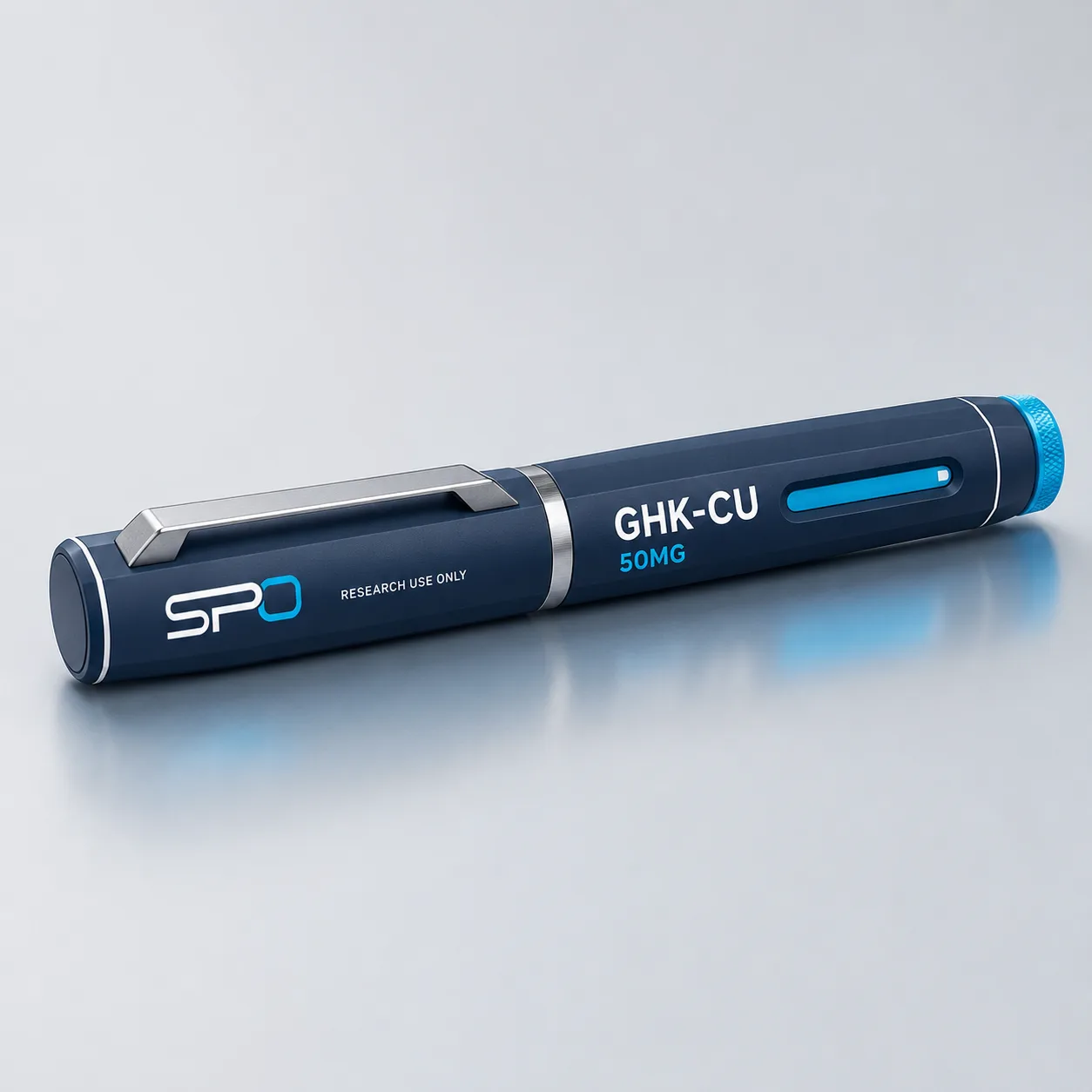
GHK-Cu in pen format. Strength options and details are on the GHK-Cu pen page.
Bacteriostatic water, pen needles and alcohol pads, listed separately.
Choose the format (vial or pen) and strength, then check the current price, stock status and COA shown on that listing. Vials and pens are separate products, so confirm the exact item in your cart before checkout.
Available COAs for GHK-Cu are shown on the product page and in the COA library. Match the product name, strength and batch to the document before relying on it.
GHK-Cu is the copper(II) complex of glycyl-L-histidyl-L-lysine (GHK), a three-amino-acid peptide that occurs naturally in human plasma. Loren Pickart first reported the tripeptide in 1973 as a serum factor that prolonged the survival of normal liver cells in culture[1], identified its sequence as Gly-His-Lys in 1977[2], and by 1980 had shown that it binds copper(II) and carries the metal into cultured cells[3]. Since then the complex has been studied mainly in fibroblast cultures and rodent wound models for its effects on collagen, glycosaminoglycans and matrix-remodelling enzymes[5, 6, 7], and more recently in mouse models of lung injury, fibrosis and colitis[14, 15, 16]. It has no approved drug form. The vials on this page are lyophilized research-grade material for in-vitro and preclinical laboratory work only.
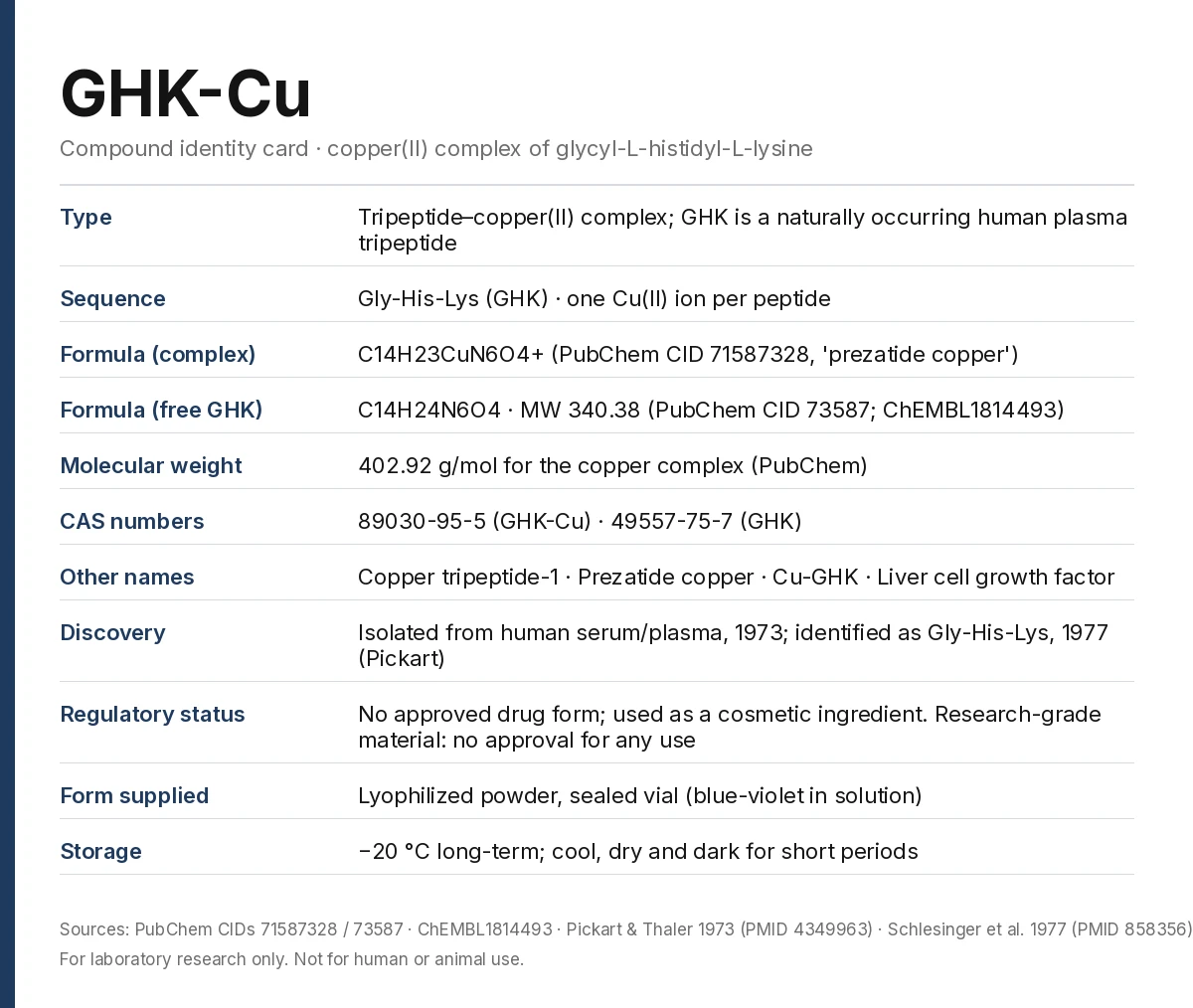
The tripeptide was found before its copper partner was understood. In the 1973 paper, a fraction of human serum prolonged the survival of normal hepatocytes and stimulated growth of hepatoma cells in culture[1]; four years later the active substance was shown to be glycyl-histidyl-lysine[2]. During purification the peptide co-isolated with roughly equimolar copper and about one-fifth as much iron, and several tripeptides sharing the histidyl-lysyl linkage were nearly as active — which, together with the resemblance between GHK and the copper-binding sites of albumin and α-fetoprotein, led Pickart’s group to propose that GHK acts as a copper-transport factor[3]. Spectroscopic work in 1982 established that at neutral pH GHK forms a mononuclear 1:1 complex with Cu(II), coordinated through two or three nitrogen atoms including the histidine imidazole, and that the oxygen-bridged copper pairs seen in the crystal do not persist in solution[4].
In 1988 Maquart and co-workers reported that GHK-Cu stimulated collagen synthesis in fibroblast cultures from about 10−12 M, peaking at 10−9 M, without changing cell number, and noted the GHK triplet inside type I collagen[5]. That observation reframed the peptide as a possible fragment of the extracellular matrix — a “matrikine” — released during tissue breakdown, a view the 2026 reviews still adopt[19].
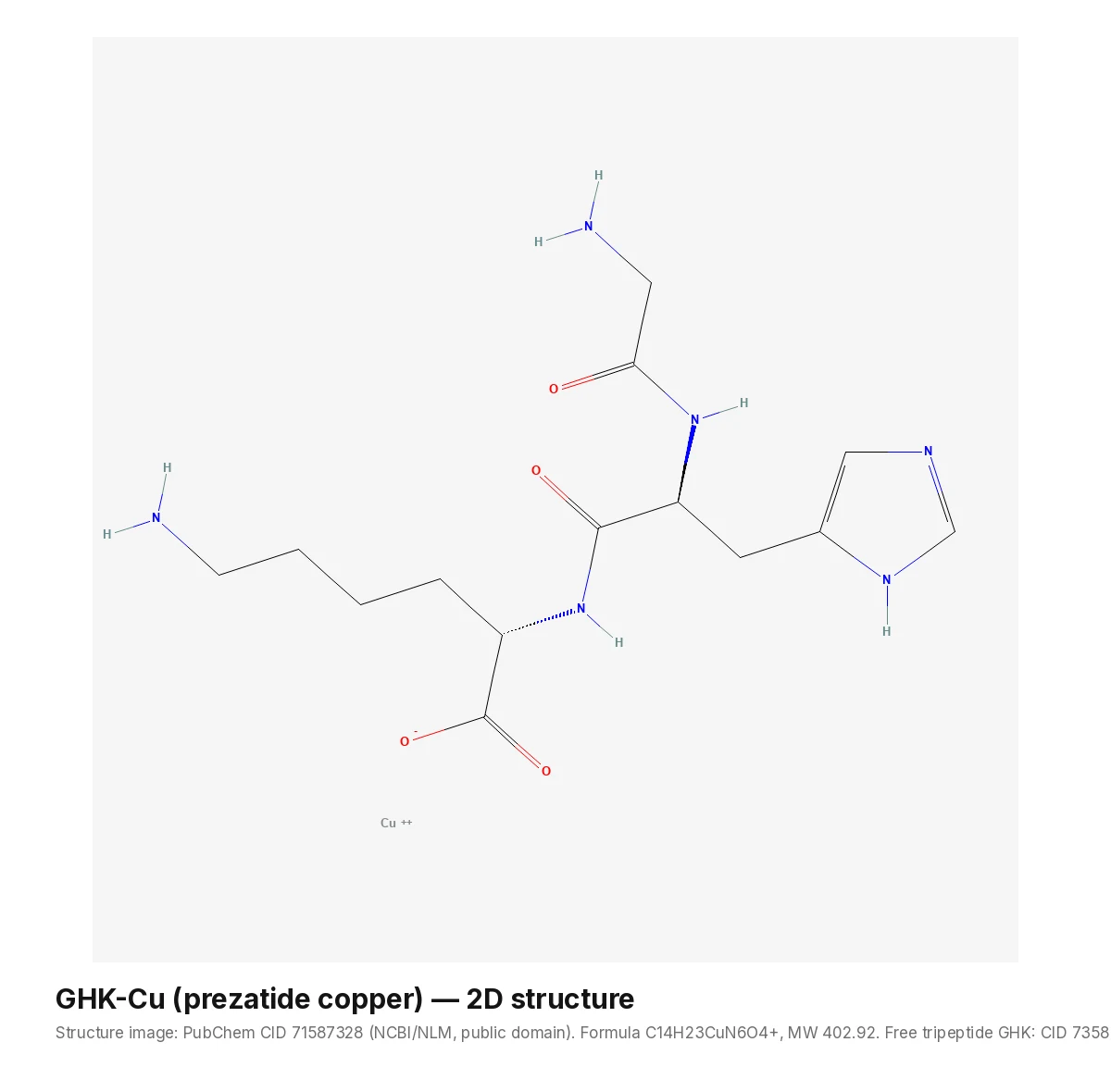
| Property | Value | Source |
|---|---|---|
| Name | Glycyl-L-histidyl-L-lysine copper(II); GHK-Cu; copper tripeptide-1; prezatide copper | PubChem synonyms |
| Sequence | Gly-His-Lys (GHK) | Schlesinger et al. 1977[2] |
| Stoichiometry | 1 Cu(II) : 1 GHK at physiological pH; N-coordinated including the imidazole | Freedman et al. 1982[4] |
| Formula / MW (complex) | C14H23CuN6O4+ / 402.92 (exact mass 402.1077) | PubChem CID 71587328 |
| Formula / MW (free GHK) | C14H24N6O4 / 340.38 | PubChem CID 73587; ChEMBL1814493 |
| CAS | 89030-95-5 (complex); 49557-75-7 (peptide) | PubChem |
| Copper share by mass | About 16% of the complex (63.55 / 402.92) | Calculated from PubChem values |
PubChem and ChEMBL agree on the free peptide (340.38). For the complex, the databases list charged species rather than a neutral salt, so the weight of a given lot also depends on its counter-ion and water content — a point the 2026 Pharmaceutics review makes at length when it argues that “GHK-Cu” is often sold and studied without its coordination state being defined[20].
The best-replicated finding is a stimulation of extracellular-matrix synthesis by cultured fibroblasts at nanomolar concentrations: collagen in the 1988 FEBS Letters study[5], and, in a 2005 serum-free model using human dermal fibroblasts taken from irradiated head-and-neck surgery patients, faster population doubling plus more basic fibroblast growth factor and VEGF production early after exposure to 1 nM GHK-Cu[11]. Those are dish measurements, not tissue outcomes.
Maquart’s group implanted stainless-steel mesh cylinders under the skin of rats and injected GHK-Cu or saline into them. Treated chambers showed concentration-dependent increases in dry weight, DNA, total protein, collagen and glycosaminoglycans; collagen synthesis rose about twice as much as non-collagen protein, type I and III collagen mRNAs increased while TGF-β mRNA did not, and a control tripeptide had no effect[6]. Follow-up work in the same model found that GHK-Cu did not change interstitial collagenase activity but prolonged MMP-9 expression in wound tissue and altered the balance of gelatinases[7], and that it increased chondroitin- and dermatan-sulfate accumulation and decorin mRNA while lowering biglycan mRNA[8].
A 1991 report in C3H mice described hair-follicle stimulation by peptide-copper complexes[9]; no abstract is indexed and the paper is cited here for the model only. In contrast, a 2013 study of irradiated dorsal skin flaps in Sprague-Dawley rats found that ten days of topical GHK-Cu gel produced no difference in flap ischaemia, vessel number or area, or VEGF expression compared with control ointment[12].
In 72 rats undergoing ACL reconstruction, weekly intra-articular GHK-Cu for four weeks reduced side-to-side knee laxity and increased graft stiffness at six weeks, but the differences were gone at twelve weeks and there was no difference in ultimate load, gait or histology — the authors describe the benefit as transient once treatment stopped[13].
In LPS-stimulated RAW 264.7 macrophages and in LPS-induced acute lung injury in mice, GHK-Cu lowered reactive oxygen species, raised superoxide dismutase activity, and reduced TNF-α and IL-6 through suppression of NF-κB p65 and p38 MAPK signalling[14]. In bleomycin-induced pulmonary fibrosis in C57BL/6 mice, intraperitoneal GHK-Cu reduced inflammatory cytokines, collagen deposition and MMP-9/TIMP-1 imbalance and partly prevented epithelial–mesenchymal transition via Nrf2, NF-κB and TGF-β1/Smad pathways[15]. A 2025 study in DSS-induced colitis in BALB/c mice reported reduced disease activity, restored tight-junction proteins and lower cytokines, with SIRT1/STAT3 signalling proposed as the mechanism[16].
Pickart and Margolina’s 2018 review collects connectivity-map data suggesting that GHK modulates a large number of human genes and uses that to explain the breadth of reported actions[17]. Those are computational associations from cultured-cell expression profiles, written by the compound’s discoverer, and the 2026 systematic reviews treat them as hypothesis-generating rather than confirmatory[20].
Human data are sparse. An 86-patient randomised, evaluator-blinded trial in venous stasis ulcers (1992) found that a 0.4% tripeptide-copper cream was no better than placebo, while silver sulfadiazine reduced ulcer size[10]. The 2026 Pharmaceutics review, covering the literature to August 2026, characterises the cosmetic reports as small or incompletely described, notes a negative 13-participant post-laser study and a positive 18-participant split-face eyebrow study that did not define what species of GHK-Cu was applied, and records a Phase 2 acute-wound trial (NCT07437586) still recruiting with no results[20]. A separate 2026 systematic review of 64 records reached the same conclusion: no adequately powered human randomised controlled trial exists[19]. A 2025 review of topical GHK as a cosmetic ingredient adds that skin-permeation data for GHK-Cu are insufficient[18].
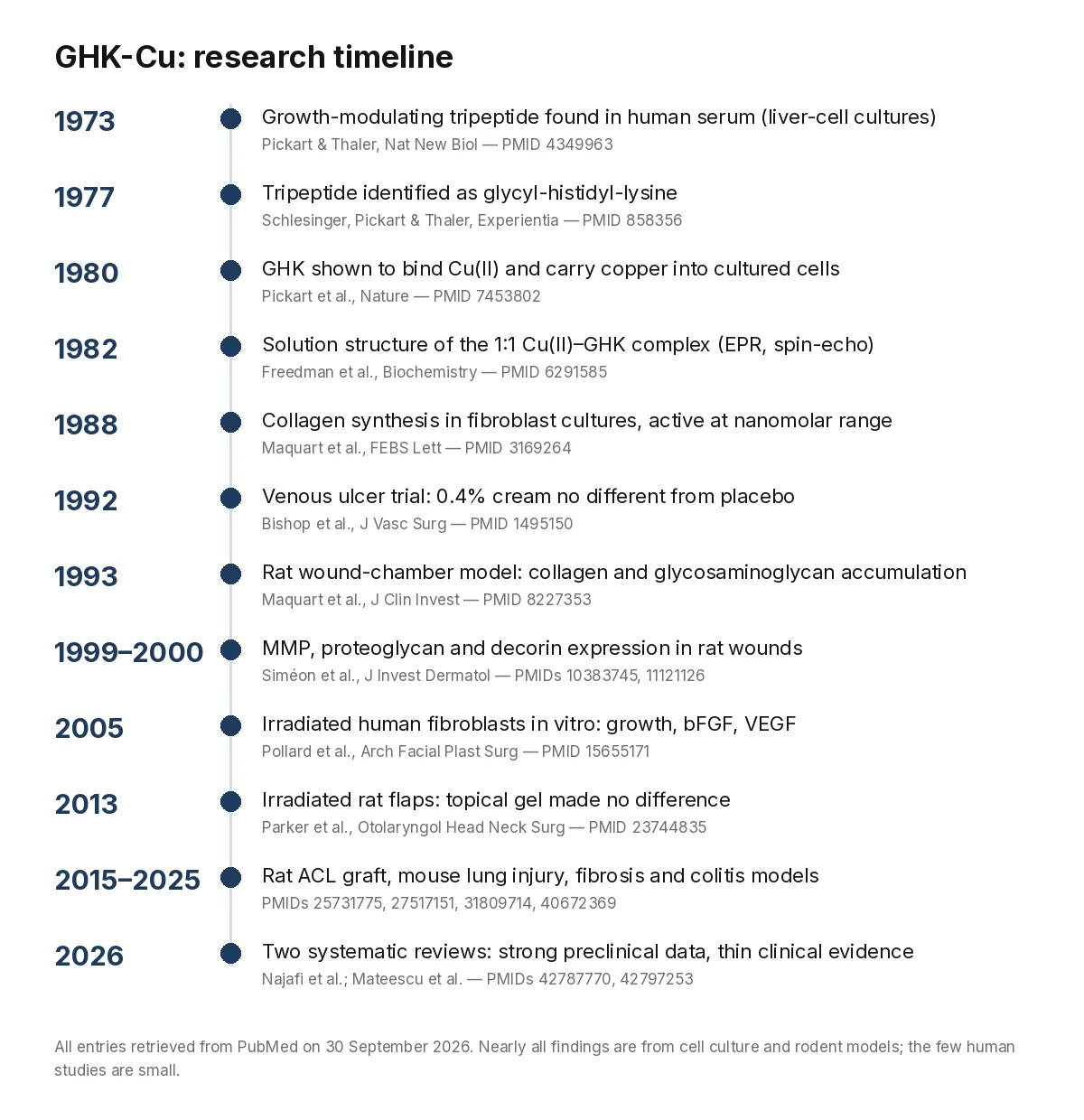
| Year | Model | What was investigated | Reference |
|---|---|---|---|
| 1973 | Human serum; rat hepatocyte and hepatoma cultures | Discovery of a growth-modulating tripeptide | PMID 4349963 |
| 1977 | Chemical identification | Sequence established as Gly-His-Lys | PMID 858356 |
| 1980 | Hepatoma cells in vitro | Copper binding and uptake; structure–activity | PMID 7453802 |
| 1982 | Spectroscopy (EPR, spin-echo, optical) | Solution structure of the 1:1 Cu(II) complex | PMID 6291585 |
| 1988 | Fibroblast culture | Collagen synthesis, 10−12–10−9 M | PMID 3169264 |
| 1992 | Human RCT, n=86, venous ulcers | 0.4% cream vs silver sulfadiazine vs placebo — no effect | PMID 1495150 |
| 1993 | Rat wound chamber | Collagen, GAG, DNA, protein; collagen I/III mRNA | PMID 8227353 |
| 1999 | Rat wound chamber | MMP-2 / MMP-9 expression and activation | PMID 10383745 |
| 2000 | Rat wound chamber; rat fibroblasts | Glycosaminoglycans, decorin, biglycan | PMID 11121126 |
| 2005 | Human dermal fibroblasts (normal and irradiated), in vitro | Growth rate; bFGF, TGF-β1, VEGF secretion | PMID 15655171 |
| 2013 | Irradiated rat skin flaps | Topical gel: ischaemia, vessels, VEGF — no difference | PMID 23744835 |
| 2015 | Rat ACL reconstruction, n=72 | Knee laxity, graft stiffness, histology — transient effect | PMID 25731775 |
| 2016 | Mouse LPS lung injury; RAW 264.7 cells | ROS, SOD, TNF-α, IL-6; NF-κB and p38 MAPK | PMID 27517151 |
| 2020 | Mouse bleomycin fibrosis | Cytokines, collagen, MMP-9/TIMP-1, EMT; Nrf2, NF-κB, TGF-β1 | PMID 31809714 |
| 2025 | Mouse DSS colitis; macrophage/epithelial co-culture | Barrier proteins, cytokines, SIRT1/STAT3 | PMID 40672369 |
| 2026 | Systematic reviews (64 records; evidence map to Aug 2026) | Preclinical consistency vs. clinical gap; formulation definition | PMID 42787770, PMID 42797253 |
An independent Janoshik report is posted for the 100mg vial: report #218248, sample received 17 August 2026, analysed 19 August 2026, purity 99.661%, measured GHK-Cu 76.04 mg GHK-Cu (63.73 mg GHK peptide + 12.31 mg copper). The laboratory reported the peptide and the copper separately; their molar amounts (63.73 mg ÷ 340.38 ≈ 0.187 mmol of GHK and 12.31 mg ÷ 63.55 ≈ 0.194 mmol of copper) are close to the 1:1 ratio described for the complex[4]. The library card lists “N2JKLM26983T” as a batch number; on the report itself that string is the Janoshik verification key, and the batch field reads “unknown”. No report is posted for the 50mg vial at the time of this review. The product page embeds the document.
GHK-Cu is one of the compounds on the page where you can buy peptides online in Canada; every listing there carries the same research-use-only terms and links to its own report where one exists.
All references were retrieved from PubMed (NCBI) on 30 September 2026 and cross-checked against Europe PMC; identity data from PubChem and ChEMBL (EMBL-EBI) on the same date. Where a database lists more than one form of the compound, each is shown with its own identifier.
Shop Peptides Online lists GHK-Cu in 50mg and 100mg vials and in pen format on this page. Orders ship from inside Canada by Canada Post, so there is no customs clearance; the free-shipping threshold and delivery times are in the shipping policy and shown at checkout. All listings are research-grade material for laboratory use only.
Yes, for the 100mg vial: independent Janoshik report #218248 (sample received 17 August 2026, analysed 19 August 2026) shows purity 99.661% and 76.04 mg GHK-Cu (63.73 mg GHK peptide + 12.31 mg copper). The product page embeds the report. No report is posted for the 50mg vial at the time of this review.
The copper(II) complex of the tripeptide glycyl-L-histidyl-L-lysine, which occurs naturally in human plasma. At neutral pH one Cu(II) ion binds one peptide through nitrogen atoms including the histidine imidazole (PMID 6291585). The complex is C14H23CuN6O4+, molecular weight 402.92 (PubChem CID 71587328); the free peptide is C14H24N6O4, 340.38 (CID 73587).
No. GHK-Cu has no approved drug form anywhere; it is used as a cosmetic ingredient and as a research reagent. The material sold here is for laboratory research only, not for human or animal consumption. Two 2026 systematic reviews found no adequately powered human trial (PMIDs 42787770, 42797253), and Shop Peptides Online provides no dosing or administration guidance.
For laboratory research use only. Not for human or animal consumption. This page identifies the material, its documentation and the published literature on the compound, and makes no claim of efficacy or safety.