For laboratory research only. Not for human or animal use. This article gives no dosing, administration or therapeutic advice.
Short answer: MOTS-c and AICAR both end up activating AMPK, but they start from different places. MOTS-c is a 16-residue peptide encoded inside the mitochondrial 12S rRNA gene; in the 2015 study that named it, it acted mainly on skeletal muscle and inhibited the folate cycle and the de novo purine synthesis tied to it, which led to AMPK activation[1]. AICAR is a nucleoside that cells take up and phosphorylate to ZMP, an AMP analogue, which activates AMPK directly[2]. AICAR was the standard AMPK tool for decades, yet many of its effects turned out to be AMPK-independent[4][5]. Same kinase, different routes, different caveats.
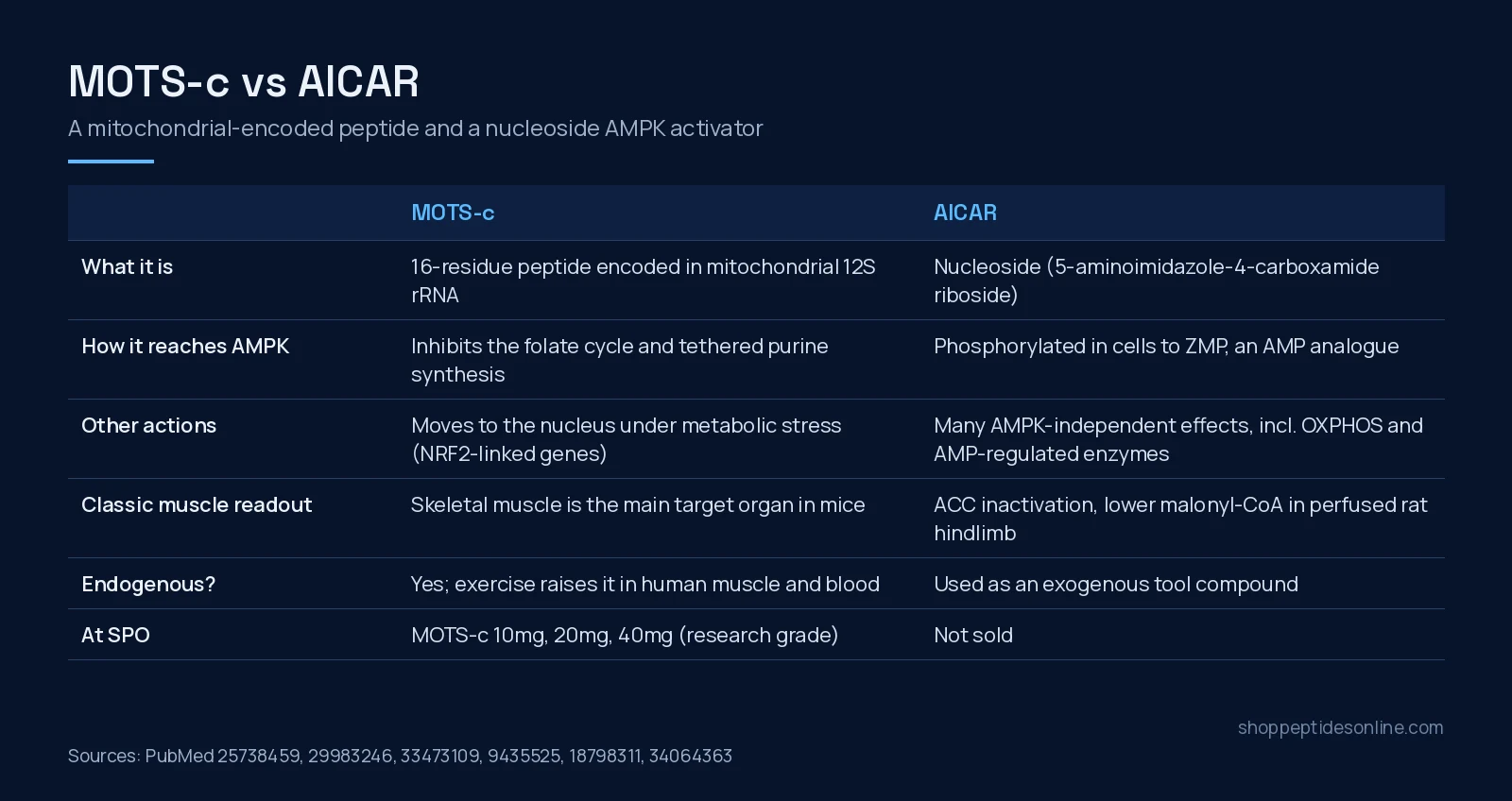
Side by side
| MOTS-c | AICAR | |
|---|---|---|
| Class | Mitochondrial-derived peptide, 16 residues[1] | Nucleoside, 5-aminoimidazole-4-carboxamide ribonucleoside[2] |
| Route to AMPK | Folate-cycle and purine-synthesis inhibition[1] | Conversion to ZMP, an AMP analogue[2] |
| Nuclear action | Moves to the nucleus under glucose restriction, AMPK-dependent, and regulates NRF2-linked genes[3] | Not described in the papers cited here |
| Known off-target issue | Few independent data sets yet | AMPK-independent effects on AMP-regulated enzymes, OXPHOS and nucleotide synthesis[5][4] |
| Endogenous in humans | Yes; exercise raises it in muscle and circulation[7] | Used as an exogenous tool in the work cited here |
| Sports testing | Both listed among emerging compounds of interest for doping-control laboratories[8] | |
| At SPO | MOTS-c 10mg (research grade) | Not sold |
AICAR: the AMPK tool compound
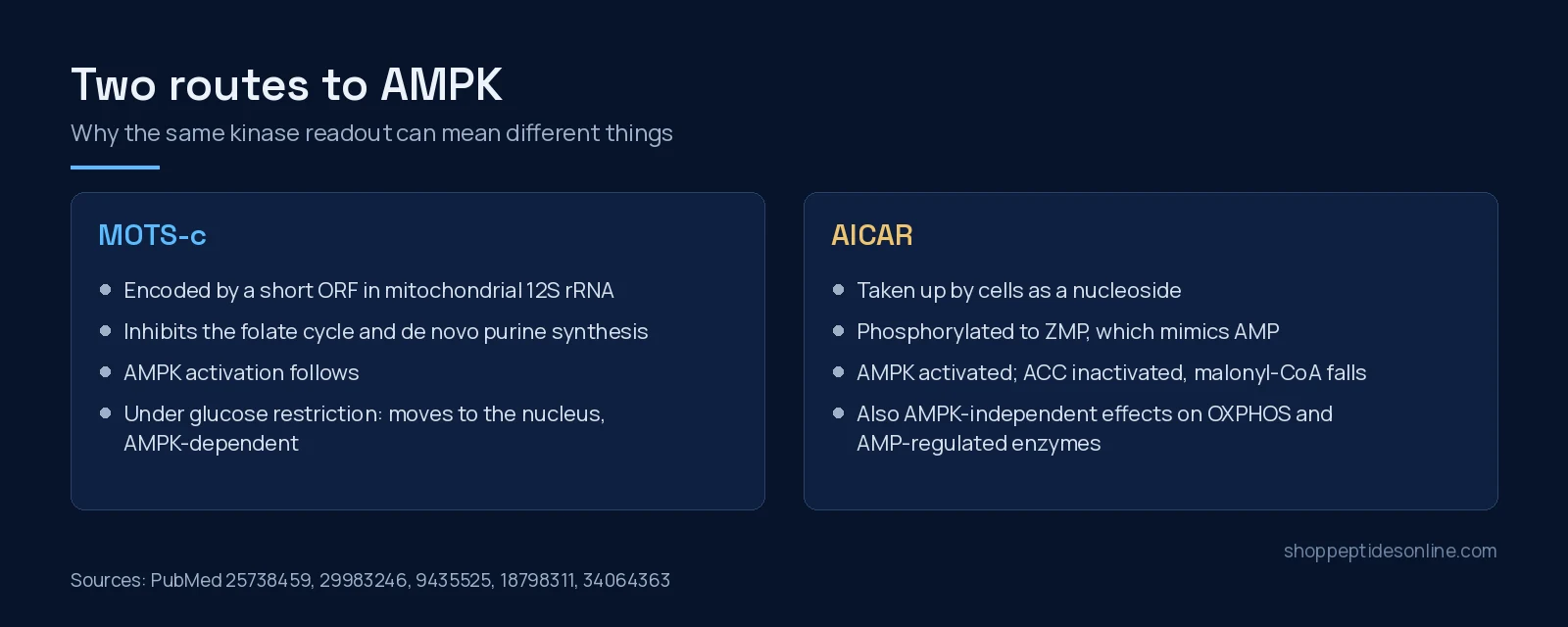
AICAR’s use as an AMPK activator rests on its metabolism. Cells take it up and phosphorylate it to ZMP, which resembles AMP. In perfused rat hindlimbs, AICAR activated AMPK in skeletal muscle, inactivated acetyl-CoA carboxylase, lowered malonyl-CoA and raised fatty acid oxidation and glucose uptake, with no change in oxygen uptake[2].
Its best-known whole-animal result came in 2008. Four weeks of AICAR in sedentary mice induced metabolic genes and increased treadmill running endurance by 44%, in a study that also showed a PPARδ agonist acting together with exercise training[6]. Results like this made AICAR a reference point in exercise-mimetic research.
The AICAR caveat
The problem is specificity. A 2009 review pointed out that AICA riboside also acts on AMP-regulated enzymes and on mitochondrial oxidative phosphorylation independently of AMPK. It contrasted AICAR with A-769662, a non-nucleoside activator that raised AMPK activity in rat hepatocytes without affecting OXPHOS or the cellular AMP:ATP ratio[5]. A 2021 systematic review went further: many effects once credited to AMPK activation by AICAR, across metabolism, hypoxia, exercise, nucleotide synthesis and cancer, are AMPK-independent, so AICAR-based studies need careful interpretation[4].
MOTS-c: a peptide the mitochondrion encodes
MOTS-c was found as a short open reading frame within the mitochondrial 12S rRNA. In the original work its main target organ appeared to be skeletal muscle, its cellular actions inhibited the folate cycle and tethered de novo purine biosynthesis, AMPK activation followed, and treatment in mice prevented age-dependent and high-fat-diet-induced insulin resistance[1]. So where AICAR supplies an AMP mimic, MOTS-c works further upstream, on the folate and purine pathways that feed nucleotide pools.
MOTS-c also has a nuclear role. Under glucose restriction it moved to the nucleus in an AMPK-dependent way, regulated a broad set of nuclear genes including those with antioxidant response elements, and interacted with stress-responsive transcription factors such as NRF2[3]. In mice of 2, 12 and 22 months it enhanced physical performance, and in humans exercise increased endogenous MOTS-c in skeletal muscle and in circulation[7]. That last point separates it from AICAR, which is studied as an added compound.
Which one fits which question?
- Mitochondrial-encoded peptides and mitonuclear signalling: MOTS-c[1][3].
- Acute AMPK activation in muscle, ACC and malonyl-CoA: AICAR, with AMPK-independent controls[2][4].
- Exercise-induced endogenous factors: MOTS-c[7].
- Historical exercise-mimetic comparisons in mice: AICAR[6].
For another mitochondrial-derived peptide, see MOTS-c vs humanin, and our MOTS-c research page covers the product. For the rest of the catalogue, see our guide to buy peptides online in Canada.
Frequently asked questions
What is the difference between MOTS-c and AICAR?
MOTS-c is a 16-residue peptide encoded in mitochondrial DNA that activates AMPK by inhibiting the folate cycle and purine synthesis. AICAR is a nucleoside converted in cells to ZMP, an AMP analogue that activates AMPK.
Is AICAR a specific AMPK activator?
No. Reviews describe many AMPK-independent effects of AICAR, including on AMP-regulated enzymes, oxidative phosphorylation and nucleotide synthesis.
Does MOTS-c occur naturally?
Yes. It is encoded in the mitochondrial 12S rRNA gene, and exercise raises endogenous MOTS-c in human skeletal muscle and circulation.
Why do both appear in sports drug testing research?
A review of emerging compounds for doping-control laboratories lists AICAR as an AMPK agonist and MOTS-c as an agent acting on the methionine-folate cycle.
Does Shop Peptides Online sell AICAR?
No. SPO lists MOTS-c for laboratory research only. AICAR is not in the catalogue.
References
- Lee C, Zeng J, Drew BG et al. (2015). The mitochondrial-derived peptide MOTS-c promotes metabolic homeostasis and reduces obesity and insulin resistance. Cell Metab. PMID: 25738459. doi: 10.1016/j.cmet.2015.02.009.
- Merrill GF, Kurth EJ, Hardie DG et al. (1997). AICA riboside increases AMP-activated protein kinase, fatty acid oxidation, and glucose uptake in rat muscle. Am J Physiol. PMID: 9435525. doi: 10.1152/ajpendo.1997.273.6.E1107.
- Kim KH, Son JM, Benayoun BA et al. (2018). The Mitochondrial-Encoded Peptide MOTS-c Translocates to the Nucleus to Regulate Nuclear Gene Expression in Response to Metabolic Stress. Cell Metab. PMID: 29983246. doi: 10.1016/j.cmet.2018.06.008.
- Višnjić D, Lalić H, Dembitz V et al. (2021). AICAr, a Widely Used AMPK Activator with Important AMPK-Independent Effects: A Systematic Review. Cells. PMID: 34064363. doi: 10.3390/cells10051095.
- Guigas B, Sakamoto K, Taleux N et al. (2009). Beyond AICA riboside: in search of new specific AMP-activated protein kinase activators. IUBMB Life. PMID: 18798311. doi: 10.1002/iub.135.
- Narkar VA, Downes M, Yu RT et al. (2008). AMPK and PPARdelta agonists are exercise mimetics. Cell. PMID: 18674809. doi: 10.1016/j.cell.2008.06.051.
- Reynolds JC, Lai RW, Woodhead JST et al. (2021). MOTS-c is an exercise-induced mitochondrial-encoded regulator of age-dependent physical decline and muscle homeostasis. Nat Commun. PMID: 33473109. doi: 10.1038/s41467-020-20790-0.
- Thevis M, Schänzer W (2016). Emerging drugs affecting skeletal muscle function and mitochondrial biogenesis – Potential implications for sports drug testing programs. Rapid Commun Mass Spectrom. PMID: 26842585. doi: 10.1002/rcm.7470.