

Description
IGF-1 1mg — insulin-like growth factor 1, research protein, Canada
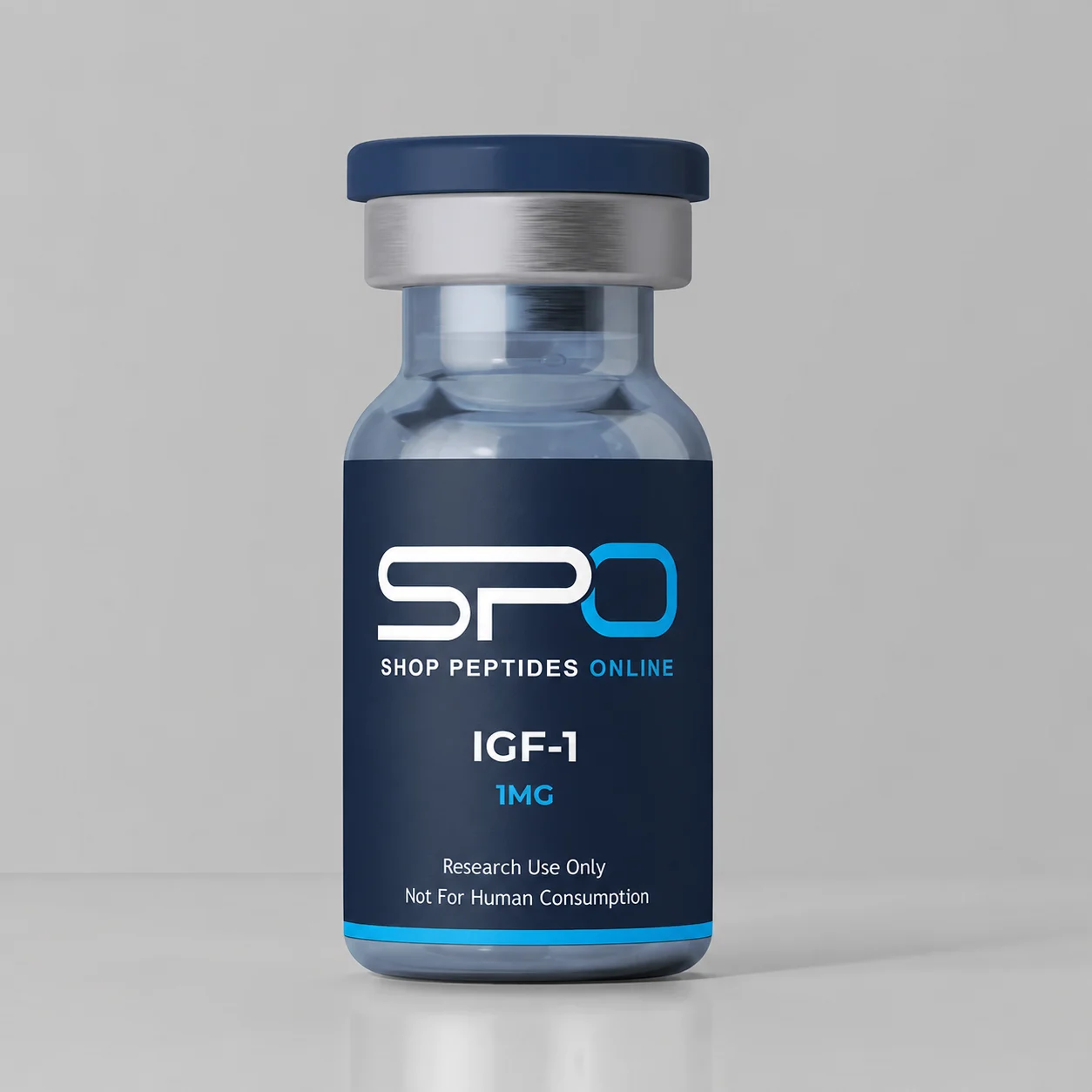
Insulin-like growth factor 1 is not a designer peptide but a human hormone: a 70-amino-acid single-chain protein, cross-linked by three disulfide bridges, whose sequence Rinderknecht and Humbel published in 1978 and whose shape echoes proinsulin[2]. It is the messenger through which growth hormone acts on cartilage and bone — the “sulphation factor” of 1957[1], later renamed somatomedin C and then IGF-1[6]. Because IGF-1 is a real drug in one rare condition and a doping concern in sport, this page is longer than most: there is no separate research guide for IGF-1 on this site, so the compound’s identity, history, laboratory literature and limits are set out here. The vial is 1mg of lyophilized research-grade IGF-1 for laboratory use only.
Identity at a glance
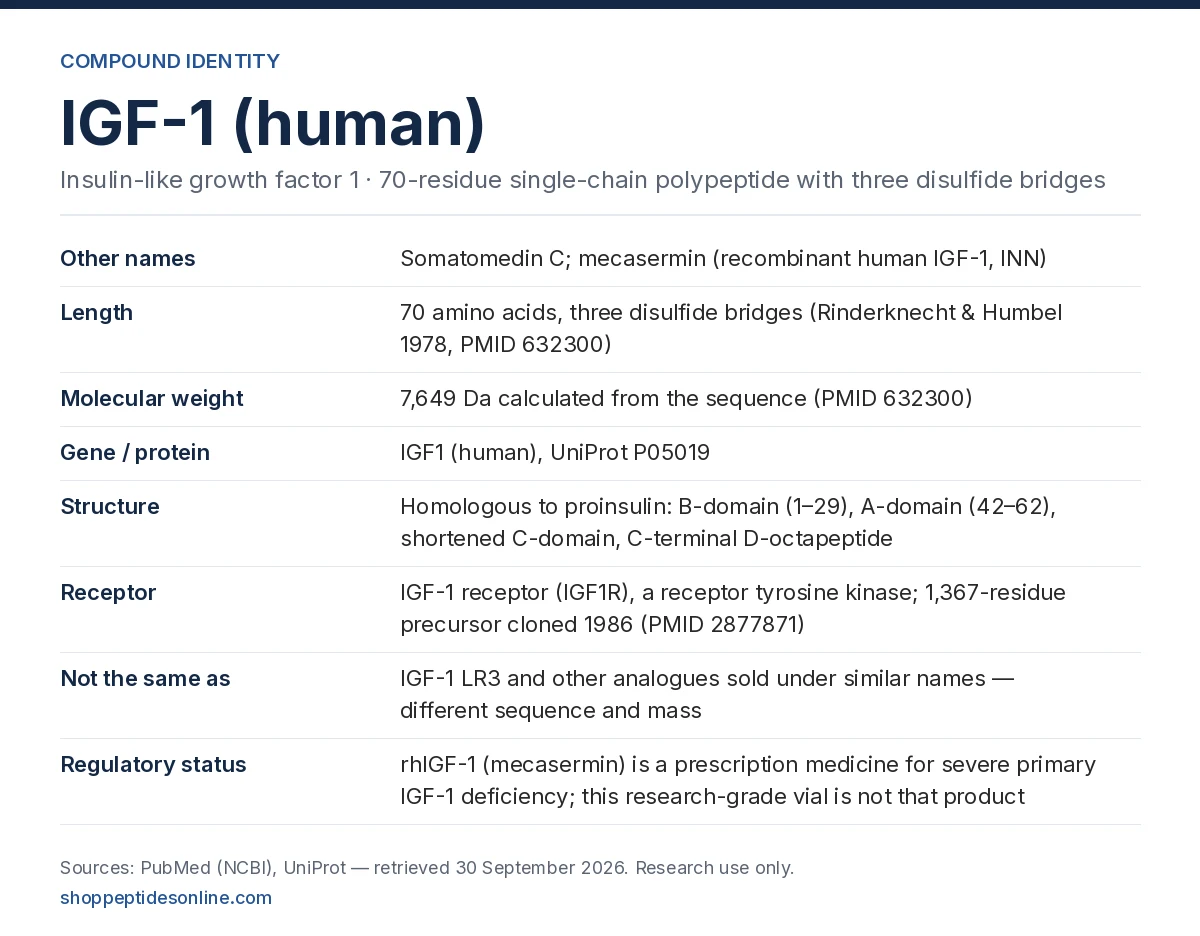
| Protein | Insulin-like growth factor 1 (IGF-1, IGF-I); somatomedin C; recombinant form: mecasermin (INN) |
| Length / mass | 70 residues; 7,649 Da calculated; three disulfide bridges[2] |
| Domains | Positions 1–29 homologous to insulin B chain, 42–62 to the A chain, joined by a 12-residue C-peptide and followed by an 8-residue D-extension[2] |
| Gene / database | IGF1 (human); UniProt P05019 — the mature chain is residues 49–118 of the 195-residue precursor |
| Receptor | IGF-1 receptor, a receptor tyrosine kinase; its 1,367-residue precursor was cloned in 1986 and shares its α/β architecture with the insulin receptor[3] |
| Not to be confused with | IGF-1 LR3, IGF-1 DES and other analogues — different sequences and masses; this listing is labelled native IGF-1 |
Batch documentation
A batch-specific COA for this strength has not been posted yet — see the COA library (/coa/). No other product’s report is shown here in its place. For a 7.6 kDa disulfide-bonded protein a useful report would give an HPLC purity figure, an intact-mass result near 7,649 Da (which also separates native IGF-1 from LR3-type analogues), and ideally an activity or receptor-binding assay, since a correct mass does not prove correct folding.
Where IGF-1 comes from
The idea came before the molecule. In 1957 Salmon and Daughaday showed that growth hormone did not act on cartilage directly but through a serum factor that stimulated sulfate uptake[1]. Two decades of purification ended with the 1978 sequence: 70 residues, three disulfides, an unmistakable resemblance to proinsulin[2]. The receptor followed in 1986, when Ullrich’s group cloned a 1,367-residue precursor that is processed into α and β subunits like the insulin receptor, with a tyrosine-kinase domain in the β chain[3]. Human genetics then fixed the hormone’s role: a 1996 report described intrauterine growth retardation and postnatal growth failure in a patient with a deletion of the IGF1 gene[4], and Laron syndrome — growth-hormone insensitivity with very low IGF-1 — became the natural experiment for what happens when the signal is absent[6, 11].
What has been studied in the laboratory
- Liver-specific knockout (mouse, 1999): deleting Igf1 in the liver caused a dramatic fall in circulating IGF-1 yet body weight, body length and femur length matched wild-type littermates — evidence that locally produced IGF-1, not the circulating pool, drives most somatic growth[5].
- Receptor biology (review, 2026): beyond the plasma membrane, the IGF-1 receptor is internalised and continues to signal from intracellular compartments, including the nucleus — a topic of oncology interest because IGF-1R signalling supports cell survival and proliferation[12].
- Exercise and muscle (review, 2026): resistance exercise raises muscle IGF-1 and the PI3K/Akt and MAPK/ERK pathways downstream of it, which the authors frame as a route to counter age-related loss of muscle mass[13]. That is a statement about endogenous IGF-1 in exercising muscle, not about exogenous protein.
- Cancer epidemiology (meta-analysis, 2016): circulating IGF-1 and IGF-binding proteins were examined against ovarian-cancer risk across the published cohorts[10] — one of many studies that make IGF-1 a two-sided molecule in the literature.
- Ageing (review, 2023): people with Laron syndrome have low IGF-1 for life and a distinctive pattern of ageing and disease risk, which the authors use to test ideas about IGF-1 and longevity[11].
The clinical and anti-doping context
Recombinant human IGF-1, mecasermin, is a regulated prescription medicine for children with severe primary IGF-1 deficiency: a 2007 report followed 76 such children through years of treatment and recorded growth responses alongside frequent adverse events — hypoglycaemia in 49% of treated children, injection-site lipohypertrophy in 32% and tonsillar/adenoidal hypertrophy in 22%[7]; a 2013 review sets out how that rare diagnosis is made and treated[8]. None of that transfers to a research vial — the medicine is a characterised pharmaceutical given under specialist care for a defined indication. IGF-1 is also an anti-doping problem: a 2013 review describes it as an attractive performance-enhancing agent, notes that IGF-1 compounds and analogues have been sold on the internet and black market for years, and reports that no test for its misuse was yet in place[9]. The material on this page is sold for laboratory research and for no other purpose.
What the evidence does not show
- No research-grade IGF-1 has been shown to do anything in a person. Every human result cited above concerns mecasermin in children with a diagnosed deficiency[7, 8]; the reviews of exercise, ageing and cancer describe the body’s own IGF-1[13, 11, 10].
- The circulating pool is not the whole story. Mice without hepatic IGF-1 grew normally[5]; what a protein in a vial would do after leaving it is not inferable from serum-level correlations.
- The literature records risks, not only effects. Hypoglycaemia, lipohypertrophy and tonsillar/adenoidal hypertrophy were documented in the treatment cohort[7], and IGF-1 signalling is a survival pathway in tumour cells[12].
- Identity is not guaranteed by a name. “IGF-1” products vary between the native protein and analogues such as LR3; without a mass-spectrometry result the vial’s contents are a label, not a fact.
Storage and handling
- Sealed vial at −20 °C for long-term storage (the site states up to 24 months as lyophilized powder); cool, dry and dark for short holds; avoid freeze–thaw cycling.
- IGF-1 is a folded protein, not a short peptide: it can be denatured by heat, vigorous mixing or the wrong pH, and its three disulfide bridges make it sensitive to reducing agents. Dissolve gently, prepare only what an experiment needs, and keep solutions cold. Reconstitution and handling protocols belong to the researcher and are not described on this site.
Related GH-axis research materials: Tesamorelin and Ipamorelin (both with full research guides). Orders ship from inside Canada by Canada Post; the shipping policy has dispatch cut-off, delivery times and the free-shipping threshold. The full range is on the page where you can buy peptides online in Canada.
Frequently asked questions
Can I buy IGF-1 1mg in Canada?
Yes. Shop Peptides Online supplies the 1mg vial of IGF-1 as research-grade lyophilized protein and ships it from inside Canada by Canada Post. It is sold for laboratory research only and is not the prescription medicine mecasermin.
Is this IGF-1 or IGF-1 LR3?
This listing is labelled IGF-1, the native 70-amino-acid human sequence (7,649 Da, PMID 632300). ‘IGF-1 LR3’ is a different, longer analogue with an altered N-terminus and a substitution at position 3; it is not what this page describes. Only a batch report’s mass-spectrometry line can confirm which protein a vial contains.
Is there a COA for IGF-1 1mg?
Not yet. No batch-specific certificate for this product is posted in the COA library, and no other product’s report is shown in its place. When an independent report for an IGF-1 lot is issued it will be embedded on this page.
How should IGF-1 be stored?
Sealed vial at −20 °C for long-term storage (the site states stability up to 24 months as lyophilized powder); cool, dry and dark for short holds; no repeated freeze–thaw. As a folded protein with three disulfide bridges it is more sensitive to heat, shear and pH than a short peptide — handle solutions gently and prepare them fresh.
Is IGF-1 for human use?
No. This vial is research-grade material for laboratory use only, not for human or animal consumption. Recombinant IGF-1 exists as a regulated prescription product for one rare paediatric indication (PMIDs 17192294, 23392102); this is not that product; IGF-1 misuse in sport is a recognised anti-doping concern (PMID 23934394); and Shop Peptides Online provides no dosing or administration guidance.
References
Retrieved from PubMed (NCBI) on 30 September 2026 and cross-checked against Europe PMC; protein identity from UniProt (P05019).
- SALMON WD, DAUGHADAY WH (1957). A hormonally controlled serum factor which stimulates sulfate incorporation by cartilage in vitro. J Lab Clin Med. PMID 13429201
- Rinderknecht E, Humbel RE (1978). The amino acid sequence of human insulin-like growth factor I and its structural homology with proinsulin. J Biol Chem. PMID 632300
- Ullrich A, Gray A et al. (1986). Insulin-like growth factor I receptor primary structure: comparison with insulin receptor suggests structural determinants that define functional specificity. EMBO J. PMID 2877871
- Woods KA, Camacho-Hübner C et al. (1996). Intrauterine growth retardation and postnatal growth failure associated with deletion of the insulin-like growth factor I gene. N Engl J Med. PMID 8857020
- Yakar S, Liu JL et al. (1999). Normal growth and development in the absence of hepatic insulin-like growth factor I. Proc Natl Acad Sci U S A. PMID 10377413
- Laron Z (2001). Insulin-like growth factor 1 (IGF-1): a growth hormone. Mol Pathol. PMID 11577173
- Chernausek SD, Backeljauw PF et al. (2007). Long-term treatment with recombinant insulin-like growth factor (IGF)-I in children with severe IGF-I deficiency due to growth hormone insensitivity. J Clin Endocrinol Metab. PMID 17192294
- Savage MO (2013). Phenotypes, investigation and treatment of primary IGF-1 deficiency. Endocr Dev. PMID 23392102
- Guha N, Cowan DA et al. (2013). Insulin-like growth factor-I (IGF-I) misuse in athletes and potential methods for detection. Anal Bioanal Chem. PMID 23934394
- Gianuzzi X, Palma-Ardiles G et al. (2016). Insulin growth factor (IGF) 1, IGF-binding proteins and ovarian cancer risk: A systematic review and meta-analysis. Maturitas. PMID 27823741
- Werner H, Laron Z (2023). Insulin-like growth factors and aging: lessons from Laron syndrome. Front Endocrinol (Lausanne). PMID 37941907
- Zhang T, Li L et al. (2026). Beyond the membrane: Internalization and compartmentalization of insulin‑like growth factor 1 receptor signaling in cancer pathogenesis and treatment (Review). Int J Oncol. PMID 41716020
- Liu Z, Tong X et al. (2026). Restoring the balance: Resistance exercise-induced insulin-like growth factor-1 restores PI3K/Akt and MAPK/ERK cross-talk to ameliorate Alzheimer's disease. Ageing Res Rev. PMID 42413217
For laboratory research use only; not for human or animal consumption. This page identifies the protein, its documentation status and its published literature, and makes no claim of efficacy or safety for the material sold.