BPC-157 and TB-500 are usually mentioned in the same breath, sold side by side and even blended in one vial. The molecules have almost nothing in common. One is a 15-residue fragment of a stomach protein. The other, as it is actually sold, is a seven-residue piece of a 43-residue protein that binds actin. This article compares them the way a lab would: what each molecule is, what has been studied, in which model, and where the evidence stops.
For laboratory research only. Not for human or animal use. This article gives no dosing, administration or therapeutic advice.
The short answer
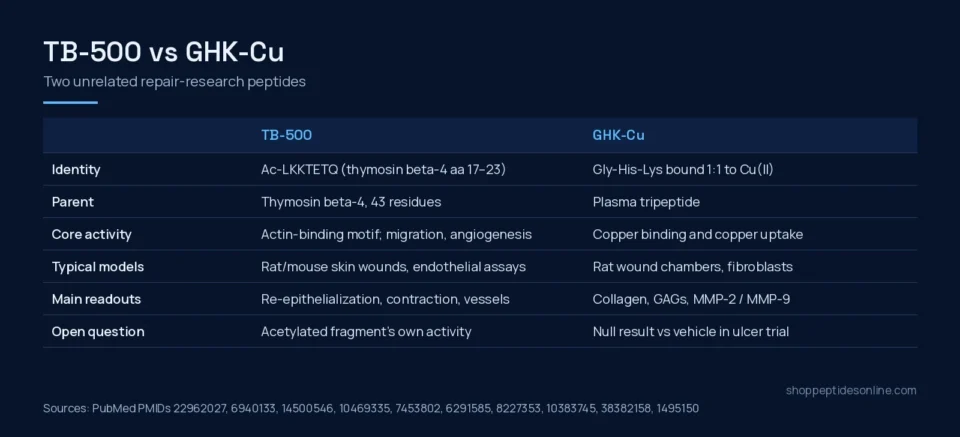
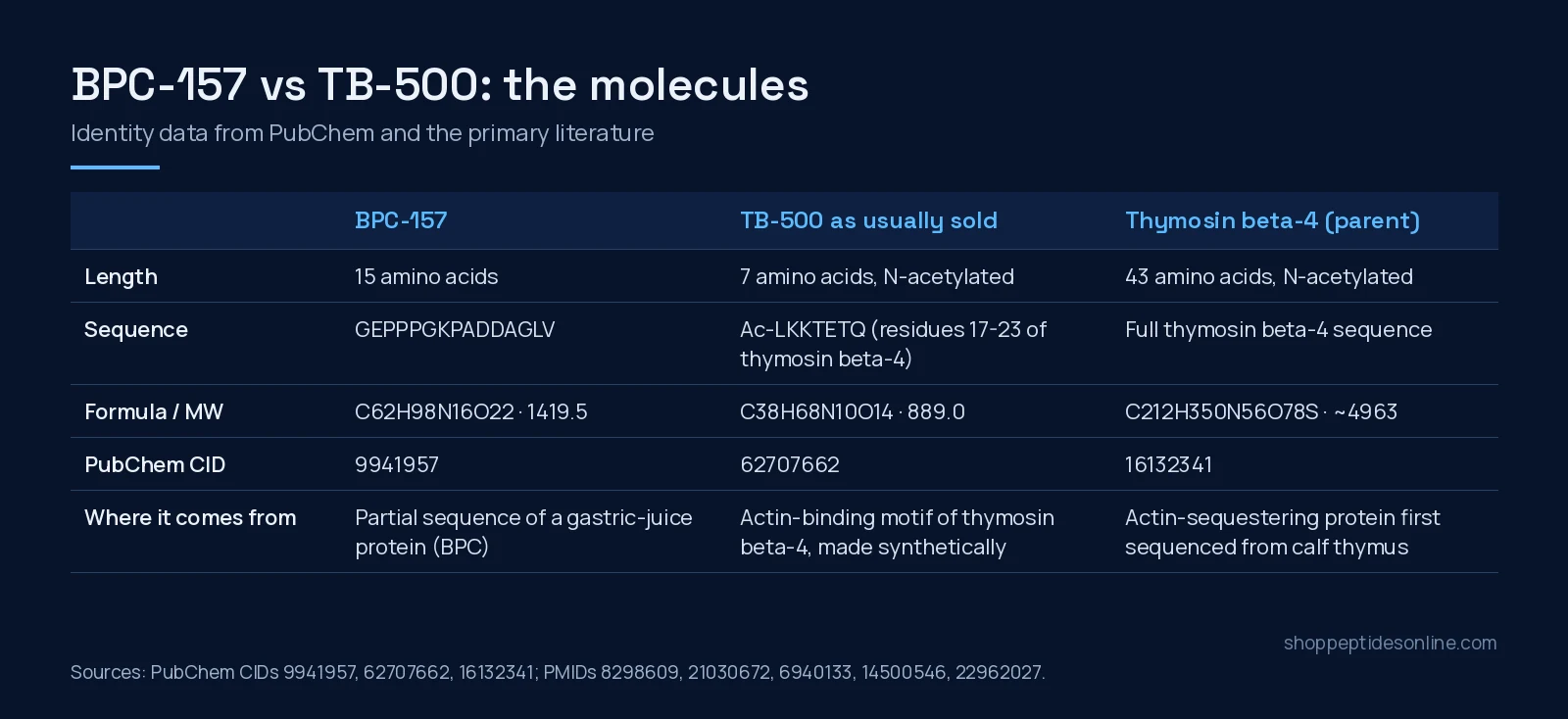
BPC-157 is a synthetic pentadecapeptide (GEPPPGKPADDAGLV) derived from a gastric-juice protein called BPC[1, 2]. “TB-500” is a trade name. Doping-control labs analysing TB-500 products found the N-acetylated 17–23 fragment of thymosin beta-4, Ac-LKKTETQ, not the full protein[3, 4]. Both have been studied mainly in rats, mice and cultured cells. In the only head-to-head study found, run in a rat tendon model, the TB-500 group reached statistical significance on more measures than the BPC-157 group, and combining the two added nothing over either alone[5]. For the fragment-versus-protein question, see our separate comparison of thymosin beta-4 vs TB-500.
Identity side by side
| BPC-157 | TB-500 (as sold) | Thymosin beta-4 | |
|---|---|---|---|
| Residues | 15 | 7, N-acetylated | 43, N-acetylated[6] |
| Sequence | GEPPPGKPADDAGLV[7] | Ac-LKKTETQ[3] | Full-length protein |
| Molecular weight | 1419.5 (PubChem CID 9941957) | 889.0 (CID 62707662) | ~4963 (CID 16132341) |
| Origin | Partial sequence of body protection compound, isolated from gastric juice[2] | Synthetic copy of thymosin beta-4’s actin-binding region[4] | Sequenced from calf thymus in 1981[6] |
| Human data | No clinical safety data found in a 2025 systematic review[8] | None found for the fragment itself | Phase I safety and pharmacokinetics in healthy volunteers[9]; a phase 2 ophthalmic trial[10] |
Two different origin stories
BPC-157: from a stomach protein
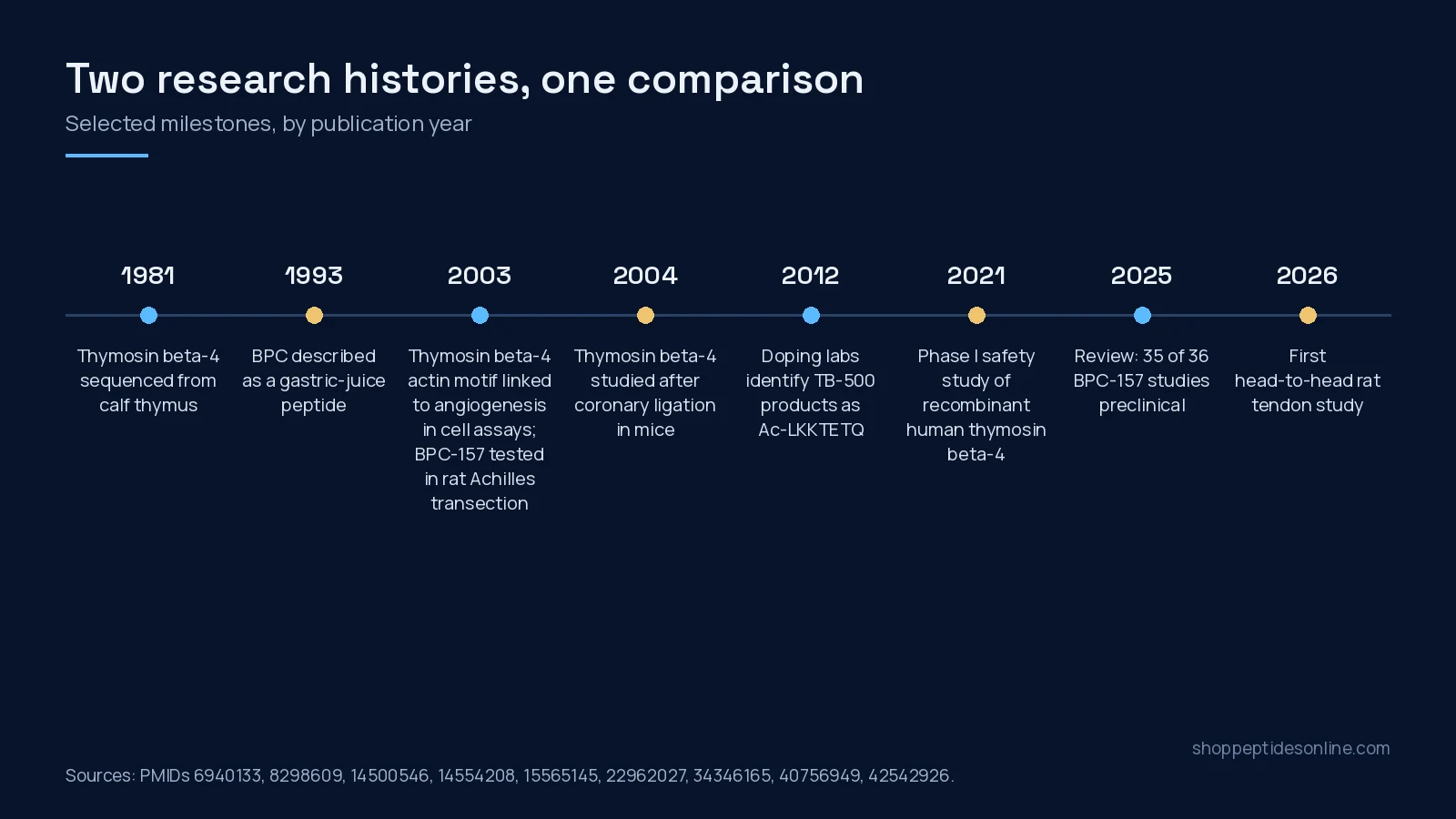
The group that introduced BPC in 1993 described it as a new gastric-juice peptide and framed it within a “stomach-stress-organoprotection” hypothesis[1]. The research compound is a 15-amino-acid partial sequence of that protein. Later papers describe it as isolated from human gastric juice[2, 11].
TB-500: from an actin-binding protein
Thymosin beta-4 is a 43-residue polypeptide with a blocked (acetylated) N-terminus, first sequenced from calf thymus[6]. It is best known as the main G-actin-sequestering peptide in mammalian cells[12, 13]. In 2003, work with proteolytic fragments and synthetic peptides showed that a seven-amino-acid actin-binding motif was essential for its activity in endothelial migration and vessel-sprouting assays. In those assays, the full protein and the motif alone behaved almost identically[12]. That motif, LKKTETQ, is what TB-500 products were later found to contain[3].
What has been studied, by model
Neither literature is clinical. The table sorts representative studies by the system they used, which is the first thing to check before reading any result.
| Model | BPC-157 | Thymosin beta-4 / TB-500 |
|---|---|---|
| Cultured cells | Rat tendon fibroblasts: faster explant outgrowth, better survival under oxidative stress and more migration, with no direct effect on proliferation[2]. Higher growth-hormone receptor expression in tendon fibroblasts[11]. Human endothelial cells: VEGFR2 upregulation and Akt–eNOS signalling[14]. | Human endothelial cells and chick aortic rings: migration and sprouting, which depended on the actin-binding motif[12]. Keratinocyte migration in a chamber assay[15]. |
| Rat | Transected Achilles tendon: biomechanical, functional and histological measures reported as improved against controls[7]. Hind-limb ischaemia: faster blood-flow recovery[14]. | Full-thickness skin wounds: more re-epithelialisation and collagen deposition than saline[15]. |
| Mouse | No mouse study is cited here. | Coronary artery ligation: activation of integrin-linked kinase and Akt, and early cardiomyocyte survival[16]. |
| Human | One small retrospective case series appears in the 2025 review. The review found no clinical safety data[8]. | Full-length recombinant thymosin beta-4 was tolerated in a phase I study, with no dose-limiting toxicities across the doses tested[9]. No human study of the TB-500 fragment was found. |
The one head-to-head study
A 2026 study compared the two directly[5]. It used 32 male Sprague-Dawley rats after Achilles tendon transection and repair, split into four groups of eight: control, BPC-157, TB-500 and the combination. Tendons were assessed at four weeks. The results were mixed rather than decisive:
- Load to failure was higher in both treated groups than in controls, but reached significance only for TB-500.
- Histology scores improved significantly for TB-500, and for the combination on one of the two scoring systems. BPC-157’s scores were numerically lower without reaching significance on the total scores.
- Collagen type I expression did not differ between groups.
- The combination gave no additional benefit over either peptide alone.
The authors call it an exploratory study and say that dose-finding and longer follow-up are still needed. There are further limits: small groups, a single four-week time point and one injury model. The abstract also calls the TB-500 used “synthetic thymosin beta-4”, so it doesn’t settle which molecule was given, fragment or full protein.
What neither literature shows
- No human efficacy data for BPC-157 or the TB-500 fragment. The 2025 systematic review counted 35 preclinical studies and 1 clinical study for BPC-157, and it lists unregulated manufacturing and contamination as possible sources of harm[8].
- Full-protein results don’t transfer automatically to the fragment. The 2003 motif result came from cell and aortic-ring assays[12]. It doesn’t show that the fragment reproduces every in-vivo finding reported for thymosin beta-4.
- No approval. BPC-157 has no FDA approval and is banned in professional sport[8]. TB-500 appears in the literature mainly as a doping-control target[3, 4].
Why the difference matters on a COA
A certificate of analysis identifies the molecule by its mass, and these masses are far apart: about 1419 for BPC-157, 889 for the fragment and roughly 4963 for full thymosin beta-4. For a two-peptide blend, the report should state an identity and purity result for each component separately. Our guide to checking blend COAs component by component walks through it. The science pages behind each compound are the BPC-157 research overview and the TB-500 research overview, and the combined material is listed as the BPC-157/TB-500 10mg blend. If you’re sourcing either compound, you can buy peptides online in Canada with the batch report linked from each listing.
Frequently asked questions
Is TB-500 the same as thymosin beta-4?
Not usually. Doping-control analyses of products sold as TB-500 identified the acetylated seven-residue fragment Ac-LKKTETQ, residues 17 to 23 of thymosin beta-4, rather than the 43-residue protein. The two differ in mass by more than 4,000 daltons, which a mass-spectrometry result on a COA can distinguish.
Has BPC-157 been compared with TB-500 directly?
One 2026 rat study compared them after Achilles tendon repair. TB-500 reached statistical significance on load to failure and on histology scores. BPC-157’s changes did not reach significance on total scores, and combining them added nothing. It was a small, exploratory four-week study.
Are there human studies of BPC-157 or TB-500?
A 2025 systematic review of BPC-157 found 35 preclinical studies, one small clinical report and no clinical safety data. Full-length recombinant thymosin beta-4 has been through phase I and phase 2 trials, but no human study of the TB-500 fragment itself was found.
Why are BPC-157 and TB-500 sold as a blend?
That is a commercial pairing, not one grounded in combination data. The only study that tested both together, in rat tendon, found no added benefit from the combination over either peptide alone.
References
- Sikirić P, Petek M, Rucman R et al. (1993). A new gastric juice peptide, BPC. An overview of the stomach-stress-organoprotection hypothesis and beneficial effects of BPC. J Physiol Paris. PMID: 8298609. doi: 10.1016/0928-4257(93)90038-u.
- Chang CH, Tsai WC, Lin MS et al. (2011). The promoting effect of pentadecapeptide BPC 157 on tendon healing involves tendon outgrowth, cell survival, and cell migration. J Appl Physiol (1985). PMID: 21030672. doi: 10.1152/japplphysiol.00945.2010.
- Esposito S, Deventer K, Goeman J et al. (2012). Synthesis and characterization of the N-terminal acetylated 17-23 fragment of thymosin beta 4 identified in TB-500, a product suspected to possess doping potential. Drug Test Anal. PMID: 22962027. doi: 10.1002/dta.1402.
- Ho EN, Kwok WH, Lau MY et al. (2012). Doping control analysis of TB-500, a synthetic version of an active region of thymosin β₄, in equine urine and plasma by liquid chromatography-mass spectrometry. J Chromatogr A. PMID: 23084823. doi: 10.1016/j.chroma.2012.09.043.
- Biçer O, Adanir O, Güleryüz Y et al. (2026). Effects of BPC-157 and TB-500 on Achilles tendon healing in rats: A histopathological and biomechanical study. Jt Dis Relat Surg. PMID: 42542926. doi: 10.52312/jdrs.2026.2951.
- Low TL, Hu SK, Goldstein AL (1981). Complete amino acid sequence of bovine thymosin beta 4: a thymic hormone that induces terminal deoxynucleotidyl transferase activity in thymocyte populations. Proc Natl Acad Sci U S A. PMID: 6940133. doi: 10.1073/pnas.78.2.1162.
- Staresinic M, Sebecic B, Patrlj L et al. (2003). Gastric pentadecapeptide BPC 157 accelerates healing of transected rat Achilles tendon and in vitro stimulates tendocytes growth. J Orthop Res. PMID: 14554208. doi: 10.1016/S0736-0266(03)00110-4.
- Vasireddi N, Hahamyan H, Salata MJ et al. (2025). Emerging Use of BPC-157 in Orthopaedic Sports Medicine: A Systematic Review. HSS J. PMID: 40756949. doi: 10.1177/15563316251355551.
- Wang X, Liu L, Qi L et al. (2021). A first-in-human, randomized, double-blind, single- and multiple-dose, phase I study of recombinant human thymosin β4 in healthy Chinese volunteers. J Cell Mol Med. PMID: 34346165. doi: 10.1111/jcmm.16693.
- Sosne G, Dunn SP, Kim C (2015). Thymosin β4 significantly improves signs and symptoms of severe dry eye in a phase 2 randomized trial. Cornea. PMID: 25826322. doi: 10.1097/ICO.0000000000000379.
- Chang CH, Tsai WC, Hsu YH et al. (2014). Pentadecapeptide BPC 157 enhances the growth hormone receptor expression in tendon fibroblasts. Molecules. PMID: 25415472. doi: 10.3390/molecules191119066.
- Philp D, Huff T, Gho YS et al. (2003). The actin binding site on thymosin beta4 promotes angiogenesis. FASEB J. PMID: 14500546. doi: 10.1096/fj.03-0121fje.
- Goldstein AL, Hannappel E, Kleinman HK (2005). Thymosin beta4: actin-sequestering protein moonlights to repair injured tissues. Trends Mol Med. PMID: 16099219. doi: 10.1016/j.molmed.2005.07.004.
- Hsieh MJ, Liu HT, Wang CN et al. (2017). Therapeutic potential of pro-angiogenic BPC157 is associated with VEGFR2 activation and up-regulation. J Mol Med (Berl). PMID: 27847966. doi: 10.1007/s00109-016-1488-y.
- Malinda KM, Sidhu GS, Mani H et al. (1999). Thymosin beta4 accelerates wound healing. J Invest Dermatol. PMID: 10469335. doi: 10.1046/j.1523-1747.1999.00708.x.
- Bock-Marquette I, Saxena A, White MD et al. (2004). Thymosin beta4 activates integrin-linked kinase and promotes cardiac cell migration, survival and cardiac repair. Nature. PMID: 15565145. doi: 10.1038/nature03000.