For laboratory research only. Not for human or animal use. This article gives no dosing, administration or therapeutic advice.
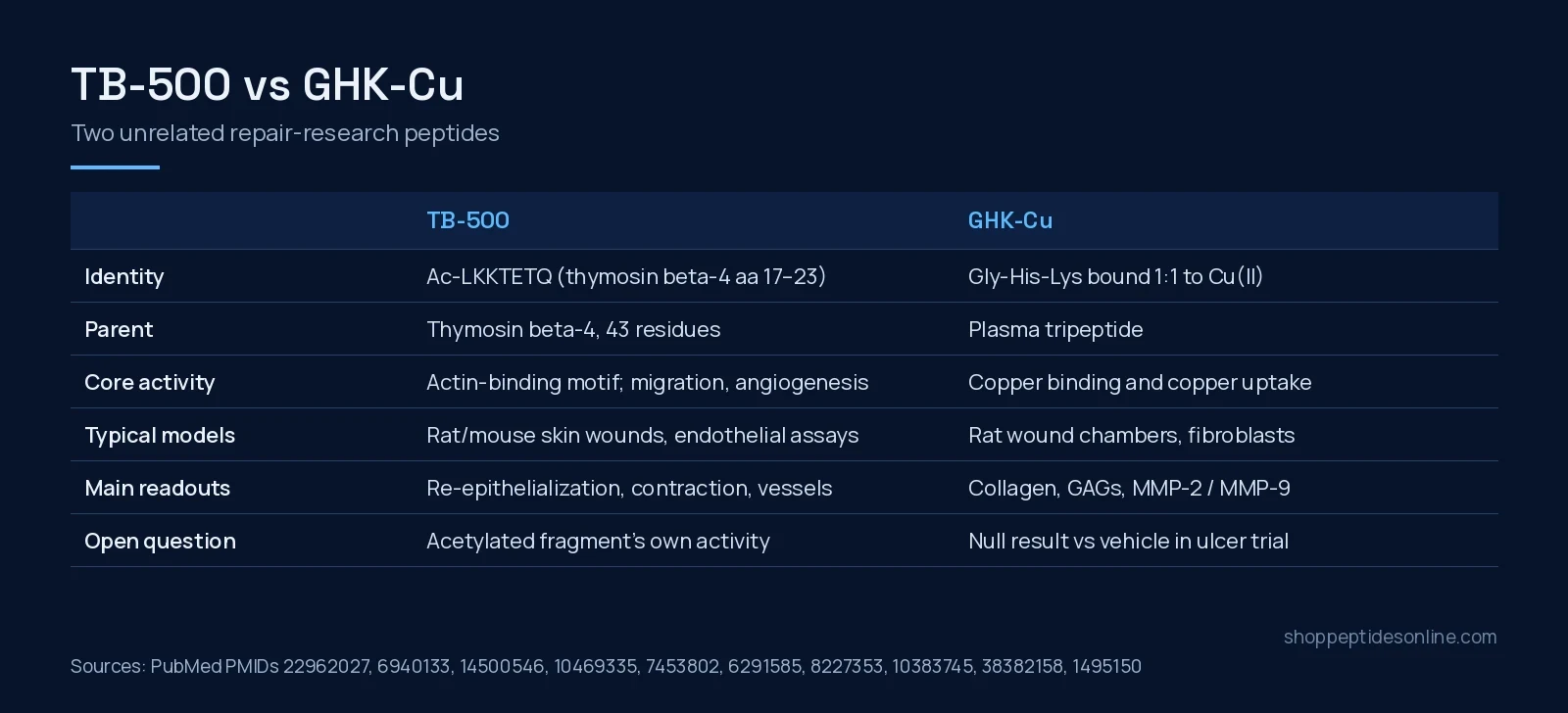
Short answer: TB-500 and GHK-Cu both turn up in wound-repair research, but they are unrelated molecules that work through different machinery. “TB-500” is the name used for a synthetic version of the actin-binding region of thymosin beta-4, identified in TB-500 products as the acetylated seven-residue fragment Ac-LKKTETQ[1][2]. GHK-Cu is a three-residue plasma peptide, glycyl-histidyl-lysine, bound to copper(II)[3][4]. Thymosin beta-4 work centres on actin, cell migration and angiogenesis[5][6]; GHK-Cu work centres on copper delivery, collagen and extracellular matrix remodelling[3][7][8]. One gap matters for buyers of research material: the biological effects of acetylated TB-500 itself had not been documented as of a 2024 metabolism study, which found that only one of its breakdown fragments showed wound-healing activity in fibroblasts[9].
Side by side
| TB-500 | GHK-Cu | |
|---|---|---|
| What it is | Ac-LKKTETQ, residues 17–23 of thymosin beta-4[1] | Glycyl-L-histidyl-L-lysine complexed 1:1 with Cu(II)[4] |
| Parent molecule | Thymosin beta-4, 43 residues, N-terminally acetylated[10] | A tripeptide found in human plasma[7] |
| Core activity studied | Actin binding; the seven-residue motif carried the angiogenic activity of the parent[5] | Copper binding and copper uptake into cultured cells[3] |
| Typical models | Rat and mouse full-thickness skin wounds, endothelial migration assays[11][12][5] | Rat subcutaneous wound chambers, fibroblast cultures[8][7] |
| Main readouts | Re-epithelialization, contraction, angiogenesis, keratinocyte migration[11] | Collagen, glycosaminoglycans, matrix metalloproteinases[8][13] |
| Open question | Activity of the acetylated fragment itself[9] | A placebo-controlled ulcer trial found no difference from vehicle[14] |
| At SPO | TB-500 10mg | GHK-Cu 50mg |
What “TB-500” means
Thymosin beta-4 is a 43-residue peptide with an acetylated N-terminus, first sequenced from calf thymus in 1981[10]. It is the main G-actin-sequestering peptide in mammalian cells[5]. A 2010 review mapped several active sites onto the molecule: an N-terminal Ac-SDKP tetrapeptide linked to anti-inflammatory and anti-fibrotic effects, a longer N-terminal stretch linked to cell survival, and the central actin-binding sequence LKKTETQ (residues 17–23) linked to angiogenesis, wound healing and cell migration[6].
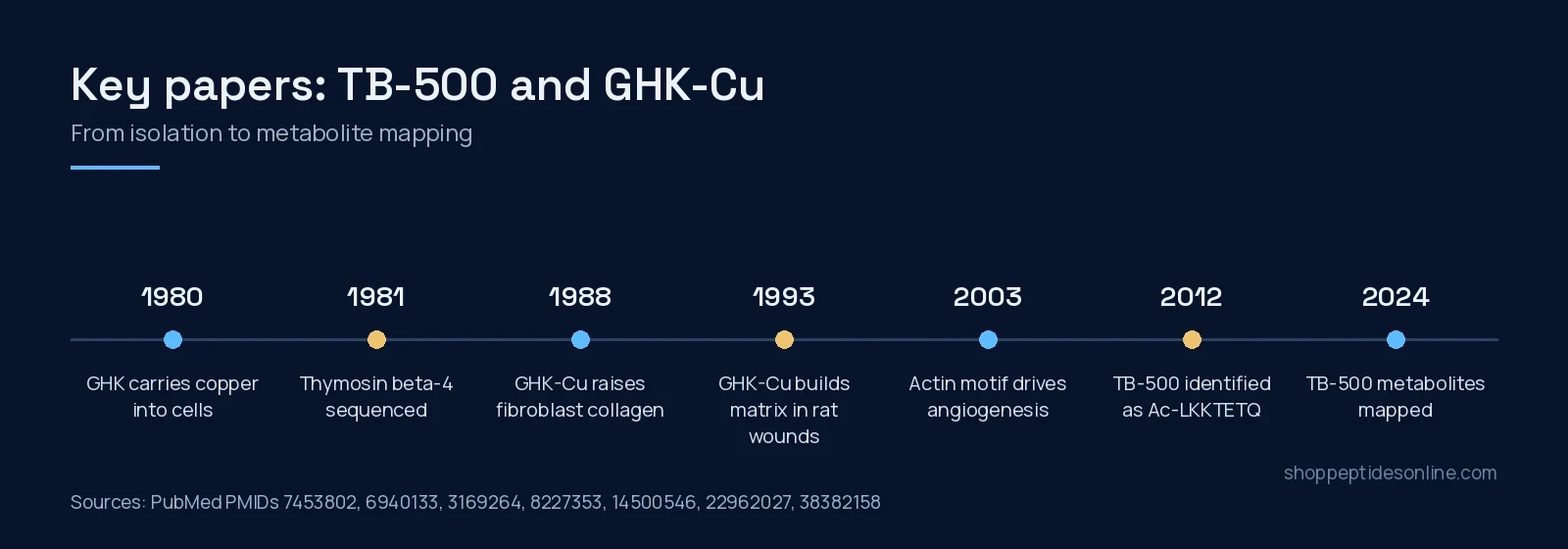
Doping-control chemists later analysed products sold as TB-500 and identified the N-terminally acetylated 17–23 fragment, Ac-LKKTETQ, by high-resolution mass spectrometry; they also synthesized it as a reference standard[1]. A second group described TB-500 as a synthetic version of an active region of thymosin beta-4 when building a detection method in horse urine and plasma[2]. The label is not used consistently in commerce, which is why identity testing by mass matters. We cover the full-length protein versus the fragment in thymosin beta-4 vs TB-500.
What GHK-Cu is
GHK is a tripeptide with affinity for copper(II), isolated from human plasma[7]. During its isolation it co-purified with roughly equimolar copper, and it readily formed copper complexes that increased copper uptake into cultured hepatoma cells, which led its discoverers to propose it acts as a copper transport factor[3]. Spectroscopy showed a mononuclear 1:1 complex at neutral pH, with copper coordinated by nitrogen atoms including one from the histidine imidazole ring[4]. The GHK sequence also appears in the alpha-2 chain of type I collagen, which the 1988 authors suggested could be released by proteases at a wound site[7].
Same wound question, different readouts
Thymosin beta-4 and its actin motif. In a rat full-thickness wound model, thymosin beta-4 applied topically or intraperitoneally increased re-epithelialization and wound contraction, with more collagen deposition and angiogenesis in treated wounds; it also stimulated keratinocyte migration in a Boyden chamber assay[11]. In endothelial migration and chick aortic ring sprouting assays, the seven-residue actin-binding motif matched the parent molecule’s activity, while peptides missing any part of the motif were inactive[5]. In aged mice, a synthetic LKKTETQ peptide promoted dermal wound repair comparably to full-length thymosin beta-4[12]. In diabetic db/db mice the full-length protein increased wound contracture and collagen deposition, but keratinocyte migration did not differ from controls[12].
GHK-Cu and the extracellular matrix. In fibroblast cultures, GHK-Cu stimulated collagen synthesis independently of any change in cell number[7]. In rat wound chambers, injected GHK-Cu produced a concentration-dependent increase in dry weight, DNA, protein, collagen and glycosaminoglycans, raised type I and type III collagen mRNAs but not TGF-beta mRNA, and a control tripeptide had no significant effect[8]. A follow-up in the same model found GHK-Cu did not alter interstitial collagenase activity but increased MMP-2 in later healing stages and prolonged MMP-9 expression in wound tissue[13].
The TB-500 evidence gap
Most of the repair data above were generated with full-length thymosin beta-4 or the unacetylated LKKTETQ peptide. A 2024 study states plainly that the biological effects of TB-500 (Ac-LKKTETQ) had not been documented[9]. It mapped TB-500 metabolism in human serum, enzyme systems and rat urine: Ac-LK was the main metabolite in rats over the first hours, and Ac-LKK was detectable for up to 72 hours. None of the parent or metabolites was cytotoxic to fibroblasts, but in the fibroblast wound-healing assay only the Ac-LKKTE metabolite differed significantly from control[9]. Researchers who cite thymosin beta-4 papers to justify TB-500 experiments should treat that as an extrapolation, not a measured result.
Which one fits which question?
- Actin dynamics, endothelial migration, angiogenesis assays: thymosin beta-4 or its actin-binding fragment[5][6].
- Collagen synthesis, glycosaminoglycans, MMP regulation, copper handling: GHK-Cu[8][13][3].
- Analytical method development, metabolite identification: TB-500, with published LC-MS methods and metabolite standards[1][9].
For more on the copper side, see GHK-Cu vs other copper peptides. For the full catalogue, see our guide to buy peptides online in Canada.
Frequently asked questions
Is TB-500 the same as thymosin beta-4?
Not necessarily. Thymosin beta-4 is a 43-residue peptide. Products sold as TB-500 have been identified as the acetylated 17–23 fragment, Ac-LKKTETQ, which contains the actin-binding motif.
How do TB-500 and GHK-Cu differ in mechanism?
Thymosin beta-4’s actin-binding motif drives endothelial migration and angiogenesis in assays. GHK binds copper(II), increases copper uptake into cultured cells and stimulates collagen and matrix changes in rat wound models.
Has acetylated TB-500 itself been tested for biological activity?
A 2024 study said its effects had not been documented. In fibroblast assays it was not cytotoxic, and only its Ac-LKKTE metabolite showed significant wound-healing activity versus control.
Are there negative results for GHK-Cu?
Yes. In a randomized venous ulcer trial, a tripeptide-copper complex cream did not differ from inert vehicle.
Does Shop Peptides Online sell both?
Yes. TB-500 and GHK-Cu are listed for laboratory research only, not for human or animal use.
References
- Esposito S, Deventer K, Goeman J et al. (2012). Synthesis and characterization of the N-terminal acetylated 17-23 fragment of thymosin beta 4 identified in TB-500, a product suspected to possess doping potential. Drug Test Anal. PMID: 22962027. doi: 10.1002/dta.1402.
- Ho EN, Kwok WH, Lau MY et al. (2012). Doping control analysis of TB-500, a synthetic version of an active region of thymosin β₄, in equine urine and plasma by liquid chromatography-mass spectrometry. J Chromatogr A. PMID: 23084823. doi: 10.1016/j.chroma.2012.09.043.
- Pickart L, Freedman JH, Loker WJ et al. (1980). Growth-modulating plasma tripeptide may function by facilitating copper uptake into cells. Nature. PMID: 7453802. doi: 10.1038/288715a0.
- Freedman JH, Pickart L, Weinstein B et al. (1982). Structure of the Glycyl-L-histidyl-L-lysine–copper(II) complex in solution. Biochemistry. PMID: 6291585. doi: 10.1021/bi00262a004.
- Philp D, Huff T, Gho YS et al. (2003). The actin binding site on thymosin beta4 promotes angiogenesis. FASEB J. PMID: 14500546. doi: 10.1096/fj.03-0121fje.
- Sosne G, Qiu P, Goldstein AL et al. (2010). Biological activities of thymosin beta4 defined by active sites in short peptide sequences. FASEB J. PMID: 20179146. doi: 10.1096/fj.09-142307.
- Maquart FX, Pickart L, Laurent M et al. (1988). Stimulation of collagen synthesis in fibroblast cultures by the tripeptide-copper complex glycyl-L-histidyl-L-lysine-Cu2+. FEBS Lett. PMID: 3169264. doi: 10.1016/0014-5793(88)80509-x.
- Maquart FX, Bellon G, Chaqour B et al. (1993). In vivo stimulation of connective tissue accumulation by the tripeptide-copper complex glycyl-L-histidyl-L-lysine-Cu2+ in rat experimental wounds. J Clin Invest. PMID: 8227353. doi: 10.1172/JCI116842.
- Rahaman KA, Muresan AR, Min H et al. (2024). Simultaneous quantification of TB-500 and its metabolites in in-vitro experiments and rats by UHPLC-Q-Exactive orbitrap MS/MS and their screening by wound healing activities in-vitro. J Chromatogr B Analyt Technol Biomed Life Sci. PMID: 38382158. doi: 10.1016/j.jchromb.2024.124033.
- Low TL, Hu SK, Goldstein AL (1981). Complete amino acid sequence of bovine thymosin beta 4: a thymic hormone that induces terminal deoxynucleotidyl transferase activity in thymocyte populations. Proc Natl Acad Sci U S A. PMID: 6940133. doi: 10.1073/pnas.78.2.1162.
- Malinda KM, Sidhu GS, Mani H et al. (1999). Thymosin beta4 accelerates wound healing. J Invest Dermatol. PMID: 10469335. doi: 10.1046/j.1523-1747.1999.00708.x.
- Philp D, Badamchian M, Scheremeta B et al. (2003). Thymosin beta 4 and a synthetic peptide containing its actin-binding domain promote dermal wound repair in db/db diabetic mice and in aged mice. Wound Repair Regen. PMID: 12581423. doi: 10.1046/j.1524-475x.2003.11105.x.
- Siméon A, Monier F, Emonard H et al. (1999). Expression and activation of matrix metalloproteinases in wounds: modulation by the tripeptide-copper complex glycyl-L-histidyl-L-lysine-Cu2+. J Invest Dermatol. PMID: 10383745. doi: 10.1046/j.1523-1747.1999.00606.x.
- Bishop JB, Phillips LG, Mustoe TA et al. (1992). A prospective randomized evaluator-blinded trial of two potential wound healing agents for the treatment of venous stasis ulcers. J Vasc Surg. PMID: 1495150. doi: 10.1067/mva.1992.37086.
- Guarnera G, DE Rosa A, Camerini R (2007). Thymosin beta-4 and venous ulcers: clinical remarks on a European prospective, randomized study on safety, tolerability, and enhancement on healing. Ann N Y Acad Sci. PMID: 17495250. doi: 10.1196/annals.1415.003.