For laboratory research only. Not for human or animal use. This article gives no dosing, administration or therapeutic advice.
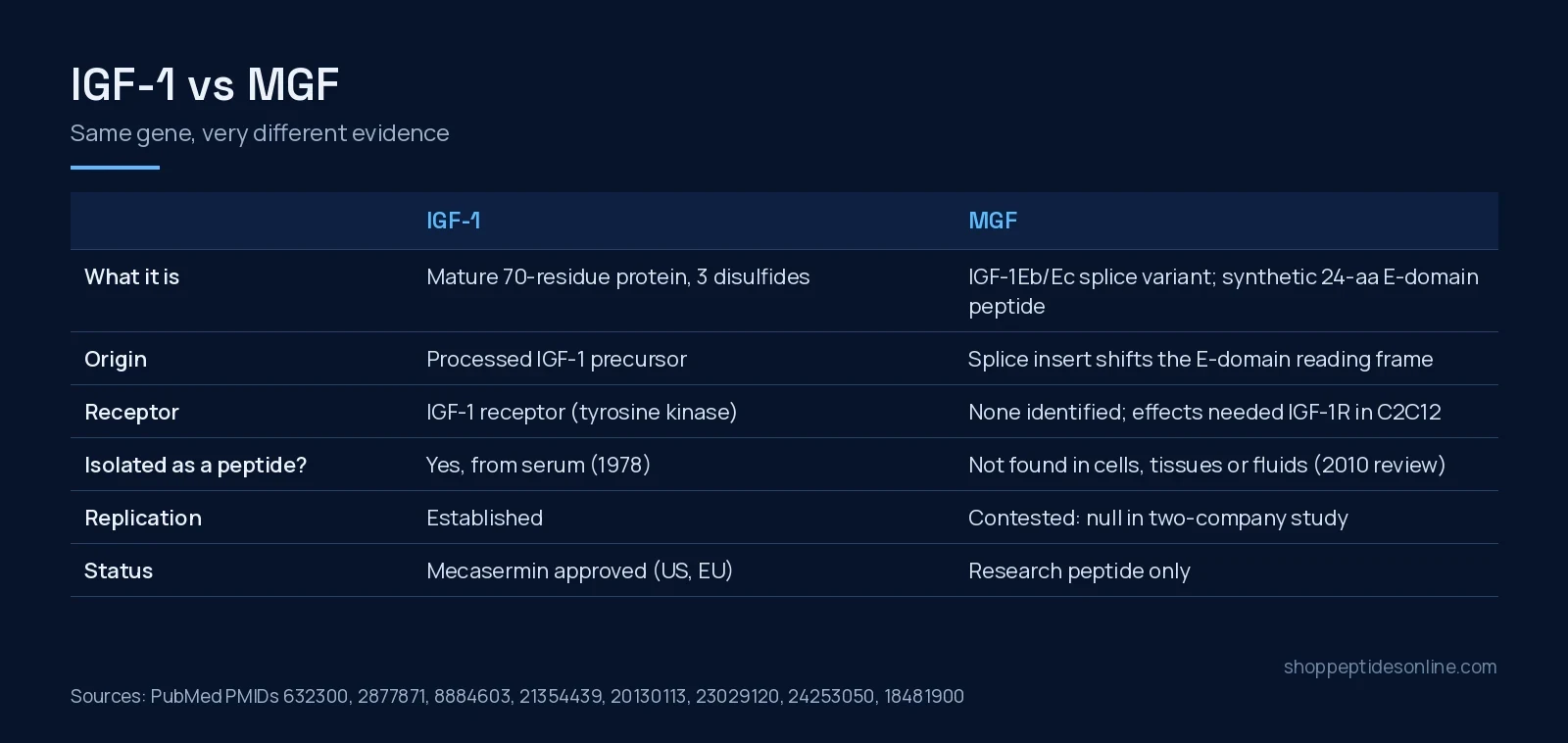
Short answer: IGF-1 and MGF come from the same gene but are very different research objects. Mature IGF-1 is a 70-residue, three-disulfide protein that signals through its own receptor tyrosine kinase[1][2]. “MGF” (mechano growth factor) first named an IGF-1 mRNA splice variant switched on in stretched or damaged muscle[3][4][5]; the peptide sold as MGF is a synthetic 24-residue piece of that variant’s C-terminal E-domain[5]. Mature IGF-1’s activity is well established; the synthetic MGF peptide’s activity is disputed, with positive cell and animal reports on one side and a two-company replication that found no effect on myoblasts on the other[6][7].
Side by side
| IGF-1 | MGF | |
|---|---|---|
| What it is | Mature protein, 70 residues, three disulfide bridges[1] | Name for the IGF-1Eb (rodent) / IGF-1Ec (human) splice variant, and for a synthetic 24-residue E-domain peptide[5][6] |
| Where it comes from | Processed from the IGF-1 precursor; the liver supplies most of the circulating pool in mice[8] | Alternative splicing that inserts 49 bp (human) or 52 bp (rodent) and shifts the E-domain reading frame[6][3] |
| Receptor | IGF-1 receptor, a 1,367-residue precursor related to the insulin receptor[2] | No receptor of its own identified; E-peptide effects in C2C12 cells depended on the IGF-1 receptor[9] |
| Found as a peptide in tissue? | Yes, isolated from serum and sequenced in 1978[1] | No analogous peptide had been isolated from cells, tissues or fluids, per a 2010 review[5] |
| Replication status | Established | Contested: no effect on myoblast proliferation or differentiation in a two-company study[7] |
| Regulatory status | Recombinant form (mecasermin) approved in the US and EU for severe primary IGF-1 deficiency[10] | Research peptide; no regulatory approval |
| At SPO | IGF-1 1mg (vial) and IGF-1 1mg cartridge refill | Not sold |
One gene, several products
Human IGF-1 was sequenced from serum in 1978: a single chain of 70 residues cross-linked by three disulfide bridges, with clear homology to proinsulin[1]. Its receptor, cloned in 1986, is a 1,367-residue precursor cleaved into alpha and beta subunits, built like the insulin receptor[2].
The IGF-1 gene does not make only the mature protein. Alternative splicing of exons 4, 5 and 6 produces precursors with different C-terminal extensions, the E-peptides[5]. In 1996, a rabbit study found that resting muscle expressed the liver-type IGF-1Ea transcript, while muscle undergoing stretch-induced hypertrophy also expressed a second isoform whose E-domain carried a 52-base-pair insert that changed the reading frame[3]. In humans the equivalent insert is 49 base pairs and the variant is called IGF-1Ec[6].
How the MGF idea grew
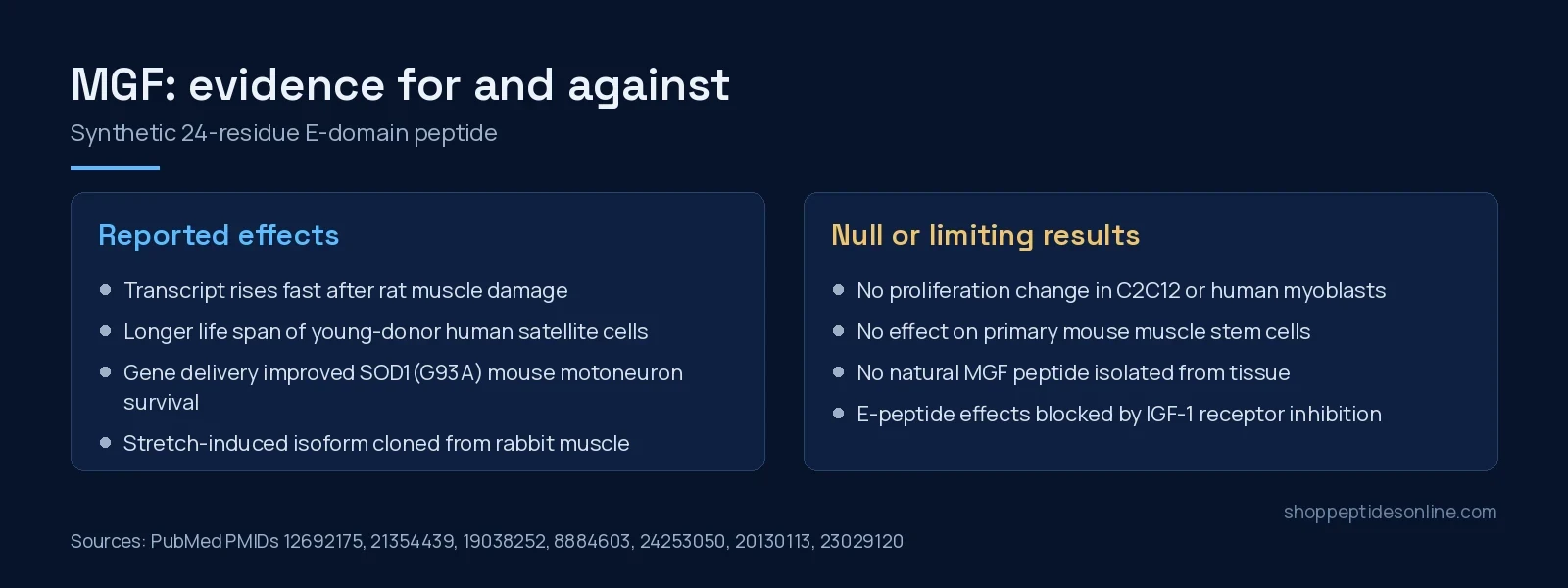
In rat tibialis anterior muscle damaged either by stretch with electrical stimulation or by bupivacaine injection, the MGF transcript rose quickly and fell within a few days, while the IGF-1Ea transcript rose more slowly as MGF declined; the timing tracked markers of satellite-cell activation[4]. A 2010 review summarized the pattern as IGF-1Eb first, linked to myoblast proliferation, then IGF-1Ea, linked to differentiation[5].
A synthetic peptide matching the last 24 residues of IGF-1Eb was then given the same MGF name and reported to promote proliferation and survival[5]. In primary human muscle cultures, that 24-residue E peptide extended proliferative life span and delayed senescence of satellite cells from neonatal and young adult donors, but not from old adult donors[6]. Separately, plasmid delivery of the MGF sequence or IGF-1 to hindlimb muscle of SOD1(G93A) mice improved muscle strength and motoneuron survival, with more motoneurons surviving in the MGF group[11]. Note that the mouse study delivered a gene construct, not the synthetic peptide.
The case against
Three findings complicate the MGF story:
- No natural peptide found. The 2010 review noted that no peptide analogous to synthetic MGF had been identified in or isolated from cultured cells, conditioned medium, animal tissues or biological fluids[5].
- Failed replication. Scientists at two pharmaceutical companies tested MGF peptides on C2C12 cells, primary human myoblasts and primary mouse muscle stem cells. MGF did not increase proliferation or block differentiation, and neither native nor stabilized MGF activated ERK in cardiac myocytes. Mature IGF-1 and full-length IGF-1Eb gave clear responses in the same systems[7].
- Receptor dependence. In C2C12 cells, synthetic rodent E-peptides raised MAPK signalling, and their effects on proliferation and migration were blocked by IGF-1 receptor inhibition; the authors concluded E-peptides have little independent activity and instead modulate IGF-1 signalling, partly by increasing receptor availability at the cell surface[9].
Where IGF-1 LR3 fits
IGF-1 LR3 is a third, engineered molecule: native IGF-1 with a Glu3-to-Arg substitution and a 13-residue N-terminal extension[12], not a splice product. We compare it with native IGF-1 in IGF-1 vs IGF-1 LR3. Researchers who see MGF and LR3 listed side by side should keep the distinction clear: one is a disputed E-domain fragment, the other a modified version of the mature hormone.
Which one fits which question?
- IGF-1 receptor signalling, growth-factor positive controls, autocrine versus endocrine IGF-1: mature IGF-1[2][8].
- IGF-1 splicing after muscle loading or injury: transcript-level work on IGF-1Ea versus IGF-1Eb/Ec, measured by RT-PCR[4][3].
- E-peptide biology: synthetic E-peptides tested with IGF-1 receptor inhibition and scrambled controls[9][7].
For the full catalogue, see our guide to buy peptides online in Canada.
Frequently asked questions
Is MGF the same as IGF-1?
No. Both come from the IGF-1 gene. IGF-1 is the mature 70-residue protein; MGF names a splice variant (IGF-1Eb in rodents, IGF-1Ec in humans) and a synthetic 24-residue peptide from its C-terminal E-domain.
Does MGF have its own receptor?
None has been identified. In C2C12 cells, the effects of synthetic E-peptides on proliferation and migration were blocked by IGF-1 receptor inhibition.
Has the MGF peptide been replicated?
Results conflict. Some studies report effects on human muscle progenitor cells, while a two-company replication found no effect on myoblast proliferation or differentiation.
Is MGF the same as IGF-1 LR3?
No. IGF-1 LR3 is an engineered analogue of mature IGF-1. MGF refers to a splice variant of the IGF-1 gene and a synthetic peptide from its E-domain.
Does Shop Peptides Online sell MGF?
No. SPO lists IGF-1 1mg for laboratory research only. MGF is not part of the catalogue.
References
- Rinderknecht E, Humbel RE (1978). The amino acid sequence of human insulin-like growth factor I and its structural homology with proinsulin. J Biol Chem. PMID: 632300.
- Ullrich A, Gray A, Tam AW et al. (1986). Insulin-like growth factor I receptor primary structure: comparison with insulin receptor suggests structural determinants that define functional specificity. EMBO J. PMID: 2877871. doi: 10.1002/j.1460-2075.1986.tb04528.x.
- Yang S, Alnaqeeb M, Simpson H et al. (1996). Cloning and characterization of an IGF-1 isoform expressed in skeletal muscle subjected to stretch. J Muscle Res Cell Motil. PMID: 8884603. doi: 10.1007/BF00123364.
- Hill M, Goldspink G (2003). Expression and splicing of the insulin-like growth factor gene in rodent muscle is associated with muscle satellite (stem) cell activation following local tissue damage. J Physiol. PMID: 12692175. doi: 10.1113/jphysiol.2002.035832.
- Matheny RW Jr, Nindl BC, Adamo ML (2010). Minireview: Mechano-growth factor: a putative product of IGF-I gene expression involved in tissue repair and regeneration. Endocrinology. PMID: 20130113. doi: 10.1210/en.2009-1217.
- Kandalla PK, Goldspink G, Butler-Browne G et al. (2011). Mechano Growth Factor E peptide (MGF-E), derived from an isoform of IGF-1, activates human muscle progenitor cells and induces an increase in their fusion potential at different ages. Mech Ageing Dev. PMID: 21354439. doi: 10.1016/j.mad.2011.02.007.
- Fornaro M, Hinken AC, Needle S et al. (2014). Mechano-growth factor peptide, the COOH terminus of unprocessed insulin-like growth factor 1, has no apparent effect on myoblasts or primary muscle stem cells. Am J Physiol Endocrinol Metab. PMID: 24253050. doi: 10.1152/ajpendo.00408.2013.
- Yakar S, Liu JL, Stannard B et al. (1999). Normal growth and development in the absence of hepatic insulin-like growth factor I. Proc Natl Acad Sci U S A. PMID: 10377413. doi: 10.1073/pnas.96.13.7324.
- Brisson BK, Barton ER (2012). Insulin-like growth factor-I E-peptide activity is dependent on the IGF-I receptor. PLoS One. PMID: 23029120. doi: 10.1371/journal.pone.0045588.
- Keating GM (2008). Mecasermin. BioDrugs. PMID: 18481900. doi: 10.2165/00063030-200822030-00004.
- Riddoch-Contreras J, Yang SY, Dick JR et al. (2009). Mechano-growth factor, an IGF-I splice variant, rescues motoneurons and improves muscle function in SOD1(G93A) mice. Exp Neurol. PMID: 19038252. doi: 10.1016/j.expneurol.2008.10.014.
- Laajoki LG, Francis GL, Wallace JC et al. (2000). Solution structure and backbone dynamics of long-[Arg(3)]insulin-like growth factor-I. J Biol Chem. PMID: 10744677. doi: 10.1074/jbc.275.14.10009.