For laboratory research only. Not for human or animal use. This article gives no dosing, administration or therapeutic advice.
Short answer: MOTS-c and SS-31 both get filed under “mitochondrial peptides”, but they reach mitochondria from opposite directions. MOTS-c is a natural 16-residue peptide encoded inside the mitochondrial 12S rRNA gene; in mice it acts mainly on skeletal muscle, inhibits the folate cycle and activates AMPK[1], and under metabolic stress it moves to the nucleus to regulate nuclear genes[2]. SS-31 (elamipretide) is a synthetic tetrapeptide, D-Arg-dimethylTyr-Lys-Phe-NH2, that concentrates in the inner mitochondrial membrane and binds the phospholipid cardiolipin[3][4]. One is a signal the mitochondrion sends out; the other is a compound designed to sit in the mitochondrial membrane.
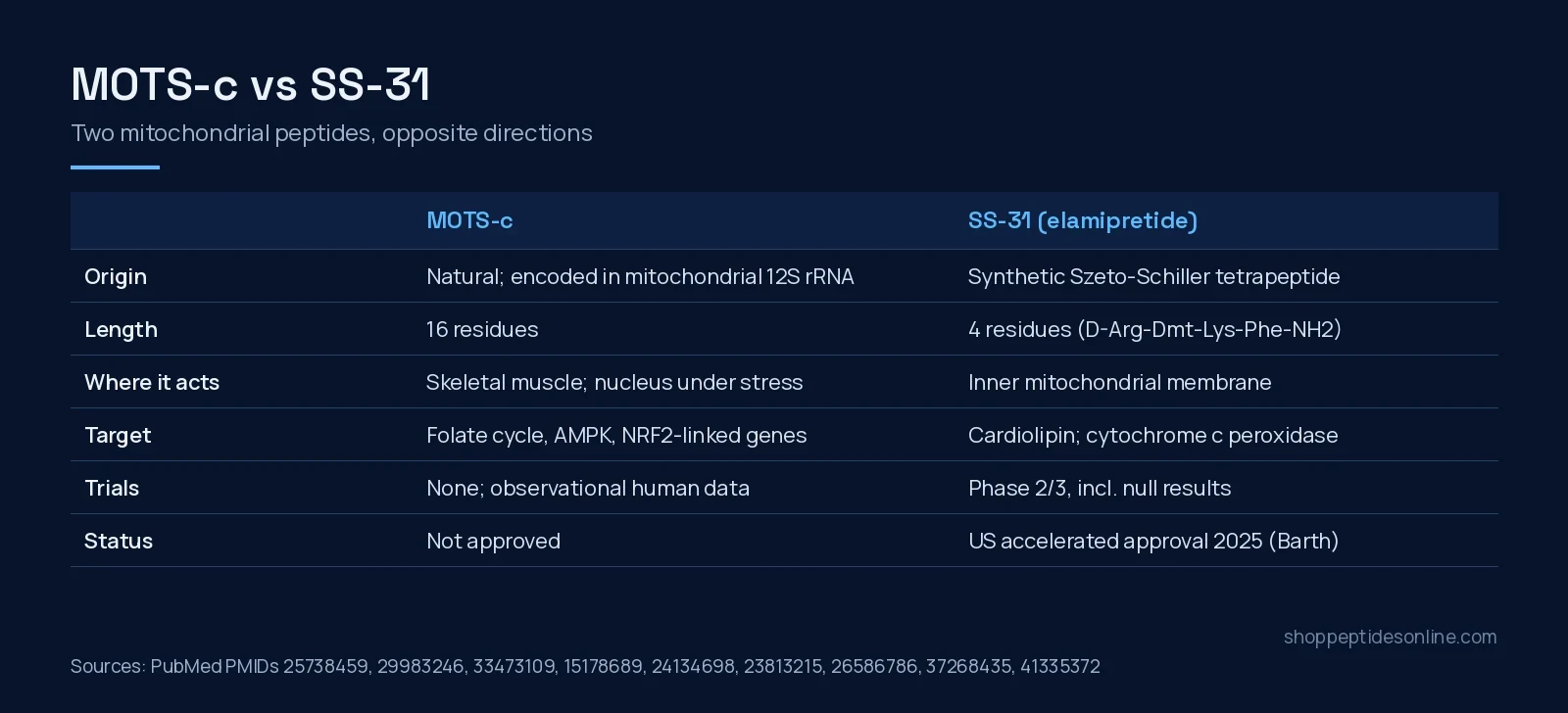
Side by side
| MOTS-c | SS-31 (elamipretide) | |
|---|---|---|
| Origin | Natural; short open reading frame in mitochondrial DNA (12S rRNA)[1] | Synthetic Szeto-Schiller peptide with alternating aromatic and basic residues[4] |
| Length | 16 residues[1] | 4 residues: D-Arg-Dmt-Lys-Phe-NH2[3] |
| Where it acts | Skeletal muscle as the main target organ in mice; nucleus under metabolic stress[1][2] | Inner mitochondrial membrane, concentrating about 1000-fold[4] |
| Molecular target | Folate cycle and purine synthesis, leading to AMPK activation; NRF2-linked genes in the nucleus[1][2] | Cardiolipin, about 1:1 in model membranes; inhibits cytochrome c peroxidase activity[3][5] |
| Human data | Exercise raises endogenous MOTS-c in muscle and blood; a K14Q variant is linked to type 2 diabetes in men[6][7] | Phase 2 and 3 trials, including null results[8][9] |
| Regulatory status | Not approved | US accelerated approval, September 2025, for Barth syndrome[10] |
| At SPO | MOTS-c 10mg | Not sold |
MOTS-c: a peptide the mitochondrial genome encodes
MOTS-c was reported in 2015 as a 16-amino-acid peptide encoded by a short open reading frame within the mitochondrial 12S rRNA gene. Its cellular actions inhibited the folate cycle and the de novo purine synthesis tied to it, which led to AMPK activation, and skeletal muscle appeared to be its primary target organ. In mice, MOTS-c treatment prevented age-dependent and high-fat-diet-induced insulin resistance[1].
Under glucose restriction, MOTS-c translocated to the nucleus in an AMPK-dependent way and regulated a broad set of nuclear genes, including antioxidant response element genes, interacting with stress-responsive transcription factors such as NRF2[2]. In mice of several ages, MOTS-c enhanced physical performance and acted on nuclear genes related to metabolism and proteostasis; in humans, exercise increased endogenous MOTS-c in skeletal muscle and in circulation[6].
A natural variant adds a genetic angle. An East Asian mitochondrial DNA variant, m.1382A>C, changes lysine 14 to glutamine (K14Q). In a meta-analysis of three cohorts, men but not women carrying the C allele had a higher prevalence of type 2 diabetes, and in high-fat-fed male mice the K14Q peptide did not reproduce the effects of standard MOTS-c on glucose tolerance[7].
SS-31: a peptide built to find cardiolipin
The Szeto-Schiller peptides were designed around alternating aromatic and basic residues, with dimethyltyrosine providing radical-scavenging chemistry. They were cell-permeable, concentrated about 1000-fold in the inner mitochondrial membrane, reduced mitochondrial ROS production, and inhibited permeability transition and swelling in isolated mitochondria; analogues without dimethyltyrosine lost these effects[4].
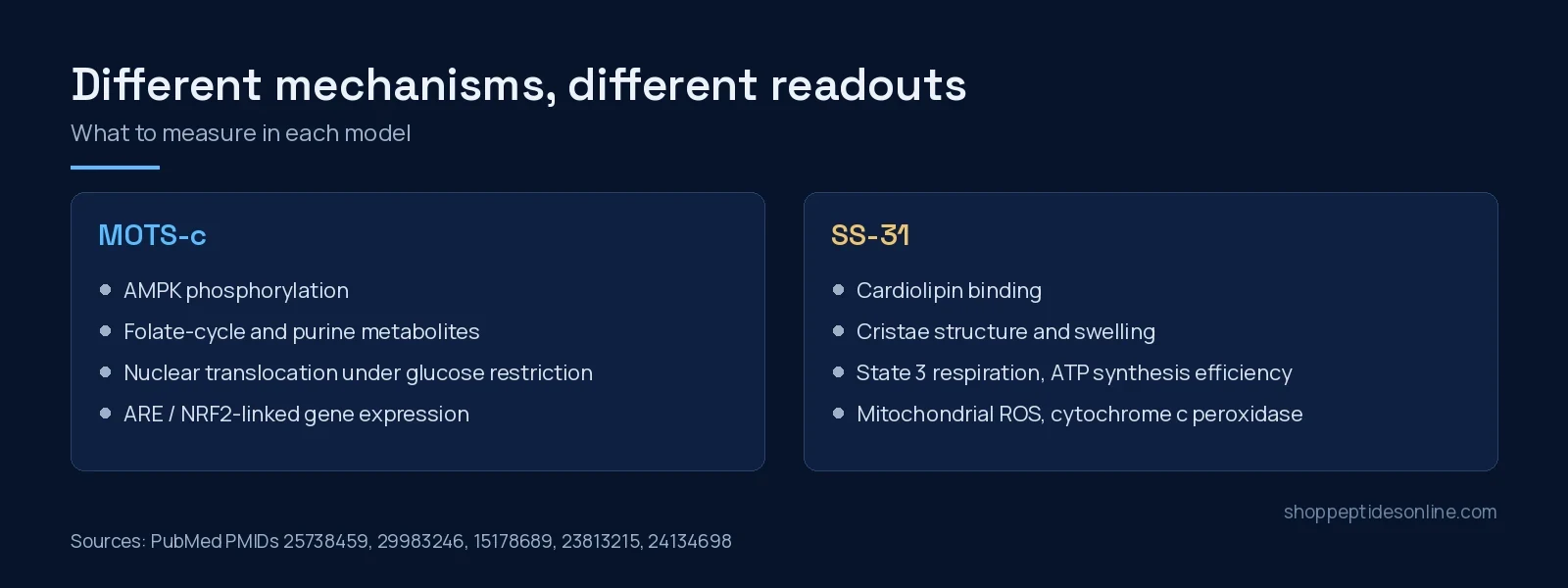
Later work pinned the mechanism on cardiolipin, the anionic phospholipid needed for cristae. A fluorescent SS-31 analogue bound cardiolipin with high affinity, and the SS-31/cardiolipin complex inhibited cytochrome c peroxidase activity; in rats it protected cristae during renal ischemia and sped ATP recovery on reperfusion[5]. In model membranes SS-31 interacted only with bilayers containing cardiolipin, at about a 1:1 ratio, with its aromatic residues penetrating deep into the bilayer, and in fresh mitochondria it increased state 3 respiration and the efficiency of ATP synthesis[3]. A 2020 biophysical study found that SS-31 partitions into the membrane interface with an affinity tied to surface charge, does not destabilize bilayers, and modulates the surface electrostatics of both model and mitochondrial membranes[11].
The clinical record, stated for context
SS-31 has a long clinical history, and not all of it is positive. In the phase 2a EMBRACE STEMI trial, the compound (as MTP-131) did not significantly reduce infarct size or improve pre-specified imaging, angiographic, electrocardiographic or clinical outcomes, although it was well tolerated[8]. In the phase 3 MMPOWER-3 trial in primary mitochondrial myopathy, elamipretide did not meet its primary endpoints of six-minute walk distance and fatigue score[9]. In September 2025, elamipretide received accelerated approval in the USA for Barth syndrome, a rare X-linked disorder[10].
MOTS-c has no comparable trial record. The human data are observational: exercise-induced rises in endogenous MOTS-c[6] and the K14Q genetic association[7].
Which one fits which question?
- Mitochondrial-encoded peptides, mitonuclear signalling, AMPK and muscle metabolism: MOTS-c[1][2].
- Cardiolipin, cristae integrity, electron transport efficiency: SS-31[5][3].
- Genetic variation in a mitochondrial peptide: MOTS-c with its K14Q variant[7].
For a comparison with the other well-studied mitochondrial-derived peptide, see MOTS-c vs humanin, and our MOTS-c research page covers the product. For the full catalogue, see our guide to buy peptides online in Canada.
Frequently asked questions
What is the difference between MOTS-c and SS-31?
MOTS-c is a natural 16-residue peptide encoded in mitochondrial DNA that acts through AMPK and nuclear gene regulation. SS-31 is a synthetic tetrapeptide that binds cardiolipin in the inner mitochondrial membrane.
Is SS-31 the same as elamipretide?
Yes. Elamipretide is the drug name for SS-31, also tested as MTP-131. It received US accelerated approval for Barth syndrome in September 2025.
Does SS-31 have negative trial results?
Yes. It did not reduce infarct size in the EMBRACE STEMI phase 2a trial, and it missed its primary endpoints in the MMPOWER-3 phase 3 trial in primary mitochondrial myopathy.
Where is MOTS-c encoded?
In a short open reading frame within the mitochondrial 12S rRNA gene.
Does Shop Peptides Online sell SS-31?
No. SPO lists MOTS-c for laboratory research only. SS-31 is not part of the catalogue.
References
- Lee C, Zeng J, Drew BG et al. (2015). The mitochondrial-derived peptide MOTS-c promotes metabolic homeostasis and reduces obesity and insulin resistance. Cell Metab. PMID: 25738459. doi: 10.1016/j.cmet.2015.02.009.
- Kim KH, Son JM, Benayoun BA et al. (2018). The Mitochondrial-Encoded Peptide MOTS-c Translocates to the Nucleus to Regulate Nuclear Gene Expression in Response to Metabolic Stress. Cell Metab. PMID: 29983246. doi: 10.1016/j.cmet.2018.06.008.
- Birk AV, Chao WM, Bracken C et al. (2014). Targeting mitochondrial cardiolipin and the cytochrome c/cardiolipin complex to promote electron transport and optimize mitochondrial ATP synthesis. Br J Pharmacol. PMID: 24134698. doi: 10.1111/bph.12468.
- Zhao K, Zhao GM, Wu D et al. (2004). Cell-permeable peptide antioxidants targeted to inner mitochondrial membrane inhibit mitochondrial swelling, oxidative cell death, and reperfusion injury. J Biol Chem. PMID: 15178689. doi: 10.1074/jbc.M402999200.
- Birk AV, Liu S, Soong Y et al. (2013). The mitochondrial-targeted compound SS-31 re-energizes ischemic mitochondria by interacting with cardiolipin. J Am Soc Nephrol. PMID: 23813215. doi: 10.1681/ASN.2012121216.
- Reynolds JC, Lai RW, Woodhead JST et al. (2021). MOTS-c is an exercise-induced mitochondrial-encoded regulator of age-dependent physical decline and muscle homeostasis. Nat Commun. PMID: 33473109. doi: 10.1038/s41467-020-20790-0.
- Zempo H, Kim SJ, Fuku N et al. (2021). A pro-diabetogenic mtDNA polymorphism in the mitochondrial-derived peptide, MOTS-c. Aging (Albany NY). PMID: 33468709. doi: 10.18632/aging.202529.
- Gibson CM, Giugliano RP, Kloner RA et al. (2016). EMBRACE STEMI study: a Phase 2a trial to evaluate the safety, tolerability, and efficacy of intravenous MTP-131 on reperfusion injury in patients undergoing primary percutaneous coronary intervention. Eur Heart J. PMID: 26586786. doi: 10.1093/eurheartj/ehv597.
- Karaa A, Bertini E, Carelli V et al. (2023). Efficacy and Safety of Elamipretide in Individuals With Primary Mitochondrial Myopathy: The MMPOWER-3 Randomized Clinical Trial. Neurology. PMID: 37268435. doi: 10.1212/WNL.0000000000207402.
- Shirley M (2026). Elamipretide: First Approval. Drugs. PMID: 41335372. doi: 10.1007/s40265-025-02269-8.
- Mitchell W, Ng EA, Tamucci JD et al. (2020). The mitochondria-targeted peptide SS-31 binds lipid bilayers and modulates surface electrostatics as a key component of its mechanism of action. J Biol Chem. PMID: 32273339. doi: 10.1074/jbc.RA119.012094.