For laboratory research only. Not for human or animal use. This article gives no dosing, administration or therapeutic advice.
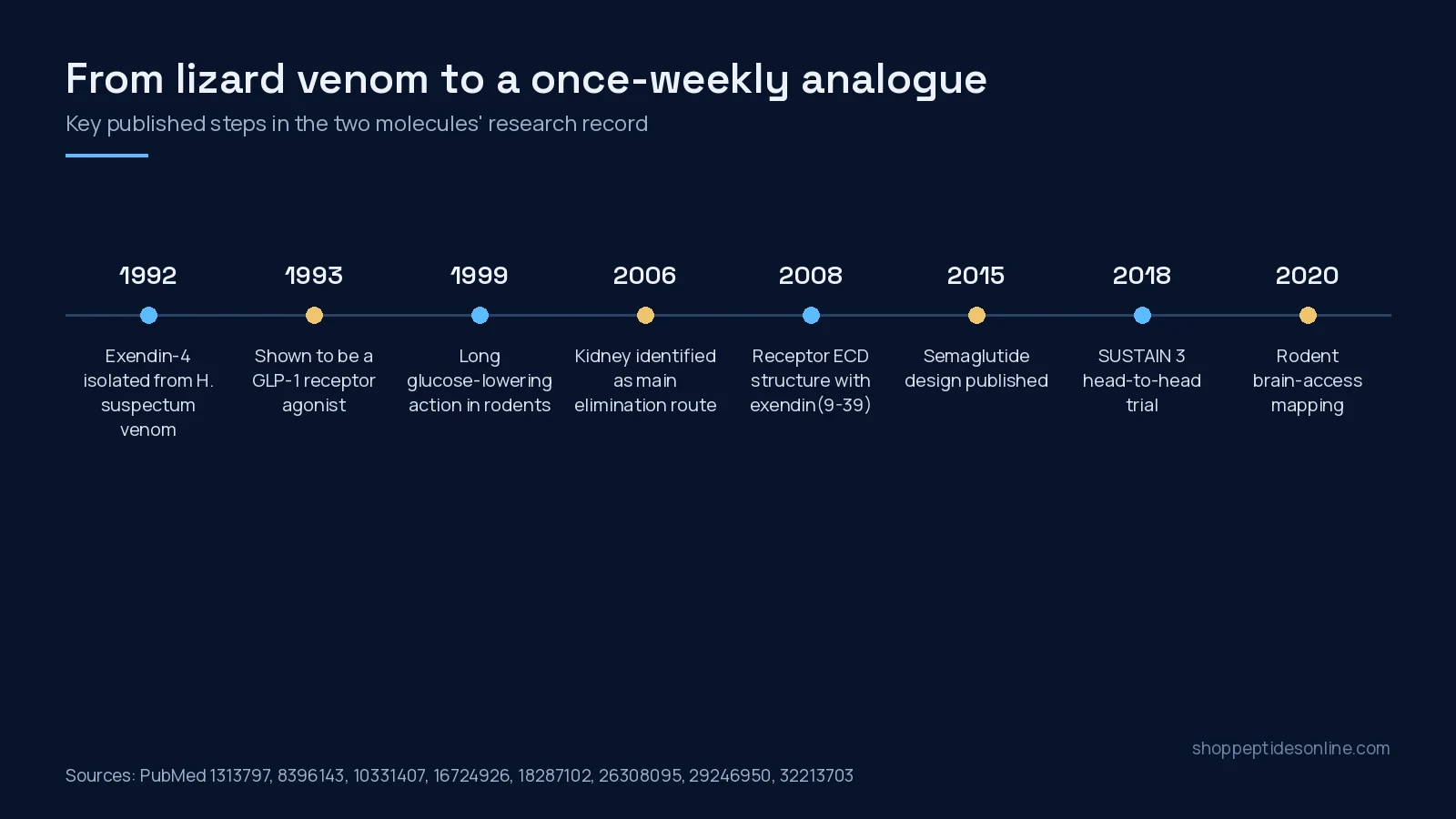
Short answer: exenatide and semaglutide both activate the GLP-1 receptor, but they come from different places. Exenatide is the synthetic form of exendin-4, a 39-residue peptide isolated from Gila monster venom in 1992[1] and shown a year later to be a high-potency agonist at the GLP-1 receptor[2]. Semaglutide was designed decades later from human GLP-1 itself: two amino acid substitutions, a fatty acid side chain at lysine 26, and reversible albumin binding for long exposure[3]. One is a natural peptide that already resisted degradation; the other is the human hormone rebuilt to do the same.
Side by side
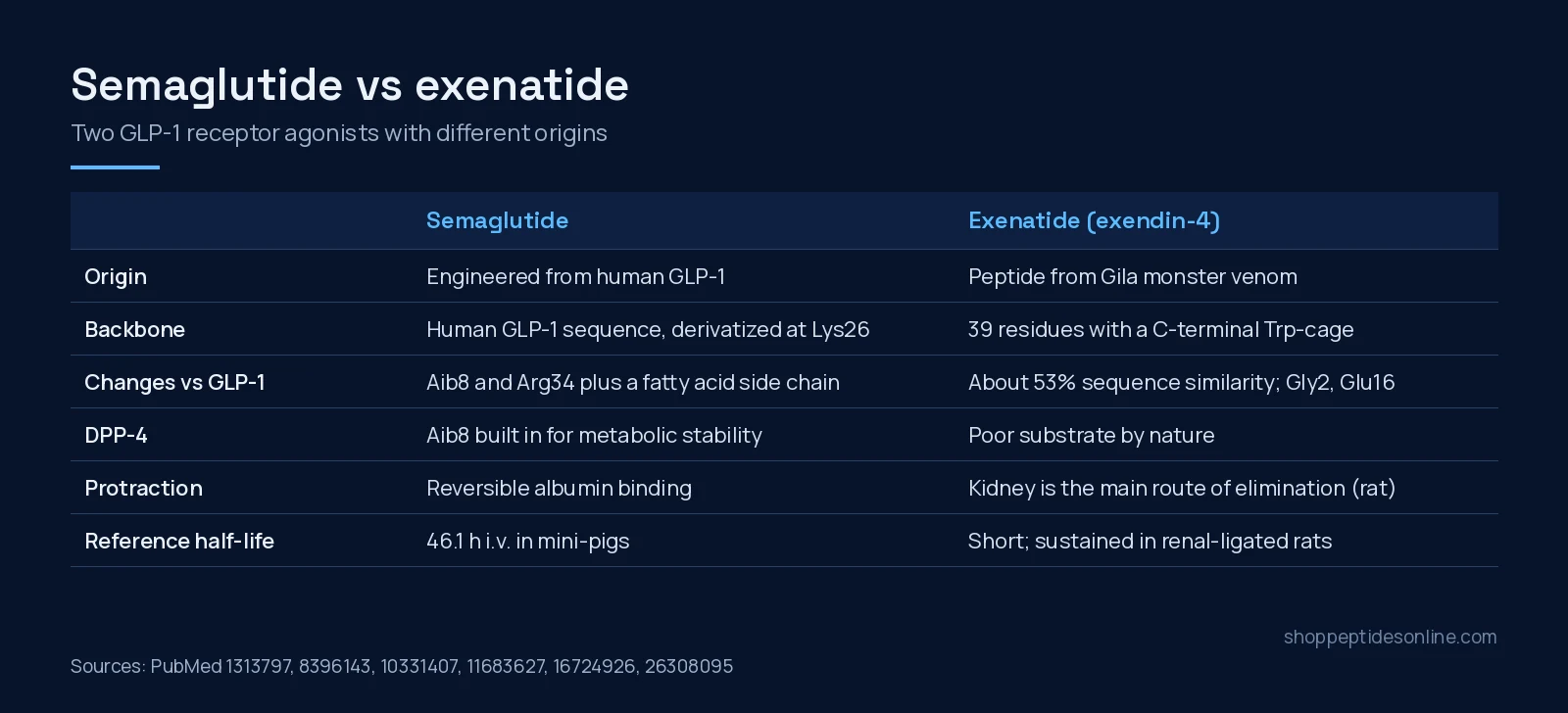
| Semaglutide | Exenatide (exendin-4) | |
|---|---|---|
| Where it comes from | Designed from human GLP-1 as a once-weekly candidate[3] | Isolated from Heloderma suspectum venom[1] |
| Sequence relationship to GLP-1 | Two substitutions (Aib8, Arg34), derivatized at Lys26[3] | About 53% sequence similarity[5] |
| Structure | Fatty acid moiety and linker chosen for albumin affinity[3] | Regular helix plus a C-terminal Trp-cage fold (Leu21–Pro38)[4] |
| Why it lasts longer than GLP-1 | Albumin binding plus full stability against metabolic degradation[3] | Poor substrate for DPP-4[6] |
| Main clearance finding | Plasma half-life 46.1 h after i.v. dosing in mini-pigs[3] | Kidney is the primary route of elimination in rats[6] |
| Status | Approved prescription medicine | Approved prescription medicine |
| At SPO | Semaglutide 10mg (research grade) | Not sold |
Exendin-4: a GLP-1 receptor agonist found in venom
Exendin-4 was found with a sequencing assay for peptides carrying an N-terminal histidine. It differs from its relative exendin-3 at only two positions (Gly2-Glu3 instead of Ser2-Asp3), and that small change altered its activity: in guinea pig pancreatic acini it raised cAMP from 100 pM, plateauing at 10 nM, without the amylase release that exendin-3 produced[1].
The link to GLP-1 came in 1993. In rat insulinoma cells exendin-4 and GLP-1 displaced each other from the same binding site, both raised cAMP, and both enhanced glucose-induced insulin secretion in isolated rat islets. The truncated fragment exendin-(9-39)-amide blocked these effects, which made it a specific GLP-1 receptor antagonist and a standard tool in the field ever since[2].
The practical difference from GLP-1 showed up in animals. In hyperglycaemic db/db and ob/ob mice, glucose lowering from GLP-1 vanished within an hour at most doses, while exendin-4 produced a similar effect that lasted more than four hours, and it was several thousand-fold more potent by the one-hour readout[5]. Part of the reason is stability: exenatide is a poor substrate for dipeptidyl peptidase-IV, the enzyme that inactivates native GLP-1[6].
Where the Trp-cage fits, and where it does not
NMR work compared the two peptides directly. Both are helical from about residue 7 to 28, but GLP-1 carries a helix-breaking glycine at position 16 while exendin-4 has a helix-favouring glutamate there, so exendin-4 forms a more regular, less fluxional helix. Its Leu21–Pro38 segment folds into a compact Trp-cage that shields Trp25 from solvent; that fold is partly populated in water and disappears when the peptide binds detergent micelles[4].
The Trp-cage was long thought to explain exendin-4’s higher affinity for the receptor. A 2.2 Å crystal structure of the human GLP-1 receptor extracellular domain bound to exendin-4(9-39) argued against that: the peptide bound as an amphipathic helix, and the Trp-cage made no contact with the domain[7]. That is a useful negative result for anyone modelling exendin analogues.
Semaglutide: rebuilding human GLP-1
Semaglutide came from a different strategy. Starting from liraglutide, an acylated GLP-1 analogue that binds albumin, the design aim was a once-weekly molecule with higher albumin affinity and full stability against metabolic degradation. The fatty acid moiety and its linking chemistry were the deciding features. The selected molecule has Aib8 and Arg34 substitutions and is derivatized at lysine 26. Its GLP-1 receptor affinity (0.38 nM) was three-fold lower than liraglutide’s, a trade made for stronger albumin binding; in mini-pigs the plasma half-life was 46.1 hours after intravenous dosing[3].
Distribution work in rodents adds a limit worth knowing. Fluorescently tracked semaglutide reached the brainstem, septal nucleus and hypothalamus, but it did not cross the blood-brain barrier; it reached the brain through the circumventricular organs and selected sites next to the ventricles, and induced c-Fos activation in 10 brain areas[8].
How each one is cleared
The two molecules leave the body by different routes in animal work. In rats, exenatide concentrations rose and stayed high when the kidneys were ligated, but were unaffected in models of liver dysfunction. Kidney membranes broke it into fragments shorter than three residues; rabbit, monkey and human kidney membranes did this at least 15-fold more slowly than mouse and rat membranes, so rodent clearance data do not transfer directly. Several fragments were inactive, and exenatide(15-39) and (16-39) showed weak antagonist activity[6]. Semaglutide’s long exposure depends instead on albumin binding and resistance to degradation[3].
The clinical record, stated for context
The two medicines were compared directly in SUSTAIN 3, a 56-week, open-label, randomized phase 3a trial in 813 people with type 2 diabetes[9]. We do not reproduce clinical outcome figures here. Both are approved prescription medicines, and questions about their use belong with a clinician. Material sold by Shop Peptides Online is for laboratory research only.
Which one fits which question?
- Fatty acid acylation, albumin binding and long exposure: semaglutide[3].
- Natural DPP-4 resistance and renal peptide handling: exenatide[6].
- Receptor structure and the Trp-cage question: exendin-4 and exendin(9-39)[4][7].
- Central access of a peripherally given GLP-1 analogue: semaglutide[8].
For the human-hormone lineage, see semaglutide vs liraglutide; for the second incretin, see GIP vs GLP-1. To compare the rest of the catalogue, see our guide to buy peptides online in Canada.
Frequently asked questions
What is the difference between semaglutide and exenatide?
Exenatide is the synthetic form of exendin-4, a 39-residue peptide from Gila monster venom. Semaglutide is a modified human GLP-1 with two substitutions and a fatty acid side chain that binds albumin. Both activate the GLP-1 receptor.
Is exenatide the same as exendin-4?
Yes. Exenatide is the drug name for synthetic exendin-4, the peptide first isolated from Heloderma suspectum venom in 1992.
Why does exendin-4 last longer than GLP-1?
Exendin-4 is a poor substrate for DPP-4, the enzyme that inactivates native GLP-1. In rats the kidney is its main route of elimination.
Does the Trp-cage bind the GLP-1 receptor?
Not the extracellular domain. A crystal structure with exendin-4(9-39) showed the peptide binding as a helix, with no contact from the Trp-cage.
Does Shop Peptides Online sell exenatide?
No. SPO lists semaglutide for laboratory research only. Exenatide is not in the catalogue.
References
- Eng J, Kleinman WA, Singh L et al. (1992). Isolation and characterization of exendin-4, an exendin-3 analogue, from Heloderma suspectum venom. Further evidence for an exendin receptor on dispersed acini from guinea pig pancreas. J Biol Chem. PMID: 1313797.
- Göke R, Fehmann HC, Linn T et al. (1993). Exendin-4 is a high potency agonist and truncated exendin-(9-39)-amide an antagonist at the glucagon-like peptide 1-(7-36)-amide receptor of insulin-secreting beta-cells. J Biol Chem. PMID: 8396143.
- Lau J, Bloch P, Schäffer L et al. (2015). Discovery of the Once-Weekly Glucagon-Like Peptide-1 (GLP-1) Analogue Semaglutide. J Med Chem. PMID: 26308095. doi: 10.1021/acs.jmedchem.5b00726.
- Neidigh JW, Fesinmeyer RM, Prickett KS et al. (2001). Exendin-4 and glucagon-like-peptide-1: NMR structural comparisons in the solution and micelle-associated states. Biochemistry. PMID: 11683627. doi: 10.1021/bi010902s.
- Young AA, Gedulin BR, Bhavsar S et al. (1999). Glucose-lowering and insulin-sensitizing actions of exendin-4: studies in obese diabetic (ob/ob, db/db) mice, diabetic fatty Zucker rats, and diabetic rhesus monkeys (Macaca mulatta). Diabetes. PMID: 10331407. doi: 10.2337/diabetes.48.5.1026.
- Copley K, McCowen K, Hiles R et al. (2006). Investigation of exenatide elimination and its in vivo and in vitro degradation. Curr Drug Metab. PMID: 16724926. doi: 10.2174/138920006776873490.
- Runge S, Thøgersen H, Madsen K et al. (2008). Crystal structure of the ligand-bound glucagon-like peptide-1 receptor extracellular domain. J Biol Chem. PMID: 18287102. doi: 10.1074/jbc.M708740200.
- Gabery S, Salinas CG, Paulsen SJ et al. (2020). Semaglutide lowers body weight in rodents via distributed neural pathways. JCI Insight. PMID: 32213703. doi: 10.1172/jci.insight.133429.
- Ahmann AJ, Capehorn M, Charpentier G et al. (2018). Efficacy and Safety of Once-Weekly Semaglutide Versus Exenatide ER in Subjects With Type 2 Diabetes (SUSTAIN 3): A 56-Week, Open-Label, Randomized Clinical Trial. Diabetes Care. PMID: 29246950. doi: 10.2337/dc17-0417.