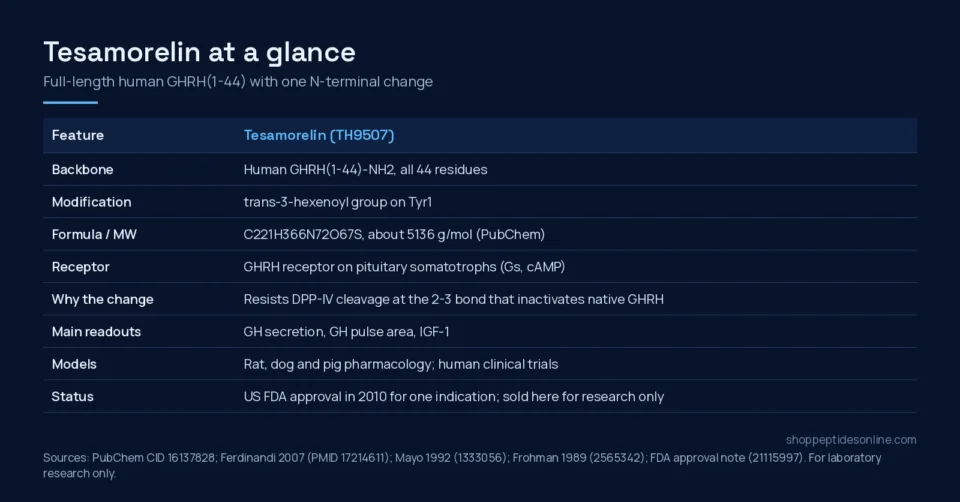
For laboratory research only. Not for human or animal use. This article gives no dosing, administration or therapeutic advice.
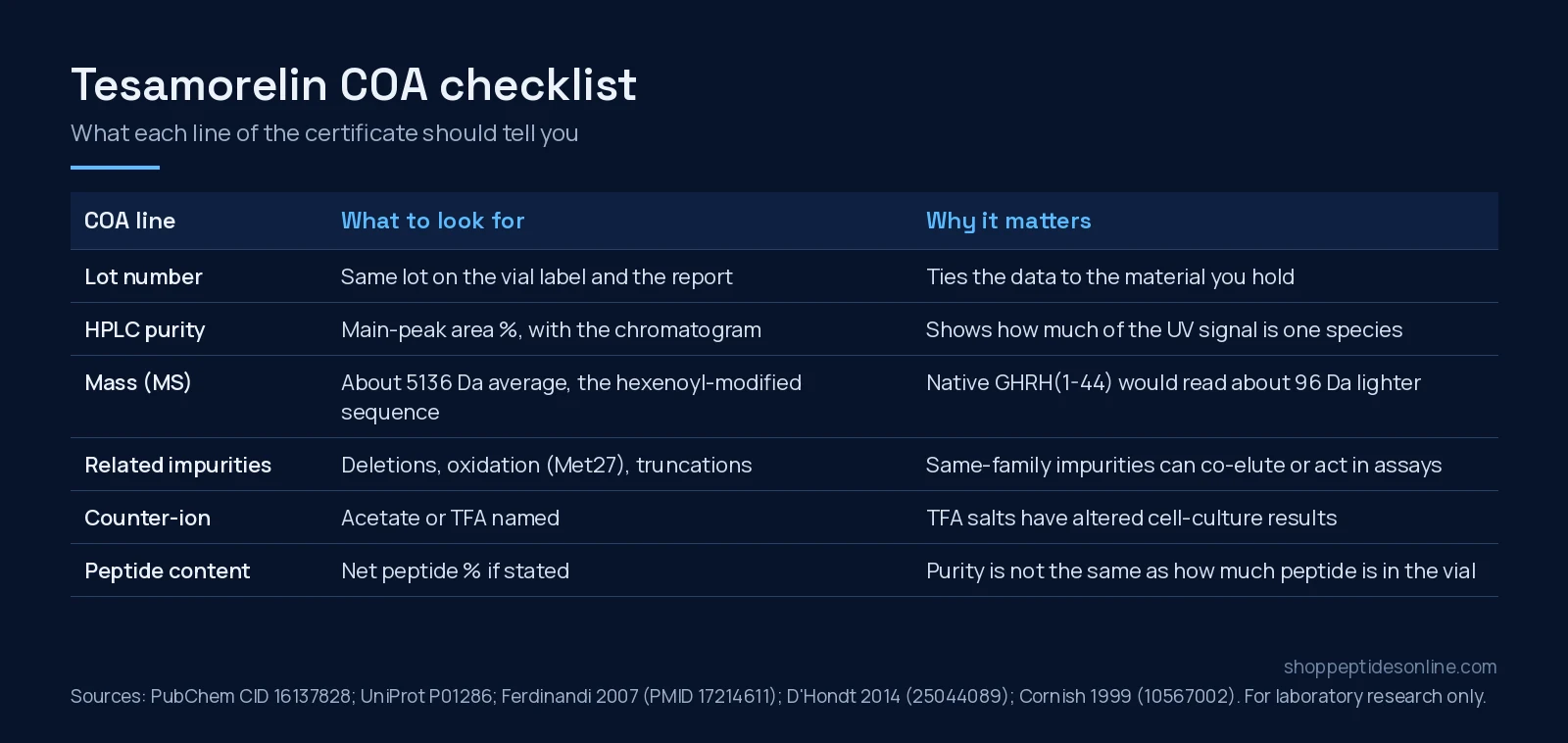
Short answer: A tesamorelin certificate of analysis (COA) should answer two separate questions. HPLC purity tells you how much of the material is one species. Mass spectrometry tells you whether that species is tesamorelin. For tesamorelin, identity has a specific test. The peptide is human GHRH(1-44) with a trans-3-hexenoyl group on Tyr1[1], so the measured mass has to match the modified sequence, not native GHRH. Add a lot number that matches the vial, a named counter-ion and, ideally, a peptide-content figure, and you can judge the report. This guide goes through each line. If you plan to buy tesamorelin in Canada for laboratory work, these are the checks to run first.
1. Lot number: tie the report to the vial
A COA is only useful for the lot it describes. The lot or batch number on the report should match the vial label exactly, and the report should carry a test date. A generic sheet with no lot number is a product description, not a certificate. Keep a copy of the report with your laboratory records, along with the lot number and the date received. Our COA library lists current third-party reports by product, with purity, test date and testing lab.
2. HPLC purity: what the percentage means
Reversed-phase HPLC separates the sample and a UV detector records the peaks. The purity figure is the main peak’s share of the total peak area. A good report shows the chromatogram, not just the number, so you can see whether small peaks sit close to the main one. Pharmacopoeias already differ in how they write peptide purity and assay specifications[3], so read the method details (column, gradient, wavelength) before comparing two suppliers’ numbers.
HPLC purity has a limit: related impurities can elute close to the main peak. Synthesis-related impurities include amino-acid deletions and insertions, racemised residues, leftover protecting groups, oxidised side chains and dimers[2]. In a 44-residue peptide, a one-residue deletion can behave much like the full sequence on a column. That is why the next line matters.
3. Mass spectrometry: the identity test
PubChem (CID 16137828) gives tesamorelin the formula C221H366N72O67S and a molecular weight of about 5136 g/mol. Electrospray spectra of a peptide this size show a series of multiply charged ions. The report should state the deconvoluted mass, or list the charge states used, and compare it with the expected value.
| What the mass shows | Likely meaning |
|---|---|
| About 5136 Da | Consistent with tesamorelin (free base, average mass) |
| About 96 Da lower | No hexenoyl group: native GHRH(1-44) (the difference is C6H8O) |
| About 16 Da higher | Oxidation, most likely at Met27 of the GHRH sequence (UniProt P01286)[2] |
| One residue’s mass lower | Deletion impurity from synthesis[2] |
The N-terminal modification is the point of tesamorelin. Native GHRH is cut by dipeptidyl peptidase-IV between residues 2 and 3[4]. In human plasma, HPLC showed intact GHRH(1-44) disappearing much faster than immunoassays suggested[5]. The hexenoyl group gives resistance to that enzyme[1]. A mass that confirms the group is the only way a COA can show the material is the modified peptide. Anti-doping laboratories rely on the same LC-MS/MS identity logic to tell GHRH analogues apart[8].
4. Counter-ion and peptide content
Peptides purified by reversed-phase HPLC often end up as trifluoroacetate (TFA) salts. In one study, TFA salts of amylin and calcitonin reduced osteoblast proliferation compared with hydrochloride salts. That was enough to hide a real proliferative effect[6]. Counter-ions such as acetate, TFA and chloride can be measured by ion chromatography or capillary electrophoresis[7]. A good COA names the salt form. If you run cell-based work, ask for it.
Purity and content are different numbers. A lyophilised peptide also holds water and counter-ion, so a vial that is 99% pure by HPLC still contains less than its fill weight of peptide. If the report gives a net peptide content, use it in your calculations. If it does not, record that it is missing. Our guide to HPLC purity vs mass spectrometry identity covers this in more general terms.
5. A quick checklist
- Lot number matches the vial, with a test date.
- HPLC purity with the chromatogram and method summary.
- Measured mass near 5136 Da, compared with the theoretical value.
- No unexplained peaks at about -96 Da (no hexenoyl group) or +16 Da (oxidation).
- Counter-ion named; peptide content stated if available.
- Appearance and storage conditions recorded.
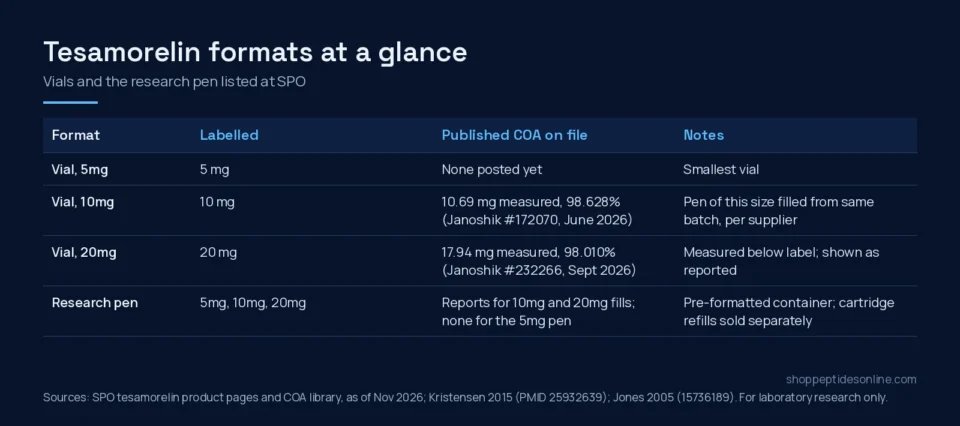
For background on the peptide itself, see tesamorelin vs sermorelin vs CJC-1295. SPO lists the tesamorelin 20mg vial, and its third-party report is in the COA library. The rest of the catalogue is in our guide to buy peptides online in Canada.
Frequently asked questions
What should a tesamorelin COA include?
A lot number that matches the vial, HPLC purity with the chromatogram, a mass spectrometry result compared with the theoretical mass, the counter-ion and, ideally, the net peptide content.
What molecular weight should tesamorelin show?
PubChem lists tesamorelin as C221H366N72O67S with a molecular weight of about 5136 g/mol. Salt forms and water change the weight of the powder, but the peptide mass by MS should match the modified sequence.
How can mass spec tell tesamorelin from native GHRH?
Tesamorelin carries a trans-3-hexenoyl group on Tyr1. Native GHRH(1-44) lacks it and reads about 96 Da lighter, which HPLC purity alone cannot show.
Is HPLC purity the same as peptide content?
No. HPLC purity is the share of UV peak area in the main peak. Peptide content is the share of the powder’s weight that is peptide, after water and counter-ion.
Can I buy tesamorelin in Canada for human use?
No. Shop Peptides Online supplies tesamorelin in Canada for laboratory research only. It is not for human or animal use.
References
- Ferdinandi ES, Brazeau P, High K et al. (2007). Non-clinical pharmacology and safety evaluation of TH9507, a human growth hormone-releasing factor analogue. Basic Clin Pharmacol Toxicol. PMID: 17214611. doi: 10.1111/j.1742-7843.2007.00008.x.
- D’Hondt M, Bracke N, Taevernier L et al. (2014). Related impurities in peptide medicines. J Pharm Biomed Anal. PMID: 25044089. doi: 10.1016/j.jpba.2014.06.012.
- Vergote V, Burvenich C, Van de Wiele C et al. (2009). Quality specifications for peptide drugs: a regulatory-pharmaceutical approach. J Pept Sci. PMID: 19750489. doi: 10.1002/psc.1167.
- Frohman LA, Downs TR, Heimer EP et al. (1989). Dipeptidylpeptidase IV and trypsin-like enzymatic degradation of human growth hormone-releasing hormone in plasma. J Clin Invest. PMID: 2565342. doi: 10.1172/JCI114049.
- Frohman LA, Downs TR, Williams TC et al. (1986). Rapid enzymatic degradation of growth hormone-releasing hormone by plasma in vitro and in vivo to a biologically inactive product cleaved at the NH2 terminus. J Clin Invest. PMID: 3093533. doi: 10.1172/JCI112679.
- Cornish J, Callon KE, Lin CQ et al. (1999). Trifluoroacetate, a contaminant in purified proteins, inhibits proliferation of osteoblasts and chondrocytes. Am J Physiol. PMID: 10567002. doi: 10.1152/ajpendo.1999.277.5.E779.
- Mrozik W, Markowska A, Guzik L et al. (2012). Determination of counter-ions in synthetic peptides by ion chromatography, capillary isotachophoresis and capillary electrophoresis. J Pept Sci. PMID: 22252914. doi: 10.1002/psc.1436.
- Memdouh S, Gavrilović I, Ng K et al. (2021). Advances in the detection of growth hormone releasing hormone synthetic analogs. Drug Test Anal. PMID: 34665524. doi: 10.1002/dta.3183.