For laboratory research only. Not for human or animal use. This article gives no dosing, administration or therapeutic advice.
Short answer: GHK-Cu is the copper(II) complex of glycyl-L-histidyl-L-lysine, a three-residue peptide first described in human plasma in the 1970s[1][2]. Copper binds the peptide through nitrogen donors that include the histidine imidazole[4][5], and the peptide was proposed to help carry copper into cells[3]. Decades of cell and animal work report effects on collagen synthesis, matrix remodelling and wound models, though a 2026 evidence review notes that clinical evidence is sparse[7][8][10]. This overview covers the chemistry, the evidence and what to check on a certificate. Labs sourcing GHK-Cu in Canada will find the formats and batch documentation on that page.
Where GHK-Cu comes from
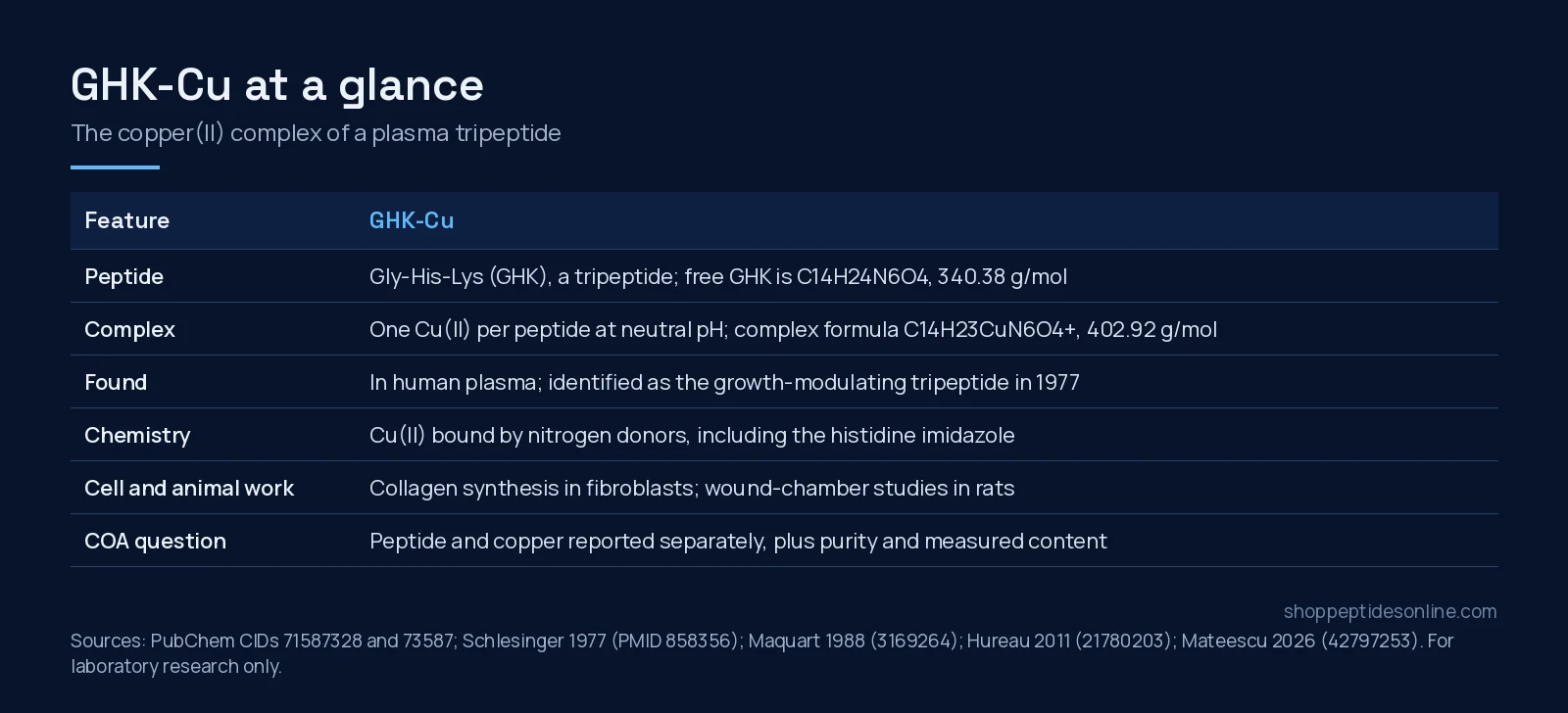
In 1973 Pickart reported a tripeptide in human serum that prolonged the survival of normal liver cells[2]. By 1977 it was identified as glycyl-histidyl-lysine[1]. A 1980 study found that the plasma tripeptide co-isolated with about an equimolar amount of copper, and that its effects in culture were largest when copper was supplied[3]. That observation is the origin of GHK-Cu as a research compound.
Chemistry: peptide, complex and the weight problem
Free GHK is C14H24N6O4, 340.38 g/mol (PubChem CID 73587). The copper complex, listed as prezatide copper, is C14H23CuN6O4+, 402.92 g/mol (CID 71587328). PubChem also lists a doubly deprotonated form at 400.90, so the weight you see depends on which protonation state is counted.
| Species | What it is | Reference |
|---|---|---|
| Apo-GHK | The free tripeptide, no copper | PubChem 73587 |
| GHK-Cu | 1:1 Cu(II) complex at neutral pH[4] | PubChem 71587328 |
| Other copper peptides | Different sequences or ligands, not interchangeable with GHK-Cu[10] | See our GHK-Cu vs other copper peptides |
Spectroscopy shows that, at neutral pH, GHK forms a mononuclear 1:1 Cu(II) complex with nitrogen donors that include the histidine imidazole[4]. X-ray and solution structures of the Cu(II) complexes of the plasma copper chelators GHK and DAHK describe their high-affinity coordination[5]. Kinetic work on this class of amino-terminal copper-binding motifs is now used to understand how copper is handed over between peptides and proteins[6]. A 2026 review warns that the literature often treats GHK-Cu as one ingredient even though coordination state, speciation and stability vary with the formulation[10].
What the cell and animal studies show
- Collagen synthesis in culture. GHK-Cu stimulated collagen synthesis by fibroblasts without changing cell number. The effect began at picomolar concentrations and peaked near nanomolar. The GHK sequence also occurs in the alpha-2(I) chain of type I collagen[7].
- Wound chambers in rats. In a rat wound-chamber model, GHK-Cu changed the expression and activation of matrix metalloproteinases in wound fluid[8].
- Broader reviews. A 2018 review collects reported effects on collagen, elastin and glycosaminoglycan synthesis, blood vessel and nerve outgrowth, and anti-inflammatory actions[9]. A 2026 evidence map finds consistent preclinical support for matrix remodelling, epithelial repair, redox and angiogenesis effects. It also finds that clinical evidence is sparse and that historical cosmetic reports are small or incompletely characterised[10].
What to check on a GHK-Cu COA
Because the compound is a peptide plus a metal, a good report treats them separately. The independent report posted for SPO’s 100mg vial (Janoshik #218248, analysed 19 August 2026) gives purity of 99.661% and a measured 76.04 mg of GHK-Cu, made up of 63.73 mg of GHK peptide and 12.31 mg of copper. Read that as two facts: how pure the peptide is by HPLC, and how much complex the vial held against its label. As always, the lot on your vial has to match the report. Our guide to HPLC purity vs mass spectrometry identity explains the identity side.
Which fits which question?
- Copper-peptide coordination chemistry: GHK-Cu, with apo-GHK as the control[5][4].
- Fibroblast collagen and matrix assays: GHK-Cu[7].
- Wound-model comparisons with other peptides: see TB-500 vs GHK-Cu and BPC-157 vs GHK-Cu.
SPO lists the GHK-Cu 50mg vial and other strengths for laboratory research only. For the rest of the catalogue, see our guide to buy peptides online in Canada.
Frequently asked questions
What is GHK-Cu?
GHK-Cu is the copper(II) complex of the tripeptide glycyl-L-histidyl-L-lysine, first described in human plasma in the 1970s.
What is the difference between GHK and GHK-Cu?
GHK is the free tripeptide (340.38 g/mol). GHK-Cu is its 1:1 copper(II) complex at neutral pH, listed by PubChem as prezatide copper (402.92 g/mol).
How does copper bind to GHK?
Spectroscopy shows a mononuclear 1:1 Cu(II) complex at neutral pH, with nitrogen donors that include the imidazole of the histidine. X-ray work on related plasma copper chelators confirms high-affinity coordination.
What does the research literature report for GHK-Cu?
Cell and animal studies report effects on collagen synthesis, matrix metalloproteinases and wound models. A 2026 review finds clinical evidence sparse.
Is GHK-Cu from Shop Peptides Online for human use?
No. SPO supplies GHK-Cu in Canada for laboratory research only. It is not for human or animal use, and this article gives no dosing advice.
References
- Schlesinger DH, Pickart L, Thaler MM (1977). Growth-modulating serum tripeptide is glycyl-histidyl-lysine. Experientia. PMID: 858356. doi: 10.1007/BF02002806.
- Pickart L, Thaler MM (1973). Tripeptide in human serum which prolongs survival of normal liver cells and stimulates growth in neoplastic liver. Nat New Biol. PMID: 4349963.
- Pickart L, Freedman JH, Loker WJ et al. (1980). Growth-modulating plasma tripeptide may function by facilitating copper uptake into cells. Nature. PMID: 7453802. doi: 10.1038/288715a0.
- Freedman JH, Pickart L, Weinstein B et al. (1982). Structure of the Glycyl-L-histidyl-L-lysine–copper(II) complex in solution. Biochemistry. PMID: 6291585. doi: 10.1021/bi00262a004.
- Hureau C, Eury H, Guillot R et al. (2011). X-ray and solution structures of Cu(II) GHK and Cu(II) DAHK complexes: influence on their redox properties. Chemistry. PMID: 21780203. doi: 10.1002/chem.201100751.
- Kotuniak R, Bal W (2021). Kinetics of Cu(II) complexation by ATCUN/NTS and related peptides: a gold mine of novel ideas for copper biology. Dalton Trans. PMID: 34816848. doi: 10.1039/d1dt02878b.
- Maquart FX, Pickart L, Laurent M et al. (1988). Stimulation of collagen synthesis in fibroblast cultures by the tripeptide-copper complex glycyl-L-histidyl-L-lysine-Cu2+. FEBS Lett. PMID: 3169264. doi: 10.1016/0014-5793(88)80509-x.
- Siméon A, Monier F, Emonard H et al. (1999). Expression and activation of matrix metalloproteinases in wounds: modulation by the tripeptide-copper complex glycyl-L-histidyl-L-lysine-Cu2+. J Invest Dermatol. PMID: 10383745. doi: 10.1046/j.1523-1747.1999.00606.x.
- Pickart L, Margolina A (2018). Regenerative and Protective Actions of the GHK-Cu Peptide in the Light of the New Gene Data. Int J Mol Sci. PMID: 29986520. doi: 10.3390/ijms19071987.
- Mateescu DM, Gavrilescu DM, Mincioaga RI et al. (2026). GHK-Cu as a Bioactive Metallopeptide and Drug-Delivery Cargo: Coordination Chemistry, Formulation Science, Therapeutic Evidence, and a Translational Roadmap. Pharmaceutics. PMID: 42797253. doi: 10.3390/pharmaceutics18091077.