For laboratory research only. Not for human or animal use. This article gives no dosing, administration, reconstitution or therapeutic advice.
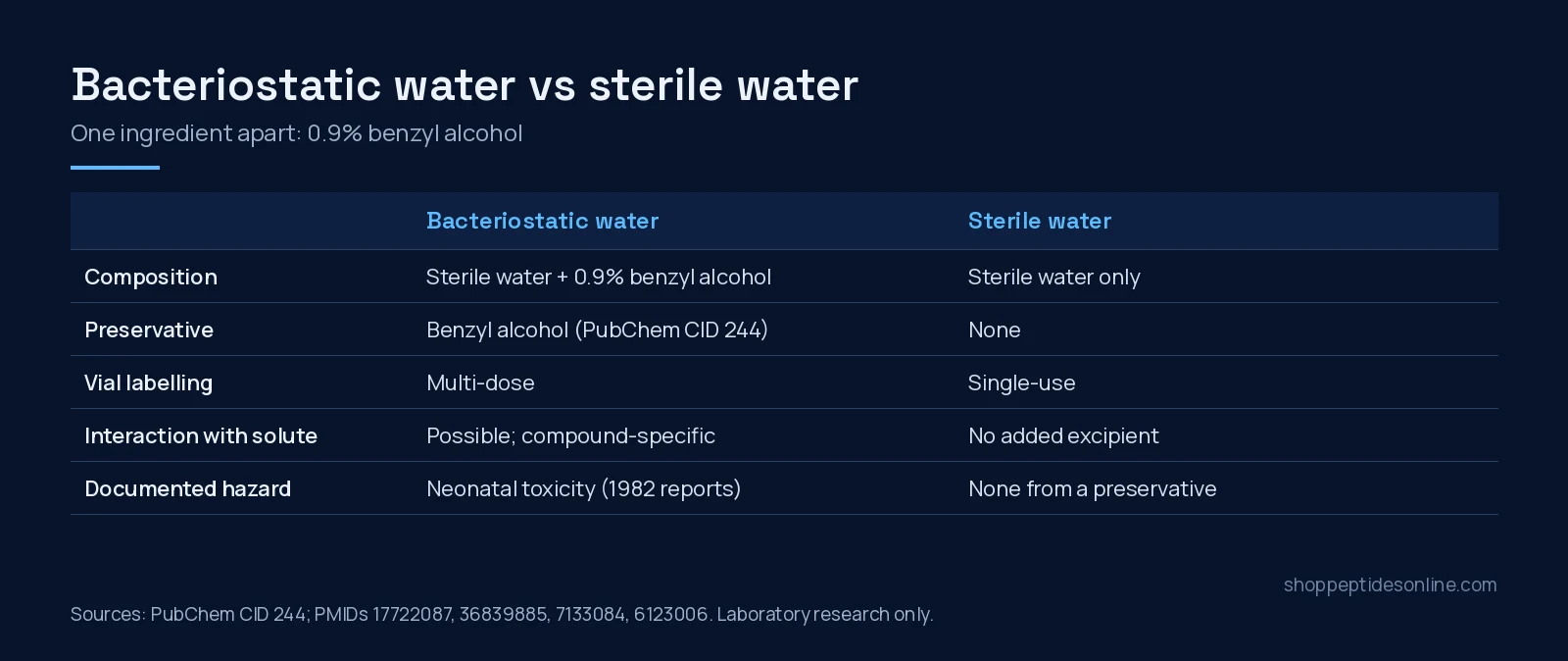
Short answer: the only compositional difference is one ingredient. Bacteriostatic water is sterile water with an antimicrobial preservative added, 0.9% benzyl alcohol in the vials SPO stocks. Sterile water has none. That one additive decides how the vial is labelled (multi-dose or single-use). It also raises a compatibility question for whatever is dissolved in it.
Side by side
| Bacteriostatic water | Sterile water | |
|---|---|---|
| Composition | Sterile water plus 0.9% benzyl alcohol (C7H8O, MW 108.14; PubChem CID 244) | Sterile water only |
| Antimicrobial preservative | Yes. Benzyl alcohol is one of the two most common preservatives in peptide and protein products[1] | None |
| How the vial is meant to be used | Multi-dose. A preservative is required for multi-dose presentations to suppress growth after repeated entry[2] | Single-use. Without a preservative, a punctured vial has no protection against contamination |
| Interaction with a dissolved molecule | Possible and compound-specific[6][7][9] | No added excipient to interact |
| Main documented hazard | Benzyl alcohol toxicity in premature neonates (1982 reports)[3][4] | None from a preservative |
| Documentation at SPO | Lot number and manufacturer specification. It’s a diluent, so no HPLC/MS report applies | SPO does not list it |
What “bacteriostatic” actually means
The word means the preservative inhibits bacterial growth. It does not sterilize. The pharmaceutics literature treats antimicrobial preservatives as functional excipients whose job is to keep microbes introduced by repeated entry into a multi-dose container from multiplying[2]. A 2007 review of licensed parenteral products found that phenol and benzyl alcohol are the two preservatives most often used in peptide and protein products. It also found that preservatives are chosen for three things: concentration, antimicrobial function, and effect on the active ingredient[1].
That third criterion is the part most vendor pages leave out.
The compatibility question: what the studies found
A preservative is another molecule in the solution, and some proteins notice it. The effect is not universal, and the evidence runs in both directions.
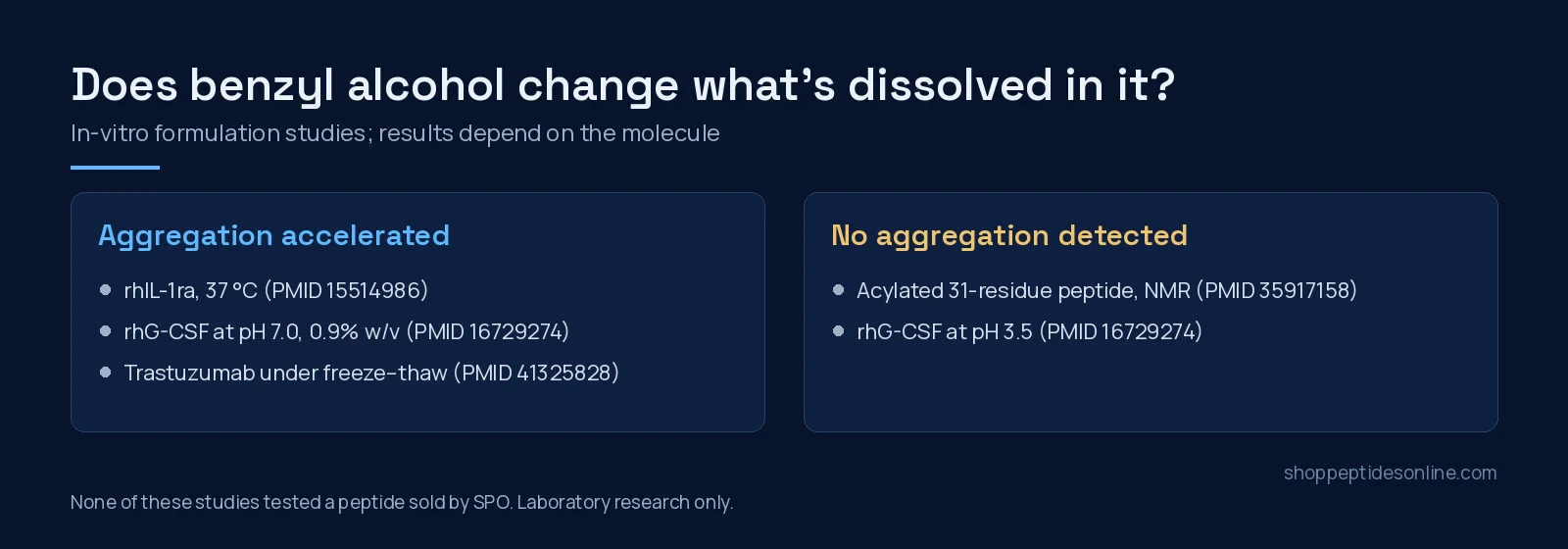
- Recombinant human IL-1 receptor antagonist (in vitro). Benzyl alcohol accelerated aggregation and precipitation at 37 °C, measured by size-exclusion HPLC. The mechanism was a small shift toward partially unfolded protein. Secondary structure was unchanged, and the interaction itself was weak[6].
- Recombinant human G-CSF (in vitro). At 0.9% w/v, the same concentration as a typical bacteriostatic diluent, benzyl alcohol accelerated aggregation at pH 7.0. The effect was much larger at 37 °C than at 25 °C. At pH 3.5 it did not induce aggregation[7].
- Trastuzumab, a monoclonal antibody (in vitro). A 2026 study found that benzyl alcohol made damage from repeated freeze–thaw cycles worse, with more subvisible particles, soluble aggregates and oxidation. The authors advise against frozen storage of benzyl-alcohol-containing formulations[8].
- An acylated 31-residue peptide (in vitro, NMR). This was a null result for benzyl alcohol. It did not induce aggregation and showed no detectable interaction. The comparison preservative, m-cresol, produced insoluble aggregates within 24 hours[9].
Three limits apply. All of these are single-molecule, in-vitro formulation studies. Most use proteins far larger than a typical research peptide. None tested the specific peptides SPO sells. What they support is narrow: a preservative’s effect depends on the molecule, the pH, the temperature and freeze–thaw stress. So compatibility is something a lab has to establish, not assume. A 2023 review makes the same point: the preservative has to be chosen to suit the active ingredient, not only for its preservation function[2].
Why benzyl alcohol carries a neonatal warning
In 1982, reports in The Lancet and the New England Journal of Medicine linked benzyl alcohol to fatal poisoning in neonatal intensive care, described as a “gasping syndrome” in premature infants[4][3]. A 1986 mouse study, which named benzyl alcohol as the agent implicated in that syndrome, found rapid conversion to its first metabolite, benzaldehyde, in both adult and neonatal mice. Blocking alcohol dehydrogenase raised benzyl alcohol levels and increased toxicity[5]. This is historical and animal-model evidence. It is included here because it explains why preserved diluents are labelled the way they are, not as guidance of any kind.
Labelling and documentation
Because the preservative is the product’s defining feature, a bacteriostatic water label should name it and its concentration. A plain sterile water label should make clear it contains no preservative. For a diluent, the useful documents are a lot number and the manufacturer’s specification. A peptide-style HPLC purity report doesn’t apply to a vial of water. The SPO bacteriostatic water listing is documented that way. The bacteriostatic water Canada page covers the 3 mL and 10 mL fills and what questions to ask a supplier about any diluent.
In the lab: points worth checking
- Record the diluent’s lot number alongside the lot of any material it’s used with. Diluent and solute are two variables, not one.
- If a study depends on a molecule’s aggregation state, the preservative is a variable worth controlling. The studies above show it can matter for some molecules and not for others[7][9].
- Freeze–thaw is a separate stress that benzyl alcohol can amplify, at least for antibodies[8].
- A preservative does not make a contaminated vial sterile again. It only slows growth after entry[2].
Diluents ship with peptide orders in the same parcel. Our buy peptides online in Canada page covers shipping and documentation.
Frequently asked questions
Is bacteriostatic water the same as sterile water?
No. Both start as sterile water. Bacteriostatic water also contains a preservative, 0.9% benzyl alcohol in the vials SPO sells. The preservative is there to suppress microbial growth after a stopper has been punctured. Plain sterile water has no preservative, so it is treated as a single-use item.
What does “bacteriostatic” mean?
It means the product inhibits bacterial growth, not that it sterilizes. Benzyl alcohol slows the growth of microbes that get in after the first puncture. It does not make a contaminated vial sterile again.
Can benzyl alcohol affect a peptide or protein in solution?
It can with some molecules. In laboratory studies it accelerated aggregation of several recombinant proteins. It showed no detectable interaction with one acylated 31-residue peptide. Compatibility is compound-specific and has to be checked for the material in question.
Why is benzyl alcohol linked to warnings about newborns?
In 1982, reports in the New England Journal of Medicine and The Lancet linked benzyl alcohol in preserved solutions to a fatal “gasping syndrome” in premature infants. Later mouse work studied its metabolism and toxicity. This history is why preserved diluents are labelled with care.
References
- Meyer BK, Ni A, Hu B et al. (2007). Antimicrobial preservative use in parenteral products: past and present. J Pharm Sci. PMID: 17722087. doi: 10.1002/jps.20976.
- Stroppel L, Schultz-Fademrecht T, Cebulla M et al. (2023). Antimicrobial Preservatives for Protein and Peptide Formulations: An Overview. Pharmaceutics. PMID: 36839885. doi: 10.3390/pharmaceutics15020563.
- Gershanik J, Boecler B, Ensley H et al. (1982). The gasping syndrome and benzyl alcohol poisoning. N Engl J Med. PMID: 7133084. doi: 10.1056/NEJM198211253072206.
- Brown WJ, Buist NR, Gipson HT et al. (1982). Fatal benzyl alcohol poisoning in a neonatal intensive care unit. Lancet. PMID: 6123006. doi: 10.1016/s0140-6736(82)92377-7.
- McCloskey SE, Gershanik JJ, Lertora JJ et al. (1986). Toxicity of benzyl alcohol in adult and neonatal mice. J Pharm Sci. PMID: 3761172. doi: 10.1002/jps.2600750718.
- Zhang Y, Roy S, Jones LS et al. (2004). Mechanism for benzyl alcohol-induced aggregation of recombinant human interleukin-1 receptor antagonist in aqueous solution. J Pharm Sci. PMID: 15514986. doi: 10.1002/jps.20219.
- Thirumangalathu R, Krishnan S, Brems DN et al. (2006). Effects of pH, temperature, and sucrose on benzyl alcohol-induced aggregation of recombinant human granulocyte colony stimulating factor. J Pharm Sci. PMID: 16729274. doi: 10.1002/jps.20619.
- Xu ZT, Yang CH, Liu W et al. (2026). Benzyl alcohol exacerbates freeze-thaw-induced aggregation of trastuzumab: elucidating mechanisms and formulation implications for clinical practice. Int J Pharm. PMID: 41325828. doi: 10.1016/j.ijpharm.2025.126433.
- Li M, Falk BT, Lu X et al. (2022). Molecular Mechanism of Antimicrobial Excipient-Induced Aggregation in Parenteral Formulations of Peptide Therapeutics. Mol Pharm. PMID: 35917158. doi: 10.1021/acs.molpharmaceut.2c00449.