For laboratory research only. Not for human or animal use. This article gives no dosing, administration, reconstitution or therapeutic advice.
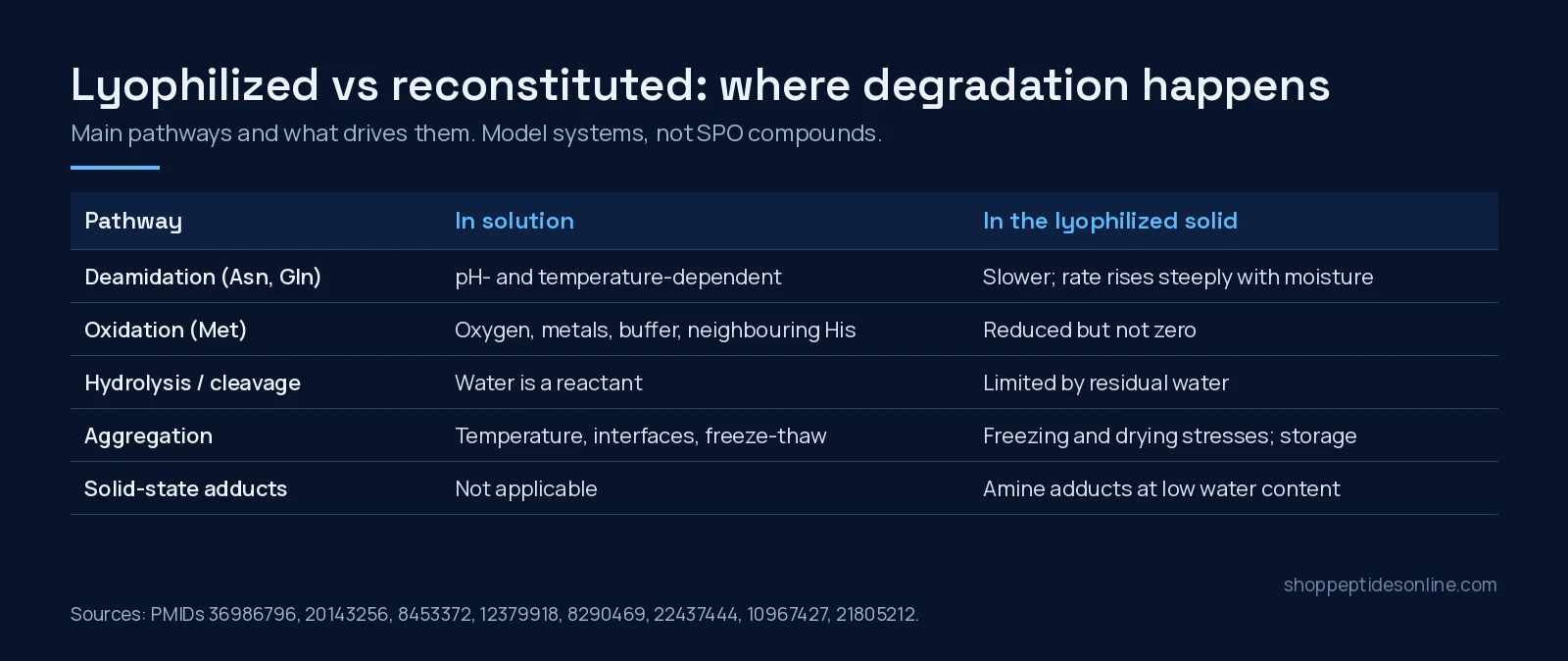
Short answer: water is both the solvent and a reactant. In solution, a peptide is exposed to chemical and physical degradation pathways such as deamidation, oxidation, hydrolysis and aggregation[1][2]. Freeze-drying removes most of that water, which is why peptide and protein products are usually stored cold or supplied lyophilized to reach an acceptable shelf life[2][4]. The dried state is slower, not inert. Degradation still happens in solids, and residual moisture changes the rate[5][9].
What happens to a peptide in solution
A 2023 review of peptide formulation surveys the degradation pathways in aqueous solution. It concludes that the most practical ways to slow them are pH optimization and buffer choice. After those it lists co-solvents, air exclusion, viscosity enhancement, PEGylation and polyol excipients[1]. The table below lists the main pathways with one primary study for each.
| Pathway | What changes | What drives it | Example study (model) |
|---|---|---|---|
| Deamidation (Asn, Gln) | The amide side chain is lost through a cyclic succinimide or imide intermediate. The product is a different molecule with the same backbone. | pH, temperature, and the dielectric environment of the solvent | Model peptides: Asn deamidation slowed markedly in low-dielectric co-solvents[6]. Glucagon fragment 22–29 at pH 1–3 and 60 °C: the Gln residue deamidated more readily than Asn, the reverse of the pattern reported at neutral and alkaline pH[7]. |
| Oxidation (Met, also His-assisted) | Methionine is converted to methionine sulfoxide. | Oxygen, metal ions, buffer choice, neighbouring residues | Small model peptides with an ascorbate/Fe3+ system: ascorbate promoted rather than inhibited Met oxidation, phosphate buffer accelerated degradation, and a His one residue away raised the rate[8]. |
| Hydrolysis and cleavage | The backbone is cut, often next to Asp. | Water, acid catalysis | Glucagon 22–29: aspartyl cleavage products formed after deamidation[7]. |
| Aggregation | Molecules self-associate into soluble or insoluble aggregates. | Temperature, concentration, interfaces, freeze–thaw | Bevacizumab (antibody): aggregation rose with the number of freeze–thaw cycles[12]. |
The 2010 update of the Manning review is the standard reference for these pathways. It also stresses that chemical and physical instability interact, and it covers stabilization in both solution and the dried state[3]. Most of the detailed mechanism work uses proteins and small model peptides. Rates for any specific research peptide depend on its sequence, and they are rarely published.
Why the powder keeps longer
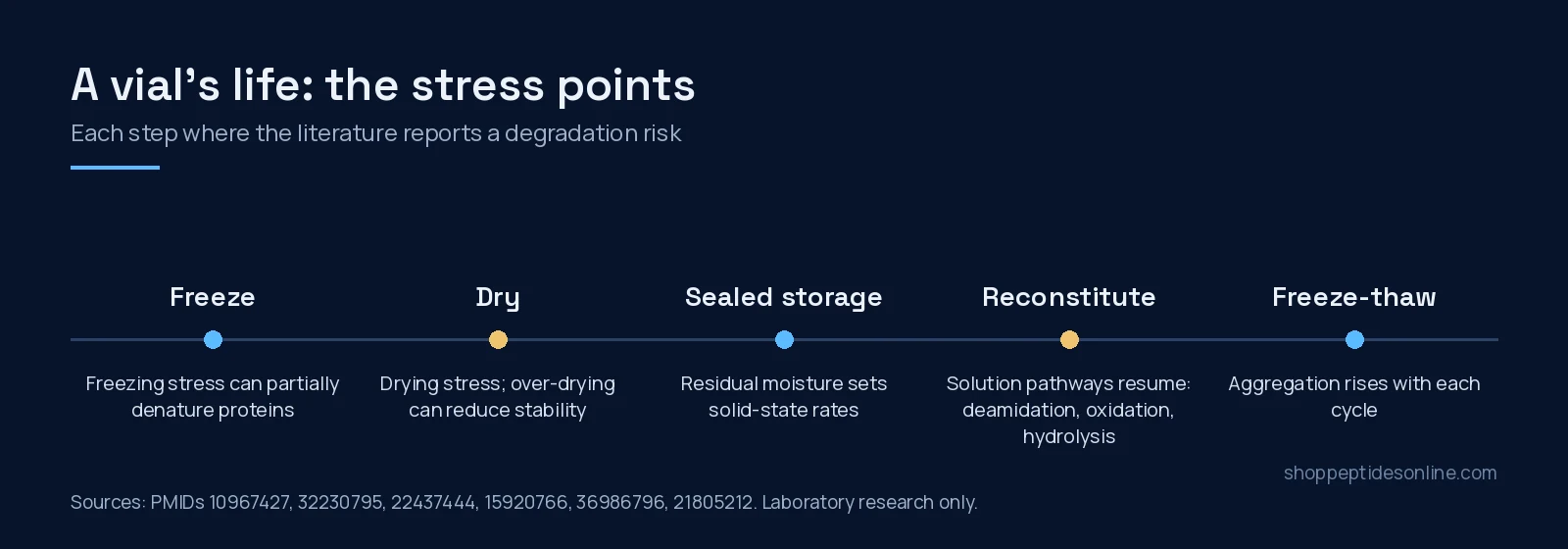
Lyophilization (freeze-drying) is the most common way to make solid protein products. Proteins are often made into solids precisely to reach an acceptable shelf life[4]. Taking out water removes a reactant. In a lyophilized model peptide, rate constants for succinimide formation and hydrolysis rose by orders of magnitude as water content increased[9]. The process has costs, though. Freezing and drying are both stresses that can denature proteins to varying degrees, and even after successful lyophilization, proteins “may still have limited long-term storage stability”[4]. A 2009 review of solid-state stability says the same: chemical and physical degradation can occur in solids on the time scale of drying, distribution and use[5].
Moisture is not simply “less is better”
This is where the storage myths break down. Three studies show the residual-water effect is not linear:
- Model asparaginyl peptide (Gly-Phe-Asn-Gly) in an amorphous solid at 40 °C. Raising humidity from 33% to 75% RH increased succinimide formation and hydrolysis rates by orders of magnitude. At low water content, amines on neighbouring molecules competed with water and formed covalent adducts. Adduct formation followed a bell-shaped curve against water content[9].
- Lyophilized IgG1 antibody. The degradation rate had a minimum at about 2–3% water, not at the lowest water content. Molecular mobility in the glass, measured as structural relaxation time, did not explain the results[10].
- Freeze-dried IgG (null and mixed results). At −20 °C and 20 °C, moisture between 0.1% and 5% made no significant difference over 6 months. At 45 °C the results split. Samples that took up moisture from the air lost more monomer at higher moisture. But when batches were made with different drying cycles, the lowest-moisture batch (0.1–1%) lost more than a 3% batch. The authors conclude that over-drying can be an issue[11].
The practical reading for a lab: keep a lyophilized vial sealed and dry, because each moisture uptake changes the chemistry. And don’t treat any published shelf-life number as universal. These are antibody and model-peptide systems, not the research peptides sold here.
Once reconstituted: freeze–thaw and additives
A solution brings back every pathway in the table. Freeze–thaw adds its own stress: ice–water interfaces and cryoconcentration of the solute. In bevacizumab, aggregation increased with each freeze–thaw cycle and fell at higher protein concentration[12]. In trastuzumab, benzyl alcohol, the preservative in bacteriostatic water, made freeze–thaw damage worse and also increased methionine oxidation. The authors advise against frozen storage of formulations that contain benzyl alcohol[13]. Whether a given peptide behaves the same way is untested. It’s a reason to treat diluent choice as a variable, not a detail.
Storage: what SPO states and what the literature supports
| Point | Basis |
|---|---|
| Store lyophilized powder cool, dry and away from direct sunlight; −20 °C for long-term storage | SPO FAQ. Cold and dry storage is consistent with the reviews[2][4] |
| “Up to 24 months” as lyophilized powder, stored properly | SPO’s stated figure. It is not a measured stability study for each compound |
| Keep the vial sealed and dry | Moisture changes solid-state reaction rates[9][10] |
| Avoid repeated freeze–thaw of solutions | Aggregation rises with cycle number (antibody data)[12][13] |
| Treat diluent and buffer as variables | pH, buffer and preservative change degradation rates[1][8] |
Identity and purity at the time of testing are what a certificate of analysis records. Storage decides how long that stays true. Batch reports are in the COA library, and the research peptides catalogue lists what is in stock. For diluents, see bacteriostatic water in Canada. Orders ship within Canada; see buy peptides online in Canada for shipping and documentation.
Frequently asked questions
Why are research peptides shipped as a powder?
Most peptides degrade faster in water than in a dry solid. Freeze-drying removes most of the water that drives hydrolysis, deamidation and aggregation. It is the standard route to an acceptable shelf life for peptide and protein products.
Does a lyophilized peptide last forever?
No. Reviews of solid-state stability report that chemical and physical degradation can still happen in the dried state. Residual moisture, temperature and the formulation all affect the rate.
Is it bad to freeze and thaw a peptide solution repeatedly?
In antibody studies, aggregation increased with the number of freeze-thaw cycles. Adding benzyl alcohol made the damage worse. Many labs split a solution into aliquots so that each portion is thawed only once.
What storage does SPO state for its lyophilized products?
SPO’s FAQ says to store the powder in a cool, dry place away from direct sunlight. For long-term storage it says to keep products in a freezer at −20 °C, and it states stability of up to 24 months as lyophilized powder when stored properly. Always follow the label and your lab’s documentation.
References
- Nugrahadi PP, Hinrichs WLJ, Frijlink HW et al. (2023). Designing Formulation Strategies for Enhanced Stability of Therapeutic Peptides in Aqueous Solutions: A Review. Pharmaceutics. PMID: 36986796. doi: 10.3390/pharmaceutics15030935.
- Wang W (1999). Instability, stabilization, and formulation of liquid protein pharmaceuticals. Int J Pharm. PMID: 10460913. doi: 10.1016/s0378-5173(99)00152-0.
- Manning MC, Chou DK, Murphy BM et al. (2010). Stability of protein pharmaceuticals: an update. Pharm Res. PMID: 20143256. doi: 10.1007/s11095-009-0045-6.
- Wang W (2000). Lyophilization and development of solid protein pharmaceuticals. Int J Pharm. PMID: 10967427. doi: 10.1016/s0378-5173(00)00423-3.
- Chang LL, Pikal MJ (2009). Mechanisms of protein stabilization in the solid state. J Pharm Sci. PMID: 19569054. doi: 10.1002/jps.21825.
- Brennan TV, Clarke S (1993). Spontaneous degradation of polypeptides at aspartyl and asparaginyl residues: effects of the solvent dielectric. Protein Sci. PMID: 8453372. doi: 10.1002/pro.5560020305.
- Joshi AB, Kirsch LE (2002). The relative rates of glutamine and asparagine deamidation in glucagon fragment 22-29 under acidic conditions. J Pharm Sci. PMID: 12379918. doi: 10.1002/jps.10213.
- Li S, Schöneich C, Wilson GS et al. (1993). Chemical pathways of peptide degradation. V. Ascorbic acid promotes rather than inhibits the oxidation of methionine to methionine sulfoxide in small model peptides. Pharm Res. PMID: 8290469. doi: 10.1023/a:1018960300769.
- DeHart MP, Anderson BD (2012). Effects of water and polymer content on covalent amide-linked adduct formation in peptide-containing amorphous lyophiles. J Pharm Sci. PMID: 22437444. doi: 10.1002/jps.23092.
- Chang LL, Shepherd D, Sun J et al. (2005). Effect of sorbitol and residual moisture on the stability of lyophilized antibodies: Implications for the mechanism of protein stabilization in the solid state. J Pharm Sci. PMID: 15920766. doi: 10.1002/jps.20363.
- Duralliu A, Matejtschuk P, Stickings P et al. (2020). The Influence of Moisture Content and Temperature on the Long-Term Storage Stability of Freeze-Dried High Concentration Immunoglobulin G (IgG). Pharmaceutics. PMID: 32230795. doi: 10.3390/pharmaceutics12040303.
- Zhang A, Singh SK, Shirts MR et al. (2012). Distinct aggregation mechanisms of monoclonal antibody under thermal and freeze-thaw stresses revealed by hydrogen exchange. Pharm Res. PMID: 21805212. doi: 10.1007/s11095-011-0538-y.
- Xu ZT, Yang CH, Liu W et al. (2026). Benzyl alcohol exacerbates freeze-thaw-induced aggregation of trastuzumab: elucidating mechanisms and formulation implications for clinical practice. Int J Pharm. PMID: 41325828. doi: 10.1016/j.ijpharm.2025.126433.