For laboratory research only. Not for human or animal use. This article gives no dosing, administration or therapeutic advice.
Short answer: almost every research peptide sold today is made by Fmoc solid-phase peptide synthesis (SPPS). The chain is built one amino acid at a time on an insoluble resin bead, cut free with trifluoroacetic acid (TFA), purified by preparative HPLC and freeze-dried.[1],[2],[3] Each step leaves its own kind of impurity, and knowing which step causes which is the fastest way to read a certificate of analysis critically.
The idea behind solid-phase synthesis
R. B. Merrifield’s approach was to anchor the growing chain to a solid resin, so that excess reagents and by-products could simply be washed away after each step.[4],[5] The two protecting-group schemes that grew out of it are Boc/benzyl and Fmoc/tert-butyl.[5] Fmoc amino acids entered SPPS in the late 1970s.[1] Fmoc is removed by base, while the tert-butyl-type side-chain groups come off only in acid, which makes the scheme “orthogonal”: each deprotection leaves the other protecting groups intact.[1] Today Fmoc SPPS is the method of choice, and multi-ton production of therapeutic peptides has made high-quality Fmoc building blocks cheap and widely available.[2]
The steps, in order
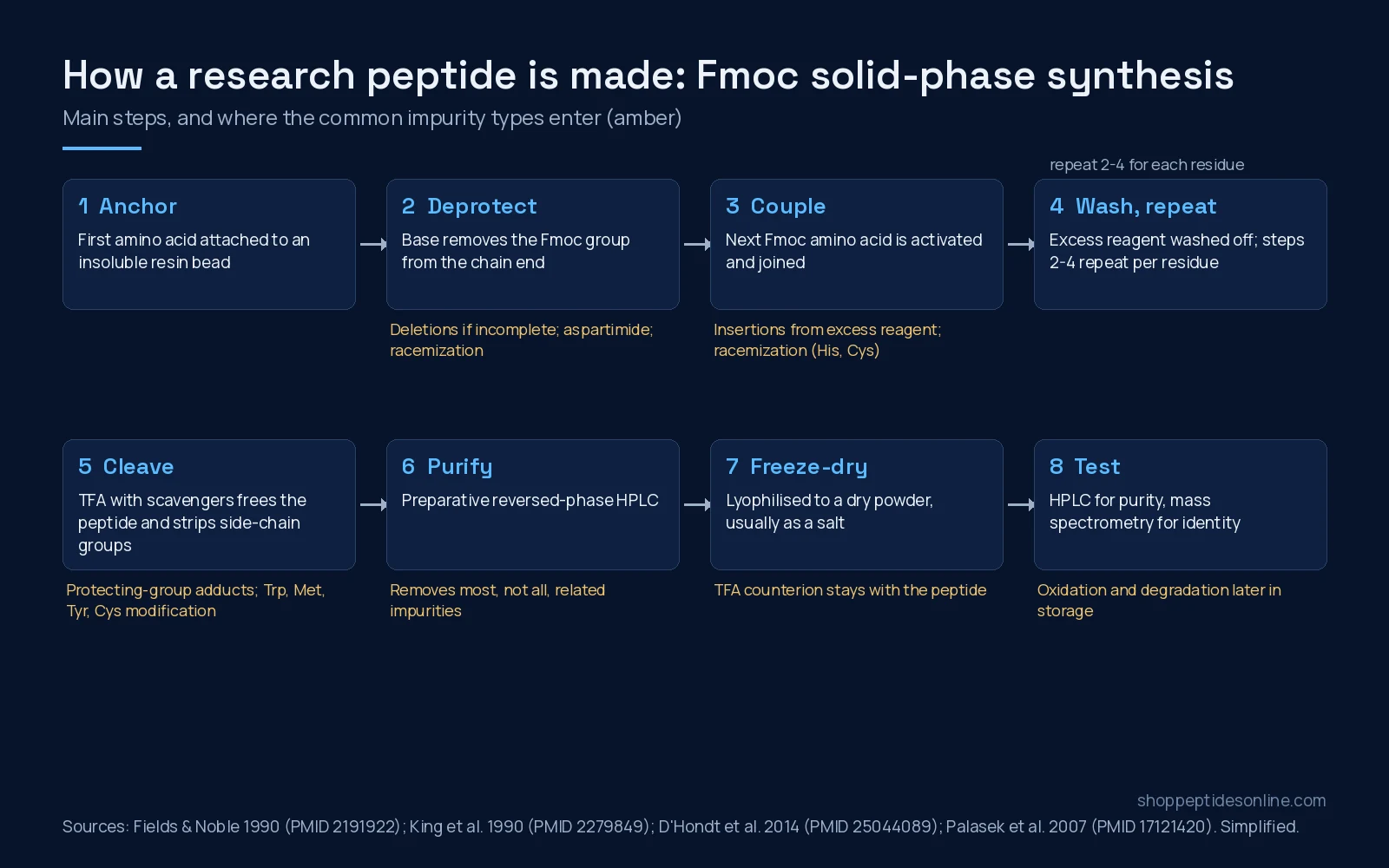
- Anchor. The first amino acid, protected at its amine end, is attached to the resin through a linker.[5]
- Deprotect. A base removes the Fmoc group, exposing the amine for the next coupling.[1]
- Couple. The next Fmoc amino acid is activated and joined to the chain. Couplings use excess reagent, which is one source of insertion impurities.[3]
- Wash and repeat. Reagents are washed off the resin, and the deprotect-couple-wash cycle repeats once per residue.[4]
- Cleave. A TFA mixture frees the peptide from the resin and removes the side-chain protecting groups. Scavengers are added because liberated protecting groups can otherwise attach to Trp, Tyr, Met and Cys.[6]
- Purify. Preparative reversed-phase HPLC is the established purification method; faster flash chromatography is sometimes used as a pre-purification step.[7],[8]
- Freeze-dry and test. The purified fractions are lyophilised to a powder, usually as a salt with the counterion from the purification buffer, and then tested.[3],[9]
The powder that comes out of step 7 is the form a research vial holds. Our post on lyophilised versus reconstituted peptides covers what happens to it next.
Why small losses per step add up
A 30-residue peptide means 30 deprotections and 30 couplings in a row. Any chain that misses a step becomes a slightly shorter or altered by-product that still sits on the same resin. The chart below is simple arithmetic, not a measured yield: if every coupling works 99% of the time, only about 74% of the chains come out full length after 30 of them.
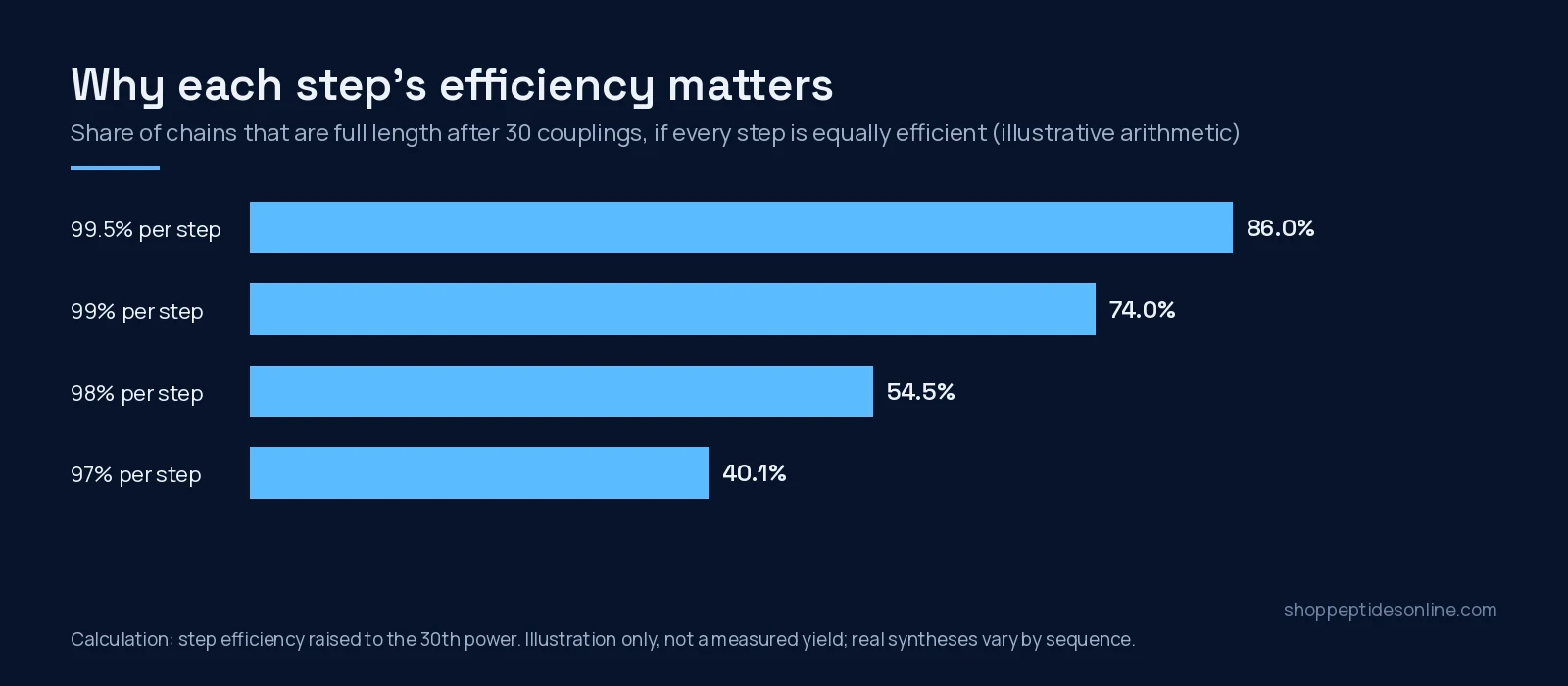
This is why long or “difficult” sequences are harder to make clean, and why purification is not optional.[5] It also fits a finding from a metrology study of a synthetic human C-peptide material used in an international laboratory comparison: using high-resolution LC-MS, the authors identified and quantified more than 65 structurally related impurities, together making up about 8.3% of the material by mass.[10]
Where each impurity type comes from
A 2014 review of peptide medicines grouped related impurities into those created during synthesis, those created by degradation afterwards, and, in finished drug products, those formed with excipients.[3] The first two groups are the ones that matter for a research-grade vial.
| Impurity type | Where it comes from | Mass vs target | How it shows up on a COA |
|---|---|---|---|
| Deletion sequence (one residue missing) | Incomplete Fmoc removal, so a coupling is skipped[3] | Lower by one residue | Side peak on HPLC; different mass on MS |
| Insertion sequence (one residue extra) | Excess amino acid reagent[3] | Higher by one residue | Side peak on HPLC; different mass on MS |
| Diastereomer (racemized residue) | Base during deprotection; His and Cys during coupling[3],[11] | Same | MS alone cannot see it; needs chromatographic separation |
| Aspartimide and its products | Base-driven side reaction at aspartic acid[12],[11] | Can differ or match | Extra HPLC peaks near the main peak |
| Protecting-group adduct | Side-chain groups not fully removed, or re-attached during TFA cleavage[3],[6] | Higher | Different mass on MS |
| Oxidation and later degradation | Oxidation of susceptible side chains; pyroglutamate and diketopiperazine formation[3] | Usually different | Grows with poor storage; new HPLC peaks |
| Counterion (TFA) | Cleavage and purification buffers[3],[9] | Not a peptide | Invisible to UV purity; lowers peptide content by weight |
Some of these are well-known enough to have their own literature. Aspartimide formation is described in a 2025 review as a “persistent challenge” of Fmoc chemistry, with strategies ranging from modified protecting groups to backbone protection.[12] Microwave energy speeds up both reactions; in one microwave-assisted synthesis, Cys, His and Asp were prone to racemization, and lowering the coupling temperature limited it for His and Cys.[11]
What this means when you read a COA
The two standard tests answer different questions. HPLC with UV detection measures the share of the sample in the main peak, so deletion, insertion and aspartimide by-products that separate on the column lower the purity figure. Mass spectrometry confirms the target mass and flags by-products with a different mass. Neither test sees everything: a racemized residue has the same mass, and the purity percentage describes only the peptide peaks, so a TFA counterion is not part of it, yet it adds to the powder’s weight and lowers the share that is peptide. Our post on why a vial can test below its label works through that difference with real report figures. A 2025 study on counterion exchange called for counterion content to be measured and specified for exactly this reason.[9],[3]
Our guide to HPLC purity versus mass-spectrometry identity explains the two methods in more detail, and every report SPO has posted is in the COA library. Regulators face the same complexity: a 2024 review notes that impurity characterisation for peptides cannot simply follow the small-molecule approach.[13]
A note on solvents
SPPS is chemically wasteful. The most common solvents, DMF, dichloromethane and NMP, are among the most toxic used in synthesis, and a 2019 review surveyed efforts to replace them with greener alternatives.[14] For buyers this is background rather than a quality signal, but it explains why peptide synthesis costs what it does.
For SPO’s range of research compounds, see the peptide catalogue, or read how to buy peptides online in Canada.
Frequently asked questions
What does “solid-phase” mean in peptide synthesis?
The growing peptide chain is attached to an insoluble resin bead for the whole synthesis. Reagents are added in solution and washed away after each step, while the chain stays on the bead until it is cleaved off at the end.
Why is Fmoc chemistry used more than Boc chemistry today?
Fmoc is removed by base while the side-chain protecting groups come off only in acid, so each deprotection leaves the others intact. Reviews describe Fmoc SPPS as the method of choice, and large-scale production of therapeutic peptides has made Fmoc building blocks inexpensive.
Can HPLC purity catch every synthesis impurity?
No. HPLC purity reflects the peptide peaks the column separates. A racemized residue may co-elute with the main peak, and counterions such as TFA are not part of the purity figure. Mass spectrometry adds identity and catches by-products of different mass.
Where does TFA in a peptide sample come from?
From the trifluoroacetic acid used to cleave the peptide from the resin and from acidic purification buffers. It stays with the freeze-dried peptide as a counterion, which is why researchers who need a different salt form exchange it, for example for chloride.
References
- Fields GB, Noble RL (1990). Solid phase peptide synthesis utilizing 9-fluorenylmethoxycarbonyl amino acids. Int J Pept Protein Res. PMID: 2191922. doi: 10.1111/j.1399-3011.1990.tb00939.x.
- Behrendt R, White P, Offer J (2016). Advances in Fmoc solid-phase peptide synthesis. J Pept Sci. PMID: 26785684. doi: 10.1002/psc.2836.
- D’Hondt M, Bracke N, Taevernier L et al. (2014). Related impurities in peptide medicines. J Pharm Biomed Anal. PMID: 25044089. doi: 10.1016/j.jpba.2014.06.012.
- Merrifield B (1986). Solid phase synthesis. Science. PMID: 3961484. doi: 10.1126/science.3961484.
- Jaradat DMM (2018). Thirteen decades of peptide synthesis: key developments in solid phase peptide synthesis and amide bond formation utilized in peptide ligation. Amino Acids. PMID: 29185032. doi: 10.1007/s00726-017-2516-0.
- King DS, Fields CG, Fields GB (1990). A cleavage method which minimizes side reactions following Fmoc solid phase peptide synthesis. Int J Pept Protein Res. PMID: 2279849. doi: 10.1111/j.1399-3011.1990.tb00976.x.
- Rivier J, McClintock R, Galyean R et al. (1984). Reversed-phase high-performance liquid chromatography: preparative purification of synthetic peptides. J Chromatogr. PMID: 6736144. doi: 10.1016/s0021-9673(01)93709-4.
- Sørensen KK, Mishra NK, Paprocki MP et al. (2021). High-Performance Reversed-Phase Flash Chromatography Purification of Peptides and Chemically Modified Insulins. Chembiochem. PMID: 33443297. doi: 10.1002/cbic.202000826.
- Erckes V, Streuli A, Chamera Rendueles L et al. (2025). Towards a Consensus for the Analysis and Exchange of TFA as a Counterion in Synthetic Peptides and Its Influence on Membrane Permeation. Pharmaceuticals (Basel). PMID: 40872554. doi: 10.3390/ph18081163.
- Li M, Josephs RD, Daireaux A et al. (2018). Identification and accurate quantification of structurally related peptide impurities in synthetic human C-peptide by liquid chromatography-high resolution mass spectrometry. Anal Bioanal Chem. PMID: 29862433. doi: 10.1007/s00216-018-1155-y.
- Palasek SA, Cox ZJ, Collins JM (2007). Limiting racemization and aspartimide formation in microwave-enhanced Fmoc solid phase peptide synthesis. J Pept Sci. PMID: 17121420. doi: 10.1002/psc.804.
- Kong MJW, van den Braak TJHP, Neumann K (2025). Aspartimide Formation and Its Prevention in Fmoc Chemistry Solid Phase Peptide Synthesis. Chembiochem. PMID: 40857621. doi: 10.1002/cbic.202500490.
- Colalto C (2024). Aspects of complexity in quality and safety assessment of peptide therapeutics and peptide-related impurities. A regulatory perspective. Regul Toxicol Pharmacol. PMID: 39243929. doi: 10.1016/j.yrtph.2024.105699.
- Varnava KG, Sarojini V (2019). Making Solid-Phase Peptide Synthesis Greener: A Review of the Literature. Chem Asian J. PMID: 30681290. doi: 10.1002/asia.201801807.