
Your cart is currently empty!.
You may check out all the available products and buy some in the shop.
Continue ShoppingGLOW 70mg is a three-peptide research blend — GHK-Cu, BPC-157 and thymosin β4 (sold as TB-500), per its batch report. Review the listing and documentation, then read what each component is and what the published preclinical work has actually examined, with references.

The store lists GLOW 70MG in vial format. The live product card supplies the current price and availability. The 70MG label is the declared total; the per-component amounts come from the batch report, quoted below.

Open the GLOW 70MG product page for the current item. Keep the exact listing name, format and batch information in your procurement record. Do not infer a GLOW pen or a different strength from a similar name elsewhere.
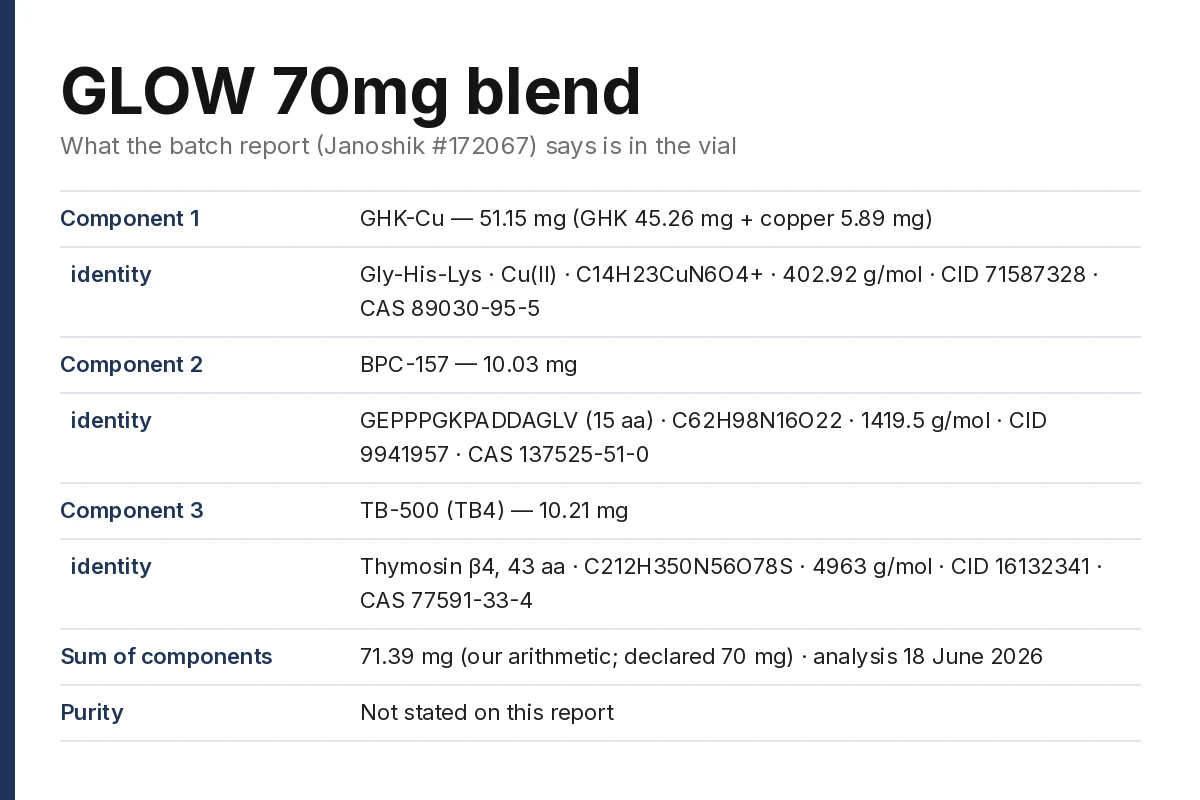
GLOW is a three-peptide blend. Its name does not tell you what is inside; the independent batch report does. Janoshik test report #172067 (analysis 18 June 2026) for the current GLOW 70mg batch lists GHK-Cu 51.15 mg (as 45.26 mg of the tripeptide GHK plus 5.89 mg copper), BPC-157 10.03 mg and TB-500 10.21 mg, with the TB-500 result labelled “TB4”, the laboratory’s shorthand for full-length thymosin β4. Those three components add up to 71.39 mg against the 70 mg declaration (our arithmetic, not a figure on the report). The report gives per-component quantities and identity only; it does not state a purity percentage, and we do not print one. Each component has its own research literature, almost entirely in rodents and cell culture, and no published study has examined the three together. The vial is supplied for laboratory research only.
| GHK-Cu | BPC-157 | TB-500 (thymosin β4) | |
|---|---|---|---|
| Sequence | Gly-His-Lys · Cu(II) | GEPPPGKPADDAGLV | Ac-SDKPDMAEIEKFDKSKLKKTETQEKNPLPSKETIEQEKQAGES (43 aa) |
| Formula | C14H23CuN6O4+ (GHK alone: C14H24N6O4) | C62H98N16O22 | C212H350N56O78S |
| Molecular weight | 402.92 g/mol (GHK 340.38) | 1419.5 g/mol | 4963 g/mol |
| CAS | 89030-95-5 (GHK 49557-75-7) | 137525-51-0 | 77591-33-4 |
| PubChem CID | 71587328 (GHK 73587) | 9941957 | 16132341 |
| Other identifiers | INN prezatide copper; UNII 6BJQ43T1I9; ChEMBL1814493 (GHK) | ChEMBL4297358; UNII 8ED8NXK95P | INN timbetasin; UNII 2D5MRE3SSY; ChEMBL4594313 |
| In this batch | 51.15 mg (45.26 mg GHK + 5.89 mg Cu) | 10.03 mg | 10.21 mg |
Identity values read from PubChem and ChEMBL on 30 September 2026; batch quantities from Janoshik #172067. PubChem also lists a 2 : 1 GHK–copper complex (CID 133697840, 744.3 g/mol); the report gives GHK and copper masses separately, so the stoichiometry in the vial is not something we can state.
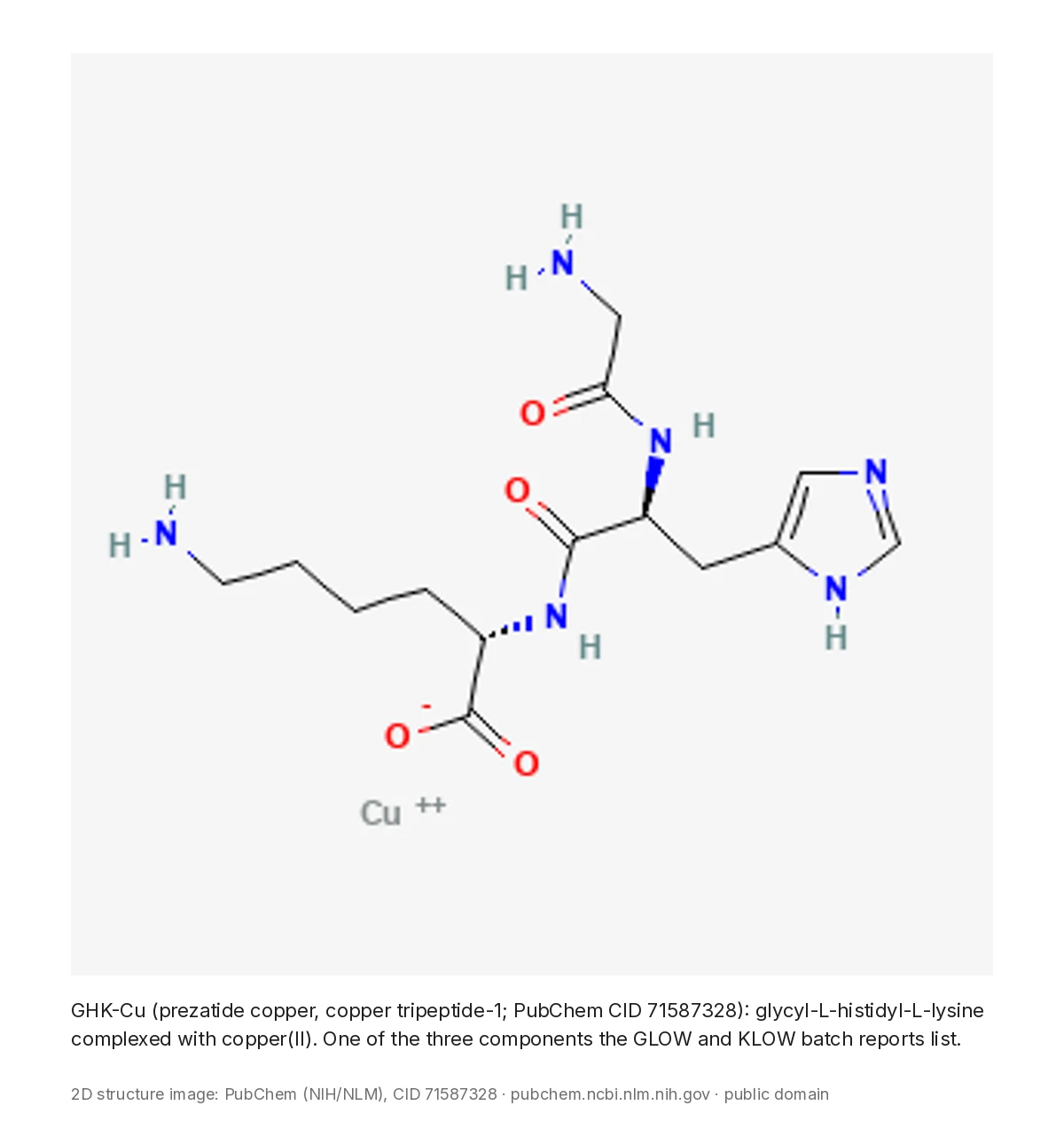
In 1973 Pickart and Thaler described a tripeptide in human serum that prolonged the survival of normal liver cells in culture while stimulating growth in neoplastic liver cells, and showed that synthetic glycyl-histidyl-lysine reproduced the effect[1, 2]. The peptide has a high affinity for copper(II)[3], and most later work used the copper complex.
Maquart and colleagues reported in 1988 that GHK-Cu stimulated collagen synthesis by cultured fibroblasts, with the effect starting between 10−12 and 10−11 M, peaking at 10−9 M, and occurring without any change in cell number; they noted that the GHK triplet occurs in the α2(I) chain of type I collagen and might be released by proteases at a wound[3]. In rat dermal fibroblasts the complex increased decorin expression without changing biglycan[5]. In 2012 a Boston University group used the Connectivity Map to look for compounds that reverse a 127-gene expression signature of emphysema severity in human lung tissue; GHK came up, and in fibroblasts from COPD lungs it reproduced TGF-β-like gene expression, organised the actin cytoskeleton, raised integrin β1 and restored collagen-gel contraction[7]. Copper-free GHK increased keratinocyte proliferation and integrin expression in monolayer culture and skin-equivalent models[9].
Using stainless-steel wound chambers implanted under the skin of rats, Maquart’s group found in 1993 that repeated GHK-Cu injections produced a concentration-dependent rise in dry weight, DNA, total protein, collagen and glycosaminoglycan content, with collagen synthesis stimulated twice as much as non-collagen protein and type I and III collagen mRNA increased while TGF-β mRNA was not; a control tripeptide had no effect[4]. A 2000 follow-up in the same model recorded more type I collagen, more chondroitin and dermatan sulfate, and higher decorin mRNA in treated chambers[5]. In a 2015 anterior-cruciate-ligament reconstruction model (72 rats), repeated intra-articular GHK-Cu reduced side-to-side knee laxity and increased graft stiffness at 6 weeks, but by 12 weeks — after treatment stopped — no difference from saline remained, and ultimate load, gait and histology never differed[8].
In eighteen New Zealand rabbits with full-thickness dorsal wounds, topical tripeptide-copper complex applied over 21 days gave a smaller unhealed area and more contraction than untreated controls at days 7, 14 and 21, faster granulation-tissue cover than either control or zinc oxide, and the most neovascularisation of the three groups[6].
Both are covered in depth on their own guides, so only the anchor findings are repeated here. BPC-157 was characterised in 1993 as a stable 15-amino-acid fragment of a roughly 40 kDa gastric-juice protein[10]. In rats with a transected Achilles tendon it improved failure load and functional scores versus saline, without affecting cultured tendocyte growth[11]; in vessel assays and rat hind-limb ischaemia it increased tube formation and flow recovery alongside VEGFR2 up-regulation[12]. A 2025 systematic review counted 35 preclinical studies and a single retrospective clinical report and concluded there are no clinical safety data[13]. Thymosin β4, the TB-500 component here, is the 43-residue G-actin-sequestering peptide first sequenced in 1981[14]; its angiogenic activity maps to a seven-residue actin-binding motif[15], and it accelerated re-epithelialisation of rat full-thickness wounds in 1999[16]. The one study to combine BPC-157 and TB-500 — 32 rats, Achilles repair, four weeks — found no additive effect[17].
| Year | Component | Model | What was investigated | Reference |
|---|---|---|---|---|
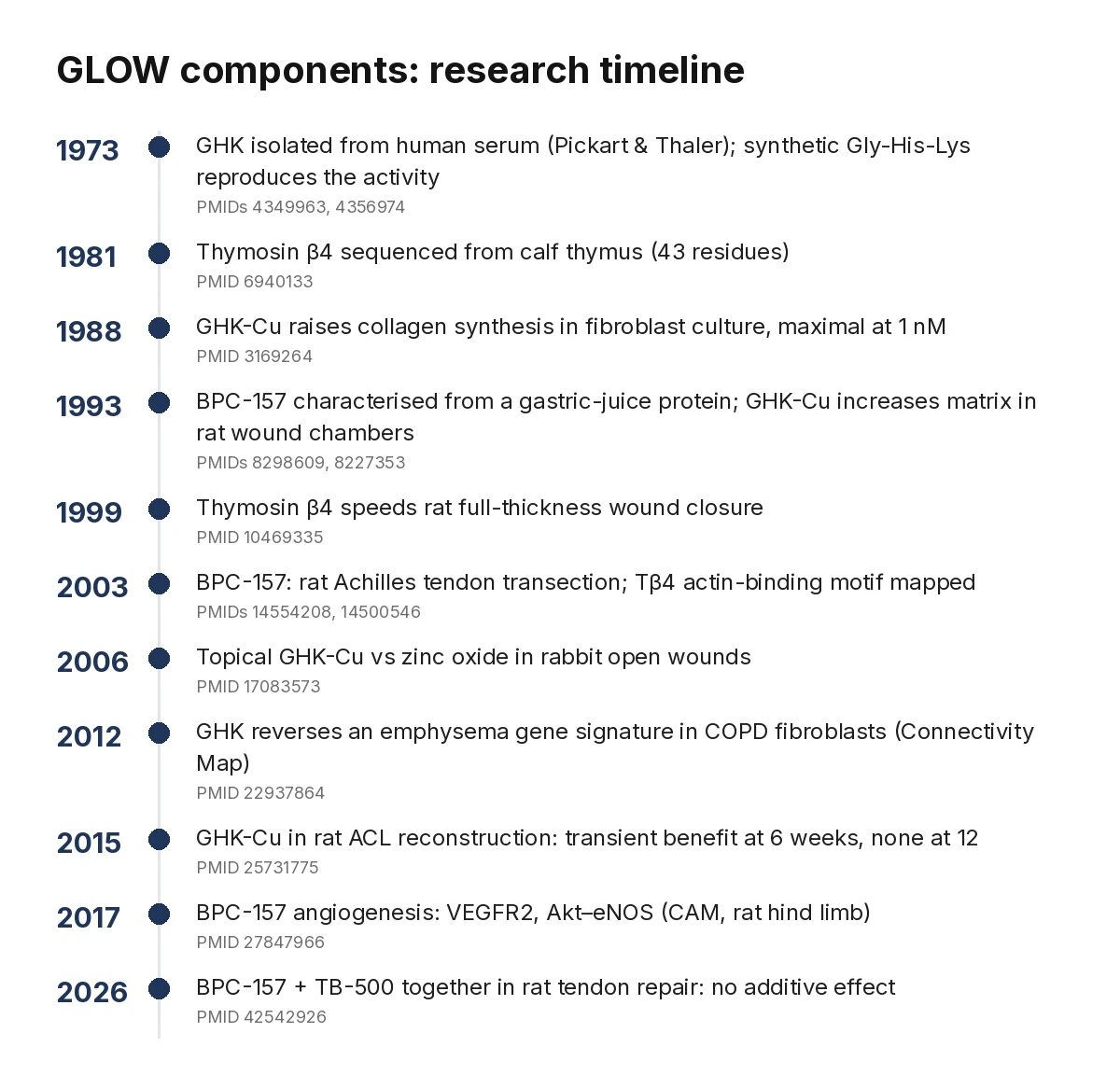
| 1973 | GHK | Human serum; liver cell culture | Isolation of the tripeptide; survival of normal liver cells | PMID 4349963, PMID 4356974 |
| 1981 | Tβ4 | Calf thymus | Sequence and mass of thymosin β4 | PMID 6940133 |
| 1988 | GHK-Cu | Fibroblast culture | Collagen synthesis, maximal at 1 nM | PMID 3169264 |
| 1993 | GHK-Cu | Rat wound chamber | Dry weight, DNA, collagen, GAG; collagen I/III mRNA | PMID 8227353 |
| 1993 | BPC-157 | Overview (rodent models) | Characterisation of the 15-aa fragment | PMID 8298609 |
| 1999 | Tβ4 | Rat full-thickness wound | Re-epithelialisation, contraction, angiogenesis | PMID 10469335 |
| 2000 | GHK-Cu | Rat wound chamber; dermal fibroblasts | Glycosaminoglycans, decorin and biglycan expression | PMID 11121126 |
| 2003 | BPC-157 | Rat Achilles transection; tendocyte culture | Failure load, function; no in-vitro growth effect | PMID 14554208 |
| 2003 | Tβ4 | HUVEC; chick aortic arch | Actin-binding motif carries angiogenic activity | PMID 14500546 |
| 2006 | GHK-Cu | Rabbit open wounds (n=18) | Wound area, contraction, granulation vs zinc oxide | PMID 17083573 |
| 2012 | GHK | Human COPD lung tissue; fibroblasts | Reversal of emphysema gene signature; actin, integrin β1 | PMID 22937864 |
| 2012 | GHK (copper-free) | Keratinocytes; skin equivalents | Proliferation, integrin α6/β1, p63 | PMID 23019153 |
| 2012 | TB-500 | Analytical | Ac-LKKTETQ identified in a TB-500 product | PMID 22962027 |
| 2015 | GHK-Cu | Rat ACL reconstruction (n=72) | Knee laxity and graft stiffness at 6 vs 12 weeks | PMID 25731775 |
| 2017 | BPC-157 | Chick CAM; HUVEC; rat hind-limb ischaemia | Angiogenesis; VEGFR2; Akt–eNOS | PMID 27847966 |
| 2025 | BPC-157 | Systematic review | 35 preclinical + 1 clinical report; no safety data | PMID 40756949 |
| 2026 | BPC-157 + TB-500 | Rat Achilles repair (n=32) | Each alone vs combination; no additive effect | PMID 42542926 |
The catalog contains separate destinations for KLOW 80mg (which its report shows as GHK-Cu, BPC-157, the 889 Da TB-500 fragment and KPV) and the BPC-157/TB-500 20MG blend. Shared ingredients do not make their documents interchangeable.
Compare each material’s full name, component list, labeled total, format and current-batch evidence. A report for a related blend should not be copied into the GLOW record without a documented sample match. The BPC-157 hub, TB-500 hub and GHK-Cu hub are separate compound references, not proof of this blend’s formulation.
Use the COA library for available reports, then compare the report description with the offered item. Do not assume every item has a matching current report simply because a library exists.
Our blend COA guide includes a worked listing review and a component worksheet. The HPLC/MS guide explains why identity, purity and measured quantity should not be merged into one conclusion.
Review current availability on the product page and the shipping policy for Canadian ordering information; the full catalogue is on the buy peptides online in Canada page. Confirm the destination and charges at checkout. This guide makes no carrier, delivery-time or legal-suitability promise.
The research procurement checklist covers wider supplier questions. For multi-item comparisons, use the research material and batch comparison guide.
Three peptides, per Janoshik report #172067 (analysis 18 June 2026): GHK-Cu 51.15 mg (45.26 mg GHK + 5.89 mg copper), BPC-157 10.03 mg and TB-500 10.21 mg, the last labelled “TB4”, i.e. full-length thymosin β4. The name GLOW itself specifies nothing; the report does.
No. Report #172067 gives identity and per-component quantity but no purity figure, so this site does not state one for GLOW. The single-compound vials (GHK-Cu, BPC-157, TB-500) have their own reports with purity values.
Not in the published literature. Each component has rodent and cell-culture studies of its own (collagen synthesis and wound-chamber matrix for GHK-Cu, PMIDs 3169264 and 8227353; tendon and vessel models for BPC-157; wound closure and angiogenesis for thymosin β4), and a single 2026 rat study combined BPC-157 with TB-500 and found no additive effect (PMID 42542926). Nothing tests all three together.
No. None of the components has an approved drug product in Canada, the US or the EU, and no human evidence exists for the blend. GLOW is supplied for laboratory research only; this page gives no dosing, mixing or administration advice.