For laboratory research only. Not for human or animal use. This article gives no dosing, administration or therapeutic advice.
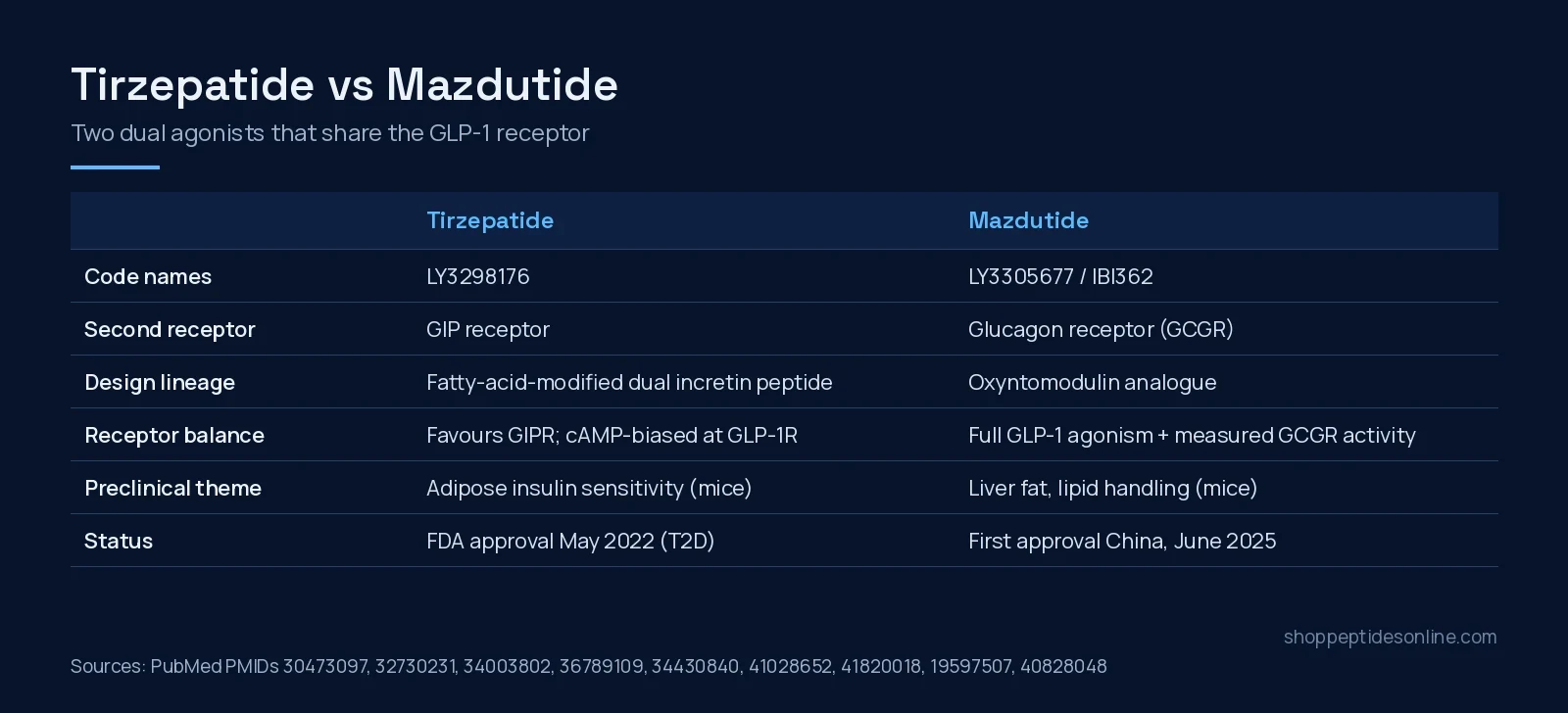
Short answer: tirzepatide and mazdutide are both once-weekly dual agonists built around the GLP-1 receptor, and they differ in the second receptor they recruit. Tirzepatide pairs GLP-1 receptor activity with the GIP receptor[1]; mazdutide pairs it with the glucagon receptor (GCGR)[2]. That single choice changes which tissues a research model is probing: GIP receptor work leans toward fat tissue and insulin sensitivity in mice[3], while glucagon receptor work leans toward the liver, fat oxidation and energy expenditure in rodents[4][5][6]. No head-to-head trial of the two molecules was found in PubMed at the time of writing.
Side by side
| Tirzepatide | Mazdutide | |
|---|---|---|
| Code names | LY3298176[1] | LY3305677, IBI362[7] |
| Receptors | GIP receptor + GLP-1 receptor[1] | Glucagon receptor + GLP-1 receptor[2] |
| Design lineage | Fatty-acid-modified peptide with dual incretin activity[1] | Oxyntomodulin analogue, first designed at Eli Lilly and developed with Innovent Biologics[8][2] |
| Receptor balance | Imbalanced toward the GIP receptor; biased toward cAMP at the GLP-1 receptor[9] | Full GLP-1 agonism plus a measured degree of glucagon receptor activity, the design logic from rodent work[4] |
| Main preclinical theme | Insulin sensitization through fat tissue in obese mice[3] | Liver fat and lipid handling in high-fat-diet mice[10][11] |
| Regulatory status | FDA approval in May 2022 for type 2 diabetes[12] | First approved in China in June 2025, a second Chinese approval in September 2025[2] |
| At SPO | Tirzepatide 20mg, for laboratory research | Not sold |
Why the second receptor matters
Both molecules keep the GLP-1 receptor as the anchor, so the comparison is really GIP receptor versus glucagon receptor. Those two receptors sit in different places and do different jobs.
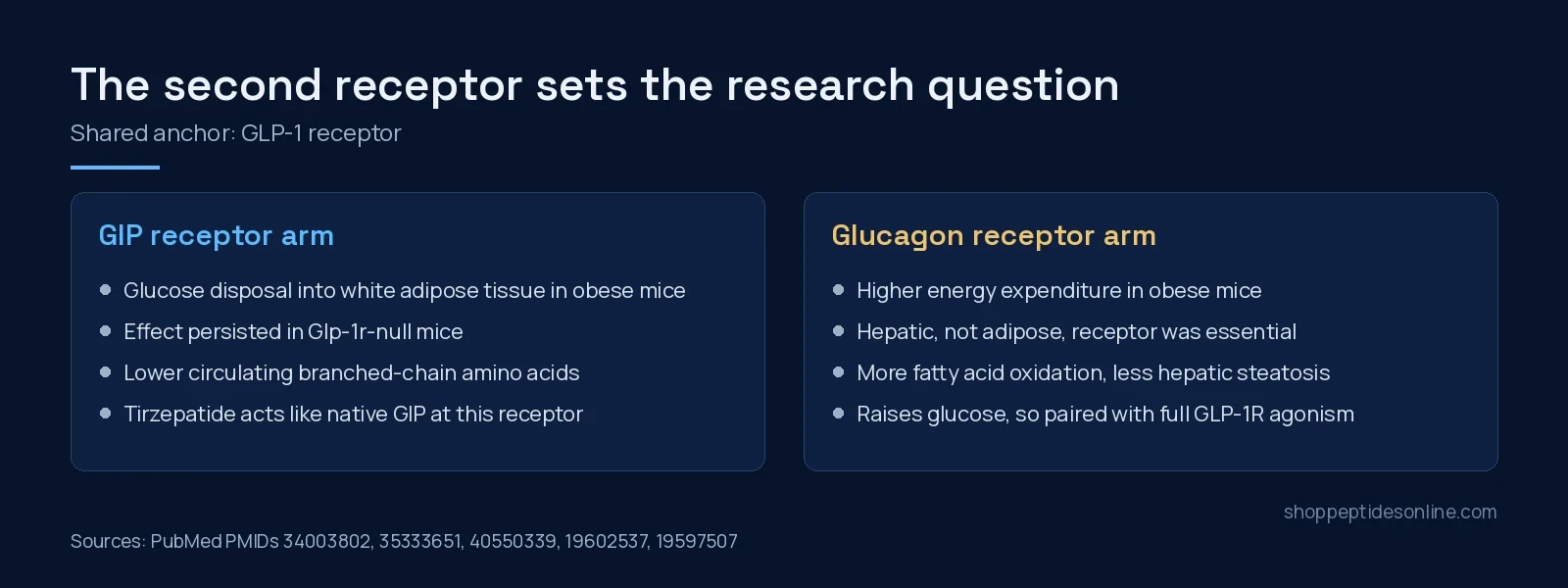
The GIP arm. In obese mice, tirzepatide improved insulin sensitivity more than GLP-1 receptor agonism alone. When the authors removed the GLP-1 receptor (Glp-1r-null mice), tirzepatide still improved insulin sensitivity by increasing glucose disposal into white adipose tissue, and a long-acting GIP receptor agonist did the same[3]. Those effects travelled with lower circulating branched-chain amino acids and ketoacids[3]. These are mouse data, and the paper frames them as a mechanism hypothesis for clinical observations, not a human finding.
The glucagon arm. Glucagon is best known for raising blood glucose, but a review of its newer biology also covers effects on lipids, body weight and vascular health, and notes that stable glucagon analogues turned glucagon agonism into a research tool for metabolic disease[13]. In diet-induced obese mice, a long-acting glucagon analogue increased energy expenditure; hepatic, not adipose, glucagon receptor signalling was essential, and the effect appeared only in obese mice, not lean ones, through sustained cAMP/PKA signalling[6]. The same study found the lipid-clearing effects ran through a separate route[6]. Because glucagon raises glucose, co-agonist designs keep full GLP-1 receptor agonism and add a measured degree of glucagon receptor activity[4][13].
Where the glucagon-plus-GLP-1 idea came from
Two 2009 rodent papers set up the logic mazdutide builds on. One team modified glucagon until it lost receptor specificity and gained GLP-1 receptor activity. In diet-induced obese mice, the PEGylated co-agonists lowered body fat through both reduced food intake and higher energy expenditure, and the authors concluded that full GLP-1 agonism plus an appropriate degree of glucagon receptor activation enhanced fat loss in these models[4].
A second team started from oxyntomodulin, a natural gut peptide that activates both receptors. They built a protease-resistant dual agonist and a GLP-1-selective control matched for GLP-1 receptor potency and pharmacokinetics. In diet-induced obese mice, the dual agonist increased fatty acid oxidation and reduced hepatic steatosis, and studies in receptor-knockout mice separated the GLP-1 receptor contribution from the glucagon receptor contribution[5]. Glucose control was comparable between the two peptides[5].
Mazdutide sits in this oxyntomodulin-analogue family; a 2026 patent review traces it from early peptide design at Eli Lilly to later formulation and clinical work led by Innovent Biologics[8].
What the mazdutide mouse studies add
- Liver fat imaging. High-fat-diet mice were treated with mazdutide, semaglutide (a GLP-1 receptor agonist) or saline for 4 weeks and scanned with 9.4-T MRI. Mazdutide gave a greater drop in liver fat fraction than semaglutide at 4 weeks, but not at 1 week, and liver iron (R2*) changes did not differ between the two at either time point[10]. Only male mice were studied.
- Liver mechanism. In a high-fat-diet MASLD mouse model and in fat-loaded hepatocytes, mazdutide reduced markers of hepatic steatosis and inflammation and was linked to lower ER stress through the PERK pathway and lower NF-κB signalling[11].
- Brain. In male db/db mice, mazdutide outperformed dulaglutide, a GLP-1 receptor agonist, on behavioural tests of cognition, with multi-omics changes in pathways tied to energy metabolism and synaptic plasticity. The authors state the findings apply to male mice only[14].
What the tirzepatide mechanism papers add
Tirzepatide’s discovery paper describes a fatty-acid-modified peptide that activated both GIP and GLP-1 receptor signalling in cell assays and acted through both receptors on glucose tolerance in mice[1]. Later work calculated receptor occupancy and found greater engagement of the GIP receptor than the GLP-1 receptor; at the GLP-1 receptor it favours cAMP generation over beta-arrestin recruitment and drives less receptor internalization than native GLP-1[9]. Cryo-EM and molecular dynamics then showed how the fatty acid modification, together with the amino acid sequence, sets that behaviour: tirzepatide resembles native GIP at the GIP receptor but differs markedly from GLP-1 at the GLP-1 receptor[15]. For a closer look at the two incretin receptors themselves, see our GIP vs GLP-1 comparison.
Clinical development, stated for context
Tirzepatide was approved by the US Food and Drug Administration in May 2022 for patients with type 2 diabetes[12]. Mazdutide received its first approval in China in June 2025 for long-term body weight management in adults, and a second Chinese approval in September 2025 for glycaemic control in type 2 diabetes; it is under clinical evaluation for further indications[2]. Its phase 3 programme in China includes a placebo-controlled trial in adults with obesity or overweight[16] and a trial against dulaglutide in type 2 diabetes[17]. Gastrointestinal events were the most common adverse events reported in both mazdutide’s early phase 1b study and the dulaglutide-comparator trial[7][17], and also for tirzepatide across its clinical trials[12].
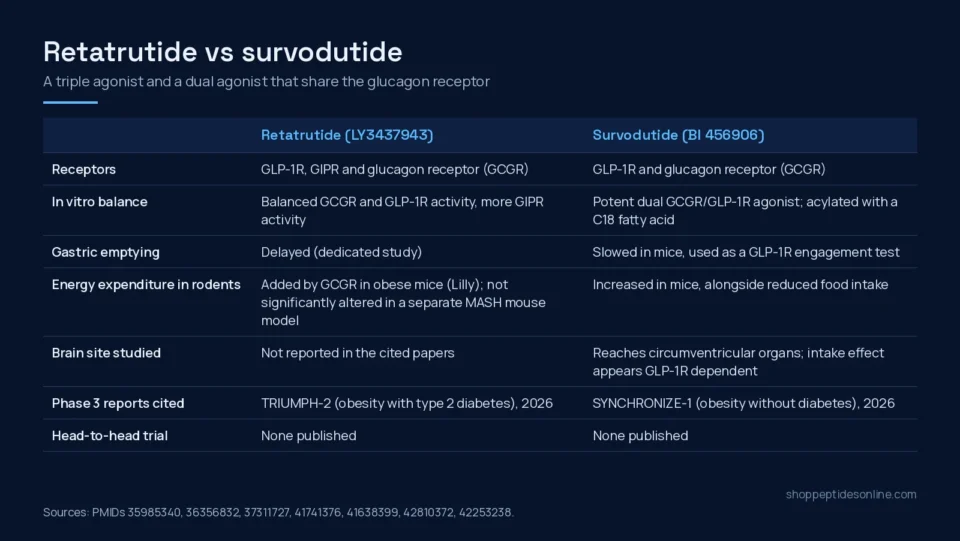
A 2026 review places mazdutide alongside survodutide as glucagon co-agonists and alongside triple agonists such as retatrutide, and notes that both GIP receptor agonism and GIP receptor antagonism are being explored with GLP-1 receptor agonism[18]. That last point is a useful reminder that the GIP arm is still debated.
Which one fits which question?
- Adipose insulin sensitivity, GIP receptor pharmacology, biased GLP-1 receptor signalling: tirzepatide[3][9].
- Hepatic lipid handling, fat oxidation, glucagon receptor biology: a GLP-1/glucagon co-agonist such as mazdutide[10][5].
- Isolating each receptor’s share: receptor-knockout designs, as used in both lines of work[3][5].
Our tirzepatide research page covers the product and its documentation. For the full catalogue, see our guide to buy peptides online in Canada.
Frequently asked questions
What is the main difference between tirzepatide and mazdutide?
Both activate the GLP-1 receptor. Tirzepatide’s second target is the GIP receptor; mazdutide’s second target is the glucagon receptor. The research questions each one suits follow from that second receptor.
Is mazdutide a GLP-1 and GIP agonist like tirzepatide?
No. Mazdutide (LY3305677, IBI362) is a GLP-1 and glucagon receptor dual agonist from the oxyntomodulin-analogue family. It does not target the GIP receptor.
Has tirzepatide been compared head to head with mazdutide?
No head-to-head trial was found in PubMed at the time of writing. Mazdutide’s comparator trials used placebo or dulaglutide, and its mouse studies used semaglutide or dulaglutide.
Why do glucagon co-agonists include GLP-1 activity?
Glucagon raises blood glucose. GCGR-based agonists add GLP-1 receptor activity, which stimulates insulin secretion, to balance that effect.
Does Shop Peptides Online sell mazdutide?
No. SPO lists tirzepatide for laboratory research only. Mazdutide is not part of the catalogue.
References
- Coskun T, Sloop KW, Loghin C et al. (2018). LY3298176, a novel dual GIP and GLP-1 receptor agonist for the treatment of type 2 diabetes mellitus: From discovery to clinical proof of concept. Mol Metab. PMID: 30473097. doi: 10.1016/j.molmet.2018.09.009.
- Shirley M (2025). Mazdutide: First Approval. Drugs. PMID: 41028652. doi: 10.1007/s40265-025-02249-y.
- Samms RJ, Christe ME, Collins KA et al. (2021). GIPR agonism mediates weight-independent insulin sensitization by tirzepatide in obese mice. J Clin Invest. PMID: 34003802. doi: 10.1172/JCI146353.
- Day JW, Ottaway N, Patterson JT et al. (2009). A new glucagon and GLP-1 co-agonist eliminates obesity in rodents. Nat Chem Biol. PMID: 19597507. doi: 10.1038/nchembio.209.
- Pocai A, Carrington PE, Adams JR et al. (2009). Glucagon-like peptide 1/glucagon receptor dual agonism reverses obesity in mice. Diabetes. PMID: 19602537. doi: 10.2337/db09-0278.
- Long F, Challa TD, Ding L et al. (2025). Glucagon controls obesity-specific energy expenditure via persistent cAMP/PKA signaling. J Hepatol. PMID: 40550339. doi: 10.1016/j.jhep.2025.06.011.
- Ji L, Jiang H, An P et al. (2021). IBI362 (LY3305677), a weekly-dose GLP-1 and glucagon receptor dual agonist, in Chinese adults with overweight or obesity: A randomised, placebo-controlled, multiple ascending dose phase 1b study. EClinicalMedicine. PMID: 34430840. doi: 10.1016/j.eclinm.2021.101088.
- Abdul Fasi M (2026). Patent landscape and therapeutic evolution of mazdutide: a dual GLP-1/Glucagon receptor agonist for obesity and type 2 diabetes. Expert Opin Ther Pat. PMID: 41820018. doi: 10.1080/13543776.2026.2645812.
- Willard FS, Douros JD, Gabe MB et al. (2020). Tirzepatide is an imbalanced and biased dual GIP and GLP-1 receptor agonist. JCI Insight. PMID: 32730231. doi: 10.1172/jci.insight.140532.
- Xia H, Min Y, Wang Y et al. (2025). Multiparametric MRI Evaluation of Liver Fat and Iron after Glucagon-like Peptide-1 Receptor and Glucagon Receptor Dual-Agonist Treatment in a High-Fat Diet-induced Mouse Model. Radiology. PMID: 40828048. doi: 10.1148/radiol.243780.
- Gan L, Duan L, Zheng X (2026). Mazdutide Ameliorates Metabolic Dysfunction-Associated Steatotic Liver Disease by Modulating Endoplasmic Reticulum Stress, Improving Lipid Metabolism and Alleviating Inflammation. Pharmaceuticals (Basel). PMID: 41901218. doi: 10.3390/ph19030371.
- Mishra R, Raj R, Elshimy G et al. (2023). Adverse Events Related to Tirzepatide. J Endocr Soc. PMID: 36789109. doi: 10.1210/jendso/bvad016.
- Müller TD, Finan B, Clemmensen C et al. (2017). The New Biology and Pharmacology of Glucagon. Physiol Rev. PMID: 28275047. doi: 10.1152/physrev.00025.2016.
- Dong W, Bai J, Yuan Q et al. (2025). Mazdutide, a dual agonist targeting GLP-1R and GCGR, mitigates diabetes-associated cognitive dysfunction: mechanistic insights from multi-omics analysis. EBioMedicine. PMID: 40479843. doi: 10.1016/j.ebiom.2025.105791.
- Sun B, Willard FS, Feng D et al. (2022). Structural determinants of dual incretin receptor agonism by tirzepatide. Proc Natl Acad Sci U S A. PMID: 35333651. doi: 10.1073/pnas.2116506119.
- Ji L, Jiang H, Bi Y et al. (2025). Once-Weekly Mazdutide in Chinese Adults with Obesity or Overweight. N Engl J Med. PMID: 40421736. doi: 10.1056/NEJMoa2411528.
- Guo L, Zhang B, Xue X et al. (2026). Mazdutide versus dulaglutide in Chinese adults with type 2 diabetes. Nature. PMID: 41407860. doi: 10.1038/s41586-025-10031-z.
- Son JW, le Roux CW, Blüher M et al. (2026). Novel GLP-1-based Medications for Type 2 Diabetes and Obesity. Endocr Rev. PMID: 41054801. doi: 10.1210/endrev/bnaf036.