
33 in stock
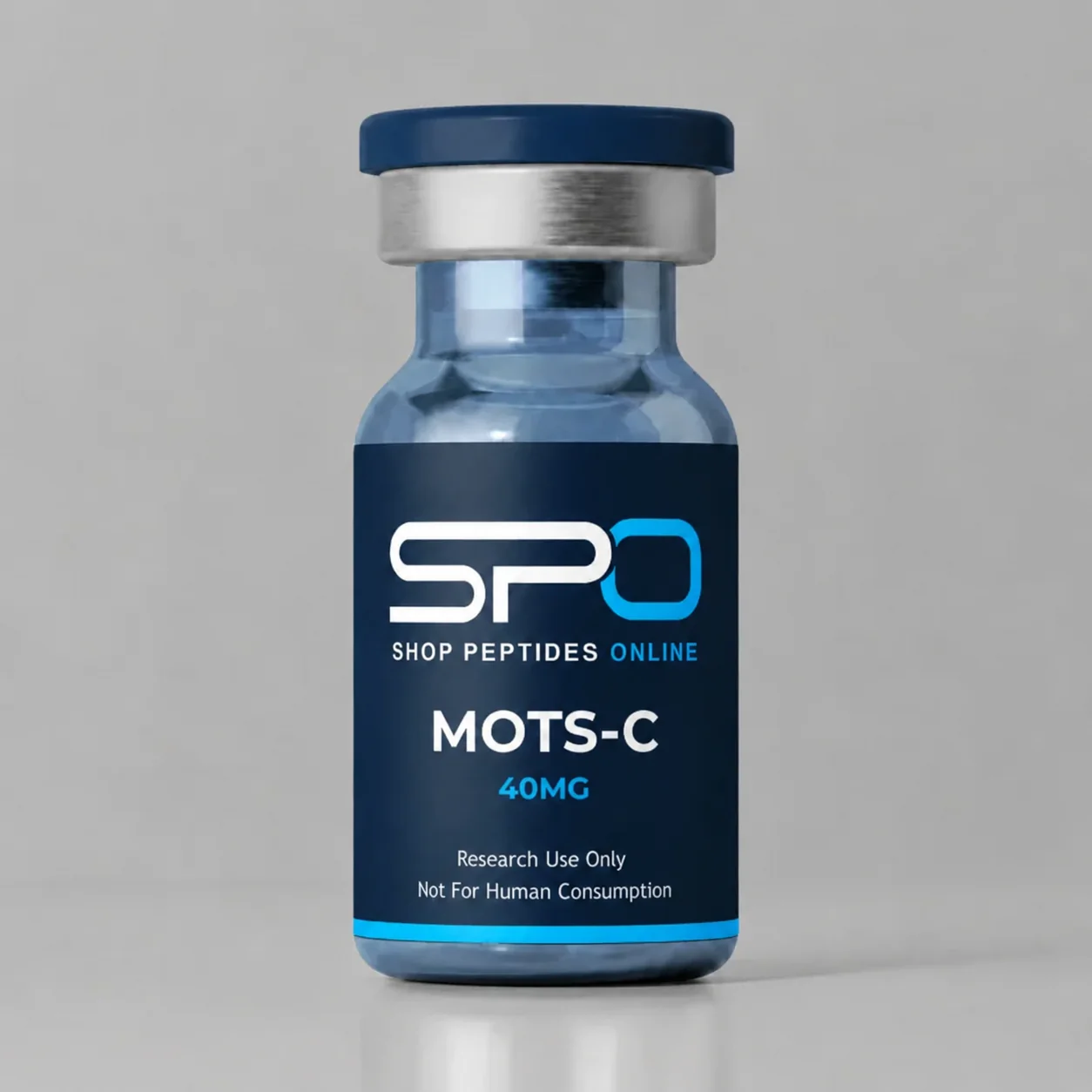
MOTS-C 40MG
$211.99
MOTS-c 40mg research peptide, vial format, supplied for laboratory research only. MOTS-c is a 16-amino-acid peptide encoded in the mitochondrial genome (a mitochondrial-derived peptide). Independent batch documentation in the COA library; priced in CAD and shipped within Canada by Canada Post. Not for human or animal use.

Estimated delivery: 1–3 business days

Free shipping: On orders over $300
Guarantee Safe Checkout:

Description
MOTS-c 40mg research peptide — Canada
The largest MOTS-c vial we stock, for laboratories running larger assay series. MOTS-c is a sixteen-amino-acid peptide encoded in the mitochondrial 12S rRNA gene; much of the recent literature concerns its relationship with exercise — the body’s own MOTS-c rises with training in mice and in people[1, 2] — and a natural variant linked to muscle-fibre type[3]. Synthetic lyophilized peptide, sealed vial, laboratory research only.
Full research overview, study table & references → MOTS-c in Canada: research guide
Identity at a glance
| Name | MOTS-c (mitochondrial open reading frame of the 12S rRNA type-c) |
| Sequence | MRWQEMGYIFYPRKLR (16 aa) |
| Formula / MW | C101H152N28O22S2 · 2174.6 g/mol |
| CAS / UNII | 1627580-64-6 / A5CV6JFB78 |
| PubChem CID | 146675088 |
| Declared content | 40 mg per vial (label value; no measured value on file) |
Batch documentation: a batch-specific COA for this strength has not been posted yet — see the COA library.
What researchers have looked at
- Exercise and ageing (2021): in mice, MOTS-c improved physical performance at 2, 12 and 22 months and, begun at 23.5 months, extended healthspan; in humans, exercise induced MOTS-c in skeletal muscle and circulation[1].
- Training in rodents (2022): 4–8 weeks of voluntary wheel running raised muscle MOTS-c protein 1.5- to 5-fold, sustained through 4–6 weeks of detraining; a single administration to untrained mice improved running time by 12% and distance by 15% in an acute test[2].
- Fibre type and a natural variant (2022): Japanese carriers of the K14Q variant had more fast-twitch MHC-IIx fibre and higher leg torque, and the allele was more frequent in sprint/power athletes than endurance athletes[3].
- Human plasma after an exercise programme (2021): 16 weeks of aerobic and resistance exercise raised plasma MOTS-c in non-Hispanic White but not Hispanic breast-cancer survivors[4]. Limits: all human data concern endogenous MOTS-c; the nuclear-translocation mechanism is from cell work[5].
Storage and handling
- Keep the sealed vial at −20 °C for long-term storage (site guidance: up to 24 months as powder); short-term cool, dry and dark; do not freeze–thaw repeatedly.
- Water-soluble. Larger vials are usually aliquoted after reconstitution to avoid repeated warming; bacteriostatic water is listed separately. Protocols are the researcher’s own.
Other strengths: MOTS-C 10MG · MOTS-C 20MG · MOTS-C (Pen). Shipped by Canada Post within Canada (policy); browse everything else on the buy peptides online in Canada page.
Frequently asked questions
Can I buy MOTS-c 40mg in Canada?
Yes. The 40 mg vial is our largest single MOTS-c listing and ships by Canada Post from inside Canada. It is supplied for laboratory research only.
Is there a certificate of analysis for the 40mg vial?
Not yet. No batch-specific report for the 40 mg strength — or any MOTS-c listing — is in the COA library at the time of writing; the page will be updated when one is posted.
Why is MOTS-c called an exercise-related peptide?
Because exercise raises the body’s own MOTS-c: in humans, muscle and circulating levels rose after exercise (PMID 33473109), and in rodents 4–8 weeks of voluntary running raised muscle MOTS-c protein 1.5- to 5-fold (PMID 35808870). Those are observations about endogenous MOTS-c, not evidence about the synthetic peptide in people.
Is MOTS-c for human use?
No. There is no approved product and no published trial of synthetic MOTS-c in humans; the human data are measurements of endogenous peptide and gene variants (PMIDs 34413391, 34728329). Laboratory research only; no dosing or administration guidance is provided.
Cited
- Reynolds et al. (2021), Nature communications — PMID 33473109
- Hyatt et al. (2022), Physiological reports — PMID 35808870
- Kumagai et al. (2022), Biochimica et biophysica acta. General subjects — PMID 34728329
- Dieli-Conwright et al. (2021), Scientific reports — PMID 34413391
- Kim et al. (2018), Cell metabolism — PMID 29983246
For laboratory research use only. Not for human or animal consumption. No dosing, administration or protocol information is provided, and nothing here is a claim of efficacy or safety in humans.
Related products
-

MOTS-C 10MG
$63.99 -
AHK-CU 50MG
$89.99 -

MOTS-C 20MG
$108.99 -
 Hot
GHK-CU 100MG
$93.99 -

KLOW 80 MG
$121.99 -
 Hot
GHK-CU 50MG
$50.99 -
AHK-CU 20MG
$49.99 -
GLUTATHIONE 1500MG
$104.99 -
 Hot
GLOW 70MG
$160.99