$121.99–$166.99Price range: $121.99 through $166.99
KLOW 80mg research peptide, vial format, supplied for laboratory research only. KLOW 80mg is a multi-component research blend; the 80mg figure is the vial's total labelled content and the component list is stated on the batch documentation. Independent batch documentation in the COA library; priced in CAD and shipped within Canada by Canada Post. Not for human or animal use.
klow 80mg was easy to find on the site. delivery was faster than I expected for a first order. thats all I needed.
Rated 5 out of 5
Casey Adams (verified owner)–
klow 80mg came in fine. checkout was quick and tracking was easy to follow.
Rated 5 out of 5
Rebecca Griffin (verified owner)–
the Klow 80mg listing answered most of my questions. the product card made it easy to compare sizes. site feels much easier than a lot of peptide shops.
Rated 5 out of 5
Jordan Barnes (verified owner)–
liked the COA section. package landed in good shape and the email updates were on time.
Rated 5 out of 5
Blake Bennett (verified owner)–
COA section looked clean on desktop and mobile. shipping was quick enough for me.
Rated 5 out of 5
Courtney Lewis (verified owner)–
placed a small order for Klow 80mg and had no drama. the product card made it easy to compare sizes. thats all I needed.
Rated 5 out of 5
Chelsea Brooks (verified owner)–
liked the product page. package landed in good shape and the email updates were on time.
Rated 5 out of 5
Nick Griffin (verified owner)–
pretty easy order. product page matched what showed in the cart.
Rated 4 out of 5
Kyle Mitchell (verified owner)–
placed a small order for Klow 80mg and had no drama. I liked that the research-only language stayed visible. would order again.
Rated 5 out of 5
Patrick White (verified owner)–
got Klow 80mg without any back and forth. pretty smooth.
Rated 5 out of 5
Rachel Martin (verified owner)–
the site made it easy to review Klow 80mg before ordering.
Description
KLOW 80mg research peptide blend — Canada
Researched & reviewed by the SPO Quality Team · Last reviewed: 30 September 2026
KLOW is GLOW plus one: the copper tripeptide GHK-Cu, the gastric pentadecapeptide BPC-157, TB-500 — here the 889 Da thymosin β4 fragment, not the whole protein — and KPV, the anti-inflammatory tail of α-MSH studied mostly in mouse gut models[1, 2]. That list comes from the batch report, not from the name. No study has looked at the four together. One vial of lyophilized powder, for laboratory research only.
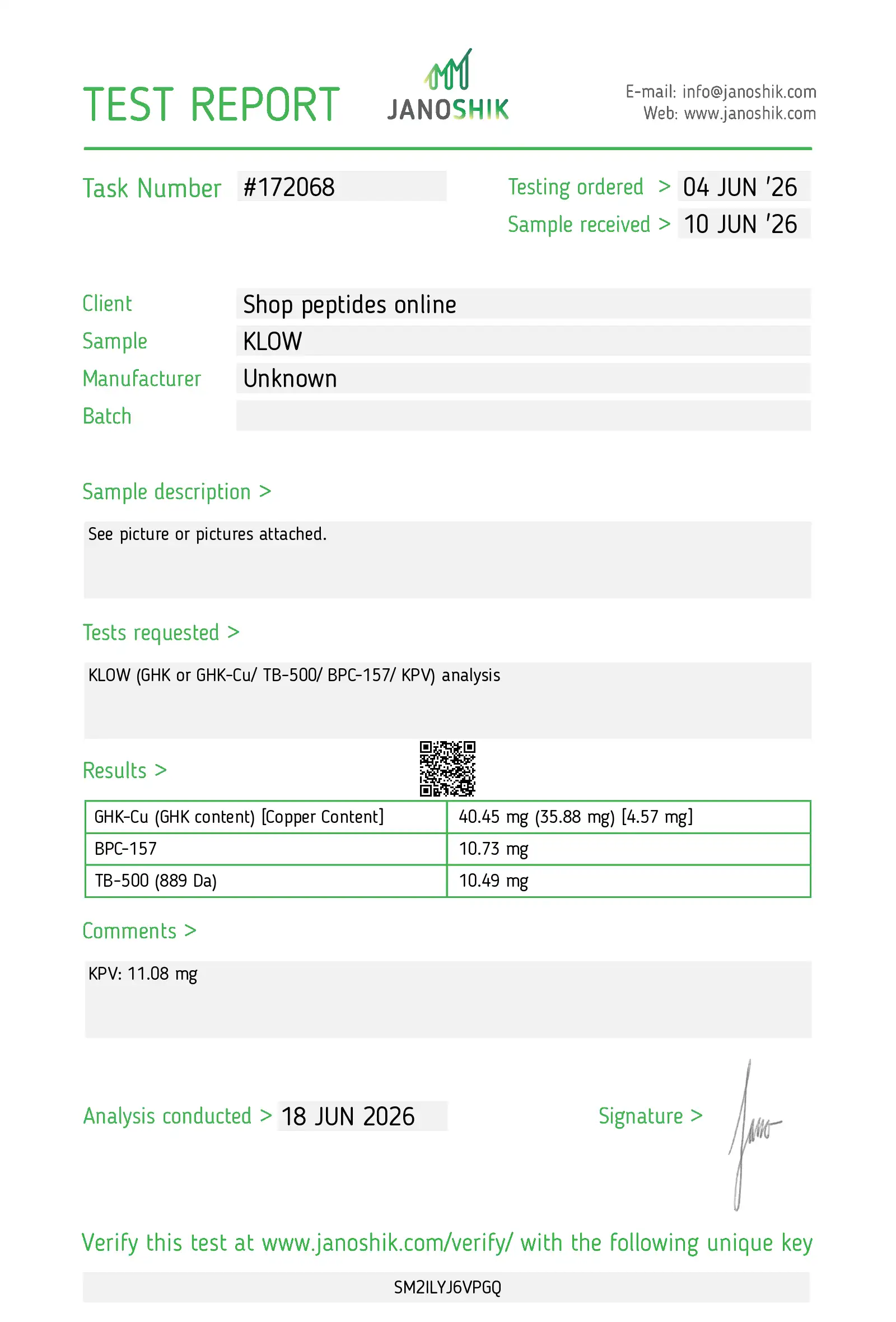
Independent test report #172068 (Janoshik, analysis 18 June 2026): per-component quantities for this KLOW batch. No purity figure appears on it.
The four amounts add up to 72.75 mg against an 80 mg declaration — our arithmetic, printed as found. Match the batch on your label to this report before use; the blend COA guide explains how to read a multi-component document one line at a time.
What researchers have looked at
KPV, mouse colitis (2008): in drinking water it lowered the incidence of DSS and TNBS colitis and cut cytokine expression, entering cells via the PepT1 transporter[1]; in a second lab, treated mice recovered weight faster with fewer infiltrates and lower myeloperoxidase, even without a working melanocortin-1 receptor[2].
KPV, microbes in vitro (2000): α-MSH and KPV inhibited S. aureus colony formation and C. albicans germ-tube formation, tracking a rise in cAMP[3].
GHK-Cu, rat wound chambers (1993): concentration-dependent increases in collagen, glycosaminoglycans, DNA and dry weight[4]. BPC-157, rat Achilles (2003): higher failure load after transection than saline[5]. Thymosin β4 motif (2003): the LKKTETQ heptapeptide alone reproduced the parent peptide’s endothelial migration and sprouting activity[6].
Limits: the one study pairing BPC-157 with TB-500 (32 rats, 2026) found no added effect from the combination[7]; a 2025 systematic review of BPC-157 reports no clinical safety data[8]; nothing tests the four-way blend, and no human study supports any use of KLOW.
Storage and handling
Keep the sealed vial frozen at −20 °C for long-term storage (the site gives up to 24 months for dry powder); short-term, somewhere cool, dry and dark; do not cycle it through freeze–thaw.
All four components are water-soluble; the mouse work gave KPV in drinking water[1] and the rat studies used saline[4, 7]. Bacteriostatic water is stocked separately. Protocols are the researcher’s own.
Yes. The vial ships from inside Canada by Canada Post, with no customs hold. It is supplied for laboratory research only; none of its four components has an approved drug product in Canada, the US or the EU.
What does the KLOW batch report actually list?
Janoshik report #172068 (analysis 18 June 2026) reports GHK-Cu 40.45 mg (35.88 mg GHK + 4.57 mg copper), BPC-157 10.73 mg, TB-500 10.49 mg labelled 889 Da (the Ac-LKKTETQ fragment), and KPV 11.08 mg. It gives no purity percentage, so none is quoted here.
What is KPV and why is it in KLOW?
KPV is Lys-Pro-Val, residues 11–13 of α-melanocyte-stimulating hormone. It is the fourth component that distinguishes KLOW from GLOW. Its published research is mainly mouse colitis models, where oral KPV reduced inflammation and was taken into cells by the PepT1 transporter (PMIDs 18061177, 18092346); no human trial of KPV was found.
How should KLOW be stored and handled?
As sealed lyophilized powder at −20 °C for the long term (the site states up to 24 months), cool, dry and dark for short periods, without repeated freeze–thaw. Dissolved, it is a four-analyte sample. No dosing or administration guidance is provided.
Cited
Dalmasso et al. (2008), Gastroenterology — PMID 18061177
Kannengiesser et al. (2008), Inflammatory bowel diseases — PMID 18092346
Cutuli et al. (2000), Journal of leukocyte biology — PMID 10670585
Maquart et al. (1993), The Journal of clinical investigation — PMID 8227353
Staresinic et al. (2003), Journal of orthopaedic research : official publication of the Orthopaedic Research Society — PMID 14554208
Philp et al. (2003), FASEB journal : official publication of the Federation of American Societies for Experimental Biology — PMID 14500546
Biçer et al. (2026), Joint diseases and related surgery — PMID 42542926
Vasireddi et al. (2025), HSS journal : the musculoskeletal journal of Hospital for Special Surgery — PMID 40756949
For laboratory research use only. Not for human or animal consumption. No dosing, administration or protocol information is provided, and nothing here is a claim of efficacy or safety in humans.







Molly Hayes (verified owner) –
klow 80mg was easy to find on the site. delivery was faster than I expected for a first order. thats all I needed.
Casey Adams (verified owner) –
klow 80mg came in fine. checkout was quick and tracking was easy to follow.
Rebecca Griffin (verified owner) –
the Klow 80mg listing answered most of my questions. the product card made it easy to compare sizes. site feels much easier than a lot of peptide shops.
Jordan Barnes (verified owner) –
liked the COA section. package landed in good shape and the email updates were on time.
Blake Bennett (verified owner) –
COA section looked clean on desktop and mobile. shipping was quick enough for me.
Courtney Lewis (verified owner) –
placed a small order for Klow 80mg and had no drama. the product card made it easy to compare sizes. thats all I needed.
Chelsea Brooks (verified owner) –
liked the product page. package landed in good shape and the email updates were on time.
Nick Griffin (verified owner) –
pretty easy order. product page matched what showed in the cart.
Kyle Mitchell (verified owner) –
placed a small order for Klow 80mg and had no drama. I liked that the research-only language stayed visible. would order again.
Patrick White (verified owner) –
got Klow 80mg without any back and forth. pretty smooth.
Rachel Martin (verified owner) –
the site made it easy to review Klow 80mg before ordering.