For laboratory research only. Not for human or animal use. This article gives no dosing, administration or therapeutic advice.
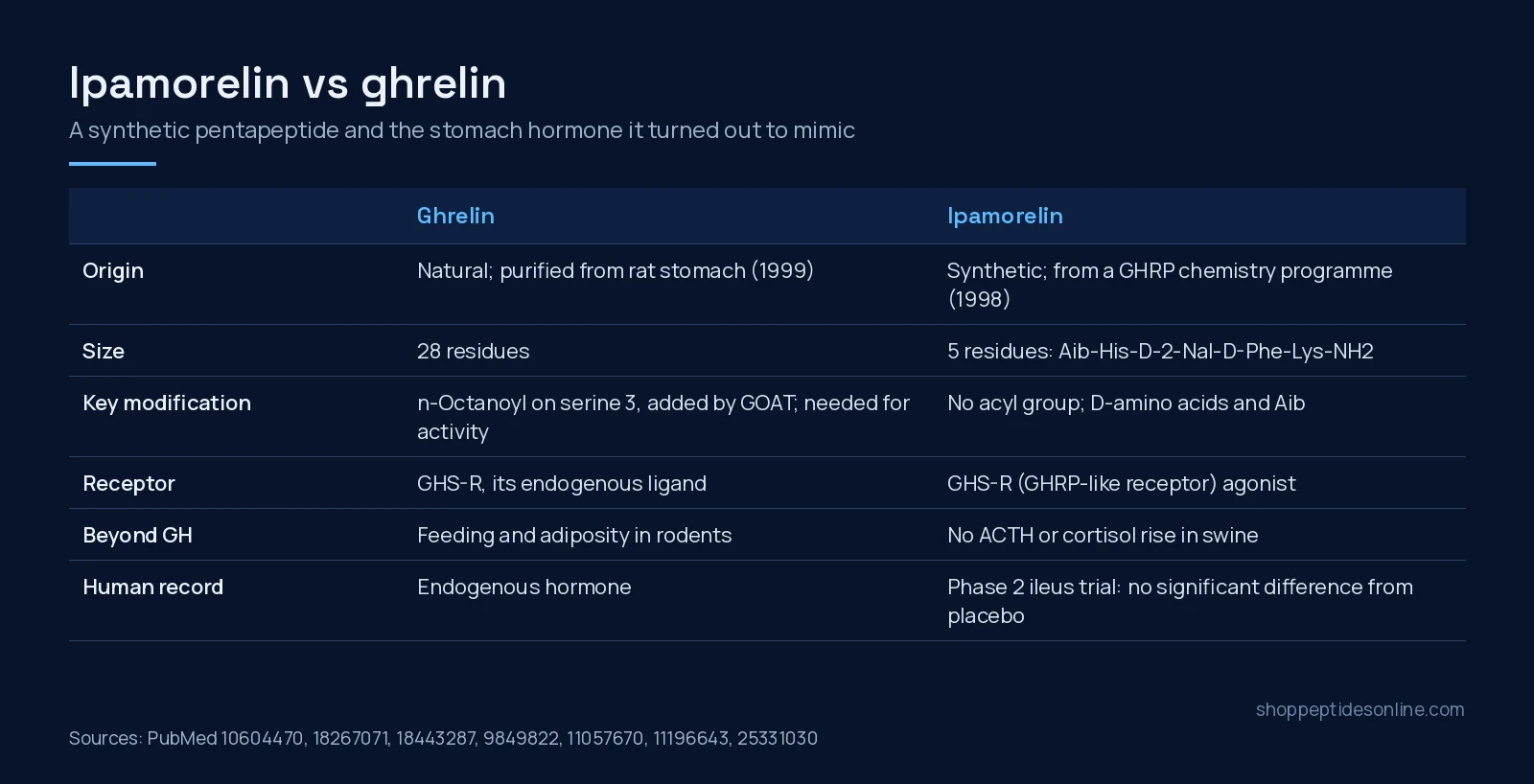
Short answer: ghrelin is the body’s own ligand for the growth hormone secretagogue receptor (GHS-R): a 28-residue stomach peptide that only works when serine 3 carries an octanoyl group[1]. Ipamorelin is a synthetic five-residue agonist of the same receptor, described in 1998, a year before ghrelin itself was identified[2][1]. Ghrelin acts on growth hormone release and on feeding and fat storage in rodents[6][7]; ipamorelin was selected because it released growth hormone without raising ACTH or cortisol in swine[2]. One is the hormone; the other is a mimic designed before anyone knew what it was mimicking.
Side by side
| Ghrelin | Ipamorelin | |
|---|---|---|
| Source | Purified from rat stomach; human ghrelin differs from rat at two positions[1] | Synthetic, from a growth hormone-releasing peptide (GHRP) chemistry programme[2] |
| Sequence | 28 residues, n-octanoylated at serine 3[1] | Aib-His-D-2-Nal-D-Phe-Lys-NH2[2] |
| What makes it active | The octanoyl group, attached by the enzyme GOAT[1][4] | Its peptide sequence; it lacks the central Ala-Trp of GHRP-1[2] |
| Receptor | Endogenous GHS-R ligand[1] | GHRP-like receptor agonist, shown with GHRP and GHRH antagonists[2] |
| Feeding and fat | Increases feeding and adiposity in rodents[6][7] | Repeated dosing increased food intake in a rat ileus model[8] |
| ACTH and cortisol | Not assessed in the papers cited here | No significant rise in swine, unlike GHRP-6 and GHRP-2[2] |
| At SPO | Not sold | Ipamorelin 10mg (research grade) |
A receptor waiting for its hormone
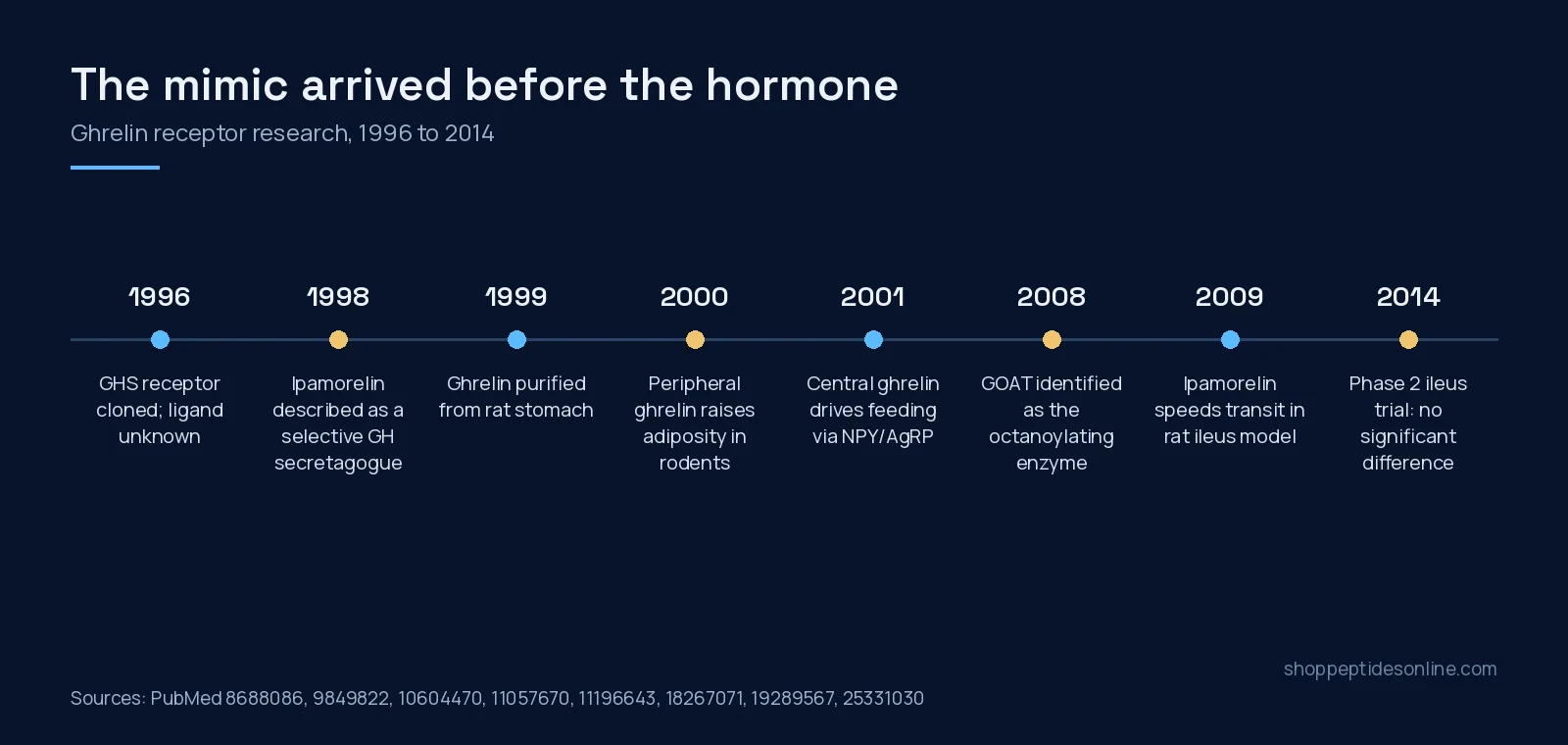
By the mid-1990s, small synthetic growth hormone secretagogues were known to act on the pituitary and hypothalamus to amplify pulsatile growth hormone release. In 1996 their target was cloned from swine and human pituitary and hypothalamus: a G protein-coupled receptor, GHS-R. Its pharmacology suggested the synthetic compounds were copying a hormone that had not yet been found[3].
Ipamorelin came out of that era. It was identified in a series of compounds lacking the central Ala-Trp dipeptide of GHRP-1. In primary rat pituitary cells it released growth hormone with potency and efficacy similar to GHRP-6, and in anaesthetised rats and conscious swine its potency was again comparable to GHRP-6. The distinguishing result was specificity: in swine, GHRP-6 and GHRP-2 raised ACTH and cortisol, while ipamorelin did not, even at doses more than 200-fold above its ED50 for growth hormone release, and none of the compounds changed FSH, LH, prolactin or TSH[2].
Ghrelin: the endogenous ligand and its fatty acid
The hormone was found in 1999 in rat stomach. It was a 28-amino-acid peptide whose serine 3 was n-octanoylated, it released growth hormone in vivo and in vitro, and the octanoyl group was essential for that activity. The name comes from “ghre”, a Proto-Indo-European root meaning to grow[1].
The enzyme behind the octanoyl group was identified in 2008 by two groups. One named it GOAT (ghrelin O-acyltransferase), a membrane-bound enzyme from a family of 16 that includes Porcupine; it was the only family member that octanoylated ghrelin in cultured endocrine cells, and its mRNA was largely restricted to stomach and intestine[4]. The other characterised human GOAT, found its transcripts mainly in stomach and pancreas, and showed that mice lacking the GOAT gene had no acylated ghrelin in circulation[5].
Ghrelin does more than release growth hormone
Feeding work followed quickly. In mice and rats, repeated peripheral ghrelin caused weight gain by reducing fat utilisation, brain-ventricle injection raised food intake and body weight in a dose-dependent way, and serum ghrelin rose with fasting and fell after refeeding or oral glucose but not water[6]. A second group found that central ghrelin stimulated feeding even in growth hormone-deficient rats, activated NPY and AgRP neurons, and lost its effect when NPY and AgRP were blocked; anti-ghrelin antibodies suppressed feeding[7].
Ipamorelin’s record outside the pituitary
Because the ghrelin receptor also affects gut motility, ipamorelin was tested in a rat model of postoperative ileus. A single dose shortened the time to first bowel movement without changing 48-hour faecal output, food intake or weight gain; repeated dosing increased all three[8].
The human follow-up was negative. In a multicentre, double-blind, placebo-controlled phase 2 study in 114 bowel-resection patients, ipamorelin showed no significant differences from placebo in the key or secondary efficacy analyses; the authors noted the study was small and enrolled patients with a broad range of conditions[9]. Ipamorelin is not an approved medicine.
Which one fits which question?
- Endogenous GHS-R signalling, acylation and GOAT: ghrelin[1][4].
- Selective GHS-R agonism without an ACTH or cortisol response: ipamorelin[2].
- Feeding circuits and NPY/AgRP neurons: ghrelin[7].
- Ghrelin-receptor effects on gut transit in rodents: ipamorelin[8].
For how ipamorelin compares with the older secretagogues, see ipamorelin vs GHRP-2 vs GHRP-6, and our ipamorelin research page covers the product. For the rest of the catalogue, see our guide to buy peptides online in Canada.
Frequently asked questions
What is the difference between ipamorelin and ghrelin?
Ghrelin is the natural 28-residue stomach hormone that activates GHS-R and needs an octanoyl group on serine 3. Ipamorelin is a synthetic five-residue agonist of the same receptor with no acyl group.
Is ipamorelin a ghrelin mimetic?
Yes. It acts at the growth hormone secretagogue receptor, the receptor ghrelin activates, and later papers describe it as a ghrelin mimetic.
Which came first, ipamorelin or ghrelin?
Ipamorelin was described in 1998. Ghrelin was identified in rat stomach in 1999, after its receptor had been cloned in 1996.
What is GOAT?
Ghrelin O-acyltransferase, the membrane enzyme that attaches octanoate to serine 3 of ghrelin. Mice without it have no acylated ghrelin in circulation.
Does Shop Peptides Online sell ghrelin?
No. SPO lists ipamorelin for laboratory research only. Ghrelin is not in the catalogue.
References
- Kojima M, Hosoda H, Date Y et al. (1999). Ghrelin is a growth-hormone-releasing acylated peptide from stomach. Nature. PMID: 10604470. doi: 10.1038/45230.
- Raun K, Hansen BS, Johansen NL et al. (1998). Ipamorelin, the first selective growth hormone secretagogue. Eur J Endocrinol. PMID: 9849822. doi: 10.1530/eje.0.1390552.
- Howard AD, Feighner SD, Cully DF et al. (1996). A receptor in pituitary and hypothalamus that functions in growth hormone release. Science. PMID: 8688086. doi: 10.1126/science.273.5277.974.
- Yang J, Brown MS, Liang G et al. (2008). Identification of the acyltransferase that octanoylates ghrelin, an appetite-stimulating peptide hormone. Cell. PMID: 18267071. doi: 10.1016/j.cell.2008.01.017.
- Gutierrez JA, Solenberg PJ, Perkins DR et al. (2008). Ghrelin octanoylation mediated by an orphan lipid transferase. Proc Natl Acad Sci U S A. PMID: 18443287. doi: 10.1073/pnas.0800708105.
- Tschöp M, Smiley DL, Heiman ML (2000). Ghrelin induces adiposity in rodents. Nature. PMID: 11057670. doi: 10.1038/35038090.
- Nakazato M, Murakami N, Date Y et al. (2001). A role for ghrelin in the central regulation of feeding. Nature. PMID: 11196643. doi: 10.1038/35051587.
- Venkova K, Mann W, Nelson R et al. (2009). Efficacy of ipamorelin, a novel ghrelin mimetic, in a rodent model of postoperative ileus. J Pharmacol Exp Ther. PMID: 19289567. doi: 10.1124/jpet.108.149211.
- Beck DE, Sweeney WB, McCarter MD et al. (2014). Prospective, randomized, controlled, proof-of-concept study of the Ghrelin mimetic ipamorelin for the management of postoperative ileus in bowel resection patients. Int J Colorectal Dis. PMID: 25331030. doi: 10.1007/s00384-014-2030-8.