
In stock
Klow (Pen)
$171.99
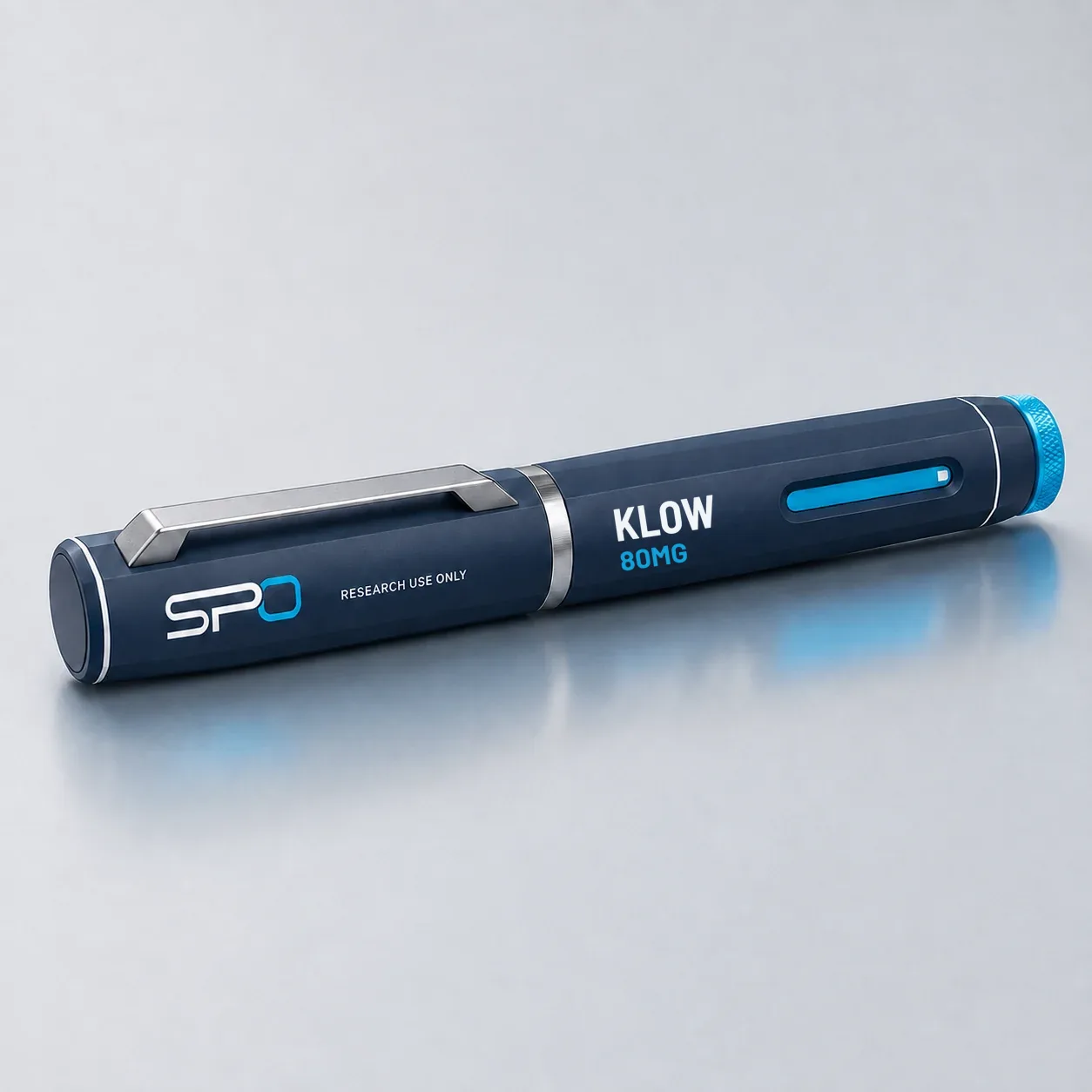
KLOW research peptide blend in pen format (80mg fill), supplied for laboratory research only. KLOW is a multi-component research blend (GHK-Cu, BPC-157, TB-500 and KPV); the component list is stated on the batch documentation. No batch COA is posted for the pen — see the COA library. Priced in CAD and shipped within Canada by Canada Post. Not for human or animal use.

Estimated delivery: 1–3 business days

Free shipping: On orders over $300
Guarantee Safe Checkout:

Description
KLOW research pen — Canada
This listing is KLOW in pen format (80mg fill) — the same research material as our KLOW vials, supplied in a pre-formatted research pen for laboratories that prefer logged, repeatable handling over loose vials. KLOW is GLOW plus one: the copper tripeptide GHK-Cu, the gastric pentadecapeptide BPC-157, TB-500 — here the 889 Da thymosin β4 fragment, not the whole protein — and KPV, the anti-inflammatory tail of α-MSH studied mostly in mouse gut models[1, 2]. No study has looked at the four together. Laboratory research only; the pen is a handling format, not an instruction.
Full research overview, study table & references → KLOW in Canada: research guide (component guides: GLOW / GHK-Cu · BPC-157 · TB-500)
Identity at a glance
| Component | Identity | In the vial batch report |
|---|---|---|
| GHK-Cu | Gly-His-Lys · Cu(II); C14H23CuN6O4+; 402.92 g/mol; CID 71587328 | 40.45 mg (35.88 mg GHK + 4.57 mg Cu) |
| BPC-157 | GEPPPGKPADDAGLV; C62H98N16O22; 1419.5 g/mol; CID 9941957 | 10.73 mg |
| TB-500 (889 Da) | Ac-LKKTETQ, thymosin β4 residues 17–23; C38H68N10O14; 889.0 g/mol; CAS 885340-08-9; CID 62707662 | 10.49 mg |
| KPV | Lys-Pro-Val (α-MSH 11–13); C16H30N4O4; 342.43 g/mol; CAS 67727-97-3; CID 125672 | 11.08 mg |
| Format | Pre-formatted research pen; declared content (80mg) on the label, no measured value on file |
Batch documentation: a batch-specific COA for the KLOW pen has not been posted yet — see the COA library. Reports for the vial listings, where posted, are on those pages.
What researchers have looked at
- KPV, mouse colitis (2008): in drinking water it lowered the incidence of DSS and TNBS colitis and cut cytokine expression, entering cells via the PepT1 transporter[1]; in a second lab, treated mice recovered weight faster with fewer infiltrates and lower myeloperoxidase, even without a working melanocortin-1 receptor[2].
- KPV, microbes in vitro (2000): α-MSH and KPV inhibited S. aureus colony formation and C. albicans germ-tube formation, tracking a rise in cAMP[3].
- GHK-Cu, rat wound chambers (1993): concentration-dependent increases in collagen, glycosaminoglycans, DNA and dry weight[4]. BPC-157, rat Achilles (2003): higher failure load after transection than saline[5]. Thymosin β4 motif (2003): the LKKTETQ heptapeptide alone reproduced the parent peptide’s endothelial migration and sprouting activity[6].
- Limits: the one study pairing BPC-157 with TB-500 (32 rats, 2026) found no added effect from the combination[7]; a 2025 systematic review of BPC-157 reports no clinical safety data[8]; nothing tests the four-way blend, and no human study supports any use of KLOW.
Storage and handling
- Follow the label: keep the pen cool, dry and out of light, and do not subject it to repeated freeze–thaw.
- Log the batch number and dates of receipt and first use, as with any research material. No protocol or administration information is provided here.
Vial strength: KLOW 80 MG. Other pens are on the peptide pens page; the whole range is on our buy peptides online in Canada page. Canada Post from inside Canada (shipping policy).
Frequently asked questions
What is the KLOW pen?
The same synthetic KLOW supplied in a pre-formatted research pen rather than a loose vial, for laboratories that want repeatable, logged handling. It is a research format only; no administration guidance of any kind is given.
Is there a batch report for the KLOW pen?
Not yet. No batch-specific report for the pen is posted in the COA library. The page will state the report when one exists.
What is KPV and why is it in KLOW?
KPV is Lys-Pro-Val, residues 11–13 of α-melanocyte-stimulating hormone. It is the fourth component that distinguishes KLOW from GLOW. Its published research is mainly mouse colitis models, where oral KPV reduced inflammation and was taken into cells by the PepT1 transporter (PMIDs 18061177, 18092346); no human trial of KPV was found.
Is the KLOW pen for human use?
No. The pen is supplied for laboratory research only and is not for human or animal use. No dosing, administration or protocol information is provided.
Cited
- Dalmasso et al. (2008), Gastroenterology — PMID 18061177
- Kannengiesser et al. (2008), Inflammatory bowel diseases — PMID 18092346
- Cutuli et al. (2000), Journal of leukocyte biology — PMID 10670585
- Maquart et al. (1993), The Journal of clinical investigation — PMID 8227353
- Staresinic et al. (2003), Journal of orthopaedic research : official publication of the Orthopaedic Research Society — PMID 14554208
- Philp et al. (2003), FASEB journal : official publication of the Federation of American Societies for Experimental Biology — PMID 14500546
- Biçer et al. (2026), Joint diseases and related surgery — PMID 42542926
- Vasireddi et al. (2025), HSS journal : the musculoskeletal journal of Hospital for Special Surgery — PMID 40756949
For laboratory research use only. Not for human or animal consumption. No dosing, administration or protocol information is provided, and nothing here is a claim of efficacy or safety in humans.
Additional information
| Amount | 80mg |
|---|
Related products
-
AHK-Cu (Pen)
Price range: $99.99 through $139.99 -
Glutathione (Pen)
$154.99 -
Glow (Pen)
$210.99