For laboratory research only. Not for human or animal use. This article gives no dosing, administration or therapeutic advice.
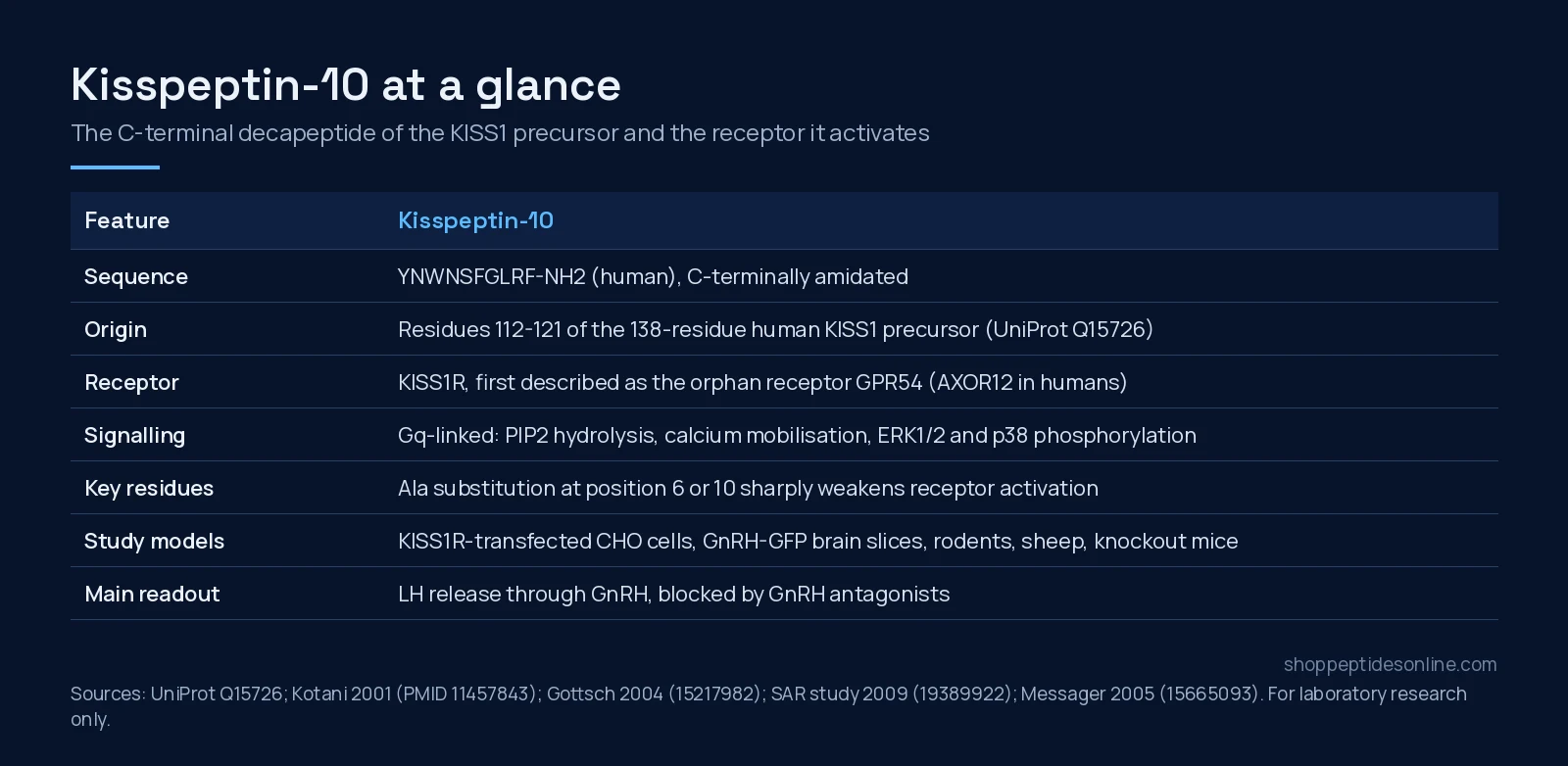
Short answer: Kisspeptin-10 is the last ten residues of the human KISS1 precursor, YNWNSFGLRF-NH2, the biologically active C-terminal decapeptide that activates the kisspeptin receptor, KISS1R (first called GPR54)[8]. The KISS1 gene was found in 1996 as a melanoma metastasis suppressor[1]; in 2001 three groups showed its peptide products are the natural ligands of GPR54[2][3][4]. Two years later, loss-of-function GPR54 mutations were linked to absent puberty[6][7], and kisspeptin became one of the most studied signals upstream of GnRH. This guide covers the structure, the receptor and the study models researchers use. If you are sourcing kisspeptin in Canada for laboratory work, it also explains what to check on the vial.
From metastasis gene to a family of peptides
KiSS-1 was cloned from human melanoma cells as a gene whose expression suppressed metastasis[1]. Its product is a 138-residue precursor (UniProt Q15726) with a 19-residue signal peptide. Processing gives a 54-residue peptide, named metastin by one group[3], and shorter C-terminal fragments: kisspeptin-14, kisspeptin-13 and kisspeptin-10. Kotani and colleagues isolated the 54-, 14- and 13-residue forms from human placenta and named the family kisspeptins[2]. All share the same C-terminus: an amidated Arg-Phe, which places them in the RF-amide peptide family.
| Peptide | Precursor residues (Q15726) | Length |
|---|---|---|
| Kisspeptin-54 (metastin) | 68-121 | 54 |
| Kisspeptin-14 | 108-121 | 14 |
| Kisspeptin-13 | 109-121 | 13 |
| Kisspeptin-10 | 112-121 | 10 |
For the trade-offs between the shortest and longest forms, see kisspeptin-10 vs kisspeptin-54.
The structure of kisspeptin-10
Human kisspeptin-10 is Tyr-Asn-Trp-Asn-Ser-Phe-Gly-Leu-Arg-Phe-NH2. PubChem (CID 25240297) lists the formula C63H83N17O14 and a molecular weight of 1302.4 g/mol. Natural kisspeptins carry a C-terminal amide[2], so a free-acid version is a different compound.
A 2009 structure-activity study tested alanine-substituted analogues in KISS1R-transfected CHO cells, in rats and by NMR[5]. Alanine at position 6 or 10 raised the EC50 by more than two orders of magnitude. In vivo, Ala6 weakened the LH response and Ala10 abolished it. NMR modelling showed a helix-like turn from Asn4 to the C-terminal residue; Ala10 broke that structure entirely[5]. In the rat peptide used in that work, the tenth residue is tyrosine rather than the phenylalanine of the human sequence, a species difference worth noting when choosing a peptide for rodent work.
KISS1R: the receptor
KISS1R is a class A G protein-coupled receptor. When it was an orphan, rat GPR54 and human AXOR12 were cloned separately; AXOR12 shares 81% homology with rat GPR54[4]. In CHO cells expressing the receptor, kisspeptins bound with low-nanomolar affinity and triggered PIP2 hydrolysis, calcium mobilisation, arachidonic acid release, ERK1/2 and p38 MAP kinase phosphorylation, and stress-fibre formation[2]. That signalling profile fits Gq/11 coupling, which is why calcium imaging is a standard first assay.
How kisspeptin-10 acts on the reproductive axis
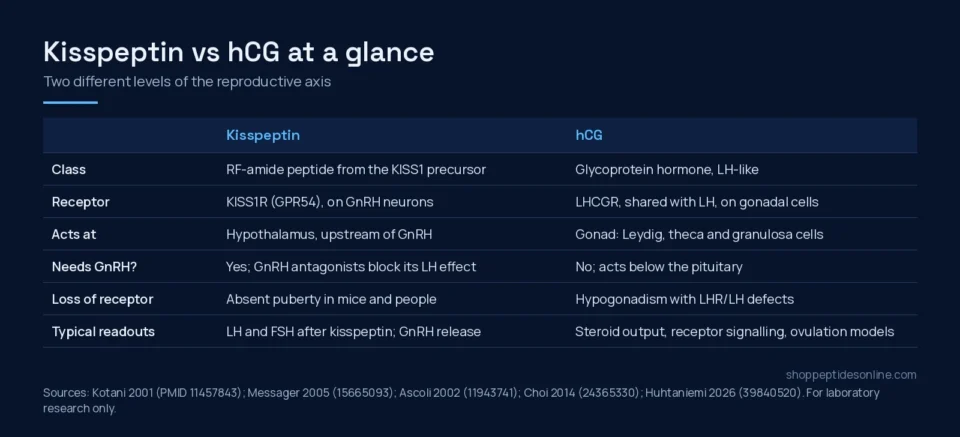
The main route runs through GnRH neurons. Gottsch and colleagues gave kisspeptin-54 and kisspeptin-10 into the mouse lateral ventricle and saw LH secretion rise; a GnRH antagonist blocked it[8]. The same paper mapped Kiss1 mRNA to the anteroventral periventricular, periventricular and arcuate nuclei. Messager and colleagues found GPR54 transcripts in mouse GnRH neurons. In sheep, central kisspeptin released GnRH into the cerebrospinal fluid alongside a rise in LH[10]. Kisspeptin given to Gpr54-null mice had no effect on LH or FSH, which shows the receptor is required[10]. For how the two peptides divide the work, see kisspeptin vs GnRH.
In mouse brain slices, kisspeptin depolarised more than 90% of adult GnRH-GFP neurons, but only 27% of juvenile and 44% of prepubertal ones[11]. That recruitment across development is one reason kisspeptin is studied as a puberty signal. A direct pituitary action exists too: about 10% of dispersed rat pituitary cells responded with a calcium rise, including gonadotrophs and somatotrophs. The LH and GH responses were smaller than those to GnRH and GHRH[12].
Study models and readouts
- Receptor-expressing cell lines: CHO cells transfected with human or rat KISS1R, read by calcium mobilisation, IP turnover and MAP kinase phosphorylation[2][5].
- Brain-slice electrophysiology: GnRH-GFP mice for direct neuronal responses across ages[11].
- Rodent LH assays: central or peripheral kisspeptin with LH and FSH measured, with GnRH-antagonist controls[8][9].
- Pulse-generator recordings: in female rats, intravenous kisspeptin-10 raised LH, but did not change the frequency of the electrical activity linked to the GnRH pulse generator[13].
- Large-animal models: sheep, where GnRH can be sampled from cerebrospinal fluid or portal blood[10].
- Knockout and antagonist tools: Kiss1 and Gpr54 knockout mice[14][15]. The antagonist peptide 234 blocked kisspeptin-induced LH release in rats and mice and the post-castration LH rise in sheep, rats and mice[16].
The arcuate kisspeptin cells that co-express neurokinin B and dynorphin (KNDy neurons) are now a main focus. They are conserved from rodents to humans, respond to sex steroids and project to GnRH cell bodies and terminals[17].
What to check on a kisspeptin-10 vial
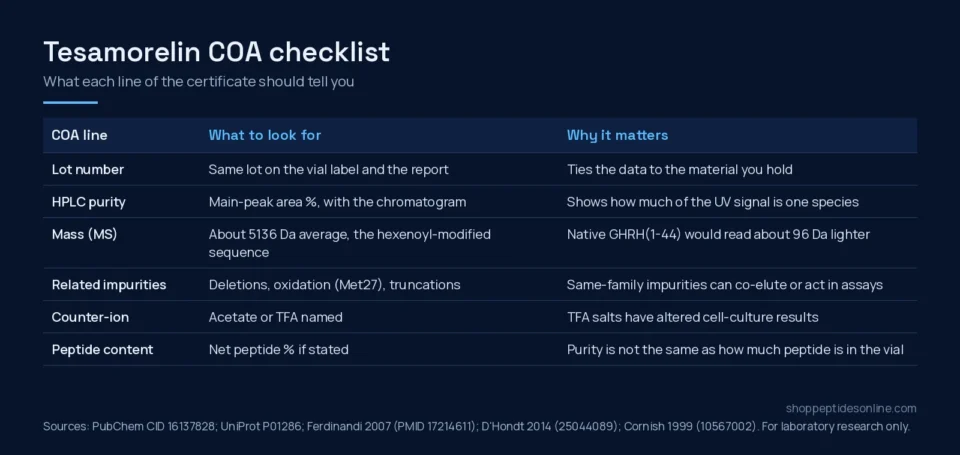
For any research lot, confirm three things on the certificate of analysis. Check that the mass matches about 1302 Da for the amidated human sequence. Check that the HPLC purity is stated for that lot. Check that the label names the sequence, so you know it is not kisspeptin-54 or a rodent variant. Our guide to HPLC purity vs mass spectrometry identity explains how to read both. Our kisspeptin research page collects the product and study notes, and you can see the rest of the catalogue in our guide to buy peptides online in Canada.
Frequently asked questions
What is kisspeptin-10?
Kisspeptin-10 is the C-terminal decapeptide of the human KISS1 precursor, YNWNSFGLRF-NH2 (residues 112-121 of UniProt Q15726). It carries the biological activity of the kisspeptin family at the KISS1R receptor.
Which receptor does kisspeptin-10 bind?
It binds KISS1R, a G protein-coupled receptor first described as the orphan GPR54 (AXOR12 in humans). Receptor activation drives PIP2 hydrolysis, calcium mobilisation and MAP kinase phosphorylation in transfected cells.
Which residues matter most for kisspeptin-10 activity?
In a 2009 structure-activity study, alanine at position 6 or 10 sharply reduced receptor activation, and alanine at position 10 abolished the LH response in rats.
Does kisspeptin-10 act directly on the pituitary?
Mainly it acts on GnRH neurons, and GnRH antagonists block its LH effect. A small direct pituitary response has been recorded in rat gonadotrophs and somatotrophs, weaker than the response to GnRH.
Is kisspeptin-10 for human use?
No. Shop Peptides Online supplies kisspeptin-10 in Canada for laboratory research only. It is not for human or animal use, and this article gives no dosing or administration advice.
References
- Lee JH, Miele ME, Hicks DJ et al. (1996). KiSS-1, a novel human malignant melanoma metastasis-suppressor gene. J Natl Cancer Inst. PMID: 8944003. doi: 10.1093/jnci/88.23.1731.
- Kotani M, Detheux M, Vandenbogaerde A et al. (2001). The metastasis suppressor gene KiSS-1 encodes kisspeptins, the natural ligands of the orphan G protein-coupled receptor GPR54. J Biol Chem. PMID: 11457843. doi: 10.1074/jbc.M104847200.
- Ohtaki T, Shintani Y, Honda S et al. (2001). Metastasis suppressor gene KiSS-1 encodes peptide ligand of a G-protein-coupled receptor. Nature. PMID: 11385580. doi: 10.1038/35079135.
- Muir AI, Chamberlain L, Elshourbagy NA et al. (2001). AXOR12, a novel human G protein-coupled receptor, activated by the peptide KiSS-1. J Biol Chem. PMID: 11387329. doi: 10.1074/jbc.M102743200.
- Gutiérrez-Pascual E, Leprince J, Martínez-Fuentes AJ et al. (2009). In vivo and in vitro structure-activity relationships and structural conformation of Kisspeptin-10-related peptides. Mol Pharmacol. PMID: 19389922. doi: 10.1124/mol.108.053751.
- de Roux N, Genin E, Carel JC et al. (2003). Hypogonadotropic hypogonadism due to loss of function of the KiSS1-derived peptide receptor GPR54. Proc Natl Acad Sci U S A. PMID: 12944565. doi: 10.1073/pnas.1834399100.
- Seminara SB, Messager S, Chatzidaki EE et al. (2003). The GPR54 gene as a regulator of puberty. N Engl J Med. PMID: 14573733. doi: 10.1056/NEJMoa035322.
- Gottsch ML, Cunningham MJ, Smith JT et al. (2004). A role for kisspeptins in the regulation of gonadotropin secretion in the mouse. Endocrinology. PMID: 15217982. doi: 10.1210/en.2004-0431.
- Navarro VM, Castellano JM, Fernández-Fernández R et al. (2005). Characterization of the potent luteinizing hormone-releasing activity of KiSS-1 peptide, the natural ligand of GPR54. Endocrinology. PMID: 15375028. doi: 10.1210/en.2004-0836.
- Messager S, Chatzidaki EE, Ma D et al. (2005). Kisspeptin directly stimulates gonadotropin-releasing hormone release via G protein-coupled receptor 54. Proc Natl Acad Sci U S A. PMID: 15665093. doi: 10.1073/pnas.0409330102.
- Han SK, Gottsch ML, Lee KJ et al. (2005). Activation of gonadotropin-releasing hormone neurons by kisspeptin as a neuroendocrine switch for the onset of puberty. J Neurosci. PMID: 16339030. doi: 10.1523/JNEUROSCI.3328-05.2005.
- Gutiérrez-Pascual E, Martínez-Fuentes AJ, Pinilla L et al. (2007). Direct pituitary effects of kisspeptin: activation of gonadotrophs and somatotrophs and stimulation of luteinising hormone and growth hormone secretion. J Neuroendocrinol. PMID: 17532794. doi: 10.1111/j.1365-2826.2007.01558.x.
- Kinsey-Jones JS, Li XF, Luckman SM et al. (2008). Effects of kisspeptin-10 on the electrophysiological manifestation of gonadotropin-releasing hormone pulse generator activity in the female rat. Endocrinology. PMID: 18063679. doi: 10.1210/en.2007-1505.
- d’Anglemont de Tassigny X, Fagg LA, Dixon JP et al. (2007). Hypogonadotropic hypogonadism in mice lacking a functional Kiss1 gene. Proc Natl Acad Sci U S A. PMID: 17563351. doi: 10.1073/pnas.0704114104.
- Lapatto R, Pallais JC, Zhang D et al. (2007). Kiss1-/- mice exhibit more variable hypogonadism than Gpr54-/- mice. Endocrinology. PMID: 17595229. doi: 10.1210/en.2007-0078.
- Roseweir AK, Kauffman AS, Smith JT et al. (2009). Discovery of potent kisspeptin antagonists delineate physiological mechanisms of gonadotropin regulation. J Neurosci. PMID: 19321788. doi: 10.1523/JNEUROSCI.5740-08.2009.
- Lehman MN, Coolen LM, Goodman RL (2010). Minireview: kisspeptin/neurokinin B/dynorphin (KNDy) cells of the arcuate nucleus: a central node in the control of gonadotropin-releasing hormone secretion. Endocrinology. PMID: 20501670. doi: 10.1210/en.2010-0022.