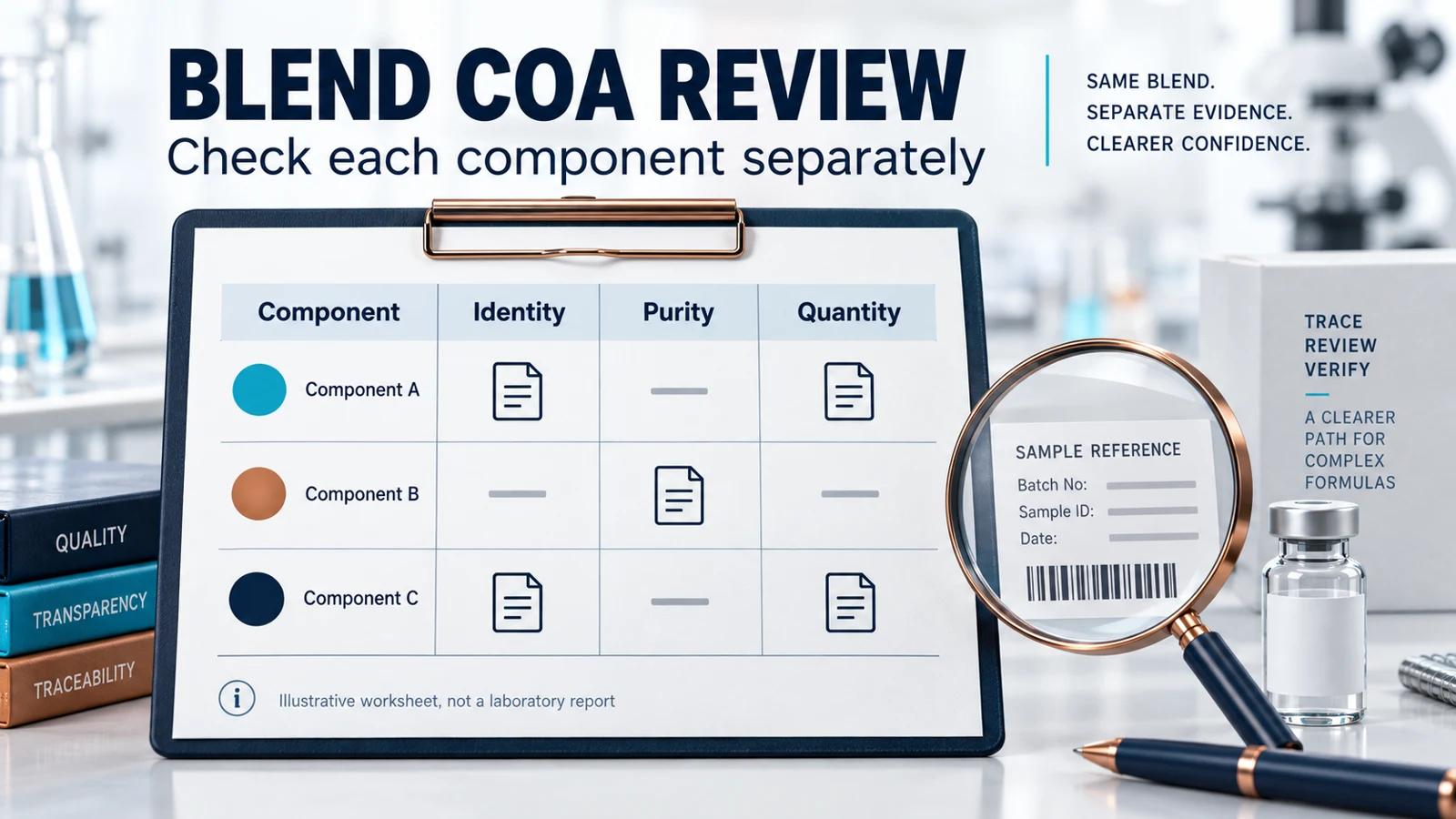
A research peptide blend contains more than one named component. A useful documentation review therefore asks what the report says about each component, not just whether the page displays a high purity number.
For laboratory research only. Not for human or animal use. This guide contains no dosing, mixing, administration or therapeutic advice.
Begin with the exact blend, not the marketing name
Write down the full component names, the listed amounts, the total labeled amount and the sample or batch identifier. Keep chemical variants separate where the listing distinguishes them. For example, a laboratory service naming a CJC DAC blend and a CJC No DAC blend is not using those labels interchangeably: Janoshik lists these as separate analysis services.
Use the Shop Peptides Online research catalog to identify the offered material, then check the COA library for the corresponding documentation. If a listing and report disagree, treat that as an open question rather than choosing whichever description is more convenient.
Look for component-specific results
Read the result table and laboratory interpretation. Which components were identified? Are results reported separately for each named component, or only as a combined result? If quantity is measured, what units and calculation basis does the report use?
A report that mentions one component does not automatically document all the others. Likewise, a single total labeled amount does not tell you the amount of each component. Record only what the document actually establishes.
Separate identity, purity and measured quantity
These are different questions. Identity asks what evidence supports the assigned compounds. Purity describes a result under the stated analytical method. Measured quantity or content, when reported, addresses amount on its own stated basis.
Bachem’s analytical FAQ distinguishes HPLC purity from peptide content. Its UV-based HPLC example relates purity to the material detected at the stated wavelength; gross sample weight can also include counterions and water. For that reason, do not infer a blend’s verified component amounts from a purity percentage alone.
For the distinction between analytical methods, see our guide to HPLC purity and mass-spectrometry identity.
Check whether the method addresses the mixture
Chromatography separates components under defined conditions. Mass spectrometry can add mass-related evidence about assigned peaks. Waters’ peptide-analysis example explains that optical liquid chromatography can have limitations when impurities are unresolved, and shows how accurate mass and fragmentation data add information.
For a blend, ask whether the laboratory’s method and interpretation distinguish the named components and any relevant additional peaks. Do not assume two similar-looking peaks are two particular peptides without the report’s assignment. Do not assume an “LC-MS” label means every component was quantified or its full sequence confirmed.
Use the report verification route
Where the laboratory supplies a report number or verification link, use that route to compare the original result with the copy provided. Check the sample description, date and identifiers as well as the result. Janoshik operates a public test directory, but a public listing is not an endorsement: its directory explicitly states that it does not endorse, sponsor or affiliate with the listed companies or products.
Verification helps establish that the report exists and what it says. It does not, on its own, establish that a different vial or later batch is the same tested sample.
A blend-documentation worksheet
- Listing: exact blend name, component names, format and labeled amounts.
- Traceability: batch or sample identifier, test date and report reference.
- Identity: the components the laboratory actually identifies.
- Purity: reported value, detector and analytical basis.
- Quantity: any separately measured component results and their units.
- Gaps: omitted components, unclear methods or conflicting identifiers.
Ask the supplier or testing laboratory to explain a missing field before treating it as confirmed. Keep the original report with the procurement record so later comparisons use the same evidence.
Why a blend needs a different review from a single compound
A single-compound review begins with one intended identity. A blend review starts with a list of intended components and asks whether the evidence addresses that list. More ingredients create more opportunities for a naming mismatch, an omitted result or a total amount that is mistaken for a component amount.
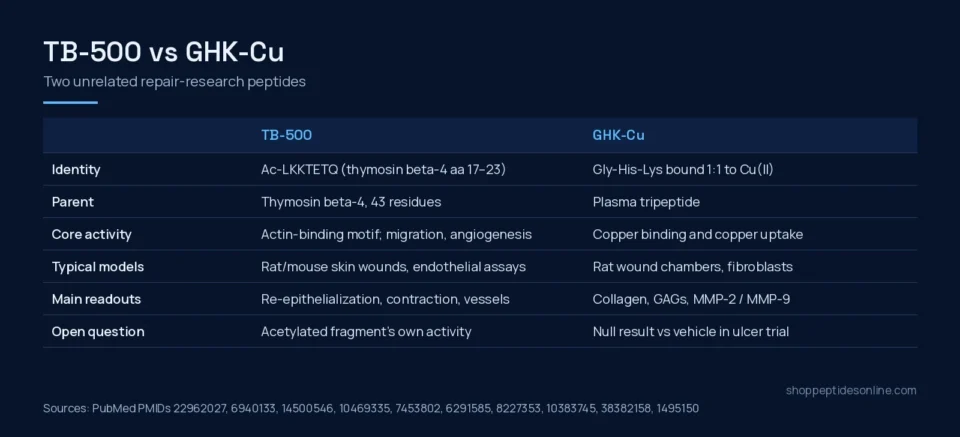
The BPC-157 research page and TB-500 research page distinguish individual materials from related blends. Those individual destinations are useful background, but their names alone do not establish the composition or measured amounts in a finished mixture.
A worked review of a two-component listing
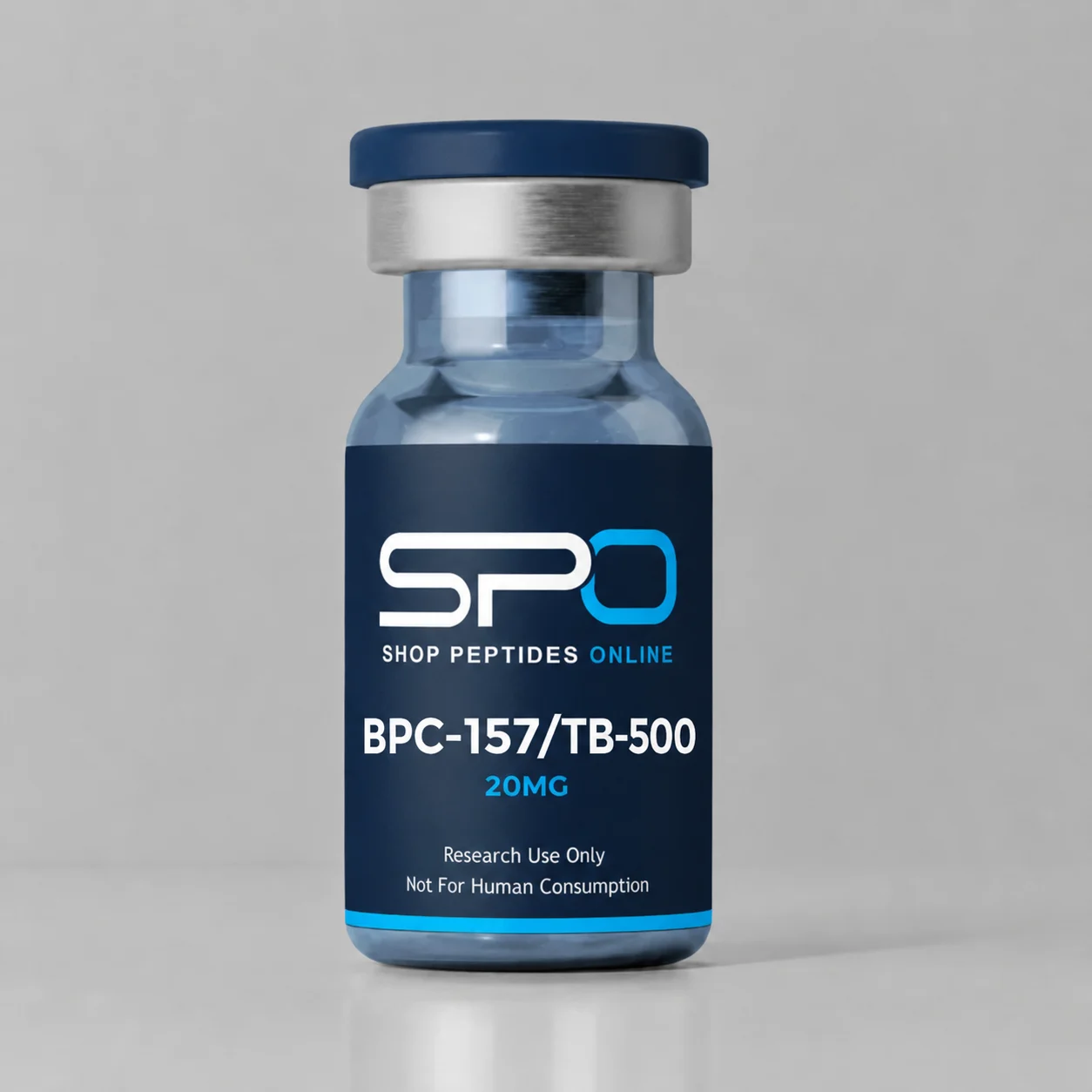
Take the current BPC-157/TB-500 20MG vial listing as an example of a catalog item to review. The product name and labeled total amount identify the offered listing. They do not, by themselves, establish a separately measured amount of each component.
Build your review in this order: copy the exact listing name, locate the relevant report in the COA library, compare identifiers and then inspect the component-specific results. If the report describes a different total or sample name, stop the comparison at that mismatch until it is explained.
Step 1: list the expected identities
Record BPC-157 and TB-500 as separate expected components because the listing names both. Do not collapse them into a single “blend identity” field that makes an omitted component hard to notice. Where a report uses a variant name or abbreviation, ask for the exact correspondence rather than guessing.
Step 2: copy the observed evidence
For each expected component, record whether the report supplies an identity assignment, a quantity result or another observation. Preserve the units. A blank field should say “not reported in this document,” not zero and not “failed.” Absence of a measurement is different from a measurement with an unfavorable result.
Step 3: separate the total from the component amounts
A combined label amount cannot answer a question about the distribution between components. If component quantities are needed for the laboratory’s procurement decision, look for separately reported values and their basis. Do not assume an equal split simply because the label contains two names.
Step 4: keep the conclusion inside the evidence
If the report supports both identity assignments but does not measure component amounts, record exactly that. If it measures amounts but lacks a clear current-batch match, keep traceability open. The conclusion should be a record of what you checked, not a broad endorsement of a supplier or a claim about suitability for people.
Comparing blend names without inventing equivalence
Products with similar marketing names can have different component lists. The KLOW research hub describes its listed blend and compares it with related catalog materials. A GLOW 70MG listing should still be reviewed on its own documents. Do not transfer a KLOW result to GLOW because the names resemble one another.
The same rule applies to individual ingredients. A report for GHK-Cu may document a submitted GHK-Cu sample. Without evidence for the finished blend and the relevant batch, it does not answer every question about a mixture that includes that name.
Janoshik’s separate CJC DAC and CJC No DAC/MOD GRF service names illustrate why full compound naming matters. The laboratory service catalog is evidence of those service distinctions. It is not proof that any particular Shop Peptides Online blend underwent those tests.
What chromatograms can show, and what a reader should not guess
A chromatogram plots detector response across the separation. The laboratory may assign peaks to components and describe other peaks or method limits. For a mixture, read those assignments together with the result table. Do not supply your own identity from peak position alone.
Waters’ analytical example explains the limitations of optical liquid chromatography when impurities are unresolved and shows how mass-related evidence and fragmentation can add information. That supports asking what information the method supplied. It does not justify declaring a report complete merely because the heading contains “LC-MS.”
Our HPLC purity versus mass-spectrometry guide explains the distinction. Use it before comparing purity and amount fields that may not share the same analytical basis.
Common documentation mismatches
- Listing and report use different names: ask whether they describe the same material and chemical variants.
- Total strength differs: do not assume a report for one strength documents another.
- Only one component has a result: record the others as unresolved in that document.
- Report has no batch match: verify the link to the offered material before using it as current-batch evidence.
- Different reports use different units: retain the original units and ask for the calculation basis before comparing.
- A verification page exists: compare its actual fields; a live page alone is not proof of every claim in a supplier summary.
Keep a blend review useful to the next reader
Save the original report and your component worksheet together. Include the listing URL, review date and unresolved questions. For each conclusion, make it clear whether it came from the listing, a laboratory result or a supplier clarification. That helps prevent a catalog label from becoming an analytical fact through repeated copying.
When comparing more than one material, the research material and batch comparison guide offers a wider procurement structure. Our online research procurement guide covers identity, format and shipping questions before an order.
Keep supplies and ancillaries separate from analytical evidence for the blend itself. If a missing field affects the choice, use the store contact page for listing clarification or the issuing laboratory for test interpretation. More documentation articles are available in Peptide Basics.
Common questions
Is a report for one ingredient enough for the finished blend?
It supports only the sample and tests it describes. Do not treat a single-ingredient report as a complete analysis of a multi-component blend.
Does one purity percentage establish the blend ratio?
Not by itself. Look for component-specific quantity results and the method behind them.
Do blend COAs provide administration guidance?
No. These materials are supplied for laboratory research only. This documentation review does not establish suitability for human or animal use.