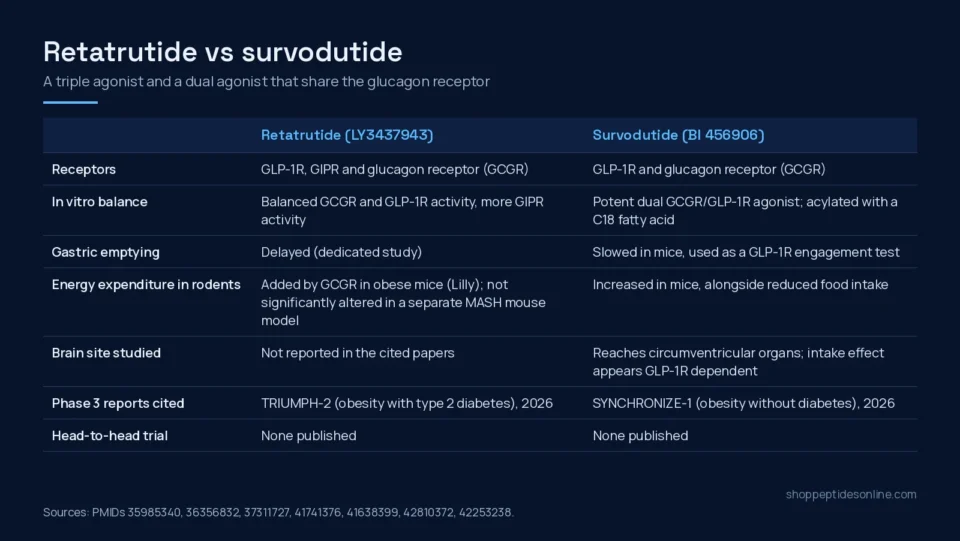
Semaglutide, tirzepatide and retatrutide are often lined up as “generations” of the same idea. The useful comparison for a laboratory isn’t which one is stronger. It’s how many receptors each one activates, how evenly, and how each was engineered to last. This article covers receptor pharmacology, structure and regulatory status only. It makes no claims about outcomes in people.
For laboratory research only. Not for human or animal use. This article gives no dosing, administration or therapeutic advice.
The short answer
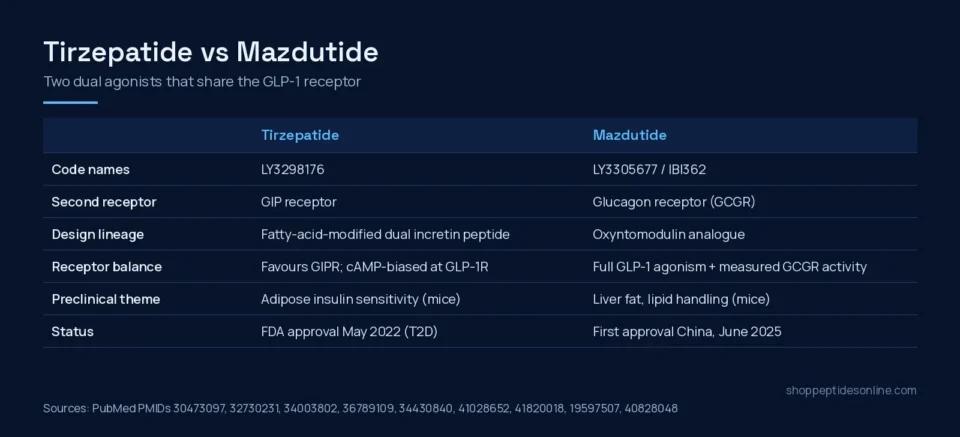
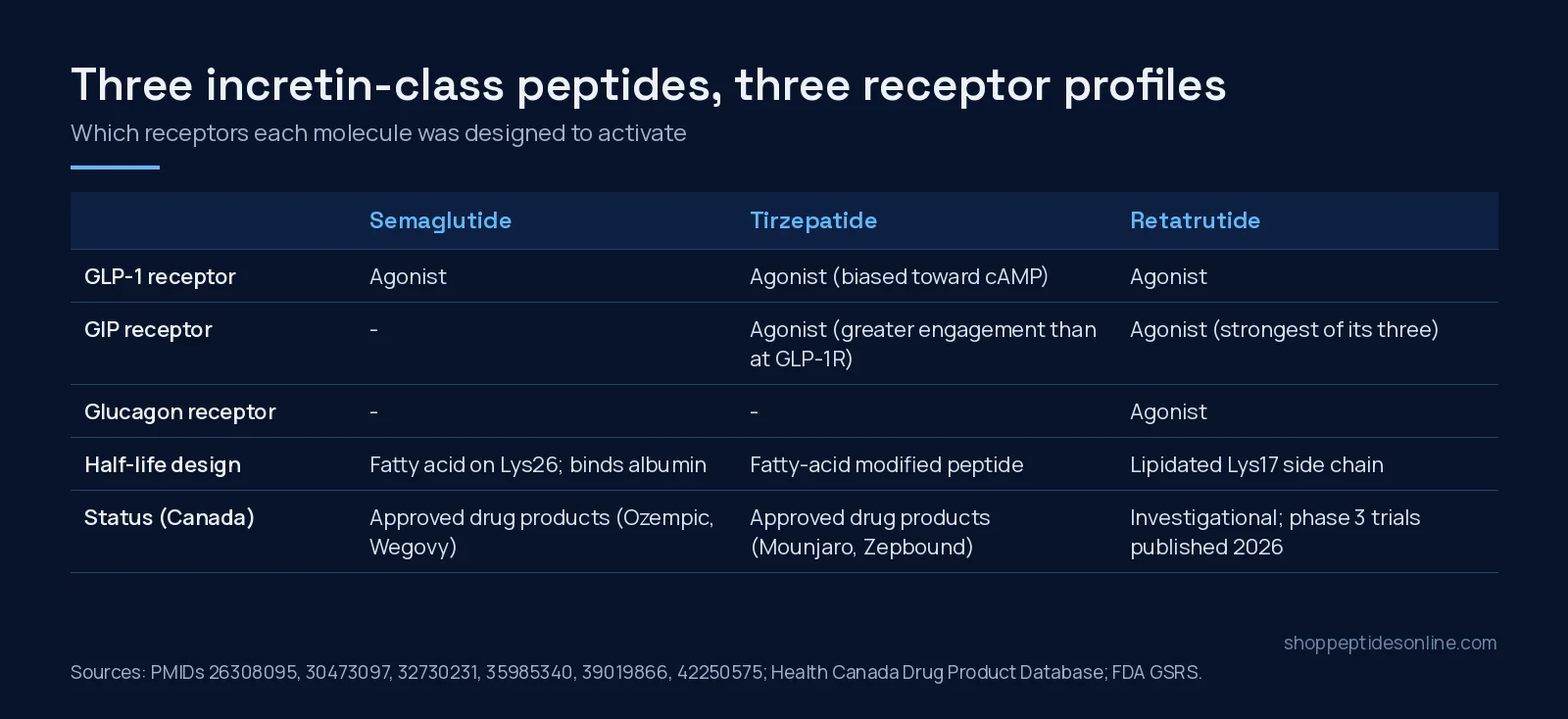
Each molecule adds one receptor to the last. Semaglutide is a GLP-1 receptor agonist, built from human GLP-1 with two amino-acid substitutions and a fatty-acid side chain that binds albumin[1]. Tirzepatide is a single peptide that activates both the GIP and GLP-1 receptors[2], and it engages the GIP receptor more than the GLP-1 receptor[3]. Retatrutide adds the glucagon receptor, with balanced glucagon and GLP-1 receptor activity and more GIP receptor activity[4]. Semaglutide and tirzepatide are ingredients of approved prescription drugs in Canada. Retatrutide is still investigational[5, 6].
Receptor profile side by side
| Semaglutide | Tirzepatide | Retatrutide | |
|---|---|---|---|
| Development code | Novo Nordisk compound | LY3298176 (Eli Lilly)[2] | LY3437943 (Eli Lilly)[4] |
| GLP-1 receptor | Agonist; affinity 0.38 nM, three-fold lower than liraglutide[1] | Agonist, biased toward cAMP over β-arrestin recruitment[3] | Agonist[4] |
| GIP receptor | None | Agonist, mimicking native GIP; the more engaged of its two receptors[3] | Agonist, its most active receptor in vitro[4] |
| Glucagon receptor | None | None | Agonist[4] |
| Half-life engineering | Aib8 and Arg34 substitutions; derivatized at Lys26 for albumin binding[1] | Fatty-acid modified peptide designed for once-weekly administration in trials[2] | Pharmacokinetics in phase 1 supported once-weekly administration[4] |
| Formula / MW | C187H291N45O59 · 4114 (PubChem 56843331) | C225H348N48O68 · 4813 (PubChem 166567236) | C221H342N46O68 · 4731 (PubChem 171390338) |
Note that “GLP-3”, the name some catalogues use for retatrutide, is not a hormone. It’s shorthand for three receptors. The molecule is a single 39-residue lipidated peptide (per the FDA Global Substance Registration System), not a mixture.
How each one was engineered
Semaglutide: making GLP-1 last
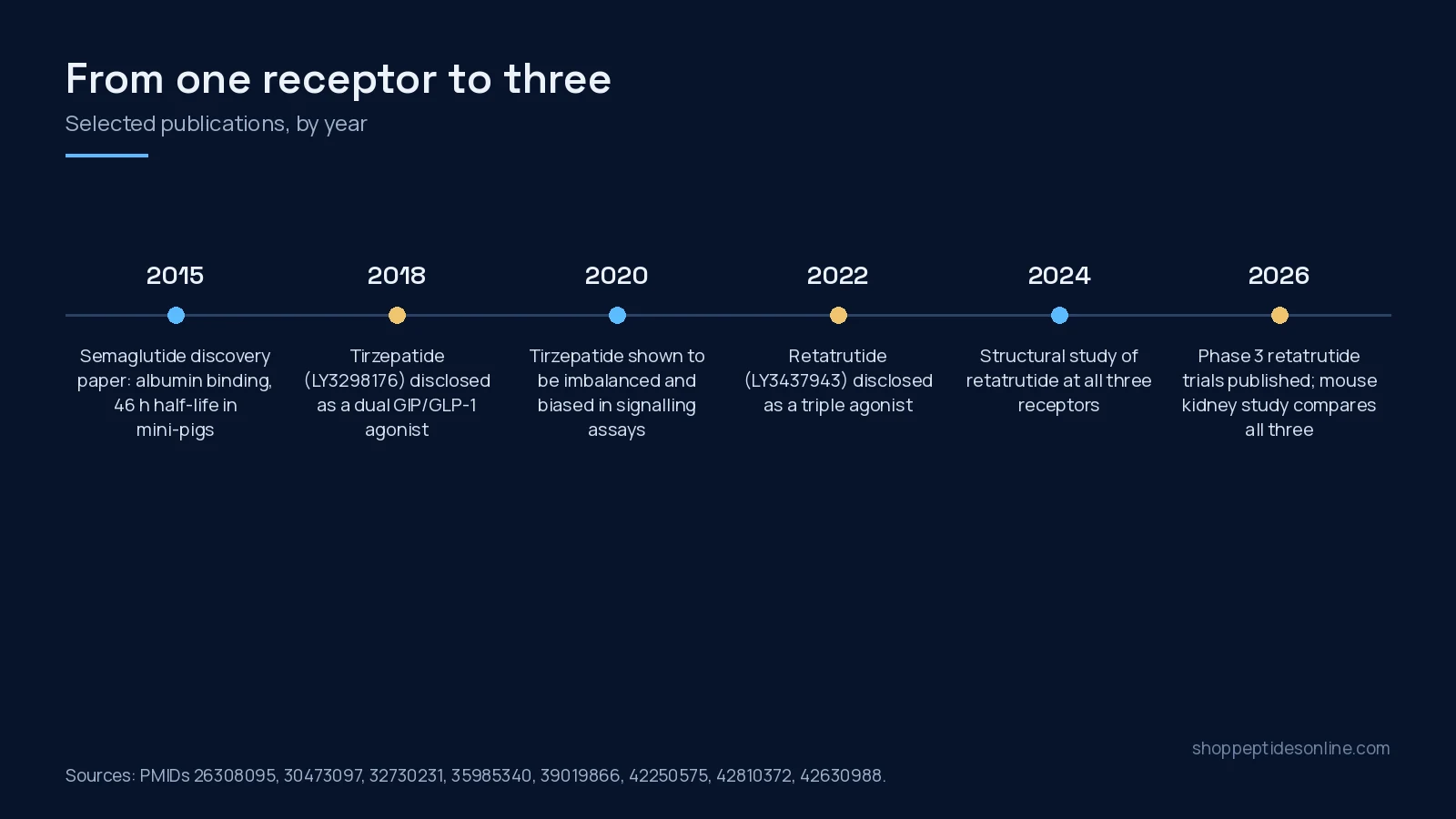
The semaglutide program started from liraglutide, an acylated GLP-1 analogue that binds serum albumin, and tuned the fatty-acid moiety and its linker for stronger albumin affinity and full stability against metabolic degradation[1]. The trade-off was measurable: receptor affinity fell three-fold compared with liraglutide, while albumin affinity rose. In mini-pigs, the plasma half-life after intravenous administration was 46.1 hours[1].
Tirzepatide: two receptors, unevenly
Tirzepatide was characterised in cell lines expressing recombinant or endogenous incretin receptors, and then in mice[2]. A 2020 pharmacology paper calculated receptor occupancy and found greater engagement of the GIP receptor than the GLP-1 receptor, which it called an “imbalanced” mechanism. At the GLP-1 receptor, tirzepatide favoured cAMP generation over β-arrestin recruitment, and it drove less receptor internalization than GLP-1 itself[3]. A separate study in HEK293 cells also reported signalling bias, toward ERK1/2 phosphorylation relative to cAMP, at both receptors[7]. The two papers used different assays and reference ligands, which is a reminder that “bias” depends on what you measure.
What does the GIP half add? In obese mice lacking the GLP-1 receptor, tirzepatide still improved insulin sensitivity, through glucose disposal in white adipose tissue. That points to a GIP-receptor contribution independent of the GLP-1 arm[8].
Retatrutide: adding glucagon
Retatrutide activates the glucagon, GIP and GLP-1 receptors. In the discovery paper, its glucagon and GLP-1 receptor activity was balanced, with more activity at the GIP receptor[4]. In mice, the authors attributed an added increase in energy expenditure to glucagon-receptor activity[4]. A 2024 structural study examined how the single peptide engages all three receptors[9].
Where the preclinical comparisons stand
Direct three-way comparisons are rare. One 2026 study compared all three in human kidney cells (HK-2) and in two mouse models of non-diabetic kidney fibrosis. It found model- and drug-specific patterns rather than one shared mechanism: PI3K-AKT inhibition for semaglutide, PI3K-AKT inhibition plus PPAR activation for tirzepatide, and inhibition of both PI3K-AKT and NF-κB for retatrutide. Retatrutide showed the largest effect at the doses tested[10]. The authors present it as hypothesis-generating. It was one lab, mouse models and kidney endpoints only.
Regulatory status, stated plainly
- Semaglutide is the active ingredient of Ozempic and Wegovy (Novo Nordisk), both listed as prescription human drugs in Health Canada’s Drug Product Database.
- Tirzepatide is the active ingredient of Mounjaro and Zepbound (Eli Lilly), also listed in the Drug Product Database.
- Retatrutide is described in its 2026 phase 3 publications as a molecule under clinical development and investigation[5, 6]. It is not an approved drug. Its earlier trials included a phase 1b study in type 2 diabetes[11] and a phase 2 trial[12].
Research-grade material is not any of these drug products. It’s sold for laboratory work only, and nothing on this site should be read as a comparison of clinical results.
What this means when you read a COA
The three molecules differ in mass by several hundred daltons (about 4114, 4813 and 4731), which mass spectrometry separates easily. The lab that tested our retatrutide lot ran a blind GLP-1 panel that screens for semaglutide, tirzepatide and retatrutide together. That report, Janoshik #232263, identified retatrutide and measured 9.24 mg in a vial labelled 10 mg, at 99.079% purity. The GLP-3 (retatrutide) research overview and the tirzepatide research overview carry the full study tables. The GLP-3 10mg listing links that report. Our catalogue page explains how to buy peptides online in Canada with batch documents attached.
Frequently asked questions
What is the difference between semaglutide, tirzepatide and retatrutide?
The number of receptors each activates. Semaglutide is a GLP-1 receptor agonist. Tirzepatide activates the GIP and GLP-1 receptors, engaging the GIP receptor more. Retatrutide activates the GIP, GLP-1 and glucagon receptors.
Is retatrutide approved in Canada?
No. Retatrutide (LY3437943) is an investigational molecule. Its phase 3 trial publications in 2026 describe it as still under clinical development. Semaglutide and tirzepatide, by contrast, are active ingredients in prescription drugs listed in Health Canada’s Drug Product Database.
Why is retatrutide called GLP-3?
It’s a catalogue nickname, not a hormone name. It refers to the molecule acting at three receptors: GLP-1, GIP and glucagon. Scientific papers use retatrutide or its code, LY3437943.
Can a COA tell these three peptides apart?
Yes. Their molecular weights differ by several hundred daltons, so a mass-spectrometry identity result distinguishes them. Some labs run a combined blind panel for all three.
References
- Lau J, Bloch P, Schäffer L et al. (2015). Discovery of the Once-Weekly Glucagon-Like Peptide-1 (GLP-1) Analogue Semaglutide. J Med Chem. PMID: 26308095. doi: 10.1021/acs.jmedchem.5b00726.
- Coskun T, Sloop KW, Loghin C et al. (2018). LY3298176, a novel dual GIP and GLP-1 receptor agonist for the treatment of type 2 diabetes mellitus: From discovery to clinical proof of concept. Mol Metab. PMID: 30473097. doi: 10.1016/j.molmet.2018.09.009.
- Willard FS, Douros JD, Gabe MB et al. (2020). Tirzepatide is an imbalanced and biased dual GIP and GLP-1 receptor agonist. JCI Insight. PMID: 32730231. doi: 10.1172/jci.insight.140532.
- Coskun T, Urva S, Roell WC et al. (2022). LY3437943, a novel triple glucagon, GIP, and GLP-1 receptor agonist for glycemic control and weight loss: From discovery to clinical proof of concept. Cell Metab. PMID: 35985340. doi: 10.1016/j.cmet.2022.07.013.
- Bajaj HS, Welch M, Shah P et al. (2026). Efficacy and safety of retatrutide, a GIP, GLP-1, and glucagon receptor agonist, in people with type 2 diabetes and inadequate glycaemic control with diet and exercise (TRANSCEND-T2D-1): a double-blind, randomised, phase 3 trial. Lancet. PMID: 42250575. doi: 10.1016/S0140-6736(26)00967-0.
- Bellido V, le Roux CW, Ekinci EI et al. (2026). Retatrutide in adults with obesity and type 2 diabetes (TRIUMPH-2): a double-blind, parallel-group, randomised, placebo-controlled, phase 3 trial. Lancet. PMID: 42810372. doi: 10.1016/S0140-6736(26)01861-1.
- Yuliantie E, Darbalaei S, Dai A et al. (2020). Pharmacological characterization of mono-, dual- and tri-peptidic agonists at GIP and GLP-1 receptors. Biochem Pharmacol. PMID: 32360365. doi: 10.1016/j.bcp.2020.114001.
- Samms RJ, Christe ME, Collins KA et al. (2021). GIPR agonism mediates weight-independent insulin sensitization by tirzepatide in obese mice. J Clin Invest. PMID: 34003802. doi: 10.1172/JCI146353.
- Li W, Zhou Q, Cong Z et al. (2024). Structural insights into the triple agonism at GLP-1R, GIPR and GCGR manifested by retatrutide. Cell Discov. PMID: 39019866. doi: 10.1038/s41421-024-00700-0.
- Ding M, Li X, Wei Y et al. (2026). Comparative effects of semaglutide tirzepatide and retatrutide on renal fibrosis in UUO and aged mice. iScience. PMID: 42630988. doi: 10.1016/j.isci.2026.117174.
- Urva S, Coskun T, Loh MT et al. (2022). LY3437943, a novel triple GIP, GLP-1, and glucagon receptor agonist in people with type 2 diabetes: a phase 1b, multicentre, double-blind, placebo-controlled, randomised, multiple-ascending dose trial. Lancet. PMID: 36354040. doi: 10.1016/S0140-6736(22)02033-5.
- Jastreboff AM, Kaplan LM, Frías JP et al. (2023). Triple-Hormone-Receptor Agonist Retatrutide for Obesity – A Phase 2 Trial. N Engl J Med. PMID: 37366315. doi: 10.1056/NEJMoa2301972.