For laboratory research only. Not for human or animal use. This article gives no dosing, administration or therapeutic advice.
Short answer: the two blends differ in two ways, not one. KLOW adds a fourth peptide, KPV, that GLOW does not contain. The “TB-500” in each blend is also a different molecule. SPO’s GLOW 70mg report labels its TB-500 line “TB4”, the full-length 43-residue thymosin beta-4 protein. The KLOW 80mg report labels it “889 Da”, the seven-residue fragment Ac-LKKTETQ[1],[2]. Each component has its own research literature, mostly in cells and rodents. No published study has tested either blend as a blend. The one rat study that combined two of the components found no additive effect[3].
What the two batch reports list
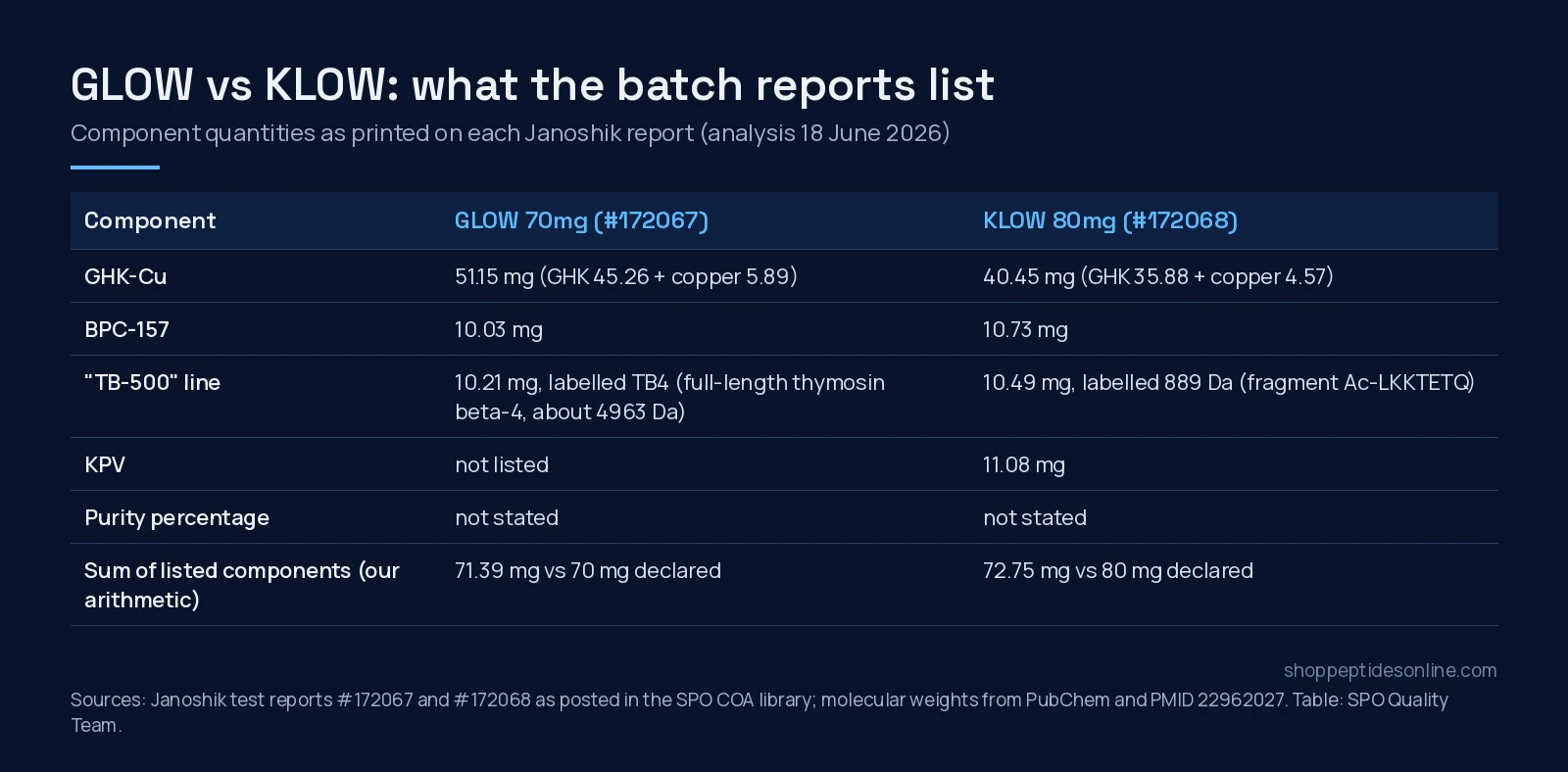
Both reports are from Janoshik, with samples received on 3 June and analysed on 18 June 2026. Neither report states a purity percentage; each lists component quantities and identity. The numbers below are printed exactly as the reports give them, and the full images are in the COA library.
| Component | GLOW 70mg (report #172067) | KLOW 80mg (report #172068) |
|---|---|---|
| GHK-Cu | 51.15 mg (GHK 45.26 mg + copper 5.89 mg) | 40.45 mg (GHK 35.88 mg + copper 4.57 mg) |
| BPC-157 | 10.03 mg | 10.73 mg |
| “TB-500” line | 10.21 mg, labelled TB4 (full-length thymosin beta-4) | 10.49 mg, labelled 889 Da (Ac-LKKTETQ fragment) |
| KPV | Not listed | 11.08 mg |
| Purity percentage | Not stated | Not stated |
| Listed components added together (our arithmetic) | 71.39 mg against 70 mg declared | 72.75 mg against 80 mg declared |
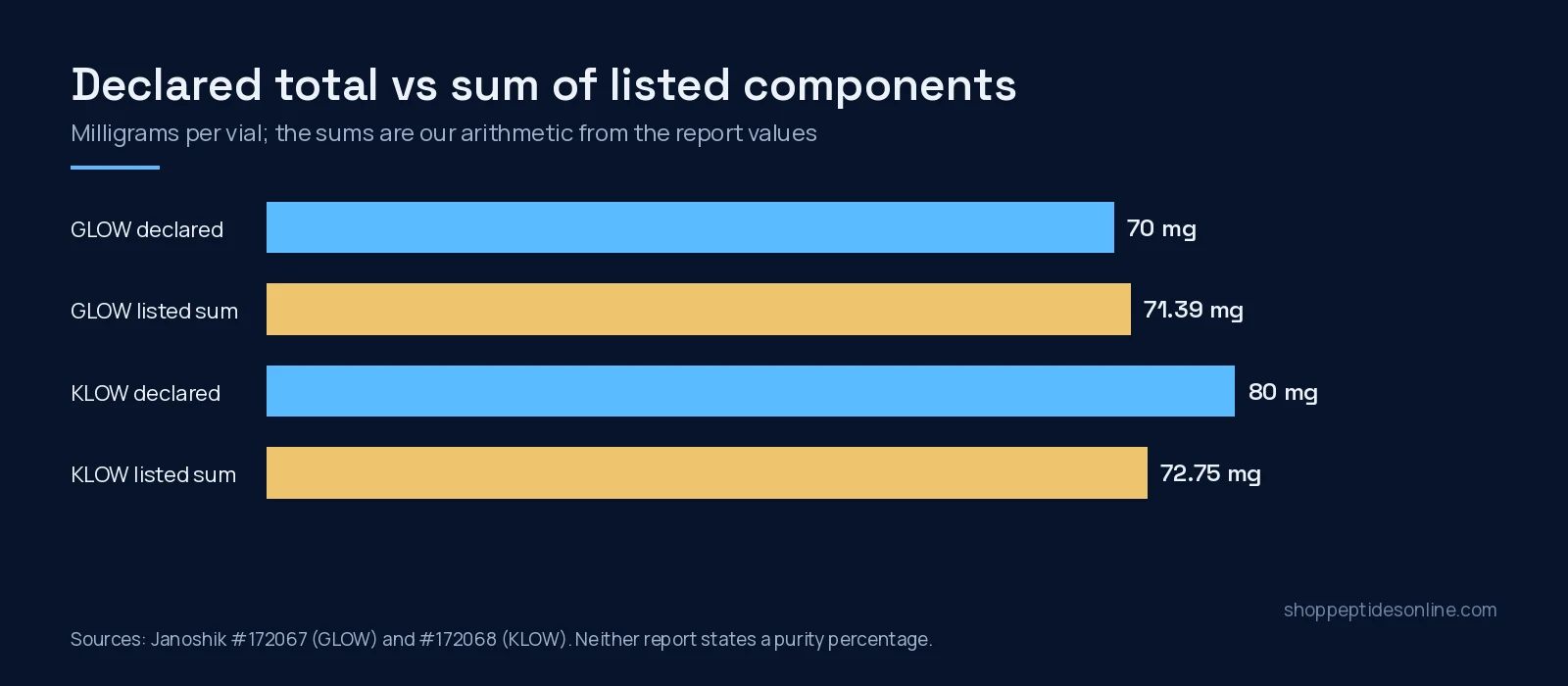
Two points stand out. First, GHK-Cu is the largest component by mass in both blends, and it is reported as peptide plus copper. Second, KLOW’s listed components add up to about 7 mg less than its 80 mg declaration. That sum is our arithmetic, and the report itself gives only the component values. If you work with either blend, read the report yourself and not only the label. Our guide to checking each component on a blend COA walks through that line by line.
The TB-500 problem: two molecules, one name
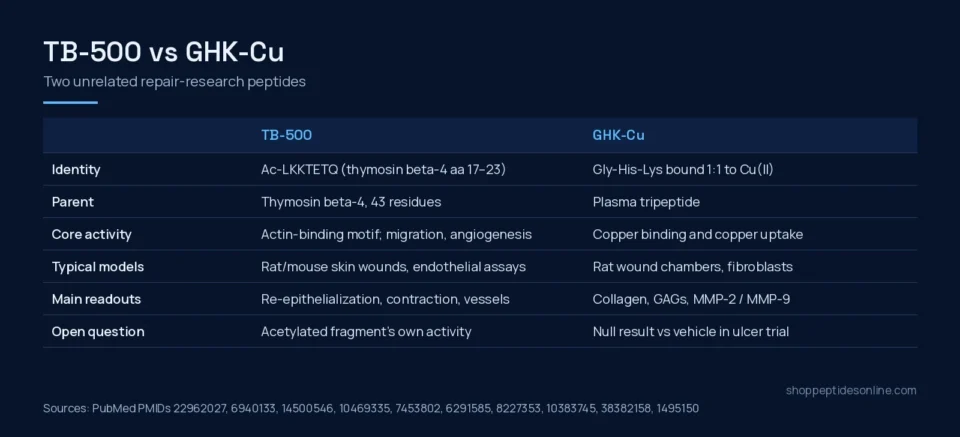
Thymosin beta-4 is a 43-residue protein, first sequenced from bovine thymus in 1981[1]. “TB-500” began as a trade name. When anti-doping chemists analysed a product sold as TB-500, they found the N-terminally acetylated 17-23 fragment of thymosin beta-4, Ac-LKKTETQ. They confirmed it by high-resolution mass spectrometry and by synthesising the fragment[2]. Equine doping-control labs also treat TB-500 as a synthetic version of an active region of thymosin beta-4[4].
The two are not interchangeable. The LKKTETQ sequence is the actin-binding motif of thymosin beta-4. In endothelial-cell and chick aortic-arch assays, the full protein and this seven-residue motif showed near-identical activity at about 50 nM, and peptides missing part of the motif were inactive[5]. That is one assay family, though. Most of the whole-protein literature, including rat wound work and the human trials, used full-length thymosin beta-4 and not the fragment[6],[7]. A mass of about 4963 Da and a mass of 889 Da are easy to tell apart on a mass spectrum, which is why the report label matters. The TB-500 research overview covers both forms in detail.
Each component, by model
GHK-Cu (both blends)
GHK was first reported in 1973 as a tripeptide in human serum that affected liver-cell survival and growth in culture. It was identified as glycyl-histidyl-lysine in 1977[8],[9]. It readily forms copper(II) complexes and increased copper uptake into cultured hepatoma cells[10]. In fibroblast cultures, GHK-Cu stimulated collagen synthesis from picomolar concentrations, independent of cell number[11]. The limits are clear too. In a rat ACL-reconstruction model, the early improvement in knee laxity was gone by 12 weeks, and ultimate load and histology did not differ[12]. In a randomised venous-ulcer trial, a GHK-Cu cream did no better than placebo[13]. The GHK-Cu overview has the full table.
BPC-157 (both blends)
BPC-157 is a 15-residue (pentadecapeptide) sequence first described by Sikirić’s group as from gastric juice[14],[15]. Most of its literature is in rats, for example transected Achilles tendon models[15]. A 2025 systematic review of 36 studies found improved outcomes in animal musculoskeletal models, but no clinical safety data in humans[16]. A 2026 pharmaceutics review counted fewer than 30 human subjects across three uncontrolled pilot studies, and none used a standardised preparation[17].
Thymosin beta-4 or its fragment (both blends, different forms)
In rats, topical and intraperitoneal full-length thymosin beta-4 accelerated skin wound repair[6]. Human trials of the full protein are few and cover narrow uses. One example is a small phase 2 dry-eye trial of eye drops in nine patients[7]; results in one tissue do not transfer to another. For the fragment, most of the published literature is analytical chemistry[2],[4].
KPV (KLOW only)
KPV is Lys-Pro-Val, the C-terminal tripeptide (residues 11-13) of alpha-MSH[18]. In intestinal epithelial and immune cells, nanomolar KPV inhibited NF-kappaB and MAP-kinase signalling. It entered cells through the PepT1 transporter, and in mice it reduced the incidence of chemically induced colitis[19]. A second group reported anti-inflammatory effects in two mouse colitis models that were at least partly independent of MC1R[20]. In vitro, alpha-MSH-related peptides including KPV inhibited Staphylococcus aureus and Candida albicans[21]. All of this is cell and mouse work.
What is missing from both blends’ evidence
- No blend-level study. We found no PubMed record testing GLOW, KLOW or any fixed GHK-Cu/BPC-157/TB-500 mixture.
- Combination did not add up in the one test we found. In a 2026 exploratory rat Achilles-tendon study, BPC-157 and TB-500 each improved early histology, and TB-500 alone showed a biomechanical advantage at four weeks. Combining them produced no additive effect[3].
- Component interactions are unstudied. GHK binds copper[10]. Whether the other peptides in a mixed vial change that, or change each other’s stability, has not been reported.
- Purity is not on either report. Only component quantities are given, so impurity profiles are unknown.
For a lab choosing between the two, the practical difference is chemical. KLOW has four analytes, one of them the 889 Da fragment. GLOW has three analytes, one of them the full-length protein. The GLOW overview and KLOW overview carry each blend’s identity tables. If you are comparing suppliers for either blend before you buy peptides online in Canada, ask which TB-500 form the certificate shows.
Frequently asked questions
What is the difference between GLOW and KLOW?
KLOW adds KPV, a fourth peptide. The TB-500 in each blend also differs: SPO’s GLOW report shows full-length thymosin beta-4 (TB4), while the KLOW report shows the 889 Da Ac-LKKTETQ fragment.
What is in GLOW 70mg according to its report?
Janoshik #172067 lists GHK-Cu 51.15 mg (GHK 45.26 mg + copper 5.89 mg), BPC-157 10.03 mg and TB-500 10.21 mg labelled TB4. No purity percentage is stated.
What is in KLOW 80mg according to its report?
Janoshik #172068 lists GHK-Cu 40.45 mg (GHK 35.88 mg + copper 4.57 mg), BPC-157 10.73 mg, TB-500 10.49 mg labelled 889 Da, and KPV 11.08 mg. No purity percentage is stated.
Has either blend been studied as a blend?
Not that we found on PubMed. Each component has its own cell and animal literature. In one rat tendon study, combining BPC-157 and TB-500 gave no additive effect.
Why does the TB-500 form matter?
Full-length thymosin beta-4 is a 43-residue protein of about 4963 Da; the fragment is seven residues and 889 Da. They are different molecules with different literatures, and mass spectrometry tells them apart.
References
- Low TL, Hu SK, Goldstein AL (1981). Complete amino acid sequence of bovine thymosin beta 4: a thymic hormone that induces terminal deoxynucleotidyl transferase activity in thymocyte populations. Proc Natl Acad Sci U S A. PMID: 6940133. doi: 10.1073/pnas.78.2.1162.
- Esposito S, Deventer K, Goeman J et al. (2012). Synthesis and characterization of the N-terminal acetylated 17-23 fragment of thymosin beta 4 identified in TB-500, a product suspected to possess doping potential. Drug Test Anal. PMID: 22962027. doi: 10.1002/dta.1402.
- Biçer O, Adanir O, Güleryüz Y et al. (2026). Effects of BPC-157 and TB-500 on Achilles tendon healing in rats: A histopathological and biomechanical study. Jt Dis Relat Surg. PMID: 42542926. doi: 10.52312/jdrs.2026.2951.
- Ho EN, Kwok WH, Lau MY et al. (2012). Doping control analysis of TB-500, a synthetic version of an active region of thymosin β₄, in equine urine and plasma by liquid chromatography-mass spectrometry. J Chromatogr A. PMID: 23084823. doi: 10.1016/j.chroma.2012.09.043.
- Philp D, Huff T, Gho YS et al. (2003). The actin binding site on thymosin beta4 promotes angiogenesis. FASEB J. PMID: 14500546. doi: 10.1096/fj.03-0121fje.
- Malinda KM, Sidhu GS, Mani H et al. (1999). Thymosin beta4 accelerates wound healing. J Invest Dermatol. PMID: 10469335. doi: 10.1046/j.1523-1747.1999.00708.x.
- Sosne G, Dunn SP, Kim C (2015). Thymosin β4 significantly improves signs and symptoms of severe dry eye in a phase 2 randomized trial. Cornea. PMID: 25826322. doi: 10.1097/ICO.0000000000000379.
- Pickart L, Thaler MM (1973). Tripeptide in human serum which prolongs survival of normal liver cells and stimulates growth in neoplastic liver. Nat New Biol. PMID: 4349963.
- Schlesinger DH, Pickart L, Thaler MM (1977). Growth-modulating serum tripeptide is glycyl-histidyl-lysine. Experientia. PMID: 858356. doi: 10.1007/BF02002806.
- Pickart L, Freedman JH, Loker WJ et al. (1980). Growth-modulating plasma tripeptide may function by facilitating copper uptake into cells. Nature. PMID: 7453802. doi: 10.1038/288715a0.
- Maquart FX, Pickart L, Laurent M et al. (1988). Stimulation of collagen synthesis in fibroblast cultures by the tripeptide-copper complex glycyl-L-histidyl-L-lysine-Cu2+. FEBS Lett. PMID: 3169264. doi: 10.1016/0014-5793(88)80509-x.
- Fu SC, Cheuk YC, Chiu WY et al. (2015). Tripeptide-copper complex GHK-Cu (II) transiently improved healing outcome in a rat model of ACL reconstruction. J Orthop Res. PMID: 25731775. doi: 10.1002/jor.22831.
- Bishop JB, Phillips LG, Mustoe TA et al. (1992). A prospective randomized evaluator-blinded trial of two potential wound healing agents for the treatment of venous stasis ulcers. J Vasc Surg. PMID: 1495150. doi: 10.1067/mva.1992.37086.
- Sikirić P, Petek M, Rucman R et al. (1993). A new gastric juice peptide, BPC. An overview of the stomach-stress-organoprotection hypothesis and beneficial effects of BPC. J Physiol Paris. PMID: 8298609. doi: 10.1016/0928-4257(93)90038-u.
- Staresinic M, Sebecic B, Patrlj L et al. (2003). Gastric pentadecapeptide BPC 157 accelerates healing of transected rat Achilles tendon and in vitro stimulates tendocytes growth. J Orthop Res. PMID: 14554208. doi: 10.1016/S0736-0266(03)00110-4.
- Vasireddi N, Hahamyan H, Salata MJ et al. (2025). Emerging Use of BPC-157 in Orthopaedic Sports Medicine: A Systematic Review. HSS J. PMID: 40756949. doi: 10.1177/15563316251355551.
- Mateescu DM, Gavrilescu DM, Constantinescu FE et al. (2026). BPC-157 as an Investigational Peptide Therapeutic: Biopharmaceutical Challenges, Formulation Strategies, and Translational Development Barriers. Pharmaceutics. PMID: 42198317. doi: 10.3390/pharmaceutics18050625.
- Brzoska T, Luger TA, Maaser C et al. (2008). Alpha-melanocyte-stimulating hormone and related tripeptides: biochemistry, antiinflammatory and protective effects in vitro and in vivo, and future perspectives for the treatment of immune-mediated inflammatory diseases. Endocr Rev. PMID: 18612139. doi: 10.1210/er.2007-0027.
- Dalmasso G, Charrier-Hisamuddin L, Nguyen HT et al. (2008). PepT1-mediated tripeptide KPV uptake reduces intestinal inflammation. Gastroenterology. PMID: 18061177. doi: 10.1053/j.gastro.2007.10.026.
- Kannengiesser K, Maaser C, Heidemann J et al. (2008). Melanocortin-derived tripeptide KPV has anti-inflammatory potential in murine models of inflammatory bowel disease. Inflamm Bowel Dis. PMID: 18092346. doi: 10.1002/ibd.20334.
- Cutuli M, Cristiani S, Lipton JM et al. (2000). Antimicrobial effects of alpha-MSH peptides. J Leukoc Biol. PMID: 10670585. doi: 10.1002/jlb.67.2.233.