For laboratory research only. Not for human or animal use. This article gives no dosing, administration or therapeutic advice.
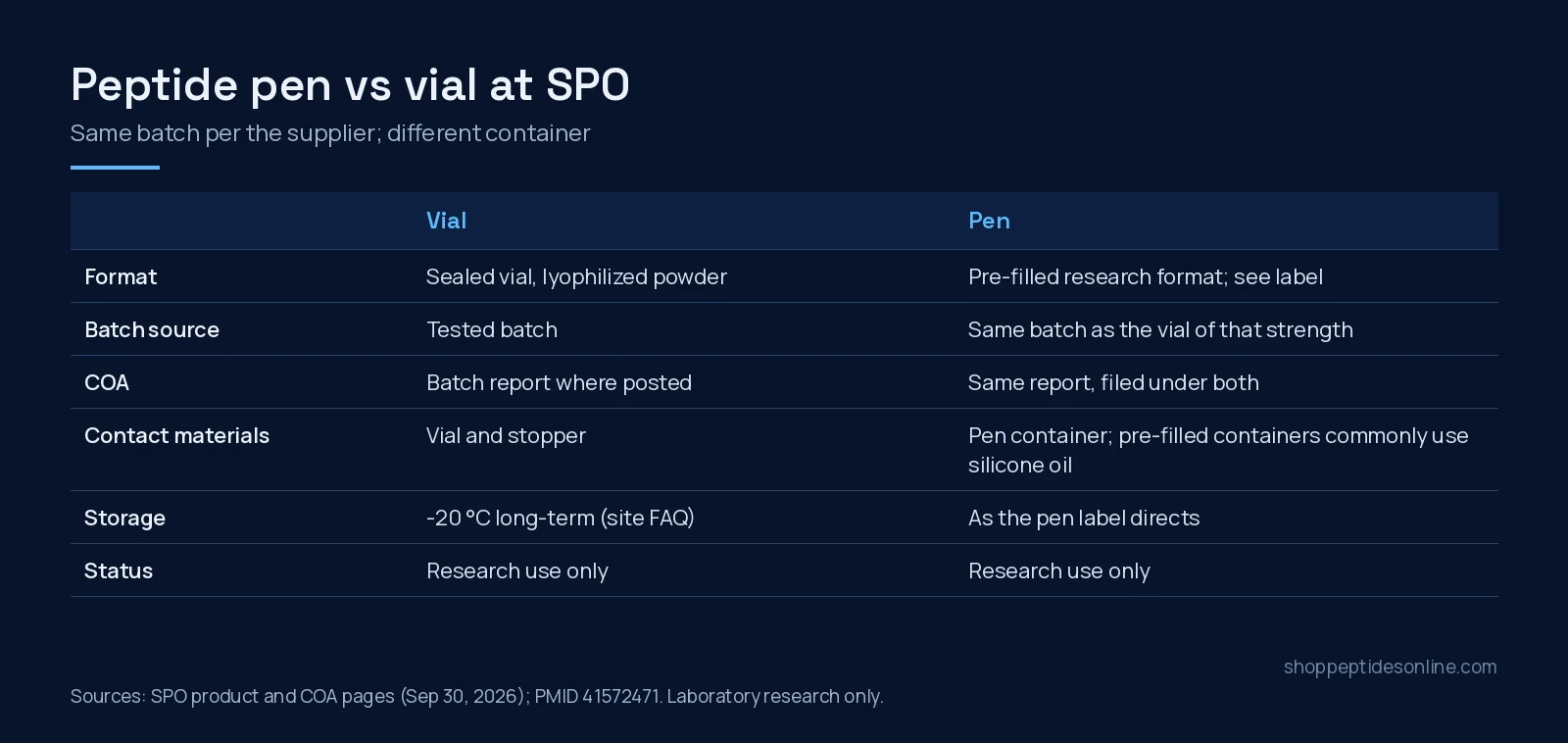
Short answer: at SPO, the pen and the vial of the same strength hold material from the same batch, according to the supplier. What differs is the container. That affects storage, what the certificate of analysis can and can’t tell you, and which container-related risks the pharmaceutics literature says to watch.
Side by side
| Vial | Pen | |
|---|---|---|
| Format | Sealed vial of lyophilized powder | Pre-filled research format. Check the label for the physical form and storage |
| Compounds at SPO | The full catalogue | GHK-Cu, MOTS-C, Tesamorelin and GLP-3 |
| Batch source | The tested batch | Per the supplier, the same batch as the vial of that strength |
| COA | Batch report where posted | The same report, filed under both vial and pen in the COA library |
| Container-contact materials | Vial and stopper | The pen’s own container. Pre-filled containers commonly use silicone oil as a plunger lubricant[1] |
| Storage stated by SPO | −20 °C long-term for lyophilized powder (site FAQ) | As the pen label directs |
| Status | Research use only. The GLP-3 pen listing states that the format “is not a medical device and not the clinical product” | |
Same batch, same report
On September 30, 2026, the supplier confirmed that SPO’s pens are filled from the same batch as the vials of the same strength. This is why the COA library lists one report under two cards:
- GLP-3 (retatrutide) 10 mg: Janoshik #232263, analysed 21 September 2026, 9.24 mg measured against a 10 mg label, purity 99.079%. The GLP-3 pen page shows this report for the 10 mg fill. The 20 mg pen has no posted report.
- Tesamorelin 10 mg: Janoshik #172070, analysed 18 June 2026, 10.69 mg, 98.628%.
- Tesamorelin 20 mg: Janoshik #232266, analysed 21 September 2026, 17.94 mg against a 20 mg label, 98.010%. Both Tesamorelin reports are on the Tesamorelin pen page.
Two practical points follow. First, match the lot on your pen’s label to the report before relying on it, as the listings advise. Second, a figure below label, like the 17.94 mg result, belongs to the batch, not to the format. Why a vial can test below its label explains what that number does and doesn’t mean.
What a batch report can’t see: the container
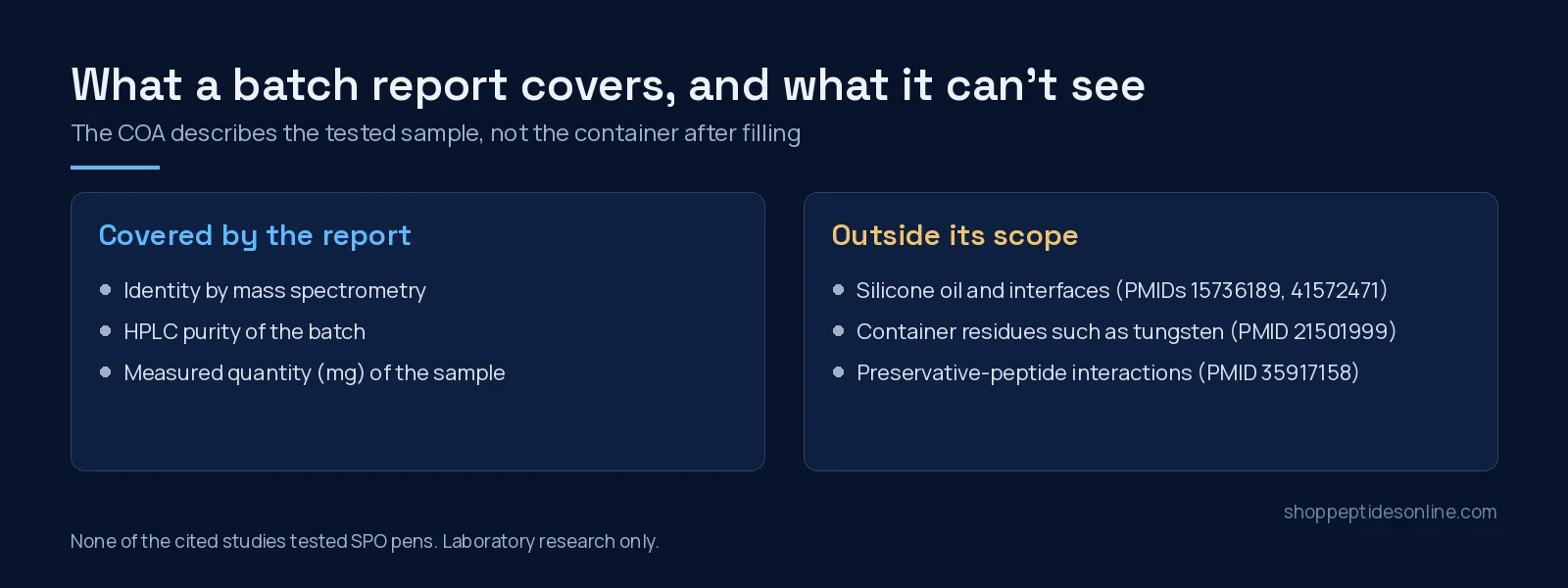
A COA describes the sample that was tested. Anything that happens after filling, from contact with the container itself, is outside its scope. The pharmaceutics literature on pre-filled containers shows why this matters:
- Silicone oil. Pre-filled containers use silicone oil to lubricate the plunger. At 0.5% oil in solution, four model proteins of different sizes and charges aggregated significantly, without large conformational changes[4]. The effect is conditional. For one IgG1 antibody, silicone oil did not cause aggregation during still incubation. It did when combined with agitation, and polysorbate 20 prevented it[5].
- A peptide example. Liraglutide, a lipidated GLP-1 analogue, showed minimal change under mild agitation or limited headspace. Larger headspace plus stronger agitation promoted fibrillation. The authors conclude that the combination of air–water and silicone-oil–water interfaces matters more than either alone[1].
- Manufacturing residues. In one pre-filled syringe case, protein aggregates were traced to tungsten left over from the pins used to form the syringe barrel. The authors note that packaging component manufacturing can affect product quality in ways the drug manufacturer doesn’t directly control[6].
- Preservatives, if present. Multi-dose containers need an antimicrobial preservative, and some preservatives increase particle formation with certain peptides and proteins[7]. In one NMR study, m-cresol aggregated an acylated 31-residue peptide and benzyl alcohol did not[8]. SPO’s listings do not state whether a pen contains a preservative. Check the label.
None of these studies tested SPO’s pens or the compounds in them. They show which variables exist, not how any SPO product behaves.
Powder in a pen: the dual-chamber route
Some pharmaceutical products need to stay lyophilized. Dual-chamber cartridges handle that by keeping a dried cake and its diluent in separate chambers. A 2016 review notes that only a few such products are on the market, because of challenges in manufacturing, formulation, stability and cost[2]. Freeze-drying inside a cartridge needs its own process design[3]. Solid-state stability has its own literature, and the dried state is slower but not inert.
Choosing between them for lab work
- Documentation is identical for strengths where a report is posted, because it’s the same report.
- Storage differs. Vials follow the site’s lyophilized guidance. Pens follow their own label.
- Container variables differ. If your work is sensitive to aggregation or particles, the container is a variable to record alongside the lot.
- Strength coverage differs. Not every strength or compound comes as a pen. See the peptide pens page for current options.
Pens and vials ship together within Canada. See buy peptides online in Canada for shipping and documentation.
Frequently asked questions
Is the peptide in an SPO pen different from the vial?
Per the supplier, each pen is filled from the same batch as the vial of the same strength. That is why the COA library files the same report under both, for example Janoshik #232263 for the GLP-3 10 mg vial and 10 mg pen.
Does every pen strength have its own report?
No. The Tesamorelin 10 mg and 20 mg pen fills each have a report (#172070 and #232266). The GLP-3 20 mg pen has none posted. Where no report exists, the listing says so.
Can the pen container affect what’s inside?
In pharmaceutical studies, container materials and conditions have mattered. Silicone oil lubricant, tungsten residues and headspace combined with agitation have each been linked to aggregation in pre-filled containers. Those studies used other products, not SPO’s pens.
Is a pen meant for human use?
No. SPO’s pens are sold for laboratory research only. The GLP-3 pen listing states that the format is not a medical device, and the peptide pens page states that a pen format does not change a product’s research-only status.
References
- Hamada N, Cutts A, Song J et al. (2026). Molecular Mechanisms of Liraglutide Aggregation Induced by Dual Air-Water and Silicone-Oil-Water Interfacial Stress. Mol Pharm. PMID: 41572471. doi: 10.1021/acs.molpharmaceut.5c01837.
- Werk T, Ludwig IS, Luemkemann J et al. (2016). Technology, Applications, and Process Challenges of Dual Chamber Systems. J Pharm Sci. PMID: 26852837. doi: 10.1016/j.xphs.2015.11.025.
- Korpus C, Friess W (2017). Lyophilization Cycle Design for Dual Chamber Cartridges and a Method for Online Process Control: The “DCC LyoMate” Procedure. J Pharm Sci. PMID: 28479354. doi: 10.1016/j.xphs.2017.04.069.
- Jones LS, Kaufmann A, Middaugh CR (2005). Silicone oil induced aggregation of proteins. J Pharm Sci. PMID: 15736189. doi: 10.1002/jps.20321.
- Thirumangalathu R, Krishnan S, Ricci MS et al. (2009). Silicone oil- and agitation-induced aggregation of a monoclonal antibody in aqueous solution. J Pharm Sci. PMID: 19360857. doi: 10.1002/jps.21719.
- Liu W, Swift R, Torraca G et al. (2010). Root Cause Analysis of Tungsten-Induced Protein Aggregation in Pre-filled Syringes. PDA J Pharm Sci Technol. PMID: 21501999.
- Stroppel L, Schultz-Fademrecht T, Cebulla M et al. (2023). Antimicrobial Preservatives for Protein and Peptide Formulations: An Overview. Pharmaceutics. PMID: 36839885. doi: 10.3390/pharmaceutics15020563.
- Li M, Falk BT, Lu X et al. (2022). Molecular Mechanism of Antimicrobial Excipient-Induced Aggregation in Parenteral Formulations of Peptide Therapeutics. Mol Pharm. PMID: 35917158. doi: 10.1021/acs.molpharmaceut.2c00449.