For laboratory research only. Not for human or animal use. This article gives no dosing, administration or therapeutic advice.
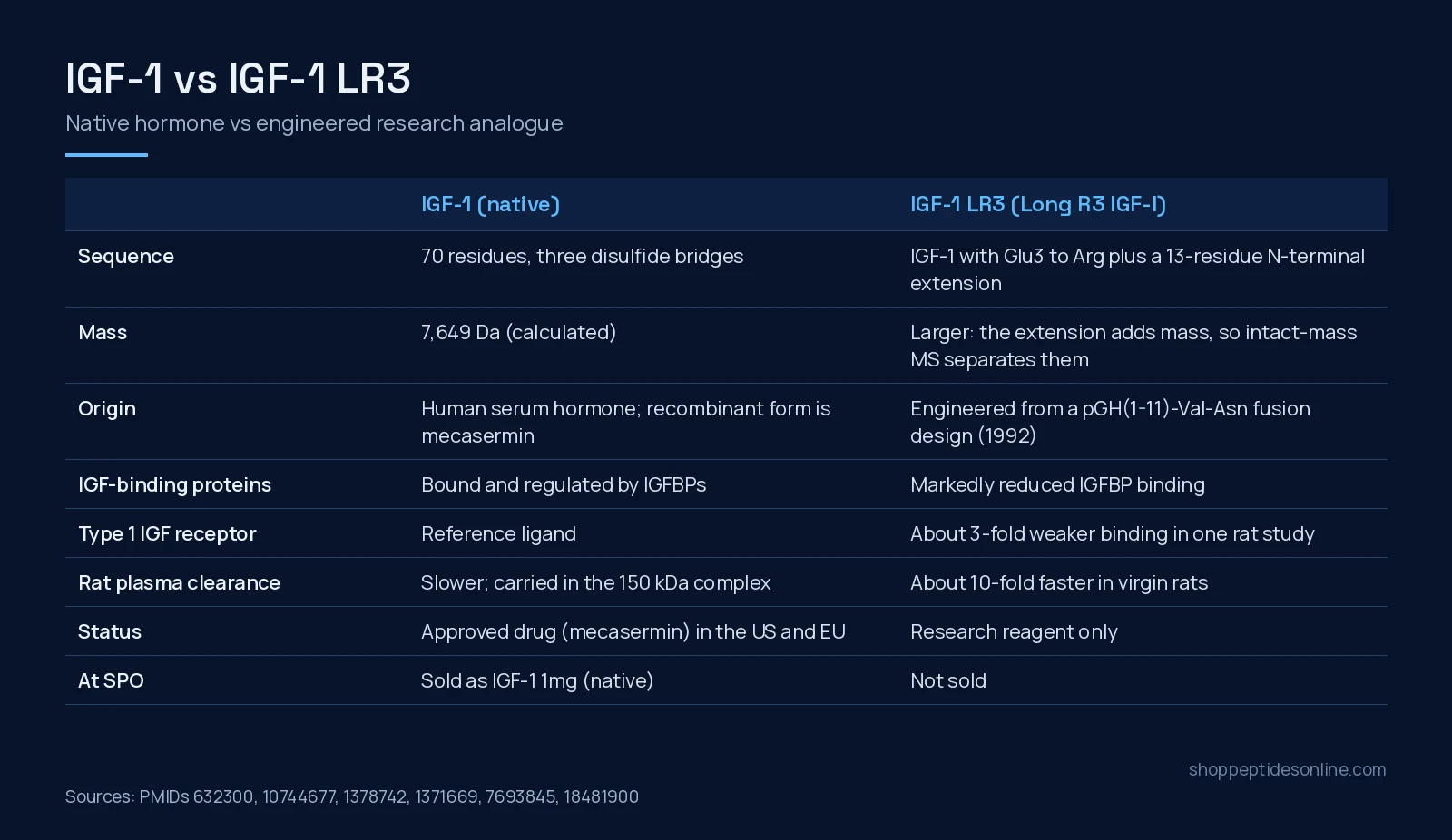
Short answer: IGF-1 is the native human hormone, 70 amino acids held together by three disulfide bridges (UniProt P05019). IGF-1 LR3 is an engineered analogue: arginine replaces glutamate at position 3 and 13 extra residues sit on the N-terminus[1][2]. Those changes cut its binding to IGF-binding proteins, so it is more potent than IGF-1 in many culture assays[3][2]. Contrary to a common assumption, it was cleared from rat plasma about ten times faster, not slower[8]. Shop Peptides Online sells native IGF-1, not LR3.
Side by side
| IGF-1 (native) | IGF-1 LR3 (Long R3 IGF-I) | |
|---|---|---|
| Sequence | 70 residues, three disulfides, 7,649 Da (UniProt P05019) | IGF-1 with Glu3→Arg plus a 13-residue N-terminal extension[1] |
| Structure | Three helical segments joined by a 12-residue C-region[12] | Same IGF-1 core in solution NMR; the extension is highly flexible[1] |
| Origin | Serum hormone; recombinant form is mecasermin[16] | Built on a [Met1]-pGH(1-11)-Val-Asn fusion design[2] |
| IGF-binding proteins | Bound and regulated by IGFBP-1 to -6[4] | Markedly reduced IGFBP affinity[8] |
| Type 1 IGF receptor | Reference ligand[13] | About 3-fold weaker binding in one rat study[7] |
| Rat plasma clearance | Slower; mainly in the 150 kDa complex[8] | About 10-fold faster in virgin rats; mostly free peptide[8] |
| Status | Approved drug (mecasermin) in the US and EU[16] | Research reagent only |
| At SPO | IGF-1 1mg, labelled native IGF-1 | Not sold |
How LR3 was built
In the early 1990s, researchers expressed IGF-1 in E. coli as fusion proteins carrying part of porcine growth hormone at the front, joined by a Val-Asn dipeptide[3]. Shortening the leader to the first 11 residues of methionyl porcine growth hormone gave a family of “Long” analogues: Long IGF-I, Long [Gly3]-IGF-I and Long [Arg3]-IGF-I[2]. The hydrophobic extension also seemed to help the protein fold correctly during manufacture[2]. Long [Arg3]-IGF-I is the molecule now sold to labs as LR3.
A solution NMR structure later confirmed that LR3 keeps IGF-1’s three-helix core, with the N-terminal extension as a flexible tail[1].
Why position 3 matters: the binding proteins
Six IGF-binding proteins (IGFBP-1 to -6) bind IGFs, but not insulin, with high affinity. They can inhibit IGF actions and, in some settings, enhance them[4]. Many cultured cells secrete these proteins into the medium, where they hold IGF away from its receptor[5].
Glutamate 3 is central to that binding. The naturally occurring truncated form des(1-3)IGF-I, which lacks the first three residues, is generally about 10-fold more potent than IGF-1 on cultured cells because it barely binds IGFBPs[6]. In chick embryo fibroblasts a purified binding protein blocked IGF-2, partly blocked IGF-1, and left des(1-3)IGF-I untouched; potency tracked inversely with binding-protein binding[5]. Swapping Glu3 for Arg or Gly gave the same pattern in rat L6 myoblasts: the variants bound IGFBP-2 very poorly, bound the receptor slightly less well, and were more potent[3]. The authors concluded that reduced binding-protein binding, not stronger receptor binding, explains the higher potency.
The binding proteins are not irrelevant to LR3, though. In porcine and L6 myogenic cells, recombinant IGFBP-3 suppressed proliferation driven by either IGF-1 or LR3, partly through IGF-independent effects. It suppressed IGF-1-driven differentiation of L6 cells but not LR3-driven differentiation[9].
What the animal studies found
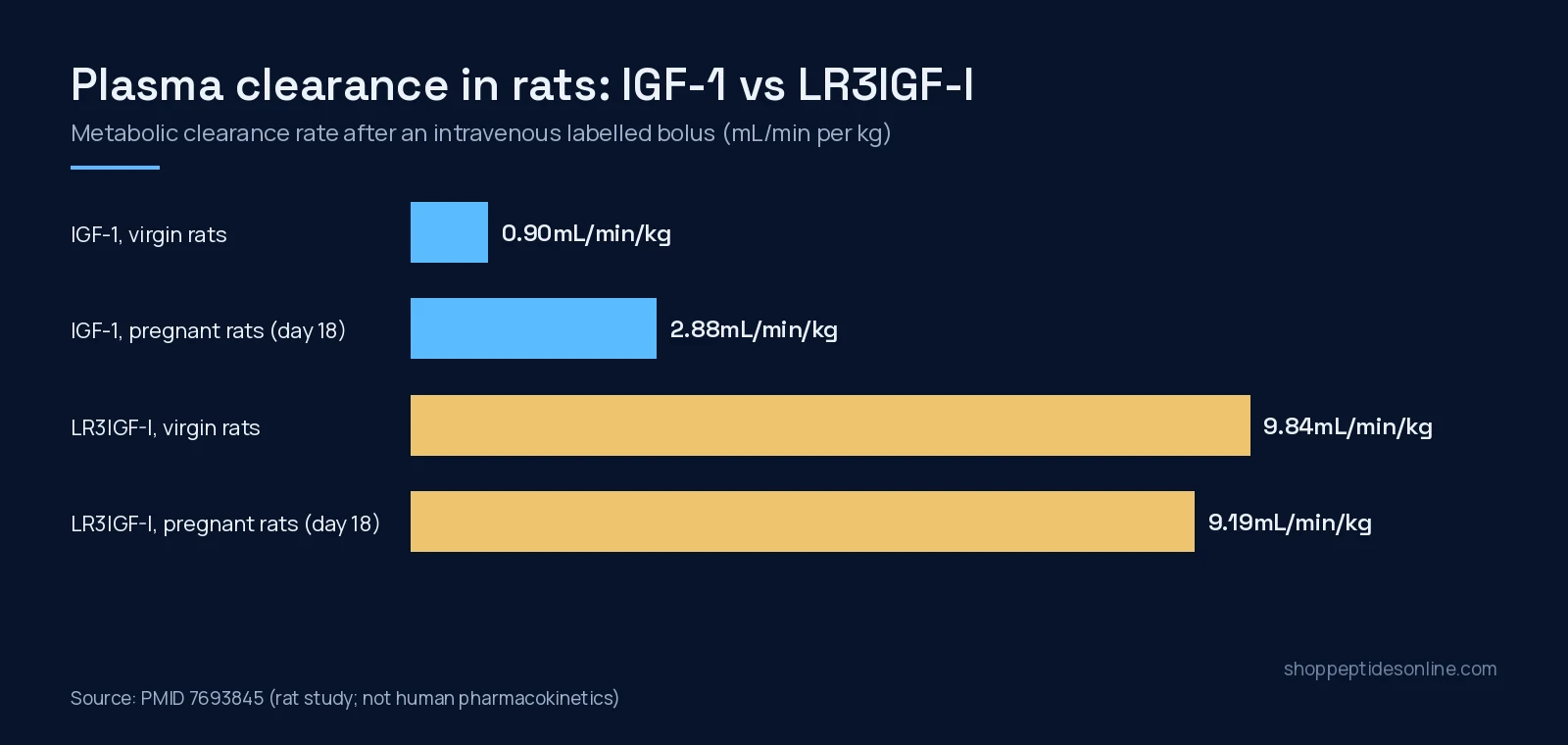
Clearance. In catheterised rats, IGF-1 had a metabolic clearance rate of 0.90 mL/min per kg in virgin animals and 2.88 in pregnant animals, when plasma IGFBP-3 falls. LR3IGF-I was cleared at 9.84 and 9.19 respectively, mostly as free peptide, with more breakdown products in plasma[8]. Escaping the binding proteins exposes the analogue to faster removal.
Potency in a catabolic model. In rats given dexamethasone, both des(1-3)IGF-I and LR3IGF-I were about 2.5 times as potent as IGF-1 on body weight and nitrogen retention, even though LR3 binds the type 1 receptor about 3-fold less well. The authors linked this to the rise in plasma IGFBP-3 in that model, which would hold back IGF-1 but not the variants[7].
Tissue effects and limits. In guinea pigs, a 7-day infusion of LR3IGF-I increased the relative weight of adrenals, gut, kidneys and spleen, but neither IGF-1 nor LR3 increased overall growth, feed intake or body composition[10]. In anaesthetised rats both IGF-1 and LR3IGF-I lowered mean arterial blood pressure[11]. These are animal findings and don’t predict effects in people.
Telling them apart in the lab
Because LR3 is IGF-1 plus 13 residues, intact-mass spectrometry separates the two easily. That matters in practice. Analysts examining a seized injection vial used nano-UPLC, high-resolution mass spectrometry of the intact and digested protein, and an immunoassay to identify not IGF-1 but His-tagged Long R3 IGF-I, a form usually made for biochemical work[15].
For a 7.6 kDa disulfide-bonded protein, a useful batch report gives HPLC purity and an intact mass near 7,649 Da. Our IGF-1 1mg listing is labelled native IGF-1. No batch certificate is posted for it yet, so check the COA library before ordering. HPLC purity vs mass spectrometry identity explains what each test shows, and lyophilized vs reconstituted peptides covers storage.
For the full catalogue, see our research peptides or the guide to buy peptides online in Canada.
Frequently asked questions
What is the difference between IGF-1 and IGF-1 LR3?
IGF-1 is the native 70-residue human hormone. IGF-1 LR3 (Long R3 IGF-I) is an engineered analogue with arginine in place of glutamate at position 3 and a 13-residue extension on the N-terminus. The changes sharply reduce binding to IGF-binding proteins, which is why LR3 is more potent than IGF-1 in many cell-culture assays.
Does IGF-1 LR3 last longer than IGF-1?
Not in the published rat data. In virgin rats, labelled LR3IGF-I was cleared from plasma about ten times faster than IGF-1 and circulated mostly as free peptide, while IGF-1 was mainly carried in the 150 kDa binding-protein complex. Its greater potency in some models is linked to escaping binding-protein sequestration, not to slower clearance.
Why is LR3 more potent in cell culture?
Cultured cells secrete IGF-binding proteins that hold IGF-1 away from its receptor. Analogues that bind those proteins poorly, such as des(1-3)IGF-I and the Arg3 variants, stay available to the receptor. LR3 actually binds the type 1 IGF receptor slightly less well than IGF-1.
Does Shop Peptides Online sell IGF-1 LR3?
No. SPO lists IGF-1 1mg, labelled as native IGF-1, and does not sell IGF-1 LR3. No batch certificate is posted yet for the IGF-1 1mg listing; check the COA library before ordering.
How can a lab tell IGF-1 and LR3 apart?
By intact mass. LR3 carries a 13-residue extension, so its mass is clearly higher than native IGF-1’s 7,649 Da. Mass spectrometry of the intact and digested protein was how analysts identified a His-tagged Long R3 IGF-I in a seized vial.
Is IGF-1 an approved drug?
Recombinant human IGF-1, mecasermin, is approved in the United States and the European Union for a rare form of IGF-1 deficiency. IGF-1 LR3 has no approval anywhere and is a research reagent. Neither is sold by SPO for human use.
References
- Laajoki LG, Francis GL, Wallace JC et al. (2000). Solution structure and backbone dynamics of long-[Arg(3)]insulin-like growth factor-I. J Biol Chem. PMID: 10744677. doi: 10.1074/jbc.275.14.10009.
- Francis GL, Ross M, Ballard FJ et al. (1992). Novel recombinant fusion protein analogues of insulin-like growth factor (IGF)-I indicate the relative importance of IGF-binding protein and receptor binding for enhanced biological potency. J Mol Endocrinol. PMID: 1378742. doi: 10.1677/jme.0.0080213.
- King R, Wells JR, Krieg P et al. (1992). Production and characterization of recombinant insulin-like growth factor-I (IGF-I) and potent analogues of IGF-I, with Gly or Arg substituted for Glu3, following their expression in Escherichia coli as fusion proteins. J Mol Endocrinol. PMID: 1311930. doi: 10.1677/jme.0.0080029.
- Bach LA (2018). IGF-binding proteins. J Mol Endocrinol. PMID: 29255001. doi: 10.1530/JME-17-0254.
- Ross M, Francis GL, Szabo L et al. (1989). Insulin-like growth factor (IGF)-binding proteins inhibit the biological activities of IGF-1 and IGF-2 but not des-(1-3)-IGF-1. Biochem J. PMID: 2539101. doi: 10.1042/bj2580267.
- Ballard FJ, Wallace JC, Francis GL et al. (1996). Des(1-3)IGF-I: a truncated form of insulin-like growth factor-I. Int J Biochem Cell Biol. PMID: 8930132. doi: 10.1016/1357-2725(96)00056-8.
- Tomas FM, Knowles SE, Owens PC et al. (1992). Insulin-like growth factor-I (IGF-I) and especially IGF-I variants are anabolic in dexamethasone-treated rats. Biochem J. PMID: 1371669. doi: 10.1042/bj2820091.
- Bastian SE, Walton PE, Wallace JC et al. (1993). Plasma clearance and tissue distribution of labelled insulin-like growth factor-I (IGF-I) and an analogue LR3IGF-I in pregnant rats. J Endocrinol. PMID: 7693845. doi: 10.1677/joe.0.1380327.
- Xi G, Kamanga-Sollo E, Pampusch MS et al. (2004). Effect of recombinant porcine IGFBP-3 on IGF-I and long-R3-IGF-I-stimulated proliferation and differentiation of L6 myogenic cells. J Cell Physiol. PMID: 15254966. doi: 10.1002/jcp.20068.
- Conlon MA, Tomas FM, Owens PC et al. (1995). Long R3 insulin-like growth factor-I (IGF-I) infusion stimulates organ growth but reduces plasma IGF-I, IGF-II and IGF binding protein concentrations in the guinea pig. J Endocrinol. PMID: 7561636. doi: 10.1677/joe.0.1460247.
- Gillespie CM, Merkel AL, Martin AA (1997). Effects of insulin-like growth factor-I and LR3IGF-I on regional blood flow in normal rats. J Endocrinol. PMID: 9415069. doi: 10.1677/joe.0.1550351.
- Vajdos FF, Ultsch M, Schaffer ML et al. (2001). Crystal structure of human insulin-like growth factor-1: detergent binding inhibits binding protein interactions. Biochemistry. PMID: 11551198. doi: 10.1021/bi0109111.
- Ullrich A, Gray A, Tam AW et al. (1986). Insulin-like growth factor I receptor primary structure: comparison with insulin receptor suggests structural determinants that define functional specificity. EMBO J. PMID: 2877871. doi: 10.1002/j.1460-2075.1986.tb04528.x.
- Yakar S, Liu JL, Stannard B et al. (1999). Normal growth and development in the absence of hepatic insulin-like growth factor I. Proc Natl Acad Sci U S A. PMID: 10377413. doi: 10.1073/pnas.96.13.7324.
- Kohler M, Thomas A, Walpurgis K et al. (2010). Detection of His-tagged Long-R³-IGF-I in a black market product. Growth Horm IGF Res. PMID: 20675162. doi: 10.1016/j.ghir.2010.07.001.
- Keating GM (2008). Mecasermin. BioDrugs. PMID: 18481900. doi: 10.2165/00063030-200822030-00004.