For laboratory research only. Not for human or animal use. This article gives no dosing, administration or therapeutic advice.
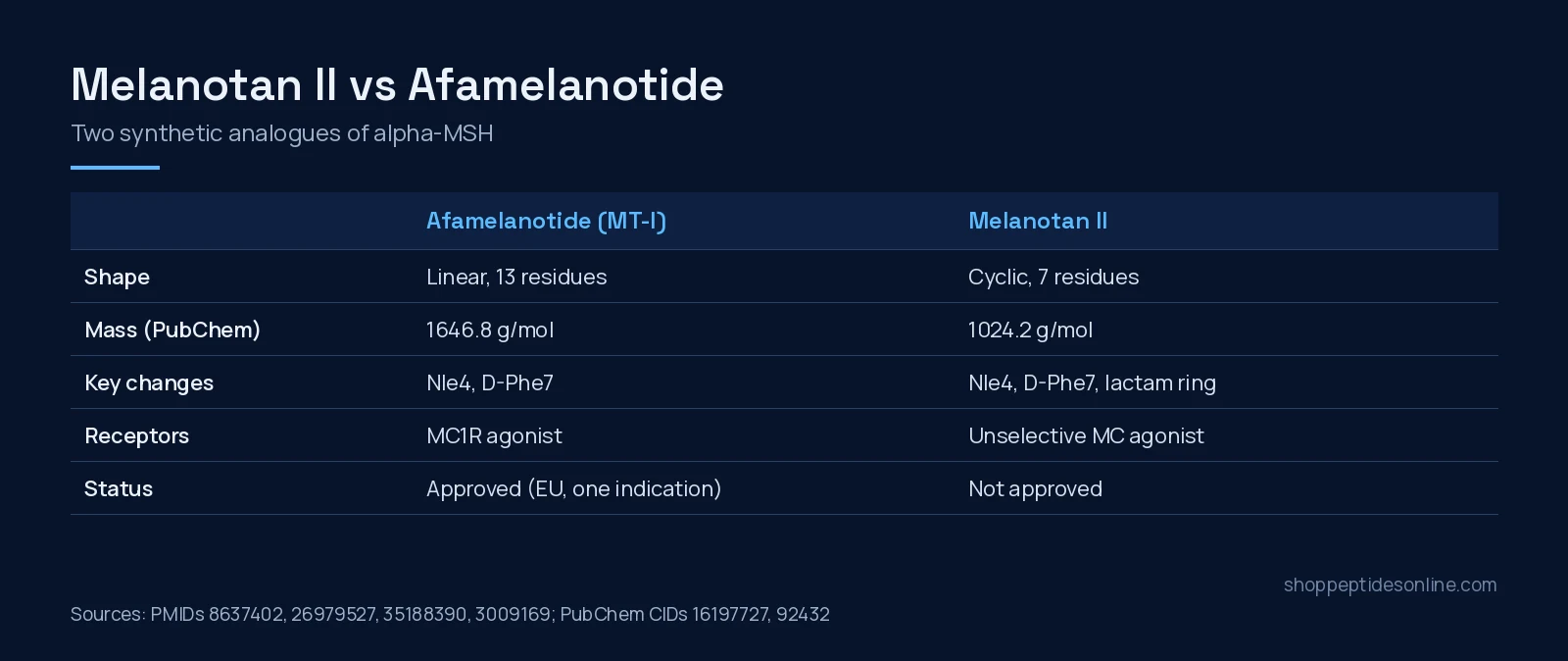
Short answer: Both are synthetic analogues of α-melanocyte-stimulating hormone (α-MSH). Afamelanotide, also called Melanotan I or NDP-MSH, is the full 13-residue α-MSH sequence with two substitutions, norleucine at position 4 and D-phenylalanine at position 7 (PubChem CID 16197727). Melanotan II is a shorter, lactam-bridged cyclic heptapeptide built on α-MSH(4–10)[1]. Afamelanotide is described as a melanocortin-1 receptor (MC1R) agonist and is an approved medicine in the EU[2]. Melanotan II is a potent but unselective agonist across human melanocortin receptors[3] and has no approval.
Side by side
| Afamelanotide (Melanotan I, NDP-MSH) | Melanotan II | |
|---|---|---|
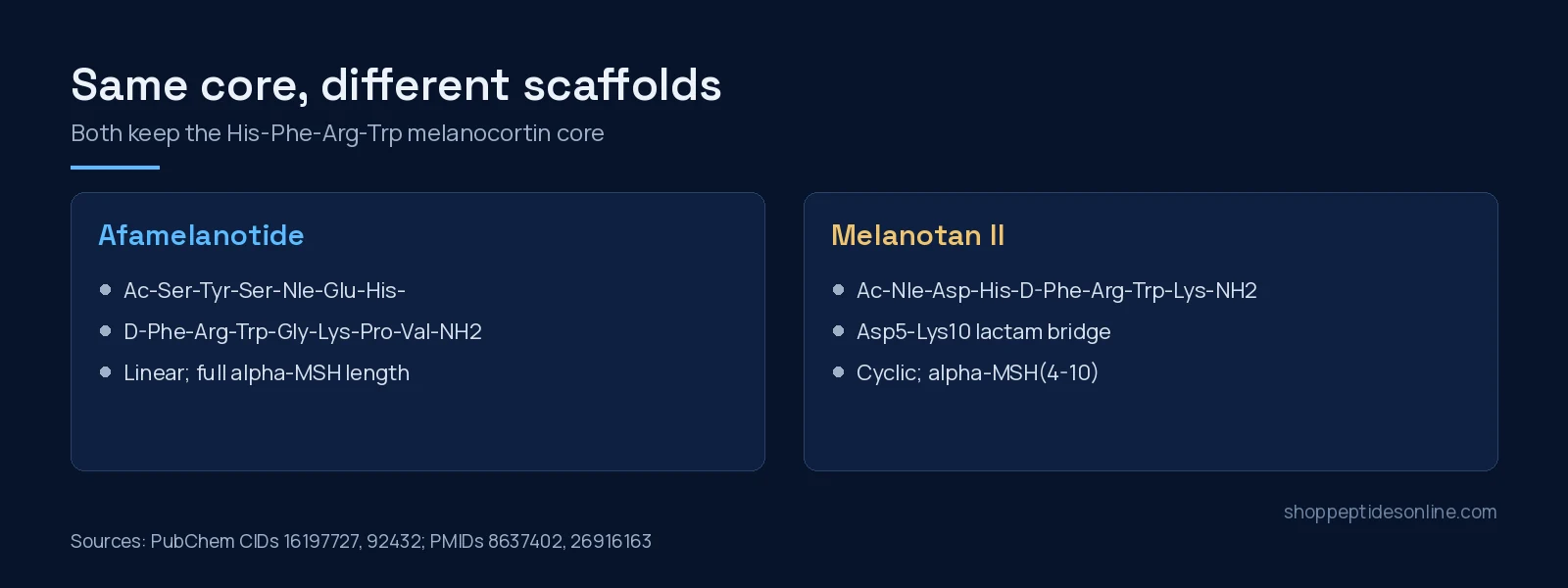
| Structure | Linear 13-mer: Ac-Ser-Tyr-Ser-Nle-Glu-His-D-Phe-Arg-Trp-Gly-Lys-Pro-Val-NH2 (PubChem) | Cyclic heptapeptide: Ac-Nle4-Asp5-His6-D-Phe7-Arg8-Trp9-Lys10 α-MSH(4–10)-NH2, lactam-bridged[1] |
| Formula (PubChem) | C78H111N21O19, 1646.8 g/mol (CID 16197727) | C50H69N15O9, 1024.2 g/mol (CID 92432) |
| Potency vs α-MSH | 100-fold more effective on melanoma-cell tyrosinase, with a sustained effect[4] | “Superpotent” melanotropic activity in vitro[1] |
| Receptor profile | Described as a first-in-class MC1R agonist[2] | Potent, unselective agonist of human MC receptors[3] |
| Stability | Very slowly biodegraded in vivo (mice)[5] | Cyclisation used to constrain conformation[3] |
| Status | Approved in the EU for one rare indication[2][6] | Not approved; unregulated products documented[6][7] |
| At SPO | Not sold | Melanotan 2 10mg research material |
The receptor family they target
The melanocortin system has five closely related G-protein-coupled receptors, MC1R to MC5R. Their natural agonists come from processing of proopiomelanocortin (POMC): ACTH for MC2R, and α-, β- and γ-MSH for the others. All share the core sequence His-Phe-Arg-Trp, conserved through evolution, and that shared core is why selective ligands for MC1R, MC3R, MC4R and MC5R have been hard to design[8].
Afamelanotide: a stabilised full-length α-MSH
[Nle4, D-Phe7]-α-MSH keeps all 13 residues of α-MSH. Norleucine replaces the methionine at position 4, and D-phenylalanine replaces L-phenylalanine at position 7 (sequence from PubChem).
In Cloudman S91 melanoma cells it was 100-fold more effective than α-MSH at stimulating tyrosinase, by minimum effective concentration. Its effect also persisted for up to 72 hours after the peptide was washed out, while α-MSH’s effect faded[4]. A mouse toxicology study described it as very slowly biodegraded in vivo and active at one-thousandth of the concentration of natural α-MSH[5].
Under the name afamelanotide it became an approved medicine in the EU for one rare photosensitivity disorder, given as a controlled-release implant[2]. A dermatology review notes it is the only α-MSH analogue approved for medical use[6].
Melanotan II: shorter and cyclic
Melanotan II keeps only the 4–10 segment of α-MSH, which contains the His-Phe-Arg-Trp core. An aspartate at position 5 and a lysine at position 10 are joined by a lactam bridge, closing the peptide into a ring, with the same Nle4 and D-Phe7 substitutions as afamelanotide[1].
The ring makes it potent but not selective. A 2022 medicinal chemistry study called it “a potent and unselective agonist” of human MC receptors. Replacing the lactam with different xylene-based thioether links produced analogues with affinities from low nanomolar to sub-micromolar, and one, compound 5, showed marked functional selectivity for hMC1R[3]. That is a useful demonstration that the cyclisation chemistry, not just the sequence, sets receptor preference.
In rats, melanotan II has been studied in a sciatic nerve crush model, where it improved recovery of sensory function at one of three doses tested[9]. Like all findings here, that is an animal result.
Identity and purity matter here
Melanotan II is a well-documented case of products sold outside any regulated supply chain. Analysts built LC-UV and LC-MS/MS methods to test vials bought from three online shops, identifying the peptide by retention time and five qualifying fragment ions from the doubly charged precursor (m/z 513). Vials from two shops contained 4.1–5.9% unknown impurities, and the measured content varied between vials[7].
A dermatology review describes risks of unregulated melanotan I and II use, including case reports of changes in moles[6]. Research material should come with batch data you can check. Our guides to HPLC purity vs mass spectrometry identity and measured content vs label explain what to look for.
Shop Peptides Online supplies melanotan 2 for laboratory research only, not for human or animal use. For the full catalogue, see our guide to buy peptides online in Canada.
Frequently asked questions
Is afamelanotide the same as Melanotan I?
Yes. Afamelanotide, Melanotan I and NDP-MSH are names for [Nle4, D-Phe7]-α-MSH, the full 13-residue α-MSH sequence with norleucine at position 4 and D-phenylalanine at position 7.
How is melanotan II different structurally?
Melanotan II is a cyclic heptapeptide based on α-MSH(4-10). An aspartate and a lysine are linked by a lactam bridge, making it shorter and ring-shaped, unlike linear afamelanotide.
Which melanocortin receptors does melanotan II activate?
It is described as a potent but unselective agonist of human melanocortin receptors. Afamelanotide is described as an MC1R agonist.
Are either of these approved medicines?
Afamelanotide is approved in the EU for one rare photosensitivity disorder. Melanotan II has no approval anywhere.
Does Shop Peptides Online sell afamelanotide?
No. SPO lists melanotan 2 10mg as laboratory research material only, not for human or animal use.
References
- Dorr RT, Lines R, Levine N et al. (1996). Evaluation of melanotan-II, a superpotent cyclic melanotropic peptide in a pilot phase-I clinical study. Life Sci. PMID: 8637402. doi: 10.1016/0024-3205(96)00160-9.
- Kim ES, Garnock-Jones KP (2016). Afamelanotide: A Review in Erythropoietic Protoporphyria. Am J Clin Dermatol. PMID: 26979527. doi: 10.1007/s40257-016-0184-6.
- Tomassi S, Dimmito MP, Cai M et al. (2022). CLIPSing Melanotan-II to Discover Multiple Functionally Selective hMCR Agonists. J Med Chem. PMID: 35188390. doi: 10.1021/acs.jmedchem.1c01848.
- Hadley ME, Abdel Malek ZA, Marwan MM et al. (1985). [Nle4, D-Phe7]-alpha-MSH: a superpotent melanotropin that “irreversibly” activates melanoma tyrosinase. Endocr Res. PMID: 3009169. doi: 10.1080/07435808509032974.
- Dorr RT, Dawson BV, al-Obeidi F et al. (1988). Toxicologic studies of a superpotent alpha-melanotropin, [Nle4, D-Phe7]alpha-MSH. Invest New Drugs. PMID: 2852652. doi: 10.1007/BF00173642.
- Habbema L, Halk AB, Neumann M et al. (2017). Risks of unregulated use of alpha-melanocyte-stimulating hormone analogues: a review. Int J Dermatol. PMID: 28266027. doi: 10.1111/ijd.13585.
- Breindahl T, Evans-Brown M, Hindersson P et al. (2015). Identification and characterization by LC-UV-MS/MS of melanotan II skin-tanning products sold illegally on the Internet. Drug Test Anal. PMID: 24771717. doi: 10.1002/dta.1655.
- Cai M, Hruby VJ (2016). The Melanocortin Receptor System: A Target for Multiple Degenerative Diseases. Curr Protein Pept Sci. PMID: 26916163. doi: 10.2174/1389203717666160226145330.
- Ter Laak MP, Brakkee JH, Adan RA et al. (2003). The potent melanocortin receptor agonist melanotan-II promotes peripheral nerve regeneration and has neuroprotective properties in the rat. Eur J Pharmacol. PMID: 12591111. doi: 10.1016/s0014-2999(02)02945-x.