For laboratory research only. Not for human or animal use. This article gives no dosing, administration or therapeutic advice.
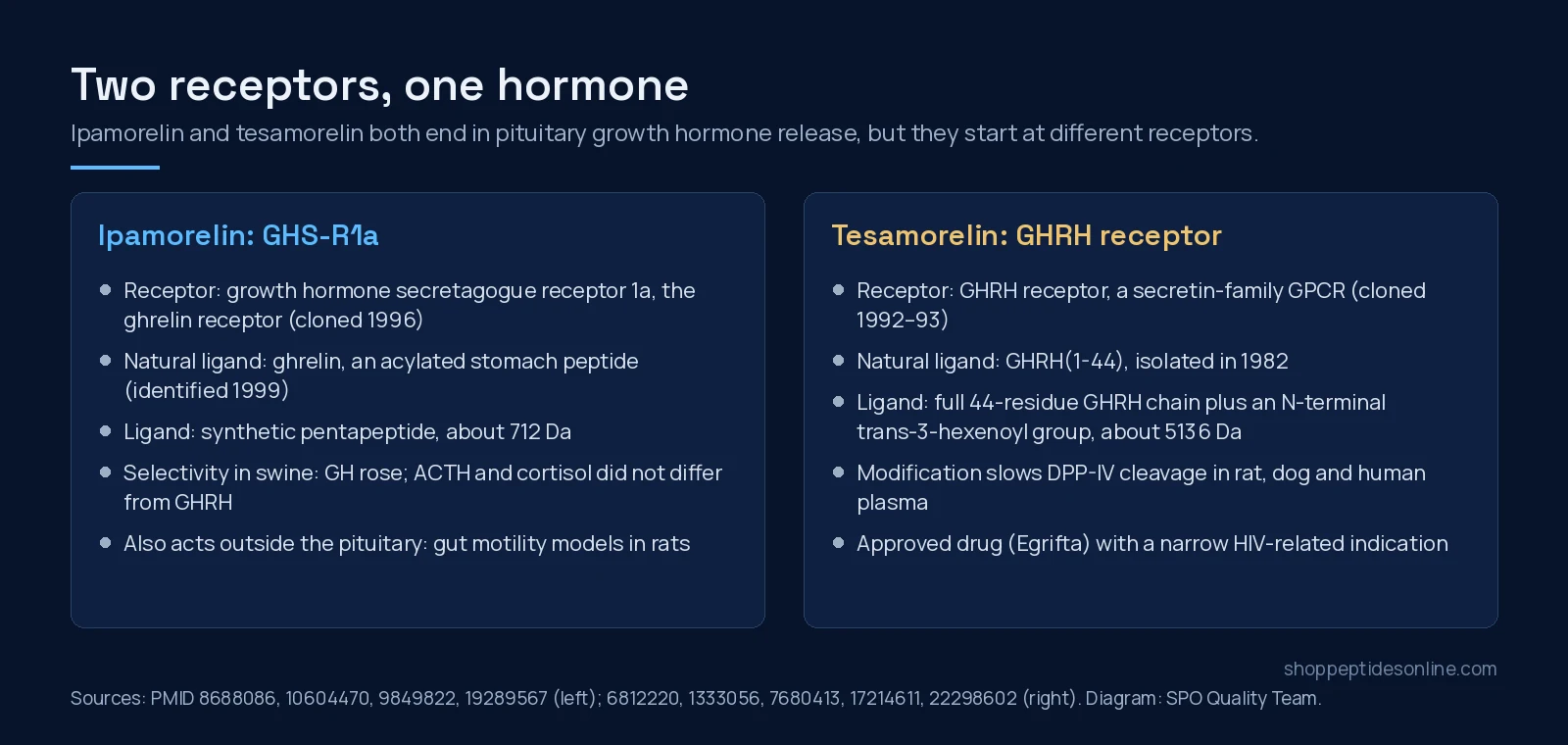
Short answer: ipamorelin and tesamorelin are often filed together because both raise growth hormone (GH) in experimental models, but they are different molecules acting on different receptors. Ipamorelin is a synthetic five-residue peptide that activates the growth hormone secretagogue receptor (GHS-R1a), the receptor later shown to bind the stomach hormone ghrelin[1],[2],[3]. Tesamorelin is the full 44-residue growth hormone-releasing hormone (GHRH) sequence with one chemical addition at its N-terminus, and it acts on the GHRH receptor[4],[5]. One is an investigational compound whose only published phase 2 trial found no significant difference from placebo; the other is an approved drug with a narrow indication[6],[7]. That split, receptor and regulatory, is what this comparison is about.
Two receptors, found fifteen years apart
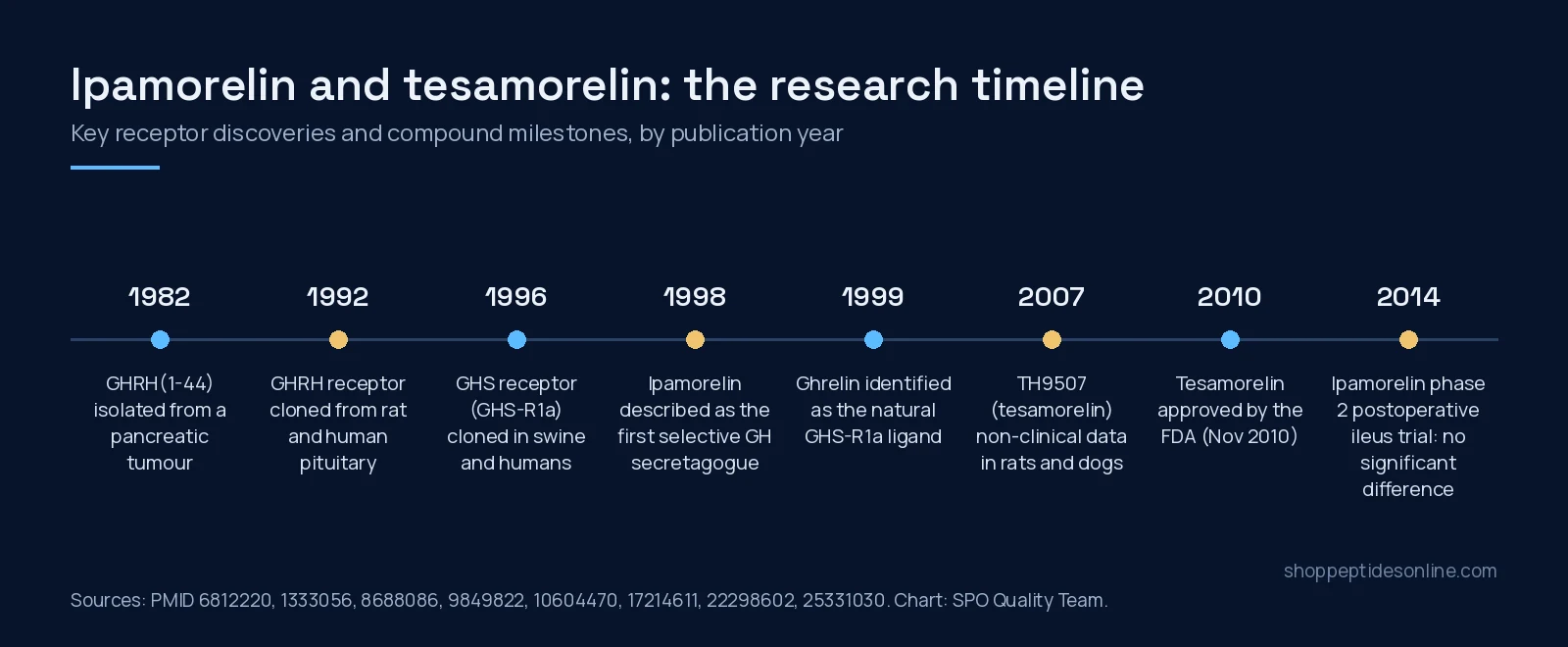
The GHRH side of the story starts in 1982, when a 44-amino-acid peptide with GH-releasing activity was isolated from a human pancreatic tumour that had caused acromegaly; the synthetic copy was fully active in vitro and in vivo[4]. Its receptor was cloned about a decade later. Mayo’s group isolated a rat pituitary cDNA and its human homolog, expressed it in human kidney 293 cells, and showed high-affinity GHRH binding and cAMP production[8]. Gaylinn and colleagues cloned the human receptor from an acromegalic pituitary library and placed it in the secretin family of GPCRs, with 47% identity to the VIP receptor[9].
The ghrelin receptor came from the opposite direction. Small synthetic GH secretagogues existed before anyone knew what they bound. In 1996 Howard and colleagues cloned the G protein-coupled receptor these compounds act on from swine and human pituitary and hypothalamus, and noted that the secretagogues seemed to mimic “an undiscovered hormone”[1]. Kojima and colleagues found that hormone three years later: ghrelin, an acylated peptide from the stomach[2]. Ipamorelin was designed inside this synthetic secretagogue programme, so it came before its receptor’s natural ligand was known[3].
Because the two receptors are different proteins with different natural ligands, an experiment that uses one compound tells you little about the other. That is the most common mistake in how these two are compared online. Comparison pages tend to put them on a single “which works better” scale, as if they were two strengths of one thing.
Identity side by side
| Property | Ipamorelin | Tesamorelin |
|---|---|---|
| Class | Growth hormone secretagogue (GHRP-type) pentapeptide[3] | GHRH(1-44) analogue[5] |
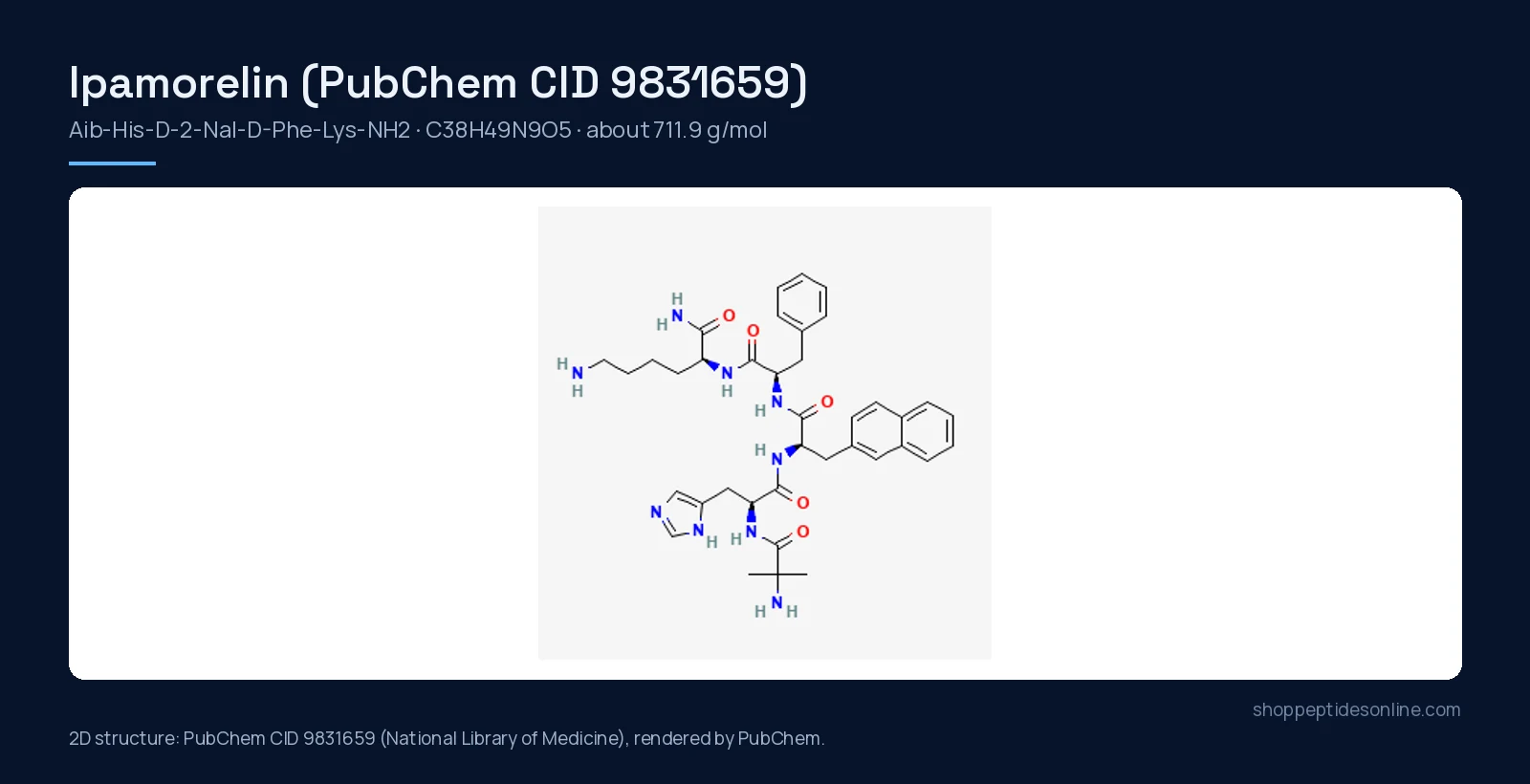
| Sequence / structure | Aib-His-D-2-Nal-D-Phe-Lys-NH2; derived from a series lacking the central Ala-Trp of GHRP-1[3] | Human GHRH(1-44)-NH2 with a trans-3-hexenoyl group on Tyr1[5] |
| Molecular formula / weight | C38H49N9O5, about 711.9 g/mol (PubChem CID 9831659) | C221H366N72O67S, about 5136 g/mol (PubChem CID 16137828) |
| Receptor | GHS-R1a (ghrelin receptor)[1],[3] | GHRH receptor, secretin-family GPCR[8],[9] |
| Development codes | NNC 26-0161 (Novo Nordisk) | TH9507; marketed as Egrifta |
| Regulatory status | Investigational; ChEMBL lists max phase 2[6] | FDA-approved in November 2010 for a single HIV-related indication[7],[10] |
| Anti-doping status | GHRPs are on the WADA Prohibited List[11] | GHRH and its analogues are prohibited by WADA[12] |
What each compound has been studied in, by model
Ipamorelin
Rat pituitary cells and anaesthetised rats. Raun and colleagues reported that ipamorelin released GH from primary rat pituitary cells with potency and efficacy similar to GHRP-6, and that antagonist profiling put its action on the GHRP-type receptor, not the GHRH receptor[3].
Swine, the selectivity finding. In conscious swine, GHRP-6 and GHRP-2 raised ACTH and cortisol. Ipamorelin did not raise them to levels significantly different from those after GHRH, even at doses more than 200-fold above its ED50 for GH release. FSH, LH, prolactin and TSH did not change with any secretagogue tested[3]. This is the origin of the phrase “selective GH secretagogue”, and it is a swine result from one research group.
Rat bone studies, with a caveat. In adult female rats, ipamorelin increased longitudinal bone growth rate dose-dependently, without changing total IGF-I or serum bone-turnover markers[13]. A 12-week rat study found higher bone mineral content with ipamorelin, GHRP-6 or GH, but once bone mineral content was corrected for the rise in body weight, the ratio was unaffected[14]. The second paper matters: it suggests much of the headline effect tracked body size.
A mouse result that complicates the “GH peptide” label. In GH-deficient (lit/lit) and GH-intact mice, ipamorelin raised fat pad weight relative to body weight, and GH-secretagogue treatment raised serum leptin and food intake, while GH itself did not. The authors concluded that secretagogues increase body fat through GH-independent mechanisms that may include feeding[15]. So a GHS-R1a agonist cannot be treated as a simple stand-in for GH.
Gut motility, and the negative trial. Ghrelin-receptor agonists also affect the gut. In a rat model of postoperative ileus, repeated ipamorelin shortened recovery measures compared with vehicle[16]. The follow-up phase 2, randomised, placebo-controlled trial in bowel-resection patients (114 in the analysed population) found no significant differences between ipamorelin and placebo on its key or secondary efficacy endpoints[6]. Published development appears to stop there. It is the clearest example in this pair of a rodent signal that did not carry over.
Tesamorelin
Plasma stability, three species. The trans-3-hexenoyl group was added to resist dipeptidyl aminopeptidase-IV (DPP-IV), which inactivates native GHRH. Compared with natural hGRF(1-44)-NH2, it slowed in vitro degradation in rat, dog and human plasma and prolonged in vivo elimination[5].
Pigs, rats and dogs. Repeated dosing raised plasma GH and IGF-1 in all three species. Four-month toxicity studies in rats and dogs showed increased body-weight gain, and dogs showed more pronounced, reversible adverse findings (liver and kidney findings, anaemia, organ-weight effects), which the authors attributed to prolonged exposure[5]. A dog study also compared pulmonary and subcutaneous delivery; terminal half-life was similar by both routes[17].
Human trials, stated neutrally. Tesamorelin went through randomised, placebo-controlled phase 3 trials in people with HIV and abdominal fat accumulation[18],[19]. The FDA approved it in November 2010 for HIV-associated lipodystrophy, and a 2011 review describes it as the only treatment indicated for that narrow use[7],[10]. That is an approval for one defined population. It is not evidence for anything else. Other investigational uses, including cognition in older adults, were studied in separate trials[20],[21]. In Canada, Health Canada’s Drug Product Database lists an Egrifta DIN marketed from 2015 with the status “Cancelled Post Market” (2022). Research-grade tesamorelin is a different product from any approved drug and has no therapeutic standing.
Pharmacokinetics: why the sizes matter
Molecular size shapes how each peptide behaves. Ipamorelin, at about 712 Da, showed dose-proportional kinetics and a short terminal half-life of about 2 hours in a healthy-volunteer PK/PD study; each infusion produced a single episode of GH release[22]. Tesamorelin, about seven times heavier, depends on its N-terminal modification to survive DPP-IV, and a population PK model found that age, body size, race and health status were not related to its clearance[5],[23]. For an analytical lab the size gap has a practical side, because the two compounds need different identity methods. A 712 Da pentapeptide and a 5.1 kDa 44-mer sit in very different mass ranges, and anti-doping labs have built separate LC-MS methods for GHRPs and for GHRH analogues[11],[12]. Our post on HPLC purity versus mass-spec identity explains why the mass reading on a certificate matters.
Why identity checks matter for this pair
Both compounds circulate outside approved channels. A 2018 analysis of black-market products found a glycine-extended “Gly-ipamorelin” analogue, confirmed by high-resolution mass spectrometry and custom synthesis[24]. A 2026 review of GH-axis peptides sold as research compounds names both ipamorelin and tesamorelin, and highlights uncertain product composition as a core problem[25]. For a lab, that is the case for batch COAs with both HPLC purity and an MS mass match. SPO posts tesamorelin reports in its COA library; the tesamorelin research overview and the ipamorelin research overview carry each compound’s full identity data and study tables. If you are sourcing either for a study, compare suppliers on those documents before you buy peptides online in Canada.
What neither literature shows
- No head-to-head study of ipamorelin against tesamorelin appeared in our PubMed searches. Any “which is better” claim is extrapolation across different models and endpoints.
- Ipamorelin’s selectivity data come from swine and rats in the late 1990s[3]; the one controlled clinical efficacy trial was negative[6].
- Tesamorelin’s human data come from specific clinical populations[19]; they say nothing about research-grade material or other settings.
- The mouse adiposity result[15] shows that GHS-R1a agonism has effects GH itself does not, so results from one receptor pathway should not be read across to the other.
Frequently asked questions
Do ipamorelin and tesamorelin act on the same receptor?
No. Ipamorelin activates GHS-R1a, the ghrelin receptor. Tesamorelin is a GHRH analogue and acts on the GHRH receptor, a different secretin-family GPCR. Both pathways end in pituitary GH release.
Is tesamorelin an approved drug?
The FDA approved tesamorelin (Egrifta) in November 2010 for one indication, HIV-associated lipodystrophy. In Canada, the Drug Product Database lists an Egrifta DIN with the status Cancelled Post Market. Research-grade material has no therapeutic standing.
Has ipamorelin been tested in a clinical trial?
Yes. A phase 2 randomised, placebo-controlled trial in postoperative ileus after bowel resection found no significant differences from placebo on its key or secondary efficacy endpoints.
Why is ipamorelin called selective?
In conscious swine, ipamorelin raised GH without raising ACTH or cortisol beyond GHRH levels, while GHRP-6 and GHRP-2 raised both. That finding comes from one 1998 animal study.
How can a lab tell the two apart analytically?
By mass. Ipamorelin is about 712 Da and tesamorelin about 5136 Da, so a mass-spectrometry identity result on the COA separates them clearly. HPLC purity alone does not confirm identity.
References
- Howard AD, Feighner SD, Cully DF et al. (1996). A receptor in pituitary and hypothalamus that functions in growth hormone release. Science. PMID: 8688086. doi: 10.1126/science.273.5277.974.
- Kojima M, Hosoda H, Date Y et al. (1999). Ghrelin is a growth-hormone-releasing acylated peptide from stomach. Nature. PMID: 10604470. doi: 10.1038/45230.
- Raun K, Hansen BS, Johansen NL et al. (1998). Ipamorelin, the first selective growth hormone secretagogue. Eur J Endocrinol. PMID: 9849822. doi: 10.1530/eje.0.1390552.
- Guillemin R, Brazeau P, Böhlen P et al. (1982). Growth hormone-releasing factor from a human pancreatic tumor that caused acromegaly. Science. PMID: 6812220. doi: 10.1126/science.6812220.
- Ferdinandi ES, Brazeau P, High K et al. (2007). Non-clinical pharmacology and safety evaluation of TH9507, a human growth hormone-releasing factor analogue. Basic Clin Pharmacol Toxicol. PMID: 17214611. doi: 10.1111/j.1742-7843.2007.00008.x.
- Beck DE, Sweeney WB, McCarter MD et al. (2014). Prospective, randomized, controlled, proof-of-concept study of the Ghrelin mimetic ipamorelin for the management of postoperative ileus in bowel resection patients. Int J Colorectal Dis. PMID: 25331030. doi: 10.1007/s00384-014-2030-8.
- Spooner LM, Olin JL (2012). Tesamorelin: a growth hormone-releasing factor analogue for HIV-associated lipodystrophy. Ann Pharmacother. PMID: 22298602. doi: 10.1345/aph.1Q629.
- Mayo KE (1992). Molecular cloning and expression of a pituitary-specific receptor for growth hormone-releasing hormone. Mol Endocrinol. PMID: 1333056. doi: 10.1210/mend.6.10.1333056.
- Gaylinn BD, Harrison JK, Zysk JR et al. (1993). Molecular cloning and expression of a human anterior pituitary receptor for growth hormone-releasing hormone. Mol Endocrinol. PMID: 7680413. doi: 10.1210/mend.7.1.7680413.
- Dhillon S (2011). Tesamorelin: a review of its use in the management of HIV-associated lipodystrophy. Drugs. PMID: 21668043. doi: 10.2165/11202240-000000000-00000.
- Semenistaya E, Zvereva I, Thomas A et al. (2015). Determination of growth hormone releasing peptides metabolites in human urine after nasal administration of GHRP-1, GHRP-2, GHRP-6, Hexarelin, and Ipamorelin. Drug Test Anal. PMID: 25869809. doi: 10.1002/dta.1787.
- Memdouh S, Gavrilović I, Ng K et al. (2021). Advances in the detection of growth hormone releasing hormone synthetic analogs. Drug Test Anal. PMID: 34665524. doi: 10.1002/dta.3183.
- Johansen PB, Nowak J, Skjaerbaek C et al. (1999). Ipamorelin, a new growth-hormone-releasing peptide, induces longitudinal bone growth in rats. Growth Horm IGF Res. PMID: 10373343. doi: 10.1054/ghir.1999.9998.
- Svensson J, Lall S, Dickson SL et al. (2000). The GH secretagogues ipamorelin and GH-releasing peptide-6 increase bone mineral content in adult female rats. J Endocrinol. PMID: 10828840. doi: 10.1677/joe.0.1650569.
- Lall S, Tung LY, Ohlsson C et al. (2001). Growth hormone (GH)-independent stimulation of adiposity by GH secretagogues. Biochem Biophys Res Commun. PMID: 11162489. doi: 10.1006/bbrc.2000.4065.
- Venkova K, Mann W, Nelson R et al. (2009). Efficacy of ipamorelin, a novel ghrelin mimetic, in a rodent model of postoperative ileus. J Pharmacol Exp Ther. PMID: 19289567. doi: 10.1124/jpet.108.149211.
- Jansen M, Darby I, Abribat T et al. (2004). Pulmonary delivery of TH9507, a growth hormone releasing factor analogue, in the dog. Int J Pharm. PMID: 15113616. doi: 10.1016/j.ijpharm.2004.02.012.
- Falutz J, Allas S, Blot K et al. (2007). Metabolic effects of a growth hormone-releasing factor in patients with HIV. N Engl J Med. PMID: 18057338. doi: 10.1056/NEJMoa072375.
- Falutz J, Mamputu JC, Potvin D et al. (2010). Effects of tesamorelin (TH9507), a growth hormone-releasing factor analog, in human immunodeficiency virus-infected patients with excess abdominal fat: a pooled analysis of two multicenter, double-blind placebo-controlled phase 3 trials with safety extension data. J Clin Endocrinol Metab. PMID: 20554713. doi: 10.1210/jc.2010-0490.
- Tomlinson B (2006). Drug evaluation: tesamorelin, a synthetic human growth hormone releasing factor. Curr Opin Investig Drugs. PMID: 17086939.
- Baker LD, Barsness SM, Borson S et al. (2012). Effects of growth hormone–releasing hormone on cognitive function in adults with mild cognitive impairment and healthy older adults: results of a controlled trial. Arch Neurol. PMID: 22869065. doi: 10.1001/archneurol.2012.1970.
- Gobburu JV, Agersø H, Jusko WJ et al. (1999). Pharmacokinetic-pharmacodynamic modeling of ipamorelin, a growth hormone releasing peptide, in human volunteers. Pharm Res. PMID: 10496658. doi: 10.1023/a:1018955126402.
- González-Sales M, Barrière O, Tremblay PO et al. (2015). Population pharmacokinetic analysis of tesamorelin in HIV-infected patients and healthy subjects. Clin Pharmacokinet. PMID: 25358450. doi: 10.1007/s40262-014-0202-x.
- Krug O, Thomas A, Malerød-Fjeld H et al. (2018). Analysis of new growth promoting black market products. Growth Horm IGF Res. PMID: 29864719. doi: 10.1016/j.ghir.2018.05.001.
- Dominikowski A, Rękoś Z, Olejarz M et al. (2026). The emerging landscape of performance-enhancing peptides modulating GH-IGF1 axis: bridging the gap between clinical evidence and patient self-administration. Front Endocrinol (Lausanne). PMID: 42395176. doi: 10.3389/fendo.2026.1822475.