For laboratory research only. Not for human or animal use. This article gives no dosing, administration or therapeutic advice.
Short answer: KPV and BPC-157 are unrelated peptides that ended up in the same corner of the literature: rodent models of intestinal inflammation. KPV is a three-residue fragment of alpha-melanocyte-stimulating hormone (alpha-MSH) that dampens inflammatory signalling inside cells after a peptide transporter carries it in[1]. BPC-157 is a fifteen-residue fragment of a gastric juice protein, studied mostly by one Croatian group for tissue-protective effects across the gut[7][8]. Neither is an approved medicine, and the human evidence for both is thin.
What each peptide is
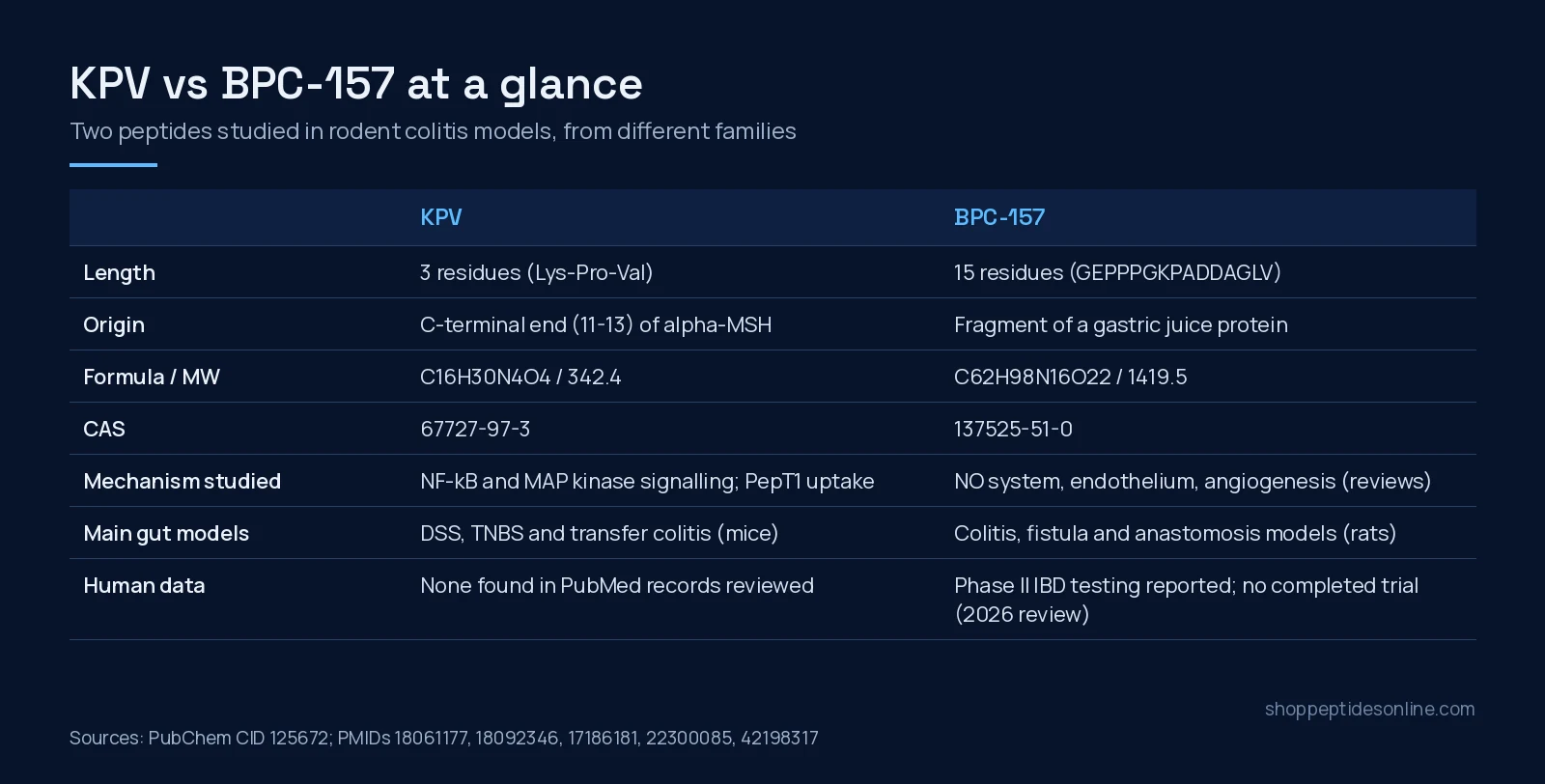
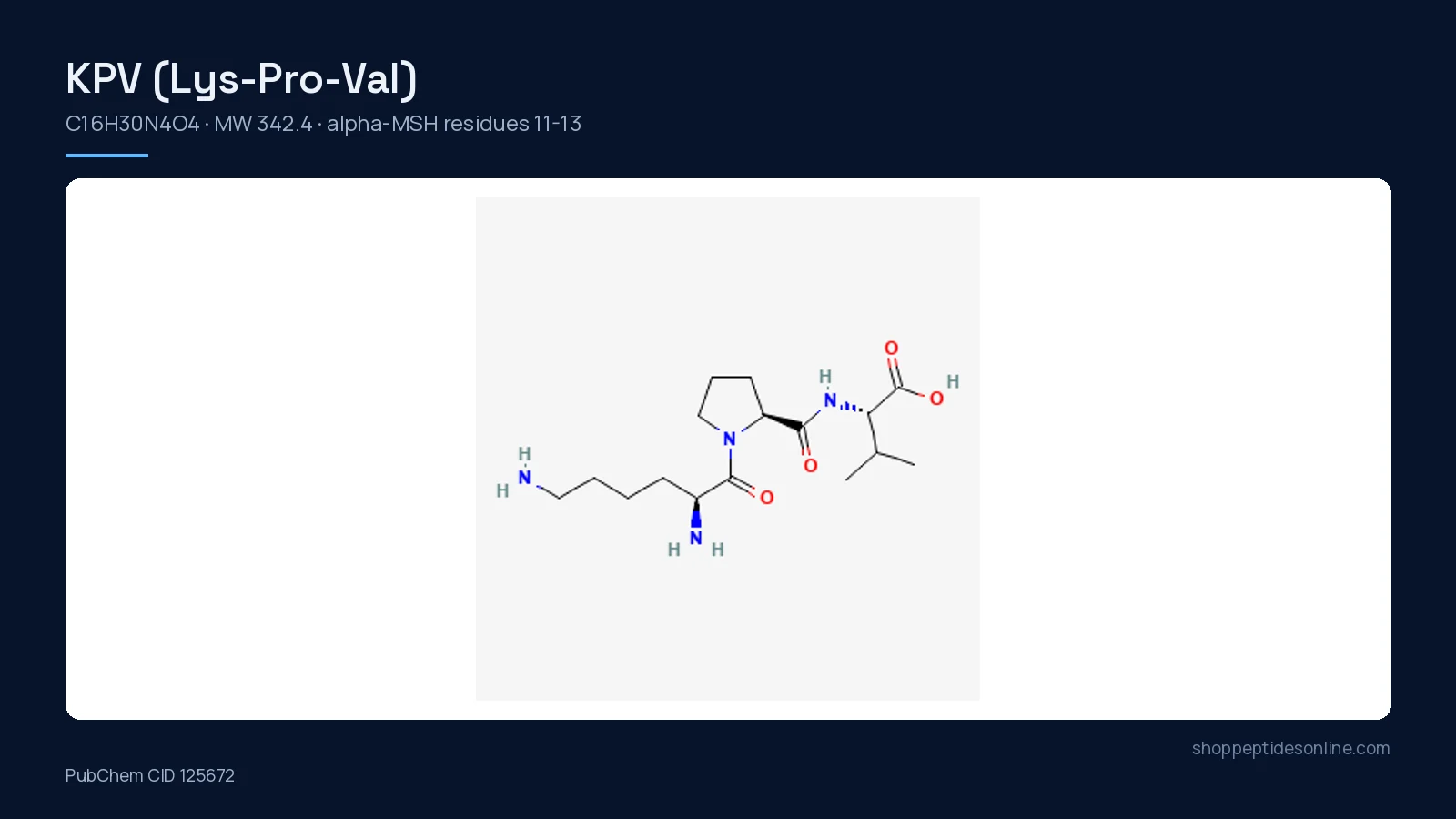
KPV is L-lysyl-L-prolyl-L-valine, residues 11 to 13 of alpha-MSH (PubChem CID 125672, C16H30N4O4, MW 342.4, CAS 67727-97-3). Alpha-MSH itself has broad anti-inflammatory activity, but it also drives pigmentation. Reviewers singled out the C-terminal tripeptide because it keeps the anti-inflammatory activity without the pigmentary action[4]. Earlier lab work also reported that alpha-MSH and KPV inhibited Staphylococcus aureus and Candida albicans in culture[5].
BPC-157 has the sequence GEPPPGKPADDAGLV (C62H98N16O22, MW 1419.5, CAS 137525-51-0). It was described in 1993 as a 15-amino-acid fragment of a larger peptide isolated from gastric juice[7]. Its research group stresses its stability in gastric juice, which is unusual for a peptide of that size[8][9].
How the mechanisms differ
The two papers that put KPV on the map took different angles. Dalmasso and colleagues showed that nanomolar KPV reduced NF-kB and MAP kinase activation and cut pro-inflammatory cytokine release in human intestinal epithelial cells and T cells. Uptake ran through PepT1, a di- and tripeptide transporter that is induced in the inflamed colon[1]. Kannengiesser and colleagues found that KPV’s effects in colitic mice were at least partly independent of the melanocortin-1 receptor, the receptor alpha-MSH normally uses[2].
The BPC-157 literature describes a wider and less specific picture. Reviews from the originating group link it to the nitric oxide (NO) system, endothelial protection and the formation of new blood vessels[8][9]. A 2025 review from outside that group summarised the same pathways, while noting that the evidence is preclinical[13]. No single receptor for BPC-157 has been pinned down in these sources.
| Question | KPV | BPC-157 |
|---|---|---|
| Proposed entry or target | PepT1 transporter; acts on NF-kB / MAPK signalling[1] | No defined receptor; NO system and blood vessels[8][9] |
| Receptor of the parent hormone needed? | Partly MC1R-independent in colitic mice[2] | Not applicable |
| Main research models | DSS, TNBS and T-cell transfer colitis in mice[1][2] | Rat colitis, fistula and anastomosis models[9][10] |
| Formulation research | Colon-targeting nanoparticles in mice[6] | Stability and pharmacokinetics under review[12] |
| Human evidence | None found in the PubMed records reviewed | Phase II IBD testing reported by its developers[9]; no completed Phase II trial per a 2026 review[12] |
What the gut-model studies reported
KPV
In DSS- and TNBS-induced colitis in mice, KPV reduced pro-inflammatory cytokine expression and histological signs of inflammation[1]. In the DSS and CD45RBhi transfer colitis models, KPV-treated mice showed less inflammatory infiltrate and lower myeloperoxidase activity[2]. A 2016 study adds an important control: in mice lacking PepT1, KPV had none of the effect on colitis-associated tumour formation seen in normal mice[3]. That result ties KPV’s activity in this model to the transporter, and it is a reminder that findings in one mouse strain do not carry over automatically.
Later work focused on how to get the tripeptide to the colon. A 2017 study loaded KPV into hyaluronic acid-coated nanoparticles held in a hydrogel and reported stronger effects in a mouse ulcerative colitis model than with a simpler nanoparticle system[6].
BPC-157
Most BPC-157 gut work comes from rats. Its developers summarise findings in colitis, short-bowel, anastomosis and fistula models[9]. In one controlled study, rats with surgically created colovesical fistulas that received BPC-157 showed closure of both defects over 28 days, while saline controls did not heal[10]. A 2026 pharmaceutics review agrees that the preclinical activity is consistent, but points to a gap between pharmacokinetics and pharmacodynamics, poorly characterised human pharmacokinetics, no approved formulation and no completed Phase II trial[12].
Limits of the evidence
- Almost all data are from rodents. Both peptides were tested mainly in chemically or surgically induced injury models, which only partly mirror human disease.
- BPC-157 research is concentrated in one group. A 2025 systematic review found 35 preclinical studies and one clinical study, and reported that no clinical safety data were available[11].
- KPV has fewer independent replications. The core colitis findings come from a handful of groups between 2008 and 2017[1][2][3].
- Regulatory status. BPC-157 is not approved by the FDA or other major regulators[11][13]. We found no approved KPV product in the sources reviewed.
Where they show up in the Shop Peptides Online catalogue
BPC-157 is available as single-compound vials, with its own research summary on the BPC-157 research page and the BPC-157 10mg product page. KPV is not sold alone. It is one of four measured components of the KLOW research blend, whose batch report lists the KPV, GHK-Cu, BPC-157 and TB-500 fragment quantities separately. Batch reports for every product are in the COA library. For the wider catalogue and shipping details, see our page on how to buy peptides online in Canada. If you are comparing BPC-157 with its usual partner, read BPC-157 vs TB-500.
Frequently asked questions
Is KPV the same as BPC-157?
No. KPV is a three-residue peptide (Lys-Pro-Val) taken from the end of alpha-MSH. BPC-157 is a fifteen-residue fragment of a gastric juice protein. They share no sequence and come from different peptide families.
Why are KPV and BPC-157 often compared?
Both have been studied in rodent models of intestinal inflammation. KPV was tested mainly in mouse colitis models, and BPC-157 mainly in rat colitis, fistula and anastomosis models. The mechanisms the papers propose are different.
Has either peptide been approved as a medicine?
No. BPC-157 has no FDA approval and no completed Phase II trial according to recent reviews. We found no human trial of KPV in the PubMed records reviewed for this article. Both are sold by Shop Peptides Online for laboratory research only.
Does Shop Peptides Online sell KPV on its own?
Not as a single-compound vial. KPV is one of the four measured components of the KLOW 80mg research blend, and its batch report lists each component’s quantity. BPC-157 is available as single-compound vials and in BPC-157/TB-500 blends.
References
- Dalmasso G, Charrier-Hisamuddin L, Nguyen HT et al. (2008). PepT1-mediated tripeptide KPV uptake reduces intestinal inflammation. Gastroenterology. PMID: 18061177. doi: 10.1053/j.gastro.2007.10.026.
- Kannengiesser K, Maaser C, Heidemann J et al. (2008). Melanocortin-derived tripeptide KPV has anti-inflammatory potential in murine models of inflammatory bowel disease. Inflamm Bowel Dis. PMID: 18092346. doi: 10.1002/ibd.20334.
- Viennois E, Ingersoll SA, Ayyadurai S et al. (2016). Critical role of PepT1 in promoting colitis-associated cancer and therapeutic benefits of the anti-inflammatory PepT1-mediated tripeptide KPV in a murine model. Cell Mol Gastroenterol Hepatol. PMID: 27458604. doi: 10.1016/j.jcmgh.2016.01.006.
- Brzoska T, Luger TA, Maaser C et al. (2008). Alpha-melanocyte-stimulating hormone and related tripeptides: biochemistry, antiinflammatory and protective effects in vitro and in vivo, and future perspectives for the treatment of immune-mediated inflammatory diseases. Endocr Rev. PMID: 18612139. doi: 10.1210/er.2007-0027.
- Cutuli M, Cristiani S, Lipton JM et al. (2000). Antimicrobial effects of alpha-MSH peptides. J Leukoc Biol. PMID: 10670585. doi: 10.1002/jlb.67.2.233.
- Xiao B, Xu Z, Viennois E et al. (2017). Orally Targeted Delivery of Tripeptide KPV via Hyaluronic Acid-Functionalized Nanoparticles Efficiently Alleviates Ulcerative Colitis. Mol Ther. PMID: 28143741. doi: 10.1016/j.ymthe.2016.11.020.
- Sikirić P, Petek M, Rucman R et al. (1993). A new gastric juice peptide, BPC. An overview of the stomach-stress-organoprotection hypothesis and beneficial effects of BPC. J Physiol Paris. PMID: 8298609. doi: 10.1016/0928-4257(93)90038-u.
- Sikiric P, Seiwerth S, Brcic L et al. (2006). Stable gastric pentadecapeptide BPC 157 in trials for inflammatory bowel disease (PL-10, PLD-116, PL 14736, Pliva, Croatia). Full and distended stomach, and vascular response. Inflammopharmacology. PMID: 17186181. doi: 10.1007/s10787-006-1531-7.
- Sikiric P, Seiwerth S, Rucman R et al. (2012). Focus on ulcerative colitis: stable gastric pentadecapeptide BPC 157. Curr Med Chem. PMID: 22300085. doi: 10.2174/092986712803414015.
- Grgic T, Grgic D, Drmic D et al. (2016). Stable gastric pentadecapeptide BPC 157 heals rat colovesical fistula. Eur J Pharmacol. PMID: 26875638. doi: 10.1016/j.ejphar.2016.02.038.
- Vasireddi N, Hahamyan H, Salata MJ et al. (2025). Emerging Use of BPC-157 in Orthopaedic Sports Medicine: A Systematic Review. HSS J. PMID: 40756949. doi: 10.1177/15563316251355551.
- Mateescu DM, Gavrilescu DM, Constantinescu FE et al. (2026). BPC-157 as an Investigational Peptide Therapeutic: Biopharmaceutical Challenges, Formulation Strategies, and Translational Development Barriers. Pharmaceutics. PMID: 42198317. doi: 10.3390/pharmaceutics18050625.
- Józwiak M, Bauer M, Kamysz W et al. (2025). Multifunctionality and Possible Medical Application of the BPC 157 Peptide-Literature and Patent Review. Pharmaceuticals (Basel). PMID: 40005999. doi: 10.3390/ph18020185.