For laboratory research only. Not for human or animal use. This article gives no dosing, administration or therapeutic advice.
Short answer: NAD+ is the coenzyme; NMN and NR are two of its precursors. NAD+ carries electrons in metabolism and is consumed by enzymes such as sirtuins, PARPs and CD38.[1] NMN sits one enzymatic step before NAD+, and NR two steps before it.[3],[7] The practical research difference is what happens at the cell membrane: in cell studies, extracellular NAD+ and NMN were mostly broken down outside the cell, and NR, a nucleoside, was what entered.[4],[7] A proposed NMN transporter, Slc12a8, is still disputed.[8],[9] NAD+ is not a peptide; we cover it because Shop Peptides Online lists it as a research compound.
Three molecules, one pathway
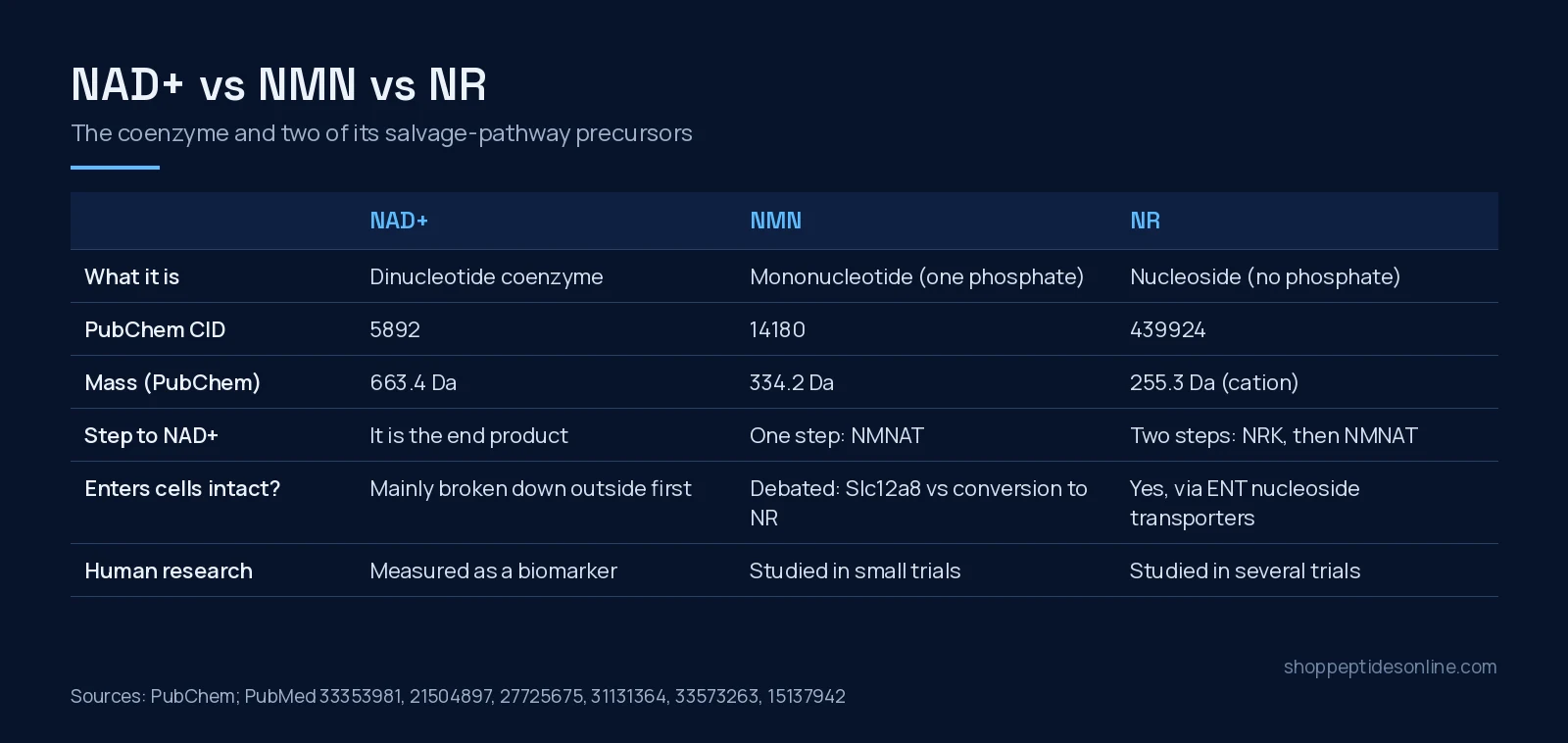
Cells make NAD+ from several vitamin B3 forms. The route most relevant here is the salvage pathway, which recycles nicotinamide released when enzymes consume NAD+. In mouse fibroblasts, the enzyme Nampt was the rate-limiting step of this pathway, turning nicotinamide into NMN; NMNAT then converts NMN to NAD+.[2]
NR joins the same pathway from the side. In 2004, Bieganowski and Brenner showed NR is an NAD+ precursor and identified nicotinamide riboside kinases (NRKs) in yeast and humans that phosphorylate NR to NMN.[3] A 2016 cell study found NRK1 was necessary and rate-limiting for using external NR and NMN to make NAD+.[7]
| NAD+ | NMN | NR | |
|---|---|---|---|
| Chemical class | Dinucleotide coenzyme | Mononucleotide | Nucleoside (no phosphate) |
| PubChem | CID 5892, C21H27N7O14P2, 663.4 Da | CID 14180, C11H15N2O8P, 334.2 Da | CID 439924, C11H15N2O5+ (cation), 255.3 Da |
| Steps to NAD+ | End product | One: NMNAT[2] | Two: NRK, then NMNAT[3],[7] |
| Fate outside cells (cell studies) | Degraded by ectoenzymes such as CD38[4],[6] | CD73 converts it to NR; CD38 degrades it[5],[6] | Imported by ENT1, ENT2 and ENT4[11] |
| Proposed transporter | Plasma-membrane route unclear; SLC25A51 carries it into mitochondria[13] | Slc12a8 (disputed)[8],[9],[10] | Equilibrative nucleoside transporters[11] |
| Human research | Measured as a biomarker | Small randomized trials[23] | Several randomized trials[19],[20],[21] |
The uptake question: what actually crosses the membrane
This is where the three molecules differ most, and where the literature is least settled.
NAD+ and NMN are mostly broken down outside
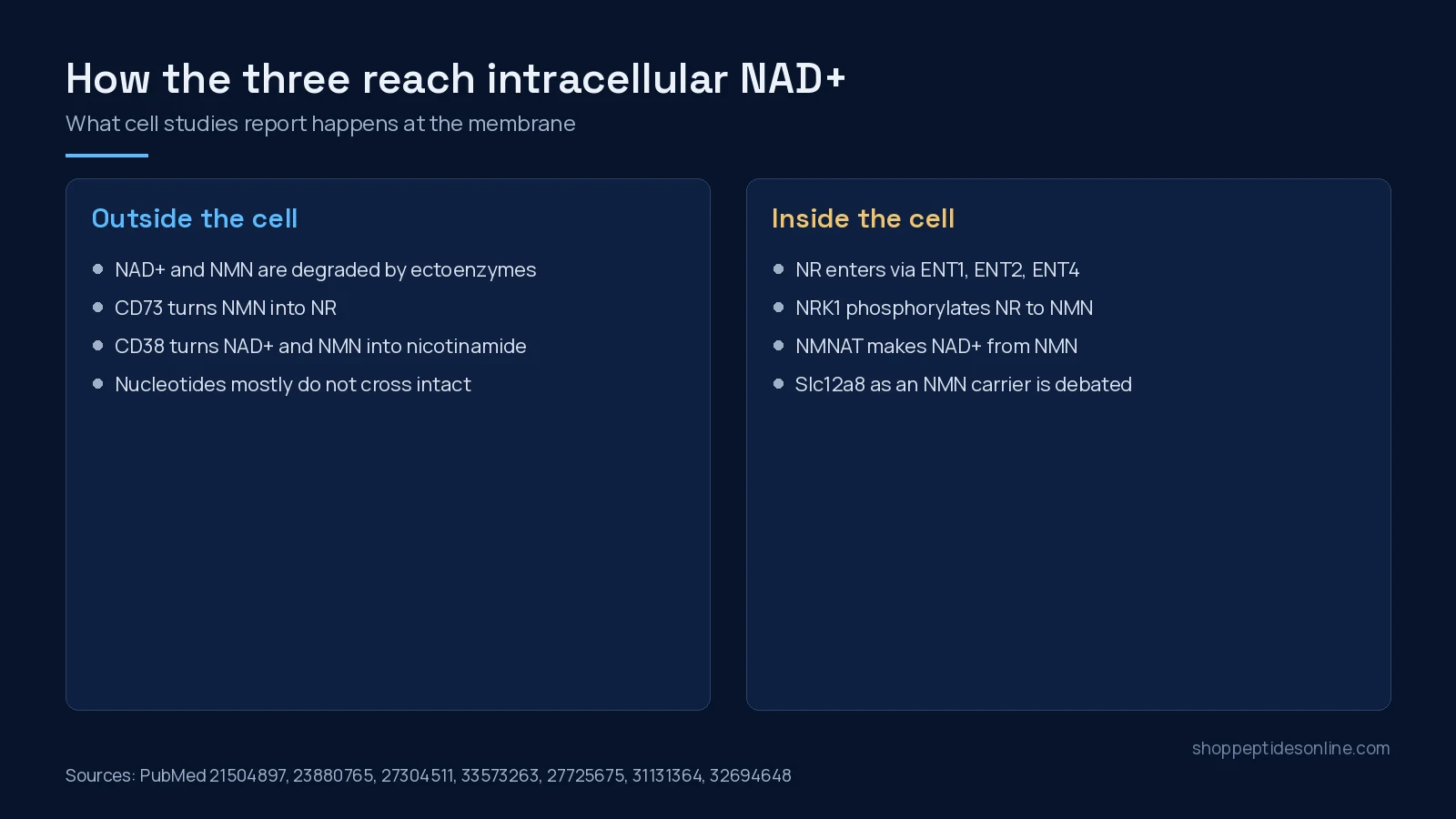
Nikiforov and colleagues traced NAD+ precursors in human cells. Besides nicotinamide and nicotinic acid, only the corresponding nucleosides (such as NR) readily entered. Nucleotides such as NAD+ and NMN were degraded outside the cell into permeable precursors, which were then rebuilt into NAD+ in the cytosol and mitochondria.[4]
Two surface enzymes do most of that work. In human cell lines, CD73 enabled the conversion of extracellular NMN to NR for NAD+ synthesis, while CD38 impaired it.[5] In mice, CD38 was identified as the main enzyme degrading NMN in vivo, and its rising activity with age was required for the age-related NAD decline seen in that model.[6] Stable-isotope work in cells reached the same conclusion: extracellular NMN was metabolised to NR, taken up, and converted back to NAD+.[7]
Extracellular NAD+ also has a feedback effect. In HeLa and other cells exposed to it for longer periods, intracellular NAD+ first rose, then returned to control levels, because uptake of the cleaved products fell; CD73 and Slc12a8 expression dropped.[12]
NR enters through nucleoside transporters
In HEK293 cells, NR was imported by the equilibrative nucleoside transporters ENT1, ENT2 and ENT4, and not by the concentrative transporters CNT1–3.[11]
The Slc12a8 debate
In 2019, Grozio and colleagues reported that Slc12a8 encodes a sodium-dependent NMN transporter that is highly expressed in mouse small intestine and carries NMN but not NR.[8] The same year, Schmidt and Brenner published a correspondence titled “Absence of evidence that Slc12a8 encodes a nicotinamide mononucleotide transporter”,[9] and the original authors replied.[10] Read both before building a study design around a dedicated NMN transporter.
Inside the cell, and inside mitochondria
Mitochondria hold the largest NAD pool in the cell. Nikiforov’s work placed NMNAT3 in the mitochondrial matrix.[4] A later review describes SLC25A51 (MCART1) as the major mitochondrial NAD+ carrier in mammals, resolving how mitochondria take up NAD+ itself.[13]
What rodent studies report
- NMN, 12 months in mice. In chow-fed C57BL/6N mice, orally given NMN was quickly used to make NAD+ in tissues, and the authors reported fewer age-associated physiological changes in that model, with no obvious toxicity.[15]
- NR, mice. Oral NR raised mouse liver NAD+ with different pharmacokinetics from nicotinic acid and nicotinamide.[16]
- Gut and liver handling, mice. A 2025 tracing study found only a small portion of oral NMN and NR was absorbed directly from the small intestine. Most was deamidated by gut bacteria to nicotinic acid. When delivered into the blood in that study, both were quickly degraded to nicotinamide.[14] That is a reminder that “NMN given” does not mean “NMN arriving in tissue”.
- Is the age decline real? Isotope tracing in aged mice found a modest tissue NAD+ drop (median about 30%) with NAD+ synthesis flux maintained, pointing to higher consumption rather than failed production.[17] A 2021 review across species concluded that evidence for a general NAD+ decline with age is limited and often confined to a single tissue, especially in humans.[18]
Where they have been studied in people
This section lists study designs only. It gives no doses and makes no outcome claims.
- NR has been studied in a randomized, placebo-controlled crossover trial in healthy middle-aged and older adults[19], a crossover trial in 12 aged men with muscle metabolomics[20] and a 12-week parallel-group trial in 40 obese, insulin-resistant men.[21] A first human pharmacokinetic study measured the blood NAD+ metabolome after single doses.[16]
- NMN has been studied in a 10-week randomized, placebo-controlled, double-blind trial in postmenopausal women with prediabetes.[23]
- A null mechanistic result: in the obese-men trial, a follow-up analysis found that NR did not change NAD metabolite concentrations in skeletal muscle, and muscle mitochondrial respiration, content and morphology were unaffected.[22] The aged-men trial likewise reported no change in muscle mitochondrial bioenergetics.[20]
Handling notes for the lab
- Cell type matters. Cultures that express CD38 or CD73 will convert added NAD+ or NMN before uptake[5],[6], so the molecule added to the medium may not be the one that enters.
- Solution stability. In a factorial study of the reduced form NADH, pH had the largest effect on degradation in solution, then temperature, then buffer type, with faster degradation in phosphate buffer.[24] Report buffer, pH and temperature when working with any nicotinamide nucleotide in solution.
- Measure the metabolome, not one number. Several studies above tracked NAD+ alongside NAAD, nicotinamide and its clearance products[16],[20], because a single NAD+ reading can miss where a precursor went.
Shop Peptides Online lists NAD+, not NMN or NR. Our NAD+ research page covers what we stock, including NAD+ 1000 mg, and third-party reports we have posted are on our COA page, listed by batch number. For how NAD+ compares with a mitochondrial peptide, see MOTS-c vs NAD+. For ordering and shipping, here is how to buy peptides online in Canada.
What the evidence does not show
- It does not show that any of the three, given to people, changes a health outcome. Human trials are listed here by design only.
- It does not settle whether NMN enters cells intact through a dedicated transporter.
- It does not show that one precursor is “better” across models: results depend on the cell type, the ectoenzymes present and, in animals, gut and liver handling.
- It does not establish a universal NAD+ decline with age in humans.
Frequently asked questions
What is the difference between NAD+ and NMN?
NAD+ (nicotinamide adenine dinucleotide) is the coenzyme itself. NMN (nicotinamide mononucleotide) is one step before it in the salvage pathway: the enzyme NMNAT joins NMN to ATP to make NAD+. NMN is smaller, with one phosphate instead of two linked nucleotides.
How is NR different from NMN?
NR (nicotinamide riboside) is NMN without its phosphate group. Inside cells, NR kinases add the phosphate to make NMN, which is then converted to NAD+. In several cell studies, extracellular NMN was converted to NR before it entered cells.
Does NAD+ enter cells intact?
In human cell studies, extracellular NAD+ and NMN were mostly broken down by surface enzymes such as CD38 and CD73, and only nicotinamide, nicotinic acid and their nucleosides readily entered the cells. Whether some cell types take up intact nucleotides is still being studied.
Is there an NMN transporter?
A 2019 mouse study reported that Slc12a8 transports NMN in the small intestine. Other researchers published a correspondence arguing the evidence was insufficient, and the original authors replied. The question is not settled.
Have NAD+ precursors been tested in people?
NR and NMN have been studied in small randomized trials, and NAD+ metabolites are measured as research biomarkers. This article reports what those studies measured, not health outcomes, and gives no doses.
Does Shop Peptides Online sell NMN or NR?
No. Shop Peptides Online lists NAD+ for laboratory research. NMN and NR are covered here for comparison only.
References
- Covarrubias AJ, Perrone R, Grozio A et al. (2021). NAD(+) metabolism and its roles in cellular processes during ageing. Nat Rev Mol Cell Biol. PMID: 33353981. doi: 10.1038/s41580-020-00313-x.
- Revollo JR, Grimm AA, Imai S (2004). The NAD biosynthesis pathway mediated by nicotinamide phosphoribosyltransferase regulates Sir2 activity in mammalian cells. J Biol Chem. PMID: 15381699. doi: 10.1074/jbc.M408388200.
- Bieganowski P, Brenner C (2004). Discoveries of nicotinamide riboside as a nutrient and conserved NRK genes establish a Preiss-Handler independent route to NAD+ in fungi and humans. Cell. PMID: 15137942. doi: 10.1016/s0092-8674(04)00416-7.
- Nikiforov A, Dölle C, Niere M et al. (2011). Pathways and subcellular compartmentation of NAD biosynthesis in human cells: from entry of extracellular precursors to mitochondrial NAD generation. J Biol Chem. PMID: 21504897. doi: 10.1074/jbc.M110.213298.
- Grozio A, Sociali G, Sturla L et al. (2013). CD73 protein as a source of extracellular precursors for sustained NAD+ biosynthesis in FK866-treated tumor cells. J Biol Chem. PMID: 23880765. doi: 10.1074/jbc.M113.470435.
- Camacho-Pereira J, Tarragó MG, Chini CCS et al. (2016). CD38 Dictates Age-Related NAD Decline and Mitochondrial Dysfunction through an SIRT3-Dependent Mechanism. Cell Metab. PMID: 27304511. doi: 10.1016/j.cmet.2016.05.006.
- Ratajczak J, Joffraud M, Trammell SA et al. (2016). NRK1 controls nicotinamide mononucleotide and nicotinamide riboside metabolism in mammalian cells. Nat Commun. PMID: 27725675. doi: 10.1038/ncomms13103.
- Grozio A, Mills KF, Yoshino J et al. (2019). Slc12a8 is a nicotinamide mononucleotide transporter. Nat Metab. PMID: 31131364. doi: 10.1038/s42255-018-0009-4.
- Schmidt MS, Brenner C (2019). Absence of evidence that Slc12a8 encodes a nicotinamide mononucleotide transporter. Nat Metab. PMID: 32694648. doi: 10.1038/s42255-019-0085-0.
- Grozio A, Mills K, Yoshino J et al. (2019). Reply to: Absence of evidence that Slc12a8 encodes a nicotinamide mononucleotide transporter. Nat Metab. PMID: 32694650. doi: 10.1038/s42255-019-0086-z.
- Kropotov A, Kulikova V, Nerinovski K et al. (2021). Equilibrative Nucleoside Transporters Mediate the Import of Nicotinamide Riboside and Nicotinic Acid Riboside into Human Cells. Int J Mol Sci. PMID: 33573263. doi: 10.3390/ijms22031391.
- Buonvicino D, Ranieri G, Pittelli M et al. (2021). SIRT1-dependent restoration of NAD+ homeostasis after increased extracellular NAD+ exposure. J Biol Chem. PMID: 34097876. doi: 10.1016/j.jbc.2021.100855.
- Ziegler M, Monné M, Nikiforov A et al. (2021). Welcome to the Family: Identification of the NAD(+) Transporter of Animal Mitochondria as Member of the Solute Carrier Family SLC25. Biomolecules. PMID: 34198503. doi: 10.3390/biom11060880.
- Yaku K, Palikhe S, Iqbal T et al. (2025). Nicotinamide riboside and nicotinamide mononucleotide facilitate NAD(+) synthesis via enterohepatic circulation. Sci Adv. PMID: 40117359. doi: 10.1126/sciadv.adr1538.
- Mills KF, Yoshida S, Stein LR et al. (2016). Long-Term Administration of Nicotinamide Mononucleotide Mitigates Age-Associated Physiological Decline in Mice. Cell Metab. PMID: 28068222. doi: 10.1016/j.cmet.2016.09.013.
- Trammell SA, Schmidt MS, Weidemann BJ et al. (2016). Nicotinamide riboside is uniquely and orally bioavailable in mice and humans. Nat Commun. PMID: 27721479. doi: 10.1038/ncomms12948.
- McReynolds MR, Chellappa K, Chiles E et al. (2021). NAD(+) flux is maintained in aged mice despite lower tissue concentrations. Cell Syst. PMID: 34559996. doi: 10.1016/j.cels.2021.09.001.
- Peluso A, Damgaard MV, Mori MAS et al. (2021). Age-Dependent Decline of NAD(+)-Universal Truth or Confounded Consensus?. Nutrients. PMID: 35010977. doi: 10.3390/nu14010101.
- Martens CR, Denman BA, Mazzo MR et al. (2018). Chronic nicotinamide riboside supplementation is well-tolerated and elevates NAD(+) in healthy middle-aged and older adults. Nat Commun. PMID: 29599478. doi: 10.1038/s41467-018-03421-7.
- Elhassan YS, Kluckova K, Fletcher RS et al. (2019). Nicotinamide Riboside Augments the Aged Human Skeletal Muscle NAD(+) Metabolome and Induces Transcriptomic and Anti-inflammatory Signatures. Cell Rep. PMID: 31412242. doi: 10.1016/j.celrep.2019.07.043.
- Dollerup OL, Christensen B, Svart M et al. (2018). A randomized placebo-controlled clinical trial of nicotinamide riboside in obese men: safety, insulin-sensitivity, and lipid-mobilizing effects. Am J Clin Nutr. PMID: 29992272. doi: 10.1093/ajcn/nqy132.
- Dollerup OL, Chubanava S, Agerholm M et al. (2020). Nicotinamide riboside does not alter mitochondrial respiration, content or morphology in skeletal muscle from obese and insulin-resistant men. J Physiol. PMID: 31710095. doi: 10.1113/JP278752.
- Yoshino M, Yoshino J, Kayser BD et al. (2021). Nicotinamide mononucleotide increases muscle insulin sensitivity in prediabetic women. Science. PMID: 33888596. doi: 10.1126/science.abe9985.
- Rover Júnior L, Fernandes JC, de Oliveira Neto G et al. (1998). Study of NADH stability using ultraviolet-visible spectrophotometric analysis and factorial design. Anal Biochem. PMID: 9648652. doi: 10.1006/abio.1998.2656.