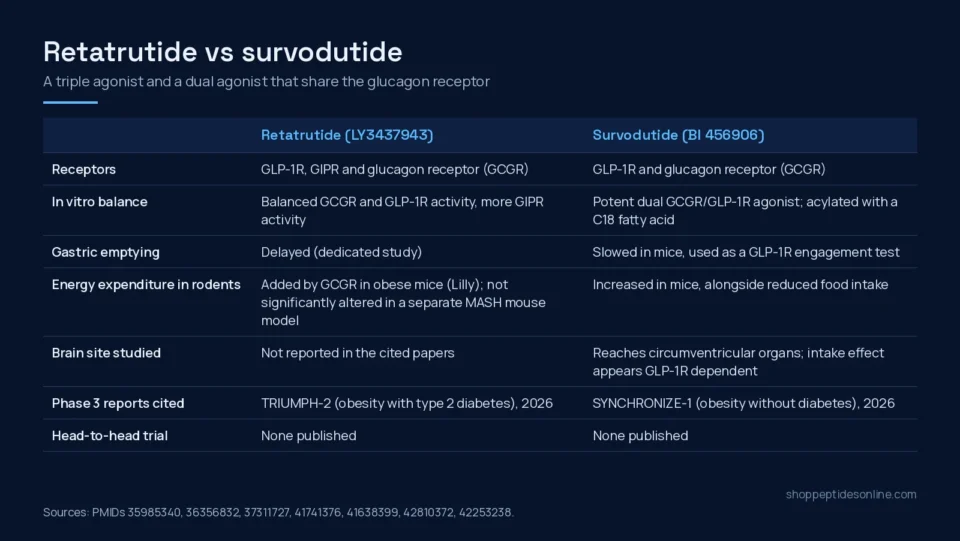
For laboratory research only. Not for human or animal use. This article gives no dosing, administration or therapeutic advice.
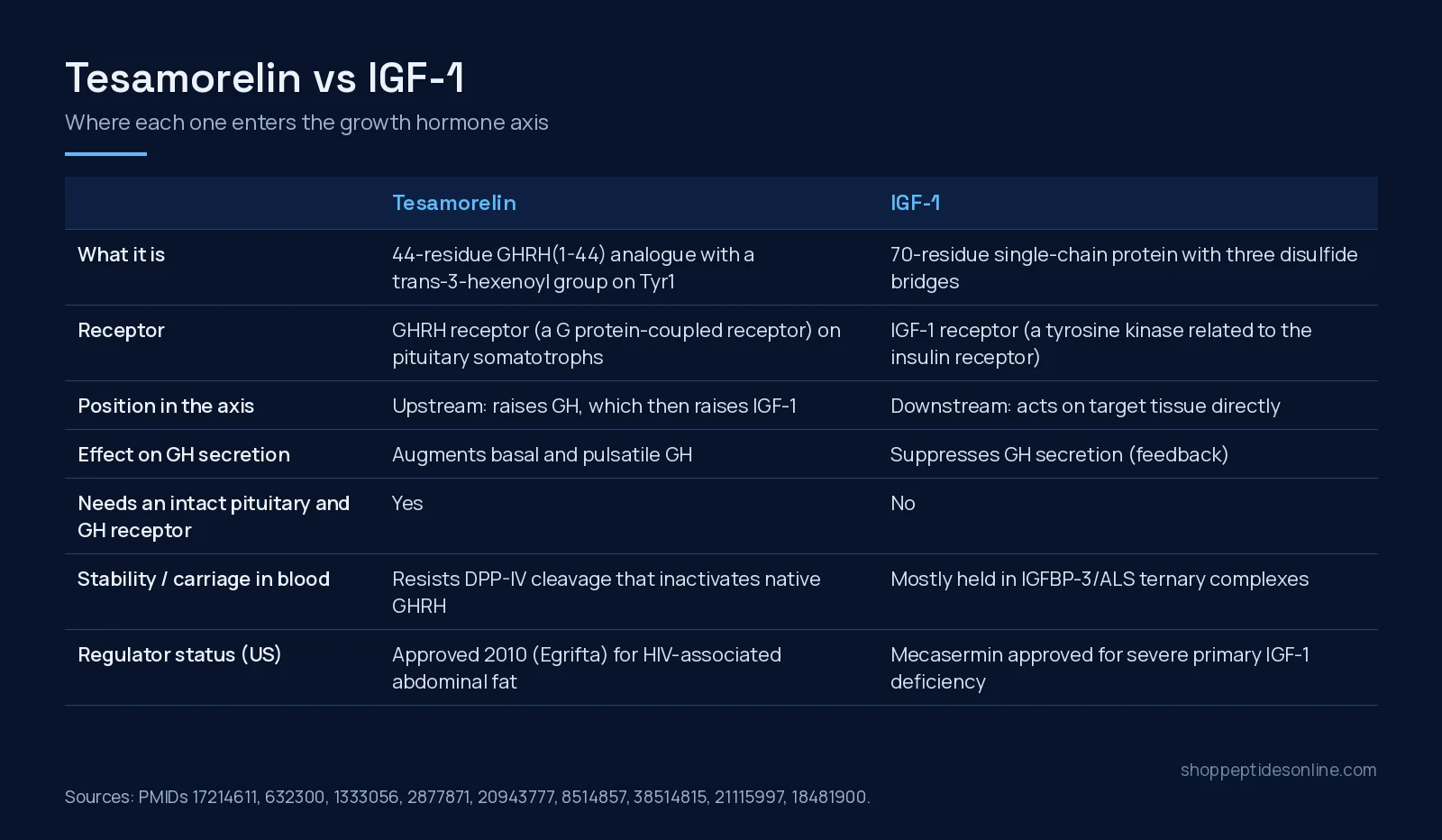
Short answer: tesamorelin and IGF-1 sit at opposite ends of the same hormone chain. Tesamorelin is a stabilised analogue of growth hormone-releasing hormone (GHRH) that acts on the pituitary and raises growth hormone (GH), and GH then raises IGF-1[3][4]. IGF-1 is the end product: a 70-residue protein that binds its own receptor on target cells[6][7]. That position decides almost everything else, including the fact that extra IGF-1 switches GH secretion down[10] while tesamorelin switches it up[4].
Side by side
| Tesamorelin (TH9507) | IGF-1 | |
|---|---|---|
| Structure | Human GHRH(1-44)-NH2 with a trans-3-hexenoyl group added to Tyr1[3] | Single chain of 70 residues, three disulfide bridges, homologous to proinsulin[6] |
| Receptor | GHRH receptor, a G protein-coupled receptor expressed mainly in the anterior pituitary[2] | IGF-1 receptor, a tyrosine-kinase receptor closely related to the insulin receptor[7] |
| Where it acts | Pituitary somatotrophs, which then release GH[2][12] | Target tissues directly; most circulating IGF-1 comes from the liver, but local IGF-1 also acts in an autocrine/paracrine way[8] |
| Effect on GH | Increased mean, basal and pulsatile GH in healthy men[4] | Suppressed pulsatile GH secretion in fasted healthy men[10] |
| Stability | Resists the DPP-IV cleavage that inactivates native GHRH[3] | Circulates mainly in ternary complexes with IGFBP-3 or IGFBP-5 and the acid-labile subunit[9] |
| US regulator status | Approved in 2010 (Egrifta) for HIV-associated lipodystrophy[15] | Recombinant IGF-1 (mecasermin) approved for severe primary IGF-1 deficiency[16] |
| At SPO | Tesamorelin research page | IGF-1 1mg (native sequence, not LR3) |
The chain, from hypothalamus to tissue
GHRH was first characterised in 1982 as a 40-residue peptide with GH-releasing activity, isolated from a human pancreatic tumour[1]. Its receptor was cloned ten years later: a seven-transmembrane G protein-coupled receptor, related to the secretin and VIP receptors, that binds GHRH with high affinity, raises cAMP and is expressed predominantly in the anterior pituitary[2].
The pituitary releases GH, and GH drives IGF-1. IGF-1 was sequenced in 1978: a single-chain polypeptide of 70 residues, cross-linked by three disulfide bridges, whose first 29 positions resemble the insulin B chain and positions 42 to 62 the insulin A chain[6]. Its receptor mirrors that family resemblance. The cloned IGF-1 receptor precursor is cleaved into alpha and beta subunits in the same way as the insulin receptor precursor[7].
Where the IGF-1 comes from matters too. When mice had the igf1 gene deleted only in the liver, circulating IGF-1 fell sharply, yet body weight, body length and femur length matched wild-type littermates[8]. The liver supplies most of the IGF-1 in blood; local tissue IGF-1 still carries much of the growth signal in that model.
Tesamorelin: a GHRH that lasts longer
Native GHRH is inactivated by dipeptidyl aminopeptidase-IV. TH9507, later named tesamorelin, adds a trans-3-hexenoyl group to Tyr1 of the full 44-residue sequence. In the non-clinical package, that change slowed degradation in rat, dog and human plasma, prolonged elimination of the immunoreactive peptide, and markedly raised plasma GH and IGF-1 in pigs, rats and dogs[3]. Dogs given repeated exposure showed a stronger anabolic effect and reversible liver, kidney and blood findings, which the authors attributed to prolonged exposure to supraphysiological GH and IGF-1[3].
In 13 healthy men studied for two weeks, tesamorelin increased mean overnight GH, GH pulse area and basal GH secretion, and raised IGF-1. Two null results stand out: neither fasting glucose nor insulin-stimulated glucose uptake on a euglycemic clamp changed significantly[4]. A population pharmacokinetic analysis in people with and without HIV described the same sequence: tesamorelin increases basal and pulsatile GH, and IGF-1 rises after that[5]. In the phase 3 trial in people with HIV and abdominal fat accumulation, IGF-I was tracked as a secondary end point[17].
IGF-1: the step after GH
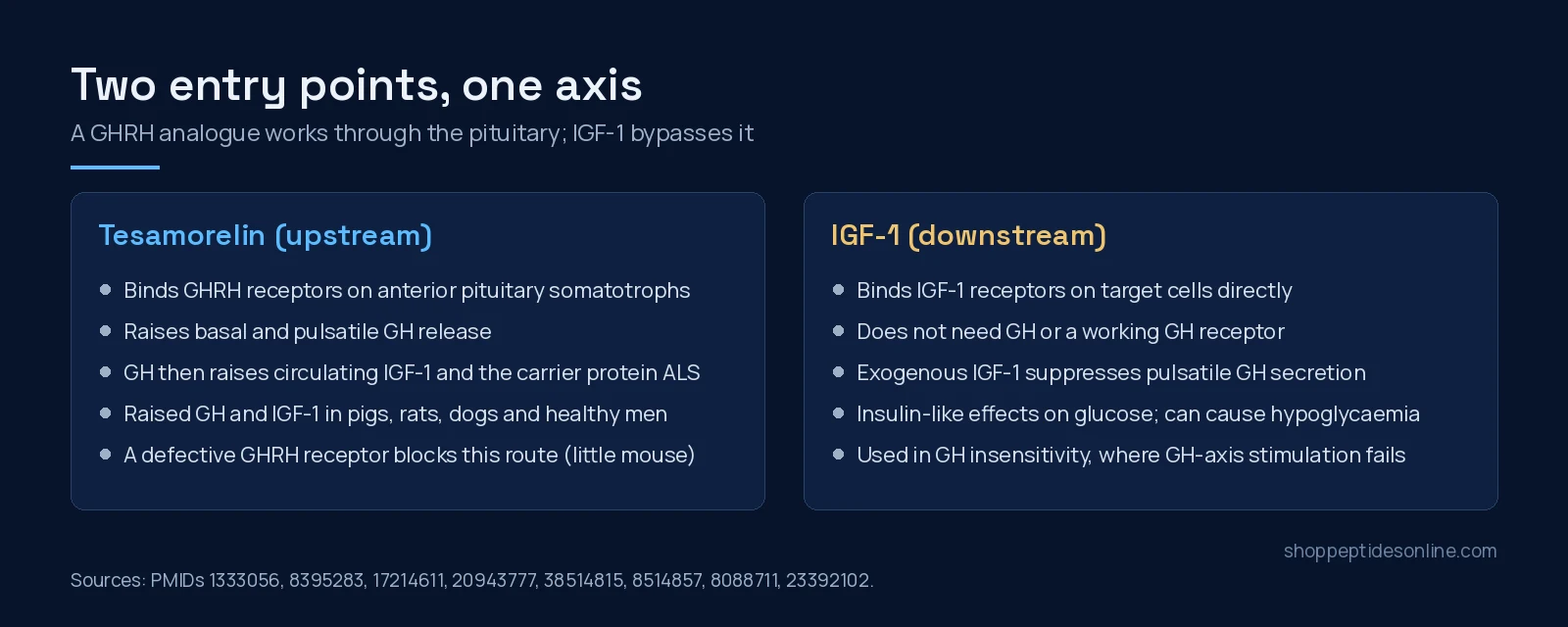
IGF-1 skips the pituitary entirely, which produces two effects tesamorelin does not.
- It shuts GH down. In ten healthy men fasted to boost GH, raising circulating IGF-1 with recombinant IGF-1 under a euglycemic clamp lowered GH secretion within 60 minutes, reduced the GH mass per pulse by 84% and the number of pulses by 32%. The authors concluded this ran through IGF-1 receptors rather than through IGF-1’s insulin-like actions[10].
- It behaves partly like insulin. Studies in healthy volunteers found IGF-1 had insulin-like effects on glucose, lipid and amino acid metabolism while inhibiting insulin secretion. IGF-1 exposure could produce hypoglycaemia, with an absent glucagon response and an attenuated GH response[11].
In blood, free IGF-1 is the exception. The acid-labile subunit forms high-affinity ternary complexes with IGFBP-3 or IGFBP-5 when they carry IGF-1 or IGF-2. Those complexes act as a stable reservoir and block the hypoglycaemic activity of unbound IGFs, and ALS synthesis is itself strongly induced by GH[9]. A GH-driven rise in IGF-1, as with tesamorelin, comes with more carrier protein; an IGF-1 spike added from outside does not bring its own.
GH insensitivity: where the two routes split completely
Primary IGF-1 deficiency, also called GH insensitivity, is caused by genetic defects in the GH-IGF-1 axis and presents as growth failure; its severe form is Laron syndrome, caused by homozygous GH receptor mutations[13]. In these patients GH is present but cannot raise IGF-1, so stimulating GH release further up the chain cannot fix the defect. Biosynthetic IGF-1 became available in 1988 and has been studied in children with Laron syndrome[14], and recombinant IGF-1 (mecasermin) is approved in the US and EU for growth failure from severe primary IGF-1 deficiency[16]. Tesamorelin’s US approval in 2010 was for a different setting, HIV-associated lipodystrophy[15].
Choosing between them for a study
- Questions about pulsatile GH, somatotroph function or GHRH receptor signalling: tesamorelin acts at that step and preserves GH pulses in healthy men[4]. For how it compares with sermorelin and CJC-1295, see our GHRH analogues comparison.
- Questions about IGF-1 receptor signalling in a specific tissue, or models where GH cannot act: IGF-1 reaches the receptor directly[7][13]. For the long-acting analogue, see IGF-1 vs IGF-1 LR3.
- Studies that read out GH: remember that IGF-1 suppresses GH secretion[10], so an IGF-1 arm and a GHRH-analogue arm move GH in opposite directions.
- Glucose readouts: IGF-1 has direct insulin-like effects[11]; tesamorelin did not change insulin-stimulated glucose uptake over two weeks in healthy men[4].
Batch identity and purity data are explained in our guide to HPLC purity vs mass spectrometry identity. For the full catalogue, see how to buy peptides online in Canada.
Frequently asked questions
What is the difference between tesamorelin and IGF-1?
Tesamorelin is a modified GHRH(1-44) analogue that acts on GHRH receptors in the anterior pituitary and raises growth hormone, which in turn raises IGF-1. IGF-1 is the downstream 70-residue protein that acts on IGF-1 receptors in target tissue directly, without the pituitary step.
Does tesamorelin raise IGF-1?
Yes, in the studies indexed on PubMed. Plasma GH and IGF-1 rose in pigs, rats and dogs given TH9507, and in a two-week study of healthy men tesamorelin increased basal and pulsatile GH and raised IGF-1.
Does IGF-1 affect growth hormone secretion?
Exogenous IGF-1 suppresses it. In fasted healthy men, raising circulating IGF-1 under a glucose clamp lowered GH secretion within an hour and cut both pulse mass and pulse number, which the authors attributed to IGF-1 receptor signalling.
Why would a study use IGF-1 instead of a GHRH analogue?
A GHRH analogue only works if the pituitary, the GHRH receptor and the GH receptor all function. In models of GH insensitivity, where GH cannot raise IGF-1, IGF-1 itself is the tool that reaches the receptor.
Are tesamorelin and IGF-1 approved drugs?
In the US, tesamorelin (Egrifta) was approved in 2010 for HIV-associated abdominal fat accumulation, and recombinant IGF-1 (mecasermin) is approved for growth failure from severe primary IGF-1 deficiency. Products sold by SPO are research materials only, not these medicines.
References
- Esch FS, Böhlen P, Ling NC et al. (1982). Characterization of a 40 residue peptide from a human pancreatic tumor with growth hormone releasing activity. Biochem Biophys Res Commun. PMID: 7159418. doi: 10.1016/0006-291x(82)91578-9.
- Mayo KE (1992). Molecular cloning and expression of a pituitary-specific receptor for growth hormone-releasing hormone. Mol Endocrinol. PMID: 1333056. doi: 10.1210/mend.6.10.1333056.
- Ferdinandi ES, Brazeau P, High K et al. (2007). Non-clinical pharmacology and safety evaluation of TH9507, a human growth hormone-releasing factor analogue. Basic Clin Pharmacol Toxicol. PMID: 17214611. doi: 10.1111/j.1742-7843.2007.00008.x.
- Stanley TL, Chen CY, Branch KL et al. (2011). Effects of a growth hormone-releasing hormone analog on endogenous GH pulsatility and insulin sensitivity in healthy men. J Clin Endocrinol Metab. PMID: 20943777. doi: 10.1210/jc.2010-1587.
- González-Sales M, Barrière O, Tremblay PO et al. (2015). Population pharmacokinetic analysis of tesamorelin in HIV-infected patients and healthy subjects. Clin Pharmacokinet. PMID: 25358450. doi: 10.1007/s40262-014-0202-x.
- Rinderknecht E, Humbel RE (1978). The amino acid sequence of human insulin-like growth factor I and its structural homology with proinsulin. J Biol Chem. PMID: 632300.
- Ullrich A, Gray A, Tam AW et al. (1986). Insulin-like growth factor I receptor primary structure: comparison with insulin receptor suggests structural determinants that define functional specificity. EMBO J. PMID: 2877871. doi: 10.1002/j.1460-2075.1986.tb04528.x.
- Yakar S, Liu JL, Stannard B et al. (1999). Normal growth and development in the absence of hepatic insulin-like growth factor I. Proc Natl Acad Sci U S A. PMID: 10377413. doi: 10.1073/pnas.96.13.7324.
- Baxter RC (2024). Endocrine and cellular physiology and pathology of the insulin-like growth factor acid-labile subunit. Nat Rev Endocrinol. PMID: 38514815. doi: 10.1038/s41574-024-00970-4.
- Hartman ML, Clayton PE, Johnson ML et al. (1993). A low dose euglycemic infusion of recombinant human insulin-like growth factor I rapidly suppresses fasting-enhanced pulsatile growth hormone secretion in humans. J Clin Invest. PMID: 8514857. doi: 10.1172/JCI116480.
- Sherwin RS, Borg WP, Boulware SD (1994). Metabolic effects of insulin-like growth factor I in normal humans. Horm Res. PMID: 8088711. doi: 10.1159/000183968.
- Godfrey P, Rahal JO, Beamer WG et al. (1993). GHRH receptor of little mice contains a missense mutation in the extracellular domain that disrupts receptor function. Nat Genet. PMID: 8395283. doi: 10.1038/ng0793-227.
- Savage MO (2013). Phenotypes, investigation and treatment of primary IGF-1 deficiency. Endocr Dev. PMID: 23392102. doi: 10.1159/000342578.
- Laron Z (2001). Insulin-like growth factor 1 (IGF-1): a growth hormone. Mol Pathol. PMID: 11577173. doi: 10.1136/mp.54.5.311.
- Traynor K (2010). FDA approves tesamorelin for HIV-related lipodystrophy. Am J Health Syst Pharm. PMID: 21115997. doi: 10.2146/news100082.
- Keating GM (2008). Mecasermin. BioDrugs. PMID: 18481900. doi: 10.2165/00063030-200822030-00004.
- Falutz J, Allas S, Blot K et al. (2007). Metabolic effects of a growth hormone-releasing factor in patients with HIV. N Engl J Med. PMID: 18057338. doi: 10.1056/NEJMoa072375.